
Is the Fed Bluffing?
Warsh talks tough on inflation—gold crashes, but can he really hike with $40 trillion in debt?
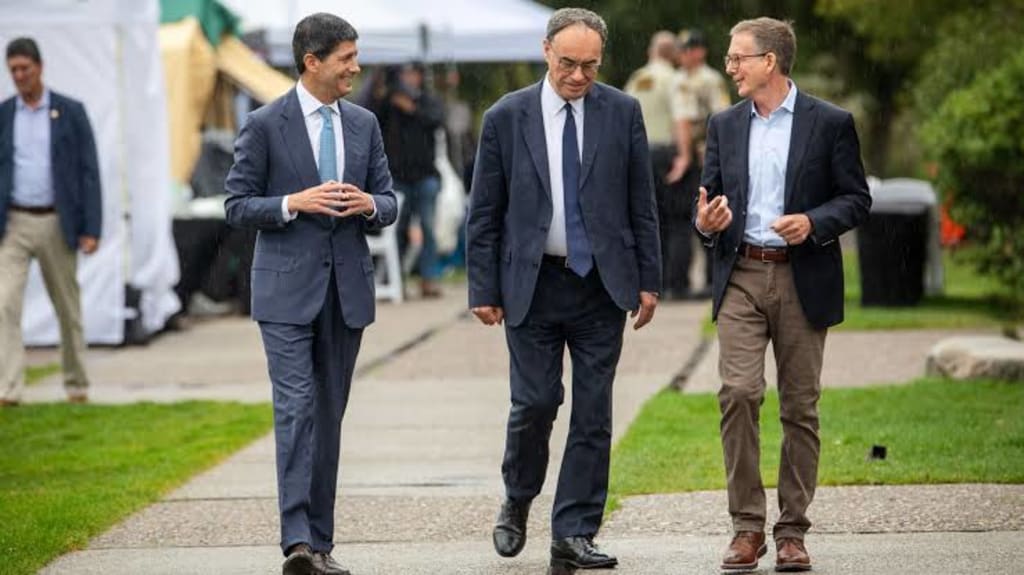
The Jackson Hole Formula: Talk Tough, Do Little
August 28, Jackson Hole. Kevin Warsh’s 100th day as Fed Chair. During his speech, gold dropped $80 in ten minutes, breaking below $4,530. The dollar index jumped nearly 40 points. The 2‑year Treasury yield climbed past 4.28%, a high not seen since July. All three major U.S. stock indexes turned red.
This was not an accidental market swing. This was expectation management with a script written well in advance.
Markets had been pricing in rate cuts before the speech. Warsh put the option of a hike back on the table.
I. What exactly did he say?
Warsh’s core message was short, just one sentence:
“My standard is this: we must be confident that underlying inflation is moving toward our 2 percent goal at a clear and sufficiently fast pace. If not, we still have work to do.”
“Work” meant only one thing to everyone in the room: higher rates.
He did two other things. First, he reaffirmed that 2% is “an unwavering, fixed target.” Second, he noted that at the July FOMC meeting, the committee agreed it “should wait for more information on supply chains, investment flows, and geopolitics” before deciding whether to adjust rates.
Taken together, JPMorgan read the message clearly: higher inflation will be met with a higher federal funds rate.
Warsh also tightened his policy‑communication framework: no more forward guidance. He made that explicit: “You can call it an outline or a road map—but don’t call it forward guidance.”
That was a signal to markets: don’t expect me to tell you our next move. Before the next FOMC meeting, you simply won’t know.
II. Why did markets react so strongly?
Two words: expectation reversal.
Before the speech, the CME FedWatch tool put the probability of a September rate hike at around 35%. During the speech, that number jumped above 50% and briefly touched 60%.
But the hike probability rose only 15 to 20 percentage points, while gold shed $80. That suggests the move was more about emotional overshoot than a fundamental repricing.
The transmission chain was straightforward: Warsh said “a rate hike is still on the table” → federal funds futures repriced → the opportunity cost of holding non‑yielding gold rose → selling pressure → price plunge. At the same time, the dollar rallied, Treasury yields rose, and equities fell—every variable in the asset‑pricing model moved in lockstep.
Markets weren’t saying “the sky is falling.” They were saying “we guessed wrong.”
III. Why did Warsh have to talk this way?
Three reasons, in order of importance.
First, credibility. Warsh placed the blame for 65 consecutive months of above‑target inflation squarely on the central bank: “The persistent overshoot over 65 months is entirely the Fed’s responsibility.” The subtext: I will not let that mistake continue. If markets sense that the Fed is softening before inflation is fully contained, inflation expectations could unanchor—a rerun of the 1970s. He had to sound hawkish to squash any hope of early easing.
Second, the economy gave him room. Warsh acknowledged that summer’s CPI and PCE readings were “better than expected,” but immediately added: “that does not tell me that the underlying trend has materially improved.” He had data to back that up: over the past 12 months, 54% of items in the PCE basket saw price increases above 3%—still far above the pre‑pandemic average of 32% over the previous two decades. He also judged that “financial conditions are not restrictive”—markets remain loose, the economy is still resilient, and there was no justification for easing.
Third, AI. Warsh devoted a notable chunk of his speech to artificial intelligence—a first for a Fed Chair at Jackson Hole. He said AI could become “a third factor of production, alongside capital and labor.” That observation itself was not new, but his next move was: the Fed set up an internal “Productivity and Employment Working Group” to track AI’s effects.
The link between AI and interest rates has two pathways, as Warsh laid them out. In the short run, building data centres, buying chips, and developing models are real, hard‑dollar investments—over half of this year’s capex growth can be traced to AI‑related construction. That is creating substantial aggregate demand, pushing up wages and raw material prices, giving reason to keep rates high. In the long run, if AI genuinely delivers systemic productivity gains, production costs fall and goods supply rises, putting downward pressure on inflation—and opening the door to rate cuts.
This is a two‑sided card. When the economy is strong, AI is cited as a demand driver, justifying high rates. When inflation cools, AI becomes a productivity story, justifying cuts. By embedding AI into his policy framework, Warsh essentially bought himself optionality in both directions.
IV. But can rates actually go up?
The Street is split.
The hawkish camp: Former Cleveland Fed President Loretta Mester said Warsh made “a very compelling case for a hike.” Barclays and Société Générale both think the odds of a September 25‑bp increase have risen. Mester’s take: the burden of proof now falls on those who want to hold rates steady.
The dovish camp: Goldman Sachs projects August core CPI and core PCE both rising about 0.2% month‑on‑month—a path that would keep the FOMC on hold. James Clouse, a former deputy director of the Fed’s monetary affairs division, argued that Warsh merely reiterated that “there is still work to do” without committing to a timeline.
Both sides have data to lean on. The real pivot point for September is the August CPI report due on September 11. If inflation comes in notably below expectations, the hawkish chorus will fade; if it overshoots again, hike probabilities will firm further.
But all of this debate sidesteps a deeper reality: can the fiscal side take it?
In 1980, Volcker could push the federal funds rate to 20% because U.S. government debt was only about 30% of GDP—hikes didn’t threaten the budget. Today, total federal debt exceeds $40 trillion, or more than 120% of GDP. The fiscal deficit for fiscal 2026 is projected at roughly $1.9 trillion, 5.8% of GDP. Interest outlays are already up about 48% year‑on‑year. The August auction of $42 billion in 10‑year notes cleared at 4.683%, the highest since 2007.
Every extra year that rates stay high widens the deficit. One more hike could push the 10‑year yield past 5%, triggering a dual sell‑off in stocks and bonds—and the Treasury would be the first to buckle.
Thus, Warsh’s tough talk has a hidden premise: he has to sound harsh enough to avoid actually acting. Verbal warnings cost almost nothing; real hikes bleed the budget. He talks the fiercest game to do the mildest thing—using expectation management as a substitute for genuine tightening.
V. Back to gold
The 10‑minute, $80 drop was the single largest market event of the day. But this move needs to be seen against a broader backdrop.
Global central banks have been net buyers of gold for multiple consecutive years, consistently exceeding 1,000 tonnes annually. That is not trading money—it is strategic allocation. The People’s Bank of China, the Reserve Bank of India, the Central Bank of Turkey—their buying is structurally supported by de‑dollarisation trends. One Warsh speech can carve an $80 hole, but it cannot punch through the floor.
Gold fears expectations of rate hikes, not actual hikes. Expectations can be reversed by a single speech, but actual hikes are constrained by the $40 trillion debt ceiling. How long Warsh’s tough stance can hold markets in check depends on the September 11 CPI print—and on when markets realise that he does not, in fact, have many real tightening cards to play.
Jackson Hole is over. Gold fell, the dollar rose, yields moved up. But whether talk alone can substitute for real tightening is not a question for weeks—it depends on the September 11 CPI number and whether markets finally notice he has no real hiking cards left.
About the Creator
Jin
Writer of reamstories
https://reamstories.com/jin
Enjoyed the story? Support the Creator.
Subscribe for free to receive all their stories in your feed. You could also become a paid subscriber, letting them know you appreciate their work.
Comments
There are no comments for this story
Be the first to respond and start the conversation.