
Instant Noodles, Half a Trillion Dollars, and the 15‑Minute Fuse
How a silicon‑chipped machine turns calm into a shock absorber — and event days into a bonfire.
3:45 PM: The Gravity Well and the Incinerator
Every day at 3:45 p.m., roughly half a trillion dollars’ worth of contracts have fifteen minutes to decide whether they expire worthless or get assigned. The people holding these contracts, if they entered through the buy-side door, mostly know they bought a lottery ticket. The ticket just gets printed and torn up faster than they can say “bought.” This is the 0DTE option, zero days to expiration. It is time itself, sliced thin and sold.
Forget the jargon. Use a cup of instant noodles.
You’re holding a “noodle futures” option. Strike price: five bucks. Expiration: today at 4 p.m. The underlying, the market price of the noodles, is now $4.80.
Delta tells you: for every dollar the noodles rise, how much does your ticket rise? At $4.80, Delta is around 0.4. If the noodles climb to $5, Delta becomes 0.5. If they hit $5.20, Delta jumps to 0.7. That’s directional sensitivity: the underlying dragging your ticket forward.
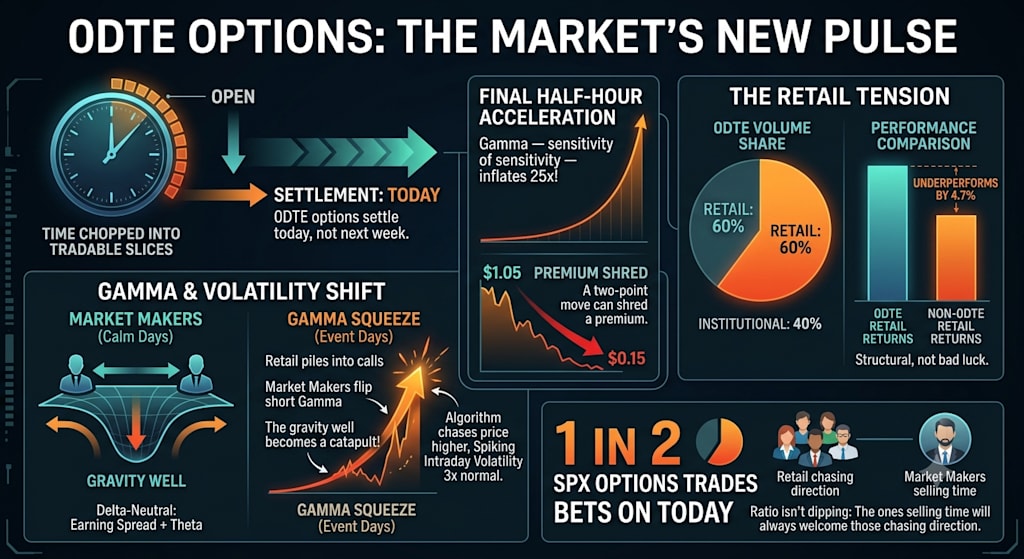
But the violence isn’t Delta. It’s Gamma. Gamma is how fast Delta itself gets dragged. Especially in the last half-hour. An at-the-money option with a month left has negligible Gamma. With one hour left, Gamma inflates to twenty-five times what it was a month ago. Your directional sensitivity turns into a lit fuse. Every penny the noodles move reshuffles the directional risk on your screen. This is the molten core of 0DTE.
Theta sits on the other side. Theta is how much of your ticket is flammable inside the fire of time.
Noon: the ticket is worth thirty cents. By 1 p.m., same price, not a single tick moved — the ticket shrinks to twenty-five cents. Five cents burned away. Nothing happened. No bad news. The market didn’t move. Only time passed. As a buyer, you pay the seller with every minute. Not commissions: time rent. You bet on direction. He eats time. And time always marches forward; direction doesn’t have to.
Market makers, those silicon chips sitting inside the bid-ask spread, are the lubricant of this machine. On a normal trading day, they hold long Gamma. What does that mean? The index drops fifteen points, they buy the underlying, catching the fall. The index rises fifteen points, they sell the underlying, pressing the rise back down. The hedging algorithms sweep orders automatically. This isn’t a desire to stabilize the market; it’s simply Delta-neutrality enforcement. The machines have no beliefs, only Delta neutrality. They don’t profit from direction; they earn the spread plus Theta. When the session stays calm, this behavior acts like a gravity well, tethering the index near the major strikes. Oxford researchers confirmed it: on normal days, 0DTE activity dampens intraday volatility.
But on event days, when a 2:00 p.m. FOMC statement drops or CPI data hits the screen, the gravity well flips straight into a catapult.
Retail floods in, buying calls. They don’t need to parse the Fed’s language; they just see price jumping and want to bet a few dozen bucks on a minutes-long double-up. The market makers have now flipped short Gamma: the market rises, they must chase it to hedge; their chasing pushes the market higher, triggering more options into the money, triggering more chasing. The chain reaction happens in microseconds. The trader doesn’t even need to lift a hand; the screen is already stacked with unhedged orders, and the algorithms are running what’s called a “Gamma squeeze.” On that day, intraday volatility runs two to three times the average. Same instrument, same players. The shock absorber turns into a bellows blowing on the fire.
Then there’s the retail crowd. They supply most of the fuel for this machine.
Fifty to sixty percent of SPX 0DTE volume comes from retail orders. Not institutions. Individuals. Fund an account, drop in a few hundred dollars, and at 47 minutes before the close buy an out-of-the-money call. The three earlier contracts already expired worthless. Their P&L isn’t a luck problem. It’s a structural disadvantage. Theta incinerates on schedule every day. Even if the direction turns out right, if it doesn’t come fast enough, the contract still goes to zero. The data shows retail 0DTE performance averaging 4.7% worse than non-0DTE options. That 4.7% is the height of the flame inside the incinerator.
3:23 p.m. A 4510-strike call option’s premium falls from $1.05 to $0.15. The underlying moved only two points. Refresh the account, and that line in the asset column has turned gray.
The same IP addresses, half an hour earlier posting a betting slip on a sports gambling forum, might now post a dead contract captioned “just one last push away.” The timestamps sit thirty-eight minutes apart.
On the other side, sellers collect the rent. There are ETFs, Roundhill’s XDTE and QDTE, that sell 0DTE calls every day and distribute the premium to holders. Annualized distribution yields have topped 40%. Day after day, like a quiet waterwheel. But there’s a crack underneath the wheel. March 2020, one afternoon, a market-making desk short puts suddenly stopped hedging. Not because the systems failed, but because panic had swallowed the quotes and no counterparty would take the other side at that price. That day’s losses erased months of accumulated profits. The settlement report that evening printed the final line: Cumulative P&L: 0.
3:45 p.m. The gravity well is still spinning. The incinerator fire hasn’t gone out. One out of every two SPX options trades is a bet on today. That ratio isn’t coming down, because the ones who sell time will always welcome the ones who buy direction. It happens on schedule every day. No moral attached. No commandment. Just like the instant noodles going cold, the contracts expiring, the machines resetting, waiting for the next trading day.
About the Creator
Jin
Writer of reamstories
https://reamstories.com/jin
Enjoyed the story? Support the Creator.
Subscribe for free to receive all their stories in your feed. You could also become a paid subscriber, letting them know you appreciate their work.
Comments
There are no comments for this story
Be the first to respond and start the conversation.