
Inflation Is a Tax Nobody Voted For
Why keeping money safe and keeping money in cash are not the same thing, and three households that show the difference
Most people think of their savings account as the safe part of their finances. The number on the screen never goes down, so nothing can be wrong.
Here is the problem. The number is not the money. What the money can buy is the money.
Your money is designed to shrink
The world’s major central banks do not aim for zero inflation. They aim for about 2% a year. The US Federal Reserve formally adopted that goal in January 2012. The European Central Bank confirmed a symmetric 2% target in July 2021.
There are sensible reasons for this. A little inflation helps wages adjust and keeps economies away from deflation. But look at what it means for cash that earns nothing:
2% a year (the official target): after 10 years your money buys about 82% of today; after 20 years about 67%; after 35 years about 49%
4% a year: after 10 years your money buys about 66%; after 20 years about 44%; after 35 years about 25%
7% a year: after 10 years your money buys about 51%; after 20 years about 26%; after 35 years about 9%
Read the first line again. Even when everything goes exactly to plan, idle cash loses about half its buying power over a 35-year working life. Nothing is broken when this happens. It is working as designed.
A trick that needs no calculator
Divide 72 by any yearly rate and you get roughly how many years it takes to double. Run it on inflation and it tells you how long it takes prices to double — which is how long it takes cash to lose half its value.
At 2%, cash halves in about 36 years.
At 5%, in about 14 years.
At 7%, in about 10 years.
Now run it on your savings account. “My account pays 1%” becomes “my money doubles in 72 years.” “Inflation is 4%” becomes “prices double in 18 years.” Put the two lines side by side and you can see at once whether you are moving forward or backwards.
This is not ancient history. By the official US consumer price index, prices have risen roughly eight times since 1971. A dollar kept under a mattress since then buys what about twelve or thirteen cents bought at the time. Nobody stole it in one night. It went a few per cent a year, so slowly that most people never noticed.
Three households, one inflation
Numbers feel abstract, so follow three composite households through the inflation of 2021–2023.
Maria, the careful saver. She is 58, has no debts and has saved 60,000 in an account paying 0.2%. Prices in her country rise about 20% over three years. Her balance grows by a few hundred. Measured in what it can buy, it is now worth about 50,000. She lost around 10,000 of real wealth without spending a cent or taking a risk she knew about.
Tom, the borrower. He is 34 and bought a small flat in 2020 with a fixed 2% mortgage. His payment stays the same, his salary rises 15%, and local flat prices rise 20%. In real terms his debt shrank and his home grew. But he also carries 4,000 on a variable-rate credit card, and when rates rise, that card starts to hurt.
Lena, the owner. She is 45 and runs a small bakery. Her costs jump in 2022, so she raises her prices carefully and most customers accept it. Her broad stock fund falls in 2022 and then recovers. A few gold coins she bought years ago are worth far more than she paid. She ends the period with her wealth intact.
The difference between them was not intelligence. Maria is probably the best with numbers of the three. It was the position each household held when inflation arrived:
Cash earning less than inflation lost value.
Fixed-rate debt on a real asset gained in real terms.
Variable-rate consumer debt became more expensive.
An income that could rise with prices protected its owner.
Ownership of real assets and productive companies held its value over time, even after a fall.
What you can do this week
Every one of these positions can be changed. You do not need a forecast to start.
Run the rule of 72 on every account you have. Write the doubling time next to the current inflation doubling time.
Keep an emergency fund in cash, and only that. Cash is for safety and short-term plans, not for the long term.
Clear variable-rate consumer debt first. It is the position that turns against you fastest when rates rise.
Ask for a raise with evidence. Bring the official price figures for your country; inflation is a fact, not a complaint.
Own something. Even a small regular amount in a broad, low-cost fund moves you from Maria’s position towards Lena’s.
Then ask yourself one question: if inflation returned tomorrow, would I be Maria, Tom or Lena?
This article is for education only and is not personal investment advice.
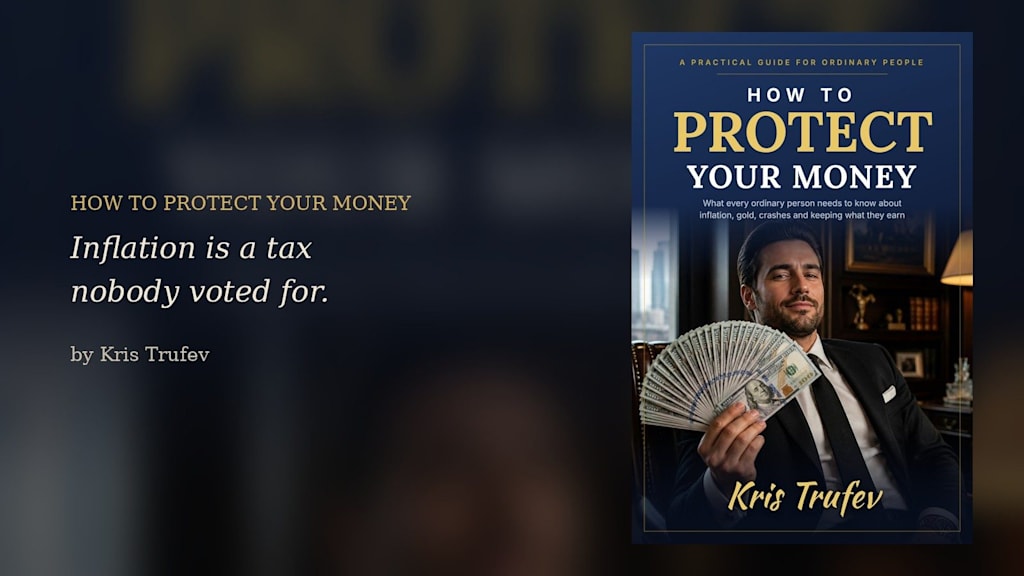
Kris Trufev writes practical books about money for ordinary readers. This article draws on his book How to Protect Your Money.
About the Creator
Enjoyed the story? Support the Creator.
Subscribe for free to receive all their stories in your feed.
Comments
There are no comments for this story
Be the first to respond and start the conversation.