
How the Daily Loss Limit in a Crypto Prop Firm Keeps You Alive
Understanding how daily loss limits work and why they exist

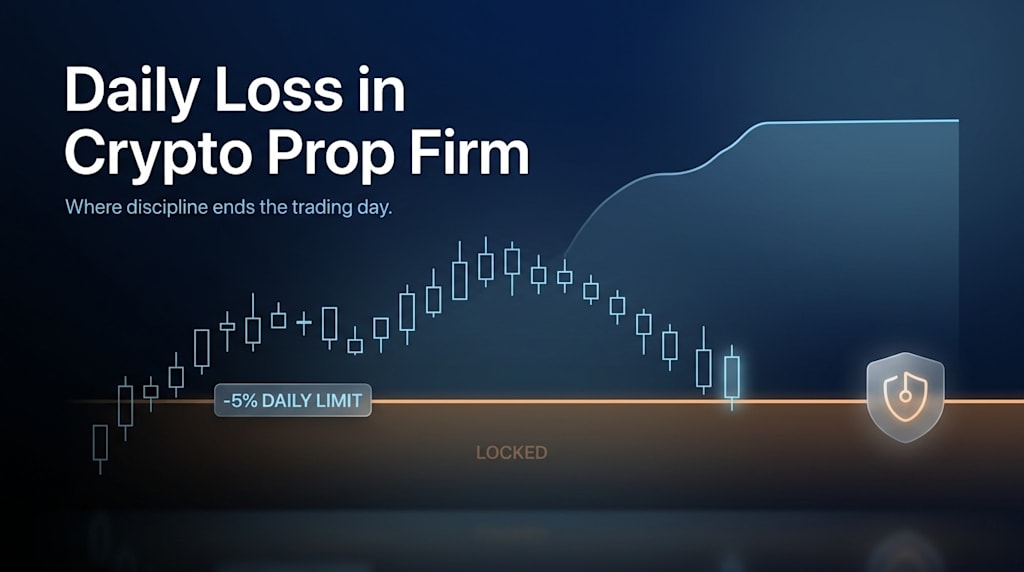
The daily loss limit is the most critical boundary in crypto prop trading. For a long time, I didn’t understand how this rule prevents emotional spirals and protects capital during high volatility, and my account blew up several times because of it. Once I started treating the limit as a strategic tool rather than a restriction, I found the discipline required to pass evaluations and keep my funding.
The Invisible Safety Net of The Daily Loss Limit
I remember the first time I hit my daily loss limit in crypto prop firm account. I was sitting there, staring at the screen, convinced I was only a few hundred dollars down. The closed trades looked manageable. In my head, I still had room to make it all back with one good entry. Then the platform locked me out. I had breached the account, and I had no idea how.
What I didn’t understand back then was that my firm measured the limit on equity, not just my closed trades. Those two open positions I was holding, the ones I was sure would bounce back, were already bleeding into my limit. By the time I decided to act, the math had already been done for me. The market had moved, the unrealized loss had stacked up, and the rule did exactly what it was built to do. It stopped me.
The Daily Loss Limit is Protection, Not Punishment
For a long time I saw that lockout as a punishment. It felt like an arbitrary wall designed to kill my momentum at the worst possible moment. But the longer I traded, the more I realized it was a safety net. The market does not care about your conviction or how badly you need a win. In crypto, it moves 24/7 with a violence that can drain a funded account in a single emotional afternoon.
The daily loss limit acts as a circuit breaker. It forces a pause when you and the market are no longer in sync. Without it, three bad trades almost always lead to a fourth, bigger one, fueled by the urge to get even. The limit steps in before that fourth trade ever happens. It guarantees that no matter how ugly a single day gets, you still have the capital to come back when conditions actually favor you.

Why your brain hates the rule but your balance needs it
Every fiber of your trading psychology fights against the daily loss limit. When you are down, your brain does not want to stop. It wants to fix the problem right now, with the same instrument that just hurt you. This is the exact moment the rule feels like an enemy, and it is also the exact moment it is doing its most important work.
The Revenge Trade Your Mind is Begging For
After a loss, your brain stops thinking in probabilities and starts thinking in recovery. You are no longer asking is this a good setup? You are asking how do I get my money back?
That shift is subtle but deadly. The revenge trade always looks justified in the moment, because the pain of being down feels bigger than the risk of going down further.
The daily loss limit removes that decision from your hands. It does not ask whether you feel ready for one more entry. It simply closes the door. What feels like a restriction is actually protection from the version of you that only exists after a bad streak, the one who sizes up, ignores the plan, and chases.
Why Your Balance Keeps Score Differently
Your balance does not remember how confident you felt or how close that last trade came to working. It only records what actually happened. While your mind is busy rationalizing the next move, your equity is quietly tracking every floating loss in real time, and in an equity based model that number can breach your limit before you ever click close.
That gap between how you feel and what your account shows is exactly where blown accounts come from. The rule exists to align the two. It lets your balance overrule your emotions on the days when your emotions are the least trustworthy thing in the room.
The Math of Daily Loss Survival in a High Volatility Market
I used to think survival was about being right. Then I learned it is about the math holding up on the days I am wrong. A daily loss limit is not an opinion about the market, it is a fixed number, and in crypto that number gets tested faster than anywhere else.
The market never closes, price moves while I sleep, and a position that looked fine an hour ago can quietly eat into my room to breathe.
How a Five Percent Limit Changes Your Entry Strategy
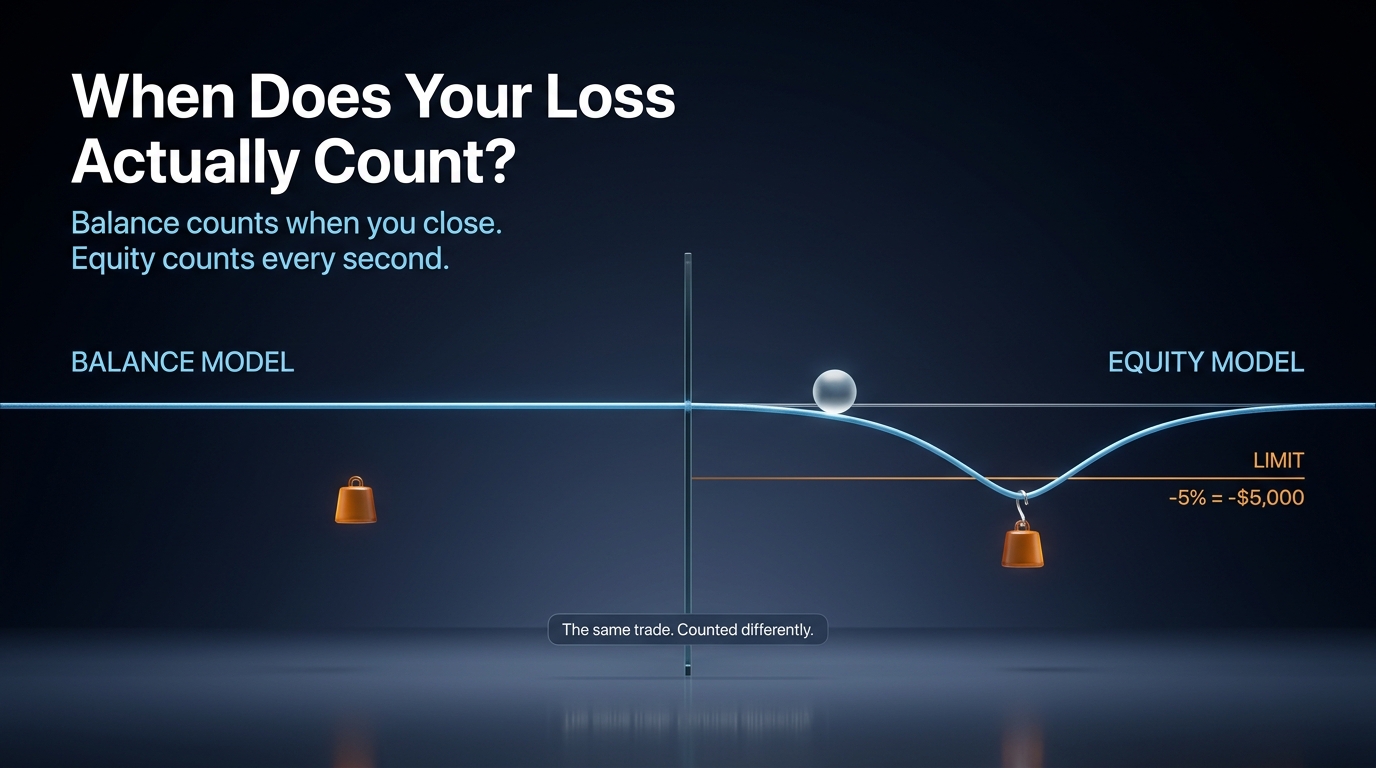
When my account is $100,000 and the daily limit is 5%, that is $5,000 I am allowed to lose before the door closes. Simple enough on paper. But the percentage is only half the story. What matters just as much is what that 5% is measured against, and when.
If the firm counts only closed trades, my balance stays still while a losing position floats in the background. If the firm counts equity, that same $5,000 limit is alive in real time, because equity is balance plus every unrealized profit and loss. So a floating loss can push me to the edge before I ever click close. Same 5%, completely different math, depending on the model.
Why 24/7 Markets Change the Equation
In a market that trades around the clock, the math does not pause for me to catch my breath. A position I hold through a volatile stretch can move from comfortable to breaching in minutes, and there is no closing bell to save me.
That is why I stopped watching only my closed losses. I learned to watch three numbers at once:
- What I have already lost
- What I am floating
- What my real-time equity says right now.
The survival math is not about avoiding losses. It is about knowing exactly how much room I have left at every moment, so the market never tells me something my account already knew.

Hit the Daily Loss Limit? Just Walk Away
The hardest part of a daily loss limit isn’t the number. It’s the moment you reach it. Your risk budget for the day is gone, the platform won’t let you take another trade, and every part of you wants to argue with that.
This is where the rule stops being math and starts being character.
The Urge to Win it Back
The second you hit the cap, your mind offers you a deal. One more trade. A smaller size. A cleaner setup that will undo the damage. It feels logical, almost responsible, like you’re fixing a mistake rather than making a new one.
But the limit exists precisely for this moment, when your judgment is at its worst and your need to be right is at its loudest. The trade you’d take to recover is almost never the trade you’d take on a calm morning. That’s the tell.
Why Stopping is the Trade
When the day is done, the most profitable thing you can do is nothing. The account survives, the next cycle resets, and tomorrow you start with a full risk allowance instead of a hole you dug deeper.
Walking away doesn’t feel like winning, but in a funded account it is. You’re not protecting today’s result anymore. You’re protecting your right to keep trading at all.
Coming Back Without Carrying it
After the reset, the work isn’t to forget the bad day. It’s to understand it. What setup pulled you in, what size was wrong, where the plan broke.
You come back with that answer, not with a grudge against the market. The traders who last aren’t the ones who never hit the limit. They’re the ones who hit it, close the laptop, and return the next day without the day before still trading inside their head.

How to respect a limit you didn't set
Here's the part nobody warns you about when you take a funded account. The number that can end your day wasn't chosen by you, the firm picked it. You don't get to negotiate it, argue with it, or decide it's too tight on a day you feel sharp.
It's already written, and the only real question is whether you bothered to read it before you put on size.
For a long time I treated that number like background noise. I knew there was a daily loss limit somewhere in the rules, I assumed it was generous, and I traded as if it didn't exist until the day it stopped me. That's the trap. A limit you didn't set still controls you completely. The only leverage you have over it is understanding it well enough to never get close.
So I stopped thinking of it as the firm's rule and started treating it as the edge of the table I'm playing on. I didn't build the table. I just have to know exactly where it ends.
Reading the Rule Before You Risk a Dollar
The first thing I check on any account is how the limit is even calculated, because two firms can both say "5 percent" and mean completely different things.
Some firms measure it off your balance. Only closed trades count, so a position bleeding against you doesn't touch the limit until you actually close it. Others measure it off equity, which includes your open profit and loss in real time. On an equity based account, a floating loss counts the second it exists. The market can breach you while your trade is still open and you haven't clicked a thing.
That difference is everything. On a balance based account you have room to manage a position through a drawdown. On an equity based one, a fast crypto candle can push your floating loss past the cap before you've even decided what to do. Same number on paper, two completely different games.
The other thing I read is the format and the reset. The limit might be written as 5 percent or as a flat $5,000, and on a $100,000 account those happen to be the same thing, but they won't always line up that cleanly. Then I find the reset time, because that's the moment the slate clears.
If I don't know whether the firm uses balance or equity, and I don't know when the day resets, I'm not trading the account. I'm guessing at it.
None of this takes long. It's ten minutes before you ever risk a dollar, and it's the difference between respecting a boundary you understand and tripping over one you never read.
Sizing Every Trade Around the Cap, Not After it
Once I know the real number, every position gets built backward from it.
The mistake I used to make was sizing the trade first and checking the damage after. I'd pick a size that felt right, set my stop, and only then glance at how much I had left in the day. That's sizing after the cap. By the time you're doing math on what's left, the trade is already on and the limit is reacting to you instead of guiding you.
Now the cap comes first. I look at how much room I have for the day, and I size so that a normal adverse move, the kind that happens on a perfectly good setup, can't put me anywhere near it.
On an equity based account I go a step further and assume the floating loss counts against me the whole way down, because it does. I'm not sizing for my stop. I'm sizing so that my stop plus a little extra noise still leaves the day intact.
That usually means smaller than my gut wants. It also means a single trade never has the power to end my day. The limit stops being a wall I might slam into and turns into something I simply trade comfortably inside of, with room to spare. The limit was set for me. How close I ever get to it is the one part that's entirely mine.
The Daily Loss Limit You'll Confuse with Everything Else
Early on I lumped every loss rule into one mental bucket.
- Daily limit
- Max drawdown
- Trailing drawdown
It all just registered as the number that kills the account. That blurriness is exactly what got me close to breaching, because these rules don't work the same way and they don't fail you at the same time.
Daily Loss vs Maximum Drawdown
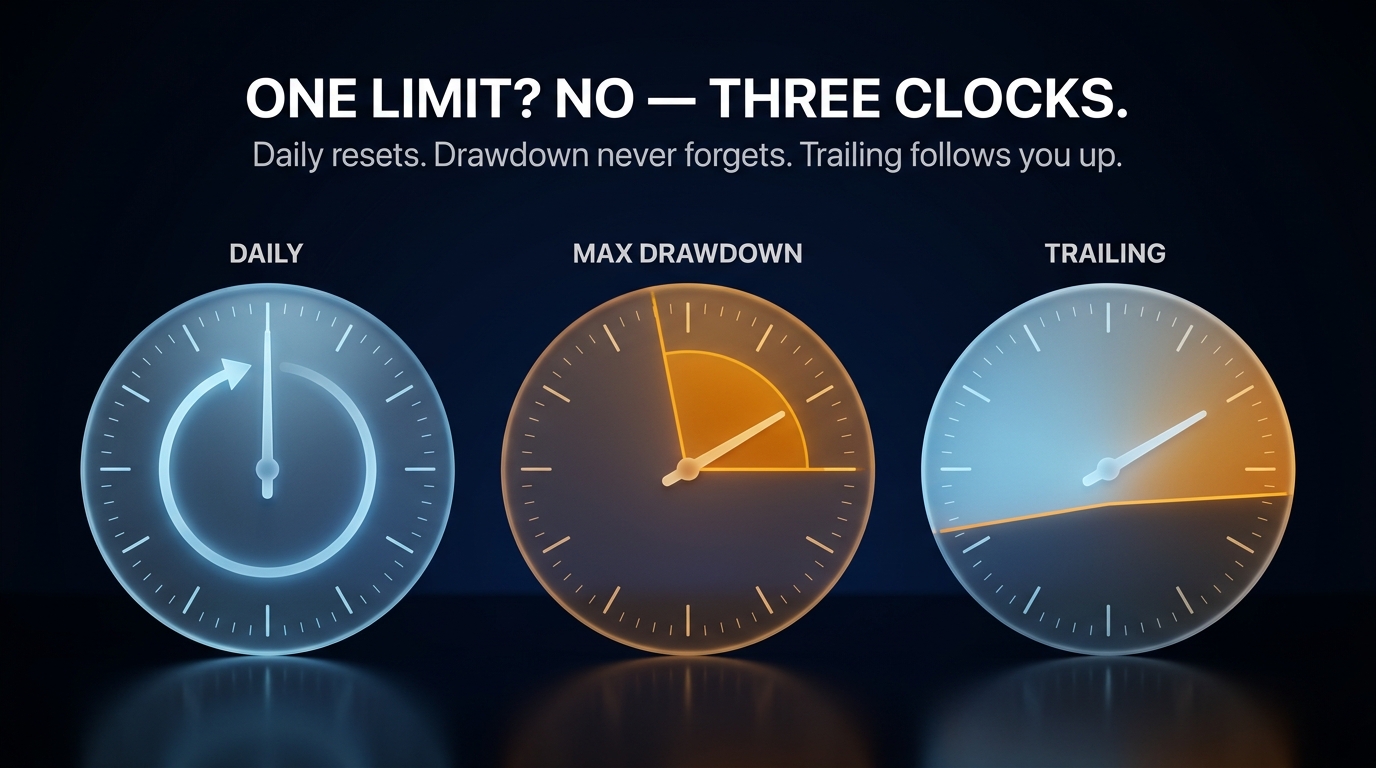
The daily loss limit is the short one. It's the most you can lose in a single trading day, and the thing that makes it survivable is that it resets. When the day rolls over, that day's damage clears and you start clean. It only ever cares about one session. Yesterday's red doesn't follow you into today.
Maximum drawdown is the long one. It's measured against your overall account, not your day, and it doesn't reset when the clock rolls. It's there to protect the account across the whole stretch you hold it.
You can stay perfectly inside your daily limit every single session and still grind into your max drawdown over a string of losing days, because the daily rule forgives the morning while the overall rule never does.
Then there's Trailing drawdown, which is the one that quietly changes shape on you. Instead of sitting at a fixed floor, it climbs upward as your profits grow. Your account rises, the threshold rises behind it, and the room you thought you had can tighten as you go. It isn't tied to a single day either, so it's nothing like the daily limit even though both can end your account.
The reason traders mix these up is honest enough. They're all loss related, they can all trigger a breach, and in some firms they're all measured off equity. So they feel like one rule wearing three names. But the thing that actually separates them is the time window. The daily limit is one day and forgives. The drawdown rules are the whole account and don't.
Why the Reset Time Decides Your Day
Once I understood the daily limit lived inside a single session, the next question was obvious: when does that session actually end? Because the reset is the whole reason the daily limit is survivable, and the exact moment it happens shapes how you trade.
Most firms anchor the reset to a fixed time, often a UTC rollover. That one detail decides everything about your day. If you don't know when your day closes, you don't know whether a late loss is the tail end of today or the opening damage of tomorrow.
I've seen traders take a rough loss, assume the slate was about to wipe clean, and keep pressing right up to a reset that was still hours away, eating into a limit they thought had already cleared.
It also works the other way. A trade that pushes you close to the limit looks very different five minutes before reset than five minutes after. Before the rollover, you're one bad tick from done for the day. After it, you've got a fresh limit and room to operate. Same trade, same size, completely different risk picture, and the only thing that changed was the clock.
So I started treating the reset time as part of my plan, not trivia buried in the rules. I knew exactly when my day began and ended, and I sized and timed my last trades around it. The daily limit only forgives you on its own schedule, and trading without knowing that schedule is just guessing when you're safe.
Surviving Long Enough to Get Funded
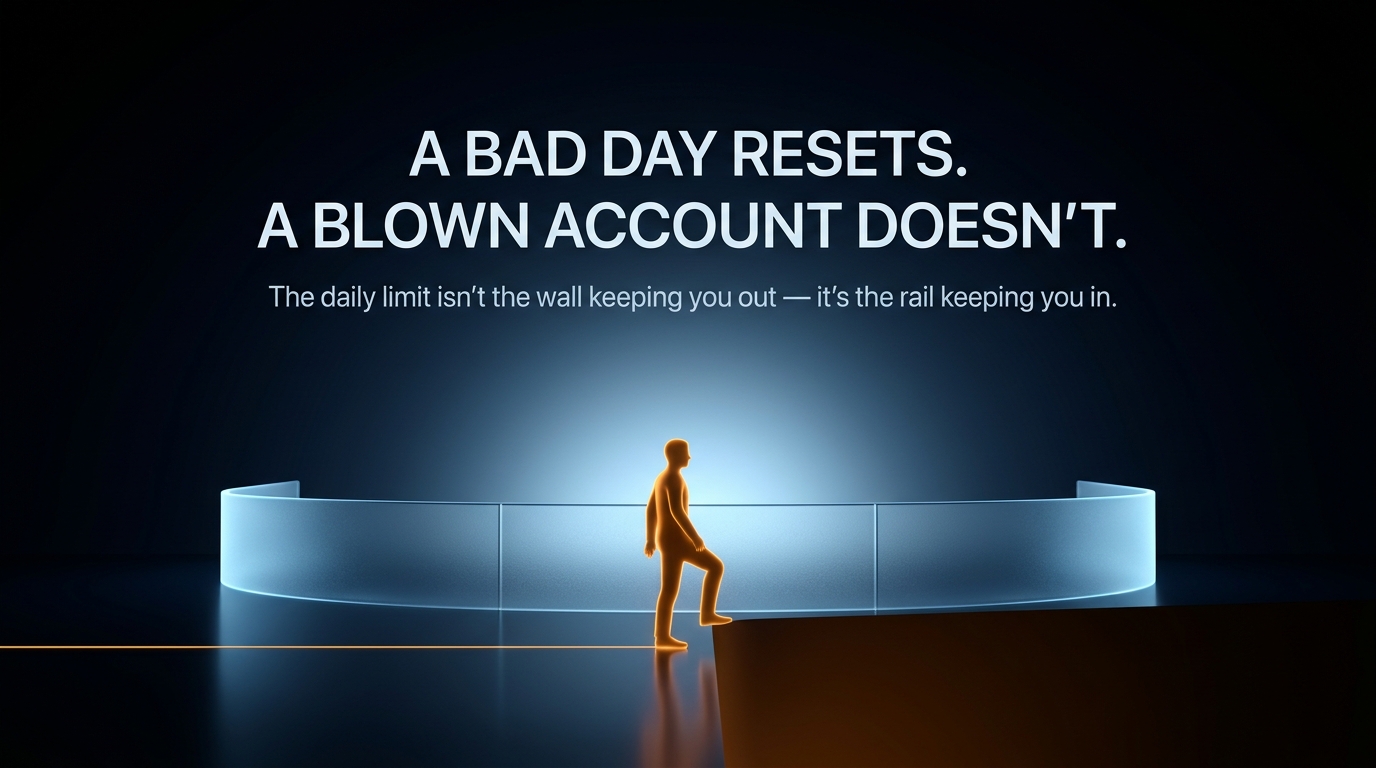
After all of it, the daily loss limit stopped looking like the wall the firm built to keep me out and started looking like the thing keeping me in. Every time I treated it as punishment I fought it, and every time I fought it I got closer to the breach I was scared of.
The day it became a tool instead of a cage, the trading got calmer and the account stayed alive.
What it really protects is your capital on the worst day. Markets hand you sessions where nothing reads right, where every entry is wrong and the recovery trade is wrong twice over. The limit caps how much one of those days can take from you. It turns a potential blown account into a bad afternoon, and a bad afternoon resets. A blown account doesn't.
The other thing it builds, quietly, is consistency. Staying inside the cap forces you to size, plan, and stop on a schedule instead of on emotion. That repetition is what gets you through a challenge.
Passing isn't one heroic recovery trade that wins it all back. It's a long stretch of days where you didn't do anything stupid, and the daily limit is the rule that makes nothing stupid the default.
So the discipline is simple to say and hard to live:
- Respect the cap
- Stop when you're near it
- Skip the emotional comeback and wait for the reset.
Do that and a bad day stays a bad day. Ignore it and a bad day becomes the last day. The traders who last aren't the ones who never lose. They’re the ones who never let one day decide everything.
Friendly Reminder: Educational content only, not financial advice. Crypto is highly volatile and inherently risky. Keep your risk management tight and only trade with funds you're completely comfortable losing.
About the Creator
Sophie
Trader focused on Price Action & Order Flow.
Into crypto, fast execution, controlled risk, and quality setups.
Passing funded accounts and refining my trading every day.
Enjoyed the story? Support the Creator.
Subscribe for free to receive all their stories in your feed.
Comments