
How Prediction Markets Called the Massie Upset Early?
Prediction markets predicted Thomas Massie’s GOP primary loss days early as traders priced in turnout, Trump backing and spending shifts.


Political analysts missed it. Mainstream polls didn't see it coming clearly. But prediction market traders were repositioning their contracts days before Election Day, steadily pricing in the defeat of a twelve-year incumbent Congressman. When the final votes were tallied on May 19, the markets had called it almost exactly.
Thomas Massie, the libertarian-leaning Kentucky Republican who had held his seat since 2012, lost his GOP primary to Ed Gallrein — a Trump-endorsed former Navy SEAL — by a margin of 54.9% to 45.1%. The outcome wasn't just a political earthquake. It was a striking real-time demonstration of what prediction markets can do that traditional forecasting tools simply cannot.
What the Markets Were Saying — and When
The story of this race on prediction markets isn't just the final result. It's the timeline. Early in the cycle, markets leaned toward Massie holding his seat — incumbents in U.S. House races win primaries at an overwhelming rate historically, and Massie had never faced a serious challenger.
Then things shifted. As Trump's endorsement of Gallrein solidified, as campaign spending poured into the district, and as turnout models began reflecting unexpectedly high mobilisation, traders started moving. Massie's winning probability dropped below 45% on major platforms in the final days of the campaign. Gallrein's contract climbed steadily.
For the complete breakdown of how the market moved across the entire timeline, including key inflection points and the final resolution, PolyPunter has the detailed analysis: Prediction Markets Nail The Thomas Massie Primary Defeat.
What drove the repositioning? Traders were integrating signals that traditional polls rarely capture in time:
Trump endorsement weight — the district's voter base had moved sharply toward MAGA alignment, and Gallrein's explicit positioning against Massie's anti-Trump votes was a decisive factor traders priced in early
Advertising spend asymmetry — Gallrein's campaign outspent Massie in the final weeks, and media tracking reflected this
Mail-in vote signals — early vote return patterns provided real-time intelligence that active traders incorporated before final counts
Turnout doubling — overall ballots cast reached over 105,000, nearly double prior primary cycles, a surge that historically favours challengers with strong ground operations
The Volume Numbers Tell Their Own Story
This race set a stunning new benchmark for single-district primary prediction market volume. Kalshi traders alone committed over $21.9 million to winner-take-all contracts, while Polymarket added another $3 million+ in parallel activity. Combined, over $25 million flowed through these markets on a Kentucky House primary — the kind of race that traditional media barely covers until election night.
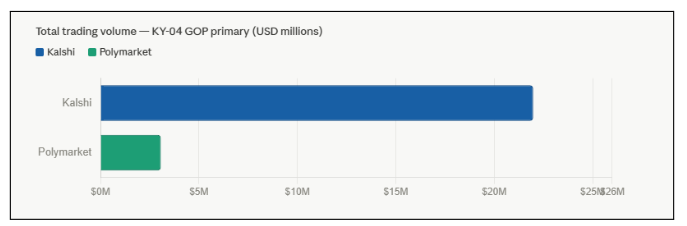
The scale of engagement reflects something important: this wasn't casual interest. These were informed traders putting real capital behind their read of the political landscape.
Why Massie Lost — and Why the Markets Saw It Coming
Understanding what the markets priced in requires understanding the specific dynamics of this race. Massie's defeat wasn't a random upset. It was the product of several converging forces that prediction market traders tracked in real time while traditional analysts were still debating whether the incumbent's name recognition would hold.
Key factors that markets absorbed before polls did
- The Trump endorsement carried structural weight in a district that has drifted steadily into MAGA alignment. Gallrein leaned into that backing explicitly, while Massie's record of breaking with the president on high-profile votes gave Republican primary voters a sharp contrast to act on — and prediction markets priced that disadvantage in early and held firm on it.
- Spending told a similar story. Gallrein's campaign outpaced Massie in the closing weeks in a way that advertising trackers picked up well before any poll reflected a shift. When one candidate is dominating the airwaves in the final stretch of a primary, traders treat that as signal rather than noise.
- Turnout was the factor that probably scrambled the most traditional models. Total ballots crossed 105,000, approaching double what prior primary cycles in the 4th District had produced. Prediction markets were pulling in early-voting data that pointed toward an unusually energized challenger base — exactly the kind of enthusiasm gap that standard polling struggles to weigh correctly.
- Late money reinforced the picture. Large contract purchases on Gallrein in the closing window carried the fingerprints of people with genuine proximity to the race. One notable position of nearly $23,000 moved against that consensus after early counts came in, but the broader market held its conviction without flinching.
- Ground-level intelligence filled in what phone surveys couldn't capture. Reports of intense mobilisation activity in Gallrein-friendly precincts filtered into trader positioning gradually, building a cumulative case that the enthusiasm gap was real and geographic — not just a national vibe.
How the Probability Shifted Over Time
The race didn't flip overnight. It was a gradual repricing that accelerated sharply in the final 72 hours before Election Day.
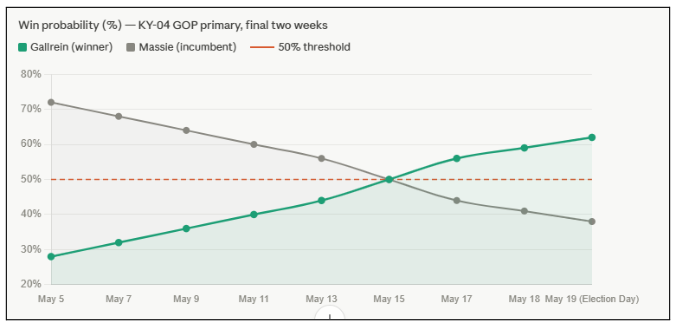
The crossover point where Gallrein's probability overtook Massie's — happened around May 15, four days before Election Day. By the time polls opened, the crowd had already reached its verdict. The final vote of 54.9% to 45.1% in Gallrein's favour tracked almost exactly with where market prices had settled.
What This Means for Political Forecasting
The Massie-Gallrein race is going to be cited in conversations about prediction market accuracy for years. Here's why it stands apart from routine political market calls:
- It involved a twelve-year incumbent in a normally safe seat — the kind of race where conventional wisdom says "the incumbent wins unless something extraordinary happens"
- The signal came not from polling but from the crowd synthesising spending data, turnout modelling, and endorsement dynamics in real time
- The final probability (roughly 62% Gallrein at close) matched the actual margin tightly — a clean result, not a photo-finish lucky call
- Volume exceeding $25 million in a single House primary represents a new benchmark for crowd engagement in down-ballot races
The future of election forecasting is increasingly being written on platforms like Kalshi and Polymarket. Each cycle, the races get more contested, the volumes get larger and the accuracy of crowd-sourced probabilities continues to impress.
Traditional polling will always have its place. But as this primary showed, the crowd often knows before the votes are counted.
About the Creator
Poly Punter
Poly Punter covers prediction market news, Polymarket trends, crypto forecasting, trader insights, and real-time event trading. We publish informative content about decentralised prediction markets and forecasting culture.
Enjoyed the story? Support the Creator.
Subscribe for free to receive all their stories in your feed.
Comments
There are no comments for this story
Be the first to respond and start the conversation.