
How Position Size Calculator Can Optimize Crypto Prop Trading
Learn to calculate trade size to protect your account

In a crypto prop firm account, position sizing is what keeps you alive, not just finding the perfect entry. I’m reframing position size around one key question: how much are you allowed to lose? Discover how stop distances, the 0.5%–1% risk range, and prop firm drawdown rules all connect in this guide, explained simply for real traders.
Use a Position Size Calculator, Don’t Blow Your Account
It usually happens on your best setup, not your worst.
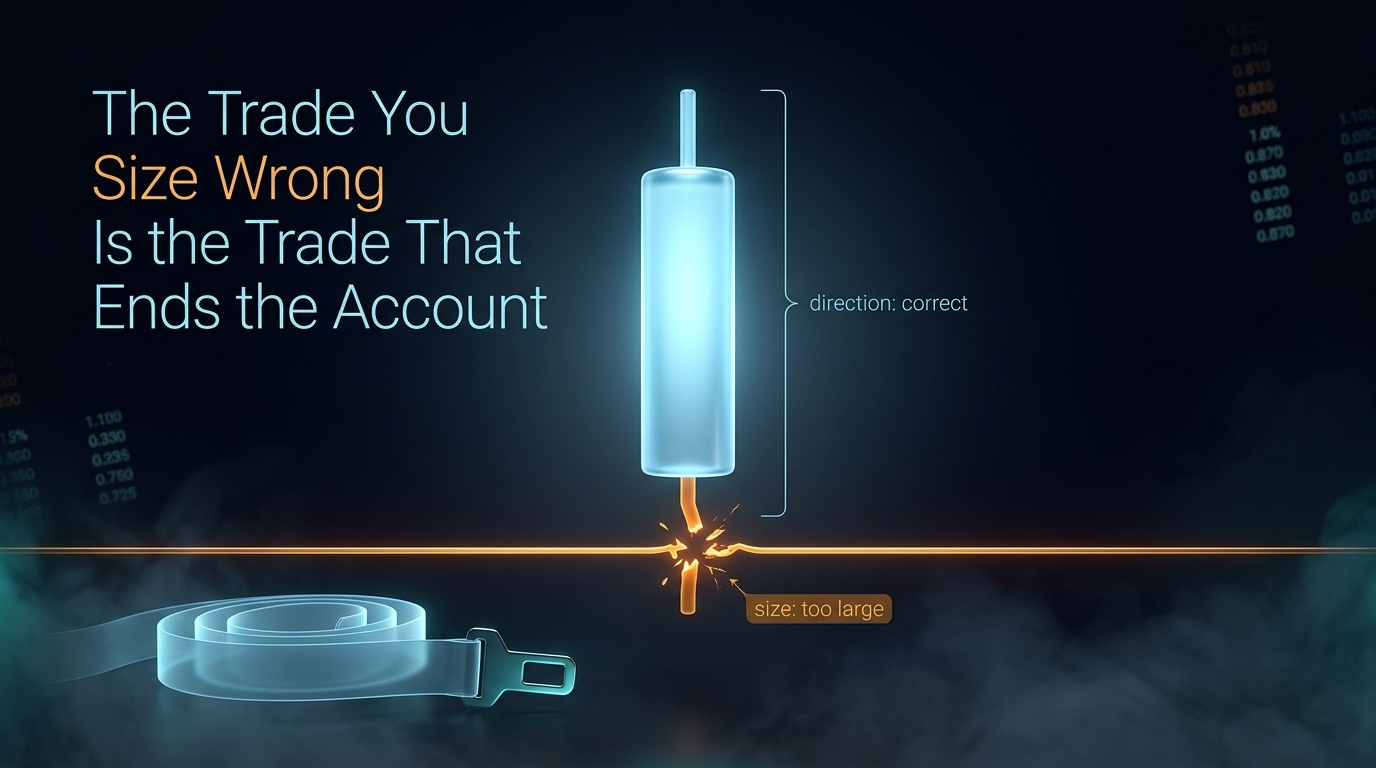
The chart lines up. The entry sits exactly where you wanted it. You’ve waited for this one, so you lean in and put on real size. Then price does the most ordinary thing in the world before any real move, it ticks against you for a moment. A wick most days you wouldn’t even notice. Except this time the position is big enough that the wick alone drags you straight into your drawdown limit. The trade hadn’t even started going wrong yet, and the account was already done.
Read that back, because it’s the part that’s hard to swallow: you called the direction correctly and still lost the account. The market did nothing unusual. Your analysis wasn’t the problem. The size was.
This is the variable almost everyone refuses to look at. After a blown challenge, traders rip apart their entries, their indicators, their timing, their session, anything except the one number that actually pulled the trigger. Running your risk parameters through a position size calculator for crypto prop firm challenges removes this blind spot entirely. It doesn’t make you money. It’s not the engine. It’s the seatbelt, the thing that decides whether one bad moment is a scratch you walk away from or the crash that ends the whole run.
Plan Your Losses First: The Secret to Proper Position Sizing
Ask a struggling trader what they expect from a trade and they’ll tell you the target. The upside. How far it could run if they’re right. Ask the same question to someone who’s actually passed a funded challenge and they answer backwards: they tell you what they’re willing to lose first.
That order is the whole game. Profit is a hope. Loss is a decision. You don’t control where price goes, but you decide, before you ever click buy, exactly how much of the account you’re putting on the table. So that’s where the thinking starts.
The way you do that is with a fixed slice of the account, not a feeling. One trade gets a small, preset piece of your balance at risk, usually somewhere between half a percent and one percent. On a $10,000 account, one percent is $100. That $100 is the most that single trade is allowed to take from you. Not around 100.
$100 unless it looks really good. A hard $100, decided in advance.
Sounds almost too small to matter. That’s exactly why it works. When the worst case on any trade is a quiet hundred bucks, no single loss can touch your future. You stay calm, you stay in the seat, and you get to take the next setup with a clear head. The traders who think in profit are negotiating with their own greed on every entry. The ones who think in loss already know the answer before the chart even moves.
Stop Guessing: The Only Position Size Formula You Need
So you’ve locked in your number. $100 on that $10,000 account. Now the obvious question:
- How much do you actually buy?
- How many coins, how big a position?
Most traders guess here, and the guess is what kills them. You don’t have to guess. The stop does the math.
Here’s the move. You already know your dollar risk ($100). You also know where you’re wrong, that’s your stop, the price level where the trade is dead and you’re out. The distance between your entry and that stop is the only other piece you need. Divide one by the other and you have your size:
Position Size=Risk Amount ÷ Stop Loss Distance
That’s it. The chart tells you the stop. The stop sets the distance. The distance sizes the trade. You never pull a number out of the air.
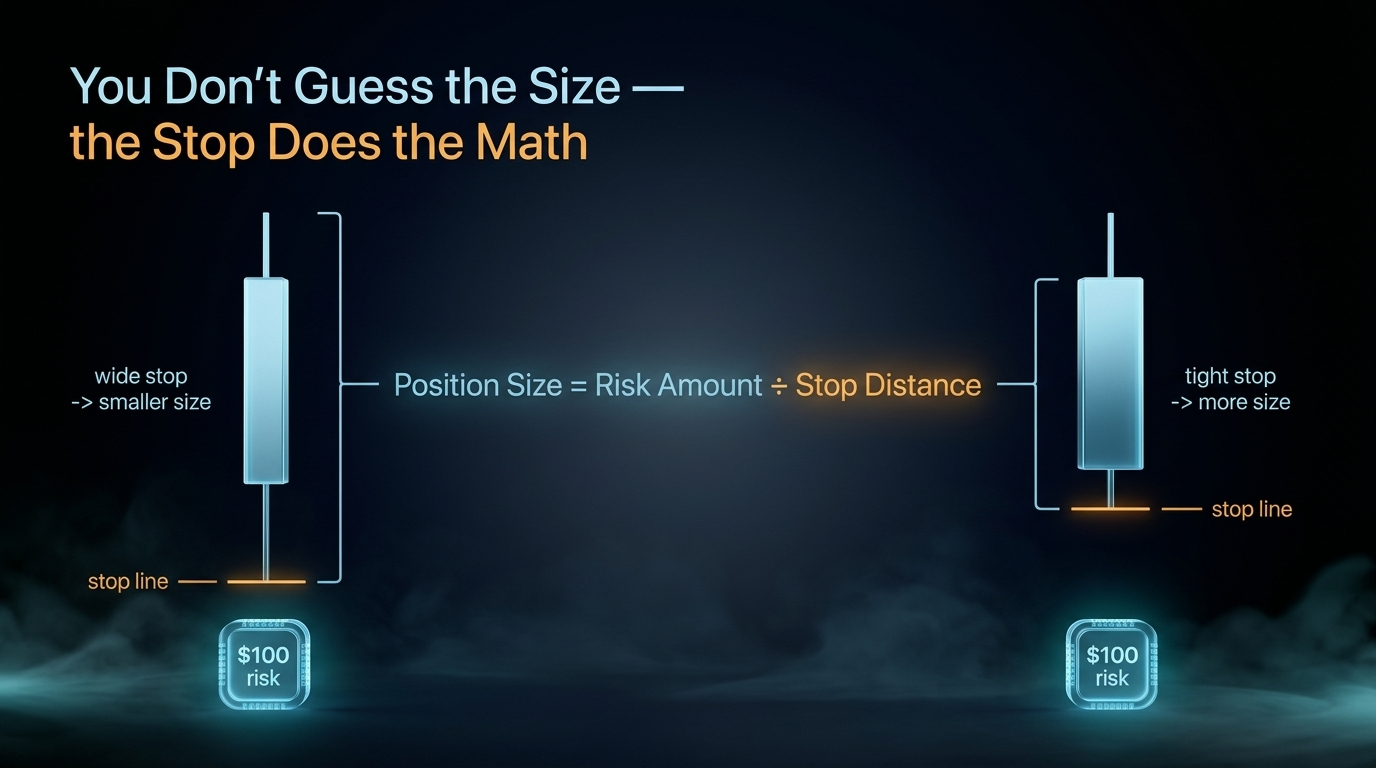
And it self corrects in a way that feels almost unfair once you see it. A wide stop, the kind volatile setups demand, means a smaller position, because that same $100 has to stretch across more room.
A tight stop means you can carry more size, because there’s less distance for the loss to fill. So the riskier looking trade automatically gets the lighter touch, and the clean, tight setup gets the weight. You’re not being cautious by willpower. The math is being cautious for you.
This is why two traders can risk the exact same $100 and hold completely different position sizes, and both be right. They’re not sizing off conviction or gut. They’re sizing off where the trade is wrong. Move your stop, the size moves with it. The decision stays honest because the number isn’t yours to fudge.
The Rulebook Changes Everything
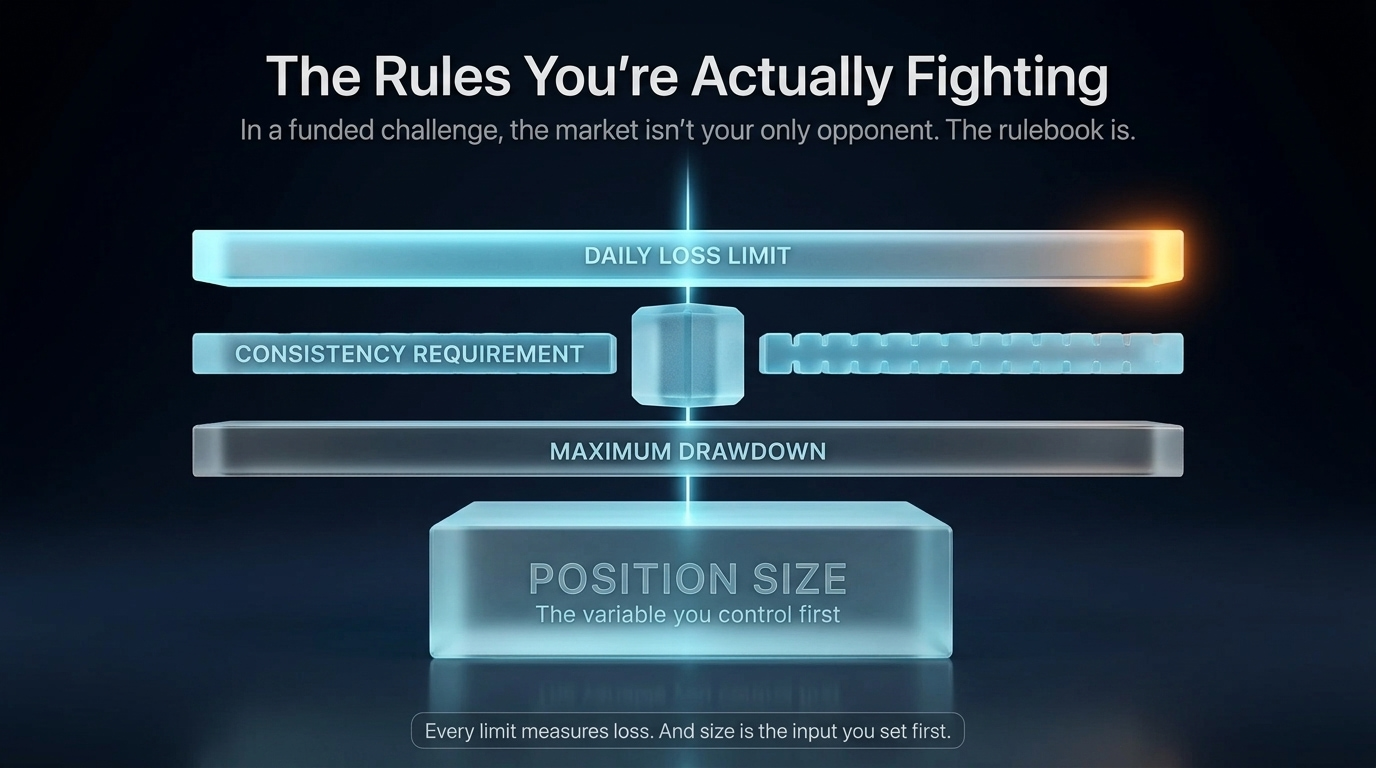
Here’s the part that trips up traders coming from a personal account: in a funded challenge, the market isn’t your only opponent. The rulebook is.
A retail account lets you bleed slowly. You can be down 40% and still log in tomorrow. A funded account doesn’t give you that rope. There’s a line, and crossing it ends the run, no matter how good the next trade would have been. So before you size anything, you need to know exactly which lines you’re trading inside of.
There are usually three of them:
- The first is the daily loss limit. A hard cap on how much you can lose in a single day. Hit it and you’re done until the next session, sometimes done for good.
- The second is the maximum drawdown, the total you can be down from your starting balance or your high-water mark across the entire challenge. That’s the one that quietly ends most accounts.
- The third is the consistency requirement, the rule that says you can’t make all your profit in one lucky swing. It forces your results to look like a trader’s, not a gambler’s.
Notice what every one of these is really measuring. Loss. Not how much you make, how much you’re allowed to give back. And the single biggest input into how much you give back on any trade is the one thing you control before entry: size.
That’s why sizing isn’t a separate skill from passing the challenge. It is the challenge.
How an oversized position breaks you without a bad call
This is the failure that confuses people most, so it’s worth slowing down on. You don’t need to be wrong to breach a drawdown rule. You just need to be too big.
Picture it. Your daily loss limit is $500 on that $10,000 account. You take a trade, decent setup, and instead of risking your planned $100 you’ve quietly put on a position five times larger, maybe because the stop felt obvious and you eyeballed the size. Price taps your stop. That’s a $500 loss on a single trade. One trade, and your entire day is gone. The call wasn’t bad. The direction might even have come back your way an hour later. But the size turned a normal, survivable loss into a rule breach.
Now stretch that across the max drawdown. You don’t blow up from one catastrophic mistake. You blow up from a handful of oversized positions, each one a little too heavy, each one eating a chunk it didn’t need to. Three trades that should have cost you $300 total cost you $1,500 instead, and suddenly the cushion you needed to ride out a losing streak isn’t there.
And the oversizing rarely comes from arrogance. It comes from small, boring errors. A decimal placed wrong. A stop distance you misjudged in the heat of entry. A position calculated by hand while the candle was moving. None of those feel reckless in the moment. All of them show up the same way on the equity curve.
The market didn’t break you. The math you skipped did.
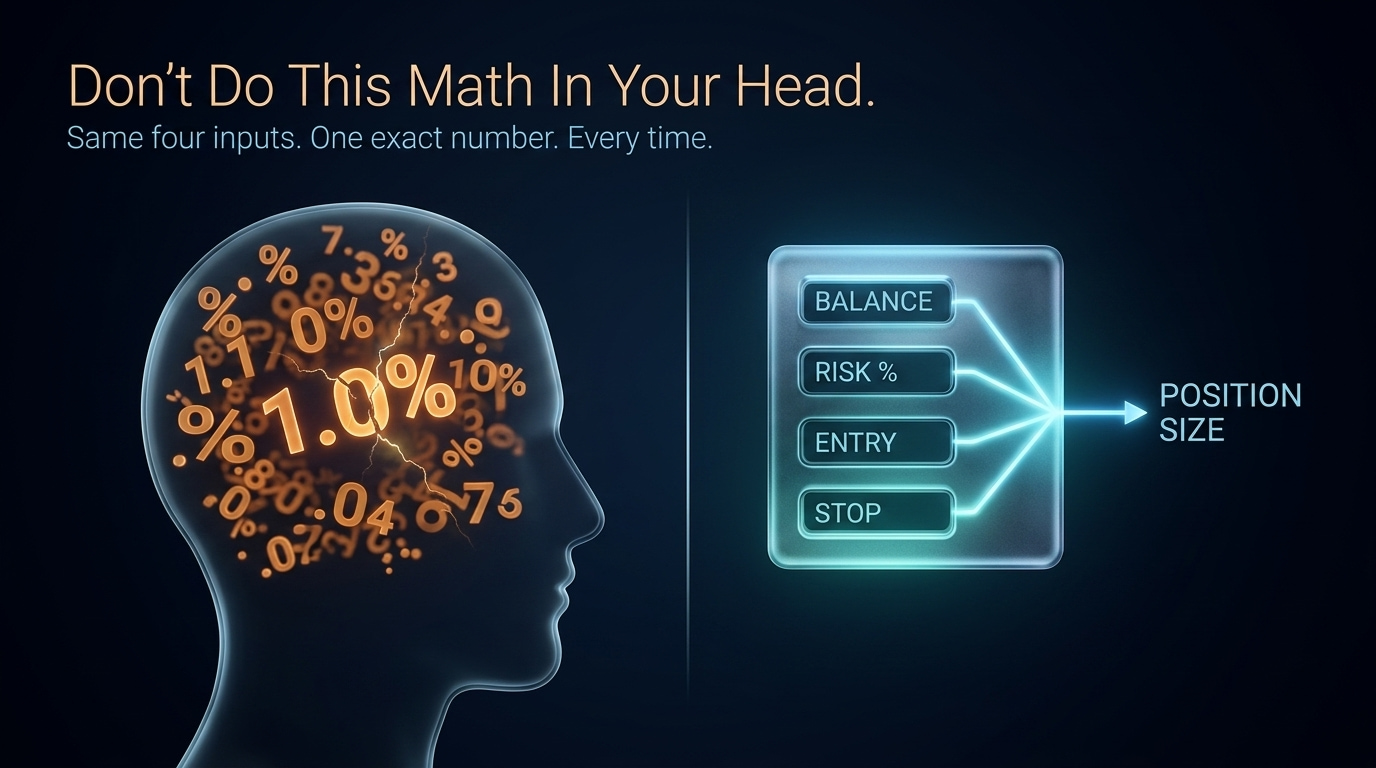
Pro Traders Automate Sizing with a Position Size Calculator
If the math is this simple, risk amount divided by stop distance, why not just do it in your head?
Because the moment that matters is the worst possible moment to do mental arithmetic.
You’ve got a setup forming. Price is moving. Your stop level is shifting as the structure develops, and you’re trying to convert a percentage into a dollar figure, then divide that by a stop distance measured in points, then translate the result back into how many units of BTC or ETH you can actually put on. All of it while the candle ticks and the part of your brain that wants the trade is screaming at you to just get in.
That’s where the decimals slip. Not because you can’t do the math, but because you’re doing it under pressure, fast, and one misplaced zero turns a 1% risk into a 10% risk without you noticing until the stop gets hit.
A calculator takes that variable off the table. You feed it the same four inputs every time: account balance, the percentage you’re willing to lose, your entry, and your stop. It hands back the exact position size. No mental shortcuts, no eyeballing, no “that looks about right.” The number is the number, and it’s the same whether you’re calm or whether the market just did something that makes your heart rate spike.
It isn’t about being bad at math. It’s about removing one more place where a normal human mistake can end a funded account. The traders who last don’t trust themselves to size correctly in the heat of an entry. They trust a process that already did the sizing before emotion entered the room.
Beyond the Numbers: The Real Psychology of Position Sizing
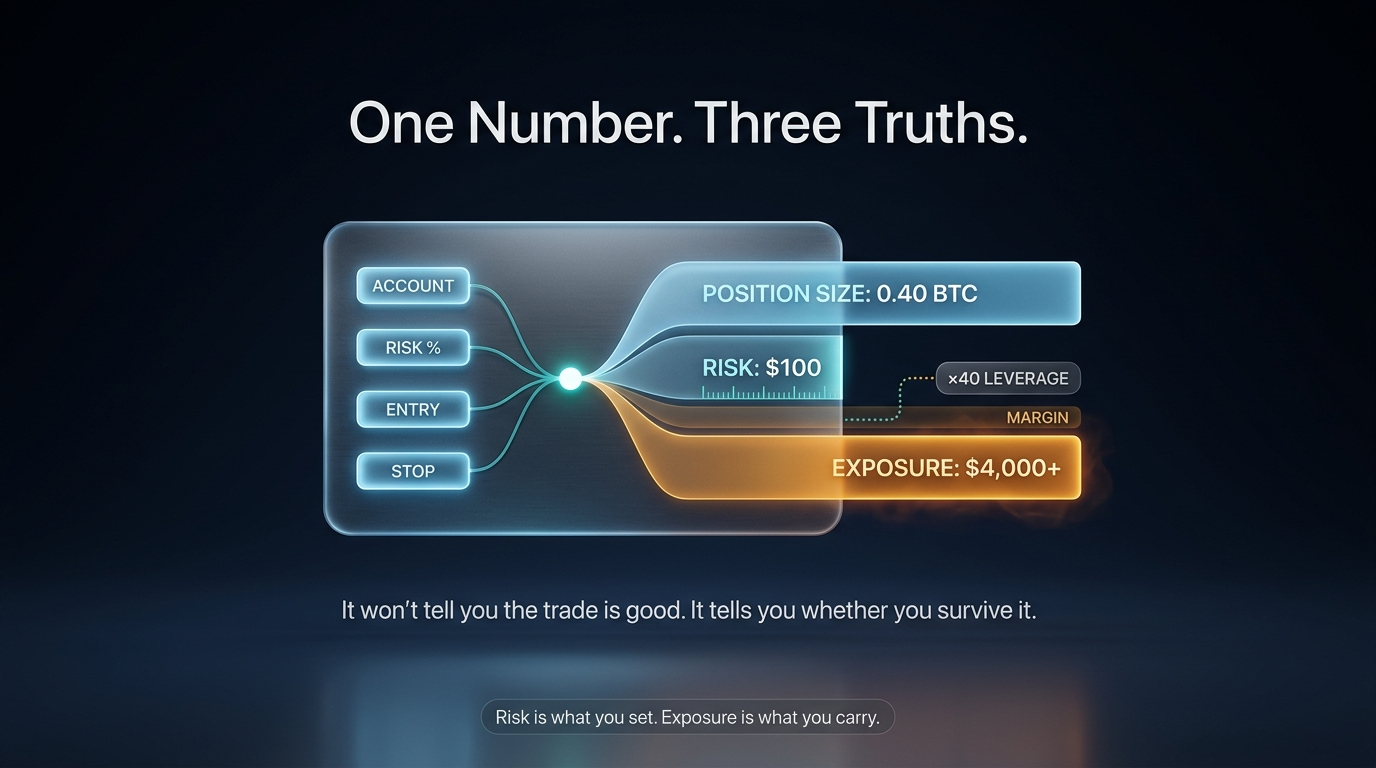
You enter four numbers and get one back. But that single output is carrying more information than it looks like.
The first thing it gives you is the position size itself, the exact quantity to put on. Not a range, not a rough idea, a specific number of units that keeps your loss at the limit you set if the stop gets hit. That's the figure that goes into the order box.
The second thing is your confirmed risk amount in real money. Seeing $100 written out, instead of an abstract 1%, does something to how you treat the trade. A percentage is easy to ignore. A dollar figure you're about to expose is harder to wave away. It makes the cost of being wrong concrete before you've committed to anything.
The third thing is total exposure, and this is where a lot of traders get a quiet shock. Your risk might be $100, but with leverage your actual position could be worth several thousand. The output shows you the full size of what you're controlling, not just the slice you're willing to lose. That gap between risk and exposure is exactly what blows accounts when nobody's watching it.
More detailed versions go further, showing how leverage scales your position and how much margin the trade ties up. That matters in a funded account, because margin you've committed to one trade is margin you can't use on the next one, and a challenge rarely comes down to a single position.
Read together, the output isn't telling you whether the trade is good. It can't know that. What it tells you is whether the trade is survivable, whether the size fits inside the rules you're being judged on. You're not clicking buy on a prediction. You're clicking buy on a position you've already confirmed you can afford to be wrong about.
The One Discipline That Makes Every Trading Strategy Work
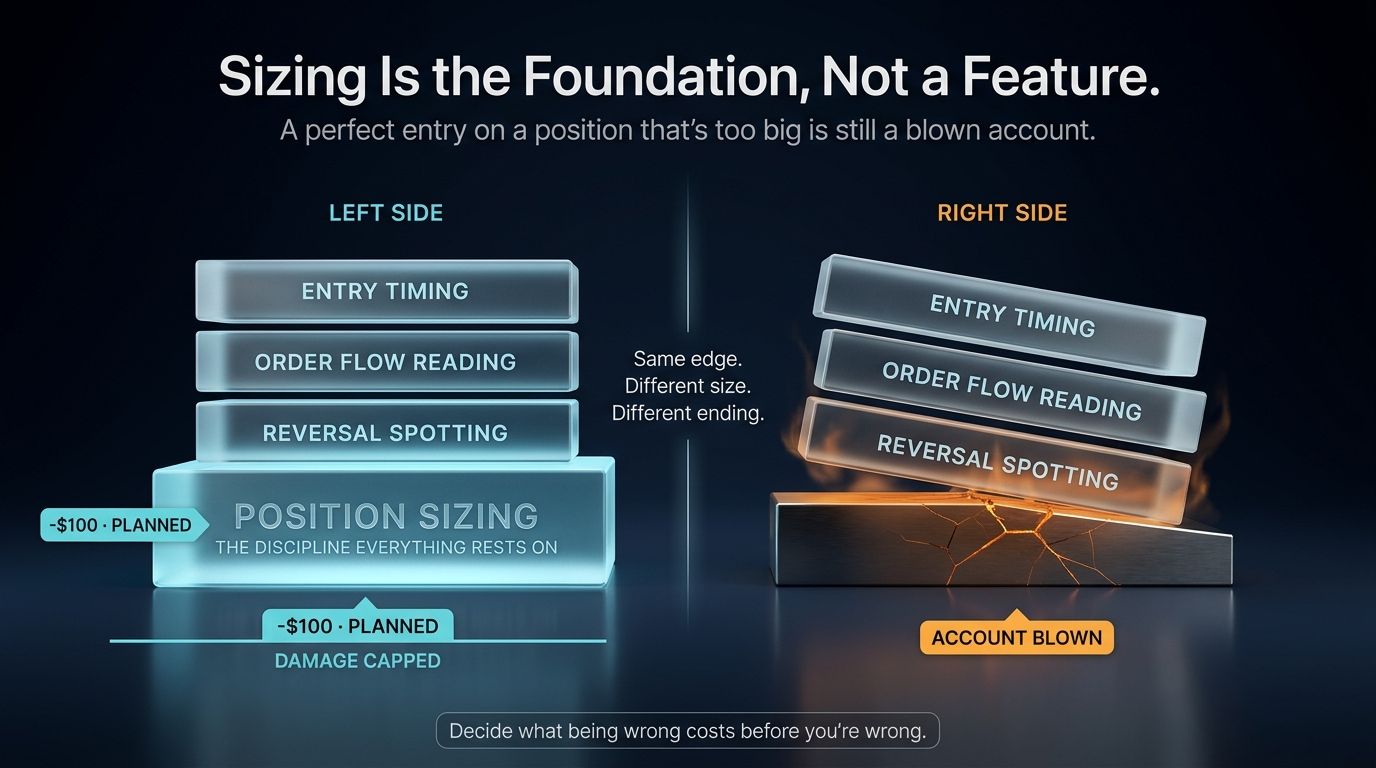
You can have a sharp eye for setups. You can read order flow, spot the reversal before it happens, time your entries better than most. None of it survives a single oversized position.
That's the part that takes traders a while to accept. Sizing isn't one skill sitting next to the others. It's the thing that decides whether any of the others get to matter. A great entry on a position that's too big is still a blown account. A mediocre entry on a position that's sized right just costs you a small, planned loss and you move on.
The traders who pass funded challenges aren't the ones who are right most often. They're the ones who are wrong without consequence. They've already decided, before the trade, how much being wrong is allowed to cost. Everything after that is just execution. The market can do whatever it wants, and the damage is capped at a number they chose in advance.
This is why sizing quietly governs your psychology too. When you know your loss is fixed and small, you stop white-knuckling every candle. You don't move your stop in a panic. You don't add to a loser to feel better. The discipline in the math becomes discipline in your head, because there's nothing left to negotiate once the size is locked.
So the question that actually decides your challenge isn't where you get in. It's how much you put on when you do. Get that number right, consistently, and the account survives long enough for your edge to show up. Get it wrong once, and none of the rest gets a chance to.
Size the trade like it's the only thing protecting you. Because it is.
Just a heads up: This content is purely educational, not financial advice. Crypto markets are incredibly volatile and come with significant risk. Keep it smart and only trade with money you are completely comfortable losing.
About the Creator
Sophie
Trader focused on Price Action & Order Flow.
Into crypto, fast execution, controlled risk, and quality setups.
Passing funded accounts and refining my trading every day.
Enjoyed the story? Support the Creator.
Subscribe for free to receive all their stories in your feed.
Comments