
How much daily volume is in the forex market?
Ever wonder how much money is moving while you sleep? The forex market isn't just big; it's an architectural marvel of global finance that dwarfs every other market on Earth. We dive into the staggering $7.5 trillion daily volume and why that number matters to the average trader.

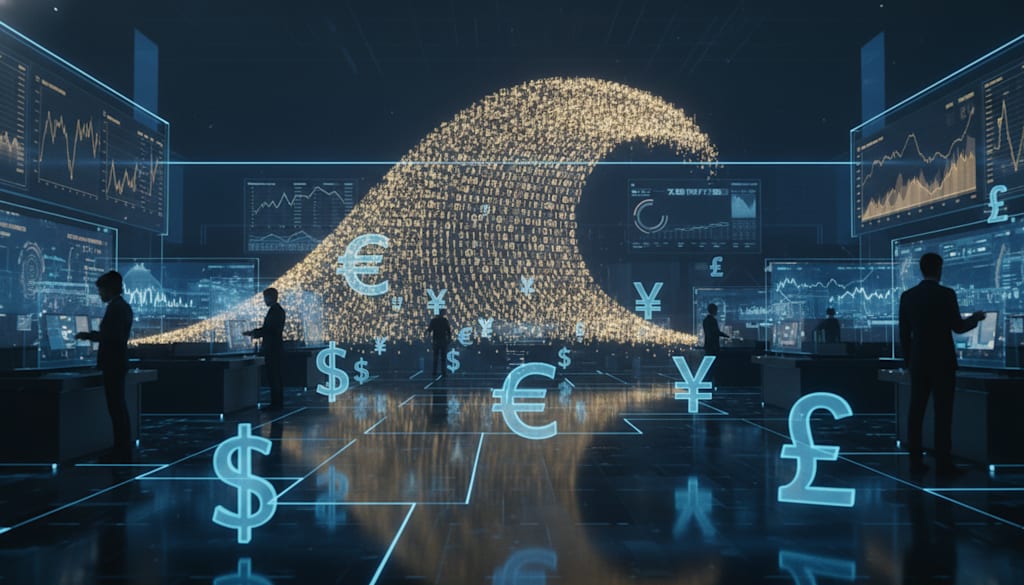
The $7.5 Trillion Ocean: What the Massive Forex Daily Volume Actually Means for You
Ever wonder how much money is moving while you sleep? The forex market isn't just big; it's an architectural marvel of global finance that dwarfs every other market on Earth. We dive into the staggering $7.5 trillion daily volume and why that number matters to the average trader.
The Ghost in the Machine
Imagine standing on the edge of a cliff, looking out over a dark, churning ocean. You can’t see the bottom, and the horizon stretches further than your mind can comfortably process. That’s the Foreign Exchange (Forex) market. While the New York Stock Exchange gets all the Hollywood movies and the frantic bell-ringing ceremonies, it’s actually a puddle compared to the deep, silent sea of currency trading.
When we talk about the daily volume of the forex market, we aren't talking about millions or billions. We’ve graduated to the 'T' word. According to the latest Triennial Central Bank Survey from the Bank for International Settlements (BIS), the daily volume has surged to a jaw-dropping $7.5 trillion.
Let that sink in. That’s $7,500,000,000,000 moving through digital wires every twenty-four hours. If you spent one dollar every second, it would take you about 237,000 years to spend what the forex market moves in a single day.
Why the Numbers Exploded
It wasn't always this way. If we look back a couple of decades, the volume was a fraction of what it is now. So, what changed? It’s not just that there are more people trading; it’s that the very nature of money has become more fluid.
First, the rise of electronic trading platforms leveled the playing field. In the 90s, you needed a massive bank account and a direct line to a broker to play this game. Now, a kid in a coffee shop in Bali can short the Japanese Yen on a smartphone. Retail trading has exploded, but it's still just a small slice of the pie.
The real heavy hitters are the institutional players—central banks, hedge funds, and multinational corporations. When Apple needs to pay a supplier in China or when the European Central Bank decides to intervene to stabilize the Euro, they aren't moving small change. They are moving mountains.
The Anatomy of the $7.5 Trillion
Where does all this money actually go? It isn't just people betting on whether the GBP will go up or down. A massive portion of this volume comes from swaps.
FX swaps are the plumbing of the global financial system. They allow banks and companies to manage their liquidity and hedge against risk. While spot trading—the kind most retail traders do—is significant, it’s the swap market that carries the heaviest weight. It’s the invisible hand that ensures a company in Germany can buy parts from Japan without getting wiped out by a sudden currency fluctuation.
Then you have the 'Big Three' currency pairs. The EUR/USD remains the undisputed heavyweight champion, accounting for nearly a quarter of all turnover. The USD/JPY and GBP/USD follow closely behind. If the forex market is an ocean, the US Dollar is the salt; it’s involved in nearly 88% of all trades. You can't escape it.
The 'Little Guy' in a Big Pond
You might be thinking, "If the market is that big, how can my $1,000 account possibly make a difference?"
The short answer? It doesn't. And that’s actually a good thing.
In smaller markets, like certain 'penny' stocks or low-cap cryptocurrencies, a single wealthy individual (a 'whale') can manipulate the price at will. They can pump it up or dump it, leaving everyone else holding the bag. In the forex market, even the world's largest banks struggle to move the needle on their own for very long. The $7.5 trillion volume provides a level of liquidity that is unmatched.
Liquidity means you can enter and exit a trade almost instantly at the price you want. You aren't going to get stuck with a 'Buy' order that nobody wants to 'Sell' to. In the forex ocean, there is always a fish on the other side of your hook.
The Danger of the Deep
But don't let the liquidity fool you into a false sense of security. Massive volume brings massive volatility. Because the market is open 24 hours a day, 5 days a week, it never truly sleeps. A political scandal in London at 3:00 AM can trigger a massive sell-off that ripples through New York by breakfast.
The sheer scale of the volume means that when a trend starts, it has the momentum of a freight train. You don't want to stand in front of it. Successful traders don't try to stop the tide; they learn to surf it.
The Future of the Volume
Are we going to see $10 trillion a day soon? Almost certainly. As emerging markets in Africa and Southeast Asia become more integrated into the global economy, their currencies will see higher turnover. The rise of algorithmic trading and AI-driven high-frequency bots also means that more trades are happening faster than a human could ever blink.
We are moving toward a world where the friction of moving money across borders is disappearing. Every time you buy a piece of clothing made overseas or subscribe to a software service based in another country, you are a tiny, microscopic part of that $7.5 trillion flow.
Respect the Scale
Understanding the daily volume of the forex market is the first step in respecting the game. It’s a reminder that you are participating in the largest collective human endeavor on the planet. It’s a mechanism that prices the value of entire nations in real-time
So, the next time you look at a currency chart, don't just see lines and candles. See the trillions of dollars of human ambition, fear, necessity, and greed flowing through the system. It’s a big ocean out there—make sure you have a sturdy boat.
About the Creator
Pooja Verma
Forexwebstore.com Discover the Best Forex Indicators for a Simple Strateg. This page features key technical indicators for the most popular currency pairs in real time.
Enjoyed the story? Support the Creator.
Subscribe for free to receive all their stories in your feed.
Comments
There are no comments for this story
Be the first to respond and start the conversation.