
How Entrepreneurs Design Risk Engines in Prop Firm Trading Platforms
An Entrepreneur’s Guide to Managing Drawdowns, Trading Exposure, and Real Time Risk Systems.

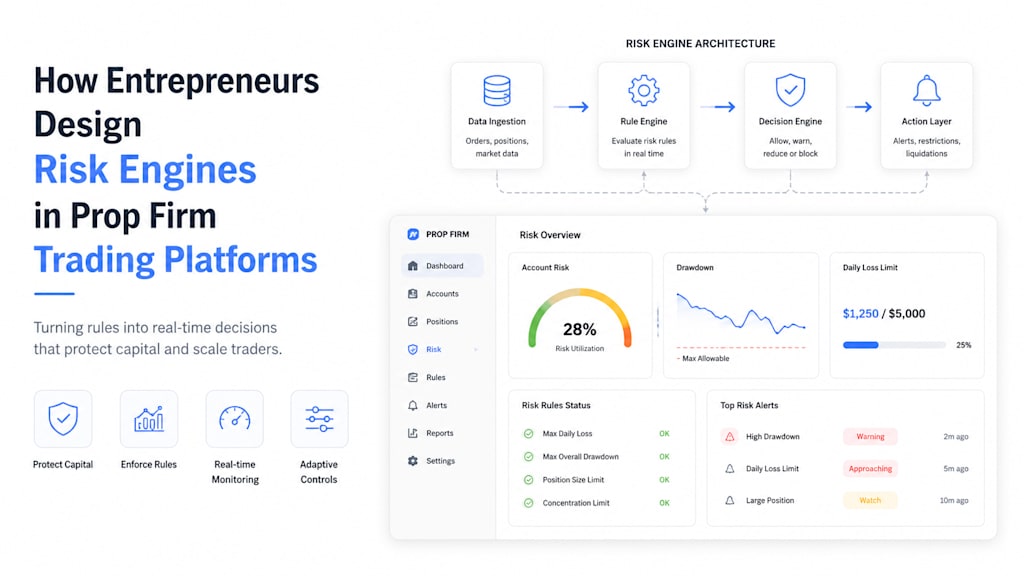
Ever wondered what actually keeps a prop firm trading platform under control when hundreds or even thousands of traders are placing trades at the same time?
It is not just the dashboard or the trading interface. The real control sits inside something called the risk engine.
If you are an entrepreneur building a prop firm, this is the part that quietly decides how safe your business is. It tracks losses, controls exposure, monitors drawdowns, and makes sure traders stay within defined limits in real time.
Most people focus on getting traders or building flashy dashboards, but the real challenge is building a system that protects the firm while still giving traders enough flexibility to perform.
In this blog, let’s break down, practically, how entrepreneurs design risk engines on prop firm trading platforms.
What is a Risk Engine in a Prop Firm Platform?
A Risk Engine is a specialized software system that constantly monitors trading activity in real time. It acts as an automated referee. Its primary job is to track every trade, calculate potential losses, and ensure that no trader breaches the firm's strict risk rules.
In contrast to retail brokers that mainly manage client deposits, prop firms carry direct exposure to trading capital. The risk engine continuously monitors trading platform data, evaluates it against predefined rules, and automatically takes action when violations occur.
How Entrepreneurs Should Think About Risk Engine Design
When designing a risk engine, entrepreneurs should not think of it as just a technical feature. It is better to think of it as a real time decision-making system.
This system must constantly evaluate risk, react instantly, and scale as the business grows.
Speed and real time processing
In trading, speed is extremely important. Markets move in seconds, and even small delays can change outcomes significantly.
If a trader crosses a risk limit, the system must respond immediately. A delay of even a few seconds can result in additional losses due to market movement.
This is why risk engines must be built with low latency architecture and direct access to trading data feeds.
Flexibility and rule configuration
Prop firms do not operate with fixed rules forever. Business strategies evolve.
For example:
- Drawdown limits may change
- evaluation rules may be adjusted
- New account types may be introduced
A strong risk engine must allow entrepreneurs to modify rules without rewriting core system logic.
This flexibility is essential for long term growth.
Data accuracy and validation
One of the most critical aspects of a risk engine is data correctness.
If trade data is delayed, duplicated, or incorrect, the system may:
- Trigger false rule violations
- Miscalculate account balances
- Create unfair trader outcomes
To avoid this, the system must validate all incoming data before making decisions. Only confirmed and accurate data should be used for risk calculations.
Why Risk Engines Are Critical for Entrepreneurs
For entrepreneurs building prop firm platforms, the risk engine is not just a backend component. It is the foundation of the entire business model.
A prop firm survives only when it can balance two things:
- Allowing traders to perform freely
- Protecting the firm’s capital from unnecessary risk
The risk engine ensures this balance is maintained at all times.
→ Capital Protection: A single unmanaged trade during a high-impact news event can wipe out a firm's entire cash reserve. The risk engine prevents these catastrophic events.
→ Business Automation: You cannot hire enough human risk managers to watch hundreds or thousands of accounts 24/7. The risk engine automates this surveillance, allowing your business to scale without a massive increase in headcount.
→ Regulatory Peace of Mind: While the regulatory landscape for prop firms is still evolving, having a transparent, rule-enforced platform protects you from accusations of unfair practices. It ensures every trader is judged by the same mathematical standards.
Core Functions of a Risk Engine in Prop Firm
A properly designed risk engine performs multiple critical functions at the same time. These functions work continuously in the background.
1. Real-Time Drawdown Tracking
This is the most vital function. The engine tracks two types of drawdowns:
- Daily Drawdown: The maximum amount an account can lose in a single day (usually calculated from the balance at the start of the day).
- Maximum (Overall) Drawdown: The total amount an account can lose from its initial funding size before it is disqualified.
2. Position Size and Margin Monitoring
Traders often increase their position sizes to maximize profits, but larger positions also increase potential losses. The risk engine ensures that traders do not open trades beyond their allowed limits, helping prevent excessive margin usage and protecting the firm's capital from unnecessary exposure.
3. News Trading Restrictions
Many prop firms restrict trading during high-impact economic news releases (like the US Non-Farm Payrolls) because price movements can be violently unpredictable. A good risk engine can automatically freeze trading or flag accounts that open positions within a specific window of these announcements.
4. IP and Consistency Tracking
To prevent fraud, modern risk engines track where trades are coming from. If an account suddenly switches IP addresses across different countries within minutes, or if the trading style changes completely, the engine flags the account for potential account-sharing or bot-manipulation.
System Flow of a Risk Engine in Prop Firms
To understand how everything works together, here is a simple step-by-step flow of a trade inside a prop firm platform.
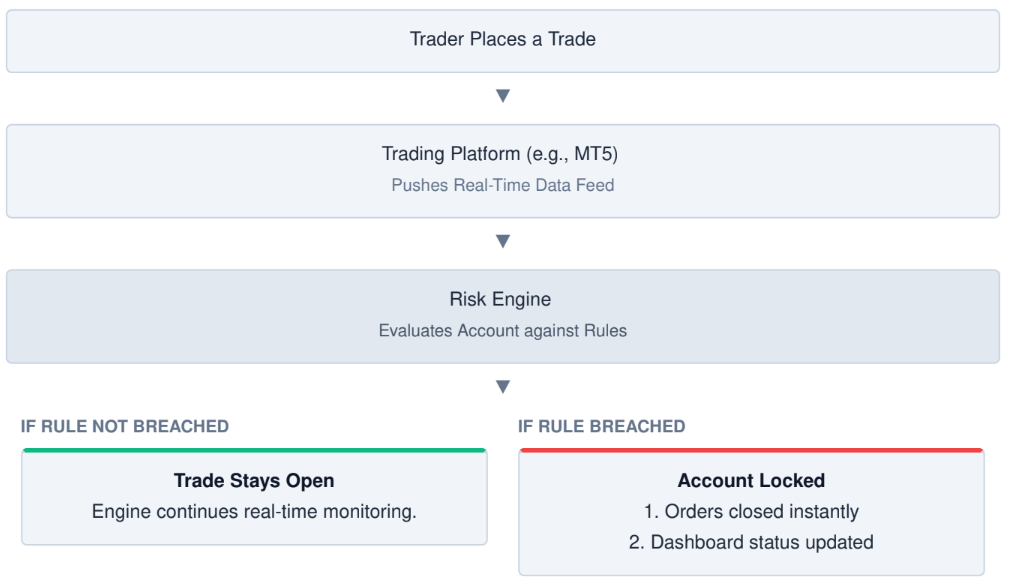
- The Trigger: The trader opens or closes a position on their trading terminal.
- Data Ingestion: The trading platform pushes this data instantly to the risk engine via an API.
- The Calculation: The engine recalculates the account's current balance, floating equity, and open risk against the firm's rules.
- The Decision:
- Scenario A (Pass): The metrics are within safe limits. The engine does nothing but continue to watch.
- Scenario B (Fail): The trader has crossed the daily loss limit.
5. Execution: The risk engine sends an immediate command back to the trading server to liquidate all open positions and lock the account credentials, preventing further trading. Simultaneously, it sends a notification to the trader's dashboard explaining the breach.
Conclusion
A prop Firm Trading Platform is a real time financial system where risk must be constantly controlled.
At the center of this system is the risk engine.
It ensures traders can trade freely while keeping the firm protected from excessive exposure. It enforces rules, tracks risk, and maintains balance across the entire platform.
For entrepreneurs, building a strong engine is the foundation that determines whether the prop firm grows, sustains, and succeeds in a competitive trading environment.
A well designed risk engine protects the entire business.
About the Creator
Augustin
Sharing easy-to-follow content about trading platforms, trading tech, modern fintech and blockchain development.
Enjoyed the story? Support the Creator.
Subscribe for free to receive all their stories in your feed.
Comments
There are no comments for this story
Be the first to respond and start the conversation.