
Hong Kong Just Did Something It Has Never Done Before. Here’s What It Means.
The city’s first five-year plan bets on finance, tech, and a new northern city. One of those bets is much harder than it looks.
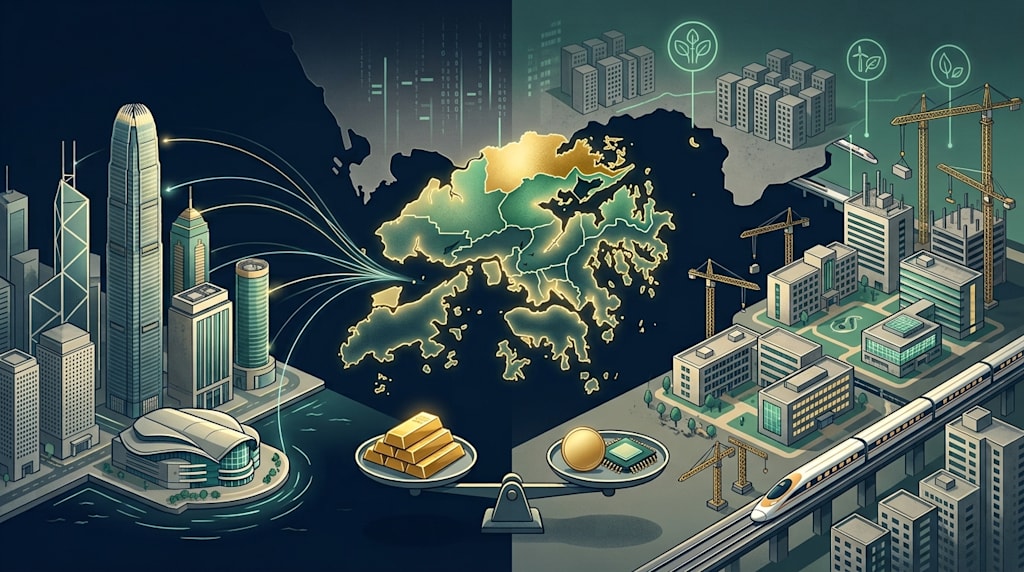
Hong Kong's First Five-Year Plan: Three Pillars and One Unanswered Question
On 16 September 2026, the Hong Kong Special Administrative Region government published the Hong Kong Special Administrative Region Economic and Social Development First Five-Year Plan (2026-2030). The document runs to about 60,000 Chinese characters. It is divided into seven parts and 28 chapters. It sets 105 indicators, of which 22 are primary indicators. Five are binding. Seventeen are indicative. The plan covers economic development, innovation and technology, the Northern Metropolis, housing, employment, and public governance. It also establishes an implementation mechanism. The five-year plan sets overall direction. Annual policy addresses translate it into yearly work. The budget supports it. The Chief Executive reports progress during annual duty visits to the central government.
This is the first time Hong Kong has produced a systematic medium-term development roadmap of this kind. The plan matters because Hong Kong is asking a different question. For decades, the city's success story was finance, trade, shipping, and professional services. The question now is whether that story is enough for the next thirty years.
Why now
The old model worked, but it concentrated risk. After manufacturing moved north in the 1980s, Hong Kong went through roughly four decades of deindustrialisation. Manufacturing's share of GDP fell from nearly 25 percent at its peak to less than 1 percent. In 2024, Hong Kong's total local innovation expenditure was HK$51.714 billion, or 1.63 percent of GDP. In the same year, Shenzhen's Nanshan District spent 7.66 percent of its GDP on research and development, about HK$85.1 billion. That is more than twice Hong Kong's entire innovation spending. Nanshan covers 185 square kilometres, less than one-sixth of Hong Kong's land area. It contributes more than a quarter of Shenzhen's GDP and produced Tencent, DJI, and ZTE.
Finance remains Hong Kong's strongest sector. In the 40th Global Financial Centres Index, Hong Kong scored 756 and ranked third globally. Singapore scored 755 and ranked fourth. The gap is one point. But in the survey question asking which financial centres will develop significantly in the next two to three years, Hong Kong ranked seventh, behind Dubai and Singapore. Hong Kong is still near the top of the existing league table. The market is less confident about its future position.
Professor Tang Heiwai of the University of Hong Kong's Faculty of Business and Economics has said that Hong Kong's economy is overly concentrated in finance and real estate, so "when there is an external shock, economic resilience is insufficient." The Chinese Manufacturers' Association of Hong Kong put it more directly. A single economic structure and an empty industrial base are the key constraints on economic resilience and long-term competitiveness. The five-year plan is meant to address that problem.
Three pillars
The first pillar is finance. The plan keeps the existing financial system and adds new areas. It places "strengthening the four centres" first. Of the 105 indicators, 45 relate to the "four centres and one highland." The plan uses finance as the capital source for transformation. It does not treat finance as a burden to replace.
Three new tracks stand out. The first is the offshore renminbi business. The plan proposes a liquidity supplement mechanism for Hong Kong's offshore renminbi market. It pushes for the inclusion of renminbi counters in Stock Connect. It asks the government to study paying its own expenses in renminbi. Hong Kong is the world's largest offshore renminbi market. This step extends an existing advantage.
The second is gold trading. The plan uses gold as an entry point to build a commodities trading market. It calls for raising gold storage capacity and refining capacity. It calls for a one-stop centre for storage, trading, clearing, and settlement. It explores a renminbi-denominated gold market. The dollar dominates commodity pricing. A renminbi-denominated gold market would differ from the dollar-priced market.
The third is finance plus technology. The plan promotes patient capital and venture capital investment in technology. It improves the listing regime for technology companies. It broadens financing channels. Hong Kong's role is to give technology firms capital, legal, accounting, consulting, and international access. It does not make products itself.
The second pillar is innovation and technology. The plan sets a target of raising local innovation expenditure from 1.63 percent of GDP in 2024 to 3 percent after 2030. It aims to raise the value added of manufacturing and new industrial sectors from 3.8 percent of GDP to 5.5 percent. Both imply roughly 10 percent annual growth. The earlier Hong Kong Innovation and Technology Development Blueprint set a 2 percent R&D target. The new plan is more ambitious.
The layout includes three innovation parks and five research institutions. They cover artificial intelligence, life sciences, and microelectronics. The Hong Kong park of the Hetao Shenzhen-Hong Kong Science and Technology Innovation Cooperation Zone is positioned as a major platform for industry, academia, and research. It focuses on upstream and midstream R&D, translation, and pilot production. The target is to have research, translation, and pilot production work together by 2030.
Hong Kong has research resources: the University of Hong Kong, Hong Kong University of Science and Technology, Chinese University of Hong Kong, and others. The weakness is translation. Many results stay in the laboratory and never become commercial applications. Shenzhen is good at turning technology into products. Hong Kong is good at connecting capital and global resources. The implied division of labour is that Hong Kong becomes a capital and technology link in the supply chain. Other Greater Bay Area cities provide industrial chains and manufacturing capacity.
The difficulty is here too. In Nanshan, 90 percent of R&D spending comes from enterprises. In Hong Kong, government funding accounts for a larger share. Market-driven research momentum is weaker. Technology industries do not grow simply because parks are built. They need firms, capital, talent, and long-term policy working together.
The third pillar is the Northern Metropolis. It is a spatial restructuring. The plan calls it the main platform for Hong Kong to participate in the Guangdong-Hong Kong-Macao Greater Bay Area and to integrate into national development. It gives hard numbers.
For "spade-ready" land, the previous five years produced about 120 hectares. The next five years target about 900 hectares, a 7.5-fold increase. For housing completions, the previous five years produced about 11,000 units. The next five years target about 70,000 units, a 6.4-fold increase. Among the five binding indicators, the Northern Metropolis spade-ready land output is the only economic development indicator. The other four relate to environmental protection.
The spatial pattern is "finance in the south, innovation in the north." The Northern Metropolis promotes a university town, the San Tin Technopole, and the Hetao Hong Kong park. It plans transport, housing, greenery, and public facilities under a smart-city approach. For decades, Hong Kong's development has been concentrated on both sides of Victoria Harbour. Land is tight. Housing is expensive. Industrial space is insufficient. The Northern Metropolis moves the city's development axis north. It shifts the spatial structure from a single core to a dual-core structure.
Execution is the hard part. Industrial land supply in the Northern Metropolis is structurally unbalanced. Departmental approvals are cumbersome. Investment promotion is not well coordinated. Private capital participation is low. The result is a "government hot, private sector cold" pattern. After spade-ready land is produced, whether industry follows is a harder question than moving earth.
Implementation: binding, indicative, and the boundary
The plan divides the 22 primary indicators into two categories: five binding indicators and seventeen indicative indicators.
Binding indicators focus on areas the government directly controls. These include Northern Metropolis spade-ready land supply, a 32.5 percent cumulative reduction in carbon intensity per unit of GDP compared with 2024, and a 30 percent share of zero-carbon energy in the fuel mix for electricity generation. If these are not achieved, accountability follows. The Chief Executive reports progress during annual duty visits.
Indicative indicators cover economic growth, research input, and industrial structure. They are directional guides, driven by the market and social resources. The 3 percent R&D target and the 5.5 percent manufacturing share are indicative, not binding. If they are missed after five years, there is no direct political accountability consequence. Maintaining momentum without hard constraints is a long-term question for implementation.
The 2026 Policy Address sets 284 indicators to implement the plan's 105. The mechanism will run only if annual indicators match the five-year ones, departments coordinate, and responsibilities are clear.
The plan says it will "adhere to the combination of an effective market and a proactive government." Hong Kong has long followed free-market principles. With a five-year plan, the government's role in allocating economic resources becomes more active. The reason: technology and regional competition are unlikely to improve in the short term through market forces alone. The risk is that government-led industrial policy meets a "government hot, private sector cold" reality. Hong Kong must balance a proactive government with a free, open market.
Unanswered questions
First, building a technology industry takes time. Hong Kong's deindustrialisation lasted about 40 years. Catching up is not a five-year task. Silicon Valley and Singapore both took decades. Hong Kong has research and financial advantages. Whether it can turn them into industrial results is the biggest challenge.
Second, global city competition is intensifying. Singapore is strengthening the link between technology and finance. Shenzhen has a complete industrial chain. Dubai is raising its profile as an international business centre. Hong Kong must prove it can be both a capital market and a place where technology firms grow.
Third, the plan depends on execution. With 105 indicators, what matters is subsequent policy, funding, and project delivery. If technology industries grow and the Northern Metropolis becomes a new growth area, Hong Kong may raise its long-term growth path. If the plan stays at the planning level, the targets will fail.
Fourth, structural change faces hard limits. Long reliance on the market's "invisible hand" to adjust industrial structure has concentrated the economy in finance and real estate and weakened resilience. After introducing a five-year plan, how to balance government guidance and market freedom is a continuing issue.
Conclusion
Five years from now, four numbers will show whether the plan worked: R&D spending as a share of GDP, manufacturing and new industrial value added as a share of GDP, spade-ready land in the Northern Metropolis, and public rental housing waiting time. The targets are 3 percent, 5.5 percent, 900 hectares, and below four years. Those numbers will show what the plan achieved.
About the Creator
Jin
Writer of reamstories
https://reamstories.com/jin
Enjoyed the story? Support the Creator.
Subscribe for free to receive all their stories in your feed. You could also become a paid subscriber, letting them know you appreciate their work.
Comments
There are no comments for this story
Be the first to respond and start the conversation.