
High Leverage Crypto Prop Firm Guide
A Practical Guide to Crypto Leverage and Prop Firm Rules


This guide explains how high leverage works within crypto prop trading, how it interacts with margin and drawdown, and which criteria should be examined before selecting a firm. The objective is not to identify the highest number on a comparison page. It is to determine whether a firm’s leverage structure supports disciplined trading without creating unnecessary exposure to account breaches.
Understanding high leverage in crypto prop trading requires looking beyond the advertised leverage ratio and examining drawdown rules, execution conditions, and position limits.
Disclaimer: This article is for educational purposes only and does not constitute financial or investment advice. Cryptocurrency and leveraged trading involve substantial risk. Prop firm rules and trading conditions vary by provider, so always review the current official terms before making a decision.
What Is a High Leverage Crypto Prop Firm?
A high leverage crypto prop firm gives eligible traders access to funded or simulated funded accounts with increased position capacity. Traders can control larger market exposure but must operate within rules governing daily losses, maximum drawdown, position limits, permitted strategies, and payouts.
Unlike exchange trading, where traders typically use their own deposited capital, prop firms provide structured accounts after an evaluation or qualification process. Depending on the firm, the account may use live, simulated, or hybrid execution.
The displayed account size should not be confused with the amount a trader can lose. For example, a $100,000 account with a 5% maximum drawdown provides only about $5,000 in total loss capacity, and its daily limit may be considerably lower.
Available Leverage vs. Used Leverage
Available leverage defines the maximum exposure a platform permits, while used leverage reflects the trader’s actual position size.
A firm may offer 1:100 leverage, but that does not mean traders should use the full capacity. Position size should be based on the planned dollar risk and stop loss distance, not the maximum exposure available.
Why Account Rules Matter More Than Leverage
Leverage is only one part of a prop trading account. Drawdown calculations, execution costs, position limits, strategy restrictions, and payout conditions collectively determine the real trading environment.
Traders should also confirm whether the challenge and funded stages are live, simulated, or hybrid, and whether the conditions change after qualification. A simulated funded account is not necessarily inferior, provided its execution model, rules, and payout terms are transparent.
Two firms offering the same leverage can therefore produce very different trading experiences. Leverage determines potential exposure, but account rules determine usable risk. A high leverage crypto prop firm should be evaluated as a complete risk and execution system, not by its advertised multiplier alone.

How Does High Leverage Work in Prop Trading?
High leverage allows a prop trader to control greater market exposure with less margin, but it does not increase the account’s permitted loss. Position size should still be based on the stop loss distance, drawdown rules, and maximum acceptable risk per trade.
Leverage affects the margin required to open a position, a simplified margin formula is:
Required margin = Position value ÷ Leverage ratio
For example, a $100,000 position requires approximately $10,000 in margin at 1:10 leverage but only $1,000 at 1:100. The exposure remains $100,000 in both cases, so a 1% adverse move still represents roughly a $1,000 loss before fees and slippage.
This is why higher leverage can improve capital efficiency without making the position itself safer.
Calculating the Appropriate Position Size
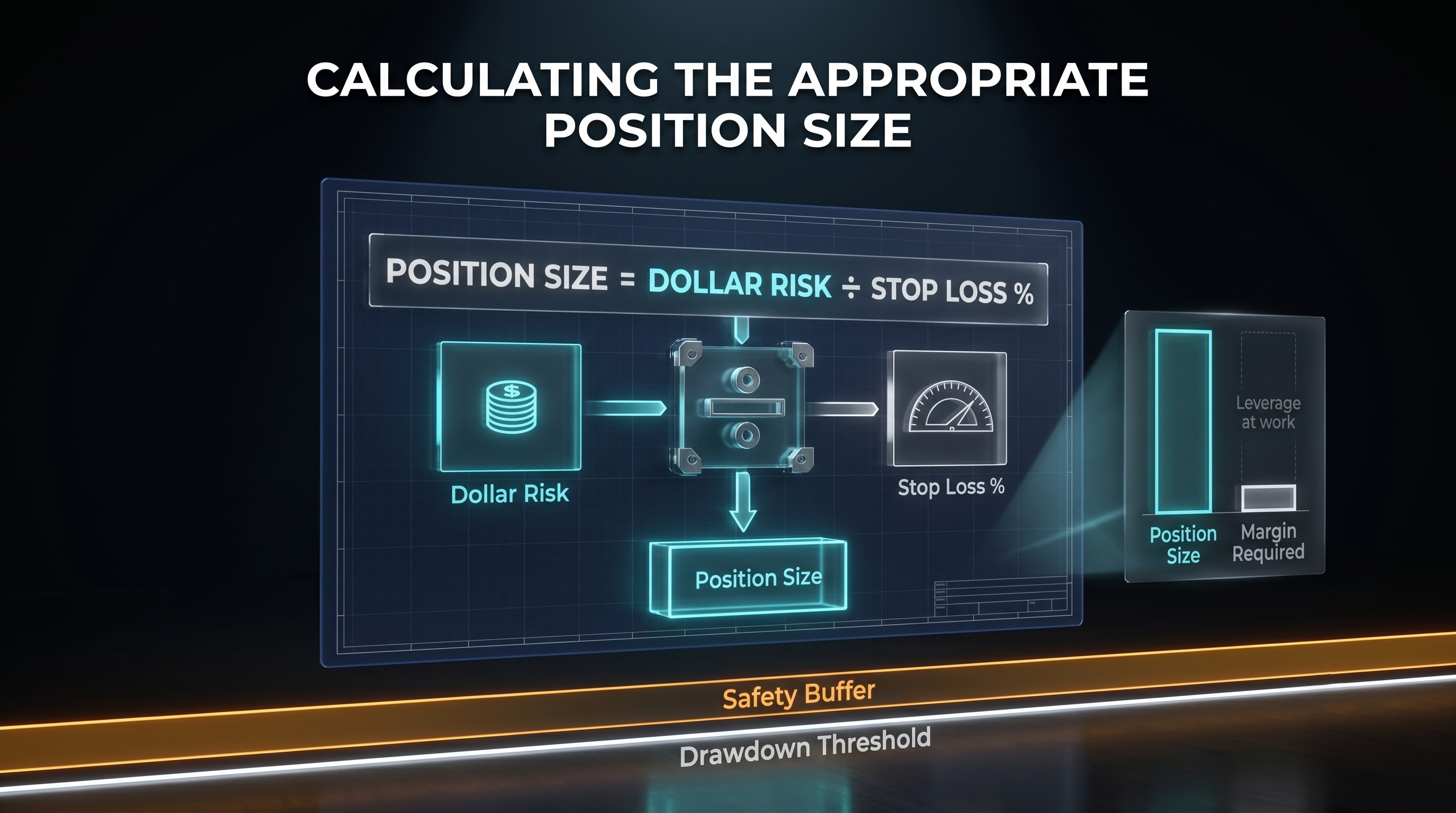
Position size should be calculated from the planned loss and stop loss distance, simplified position sizing formula is:
Position size = Dollar risk per trade ÷ Stop loss percentage
Suppose a trader is prepared to risk $250 and places the stop loss 0.5% from the entry:
$250 ÷ 0.005 = $50,000 position size
At 1:100 leverage, this position would require approximately $500 in margin. However, the $250 risk limit, not the leverage available, determines the appropriate position size.
The actual loss may be slightly higher because of commissions, spreads, slippage, or price gaps. Traders should therefore leave a safety buffer rather than operating too close to the firm’s drawdown threshold.
Leverage Should Support Risk Management
The correct process is to identify the technical invalidation point, define the maximum acceptable loss, and then calculate position size. Leverage should only provide the margin flexibility required to execute that decision.
Using the maximum available leverage can quickly consume the daily drawdown, particularly when several correlated crypto positions are open. A trader should therefore ask, “What position size keeps this trade within my risk limit?” rather than, “How large a position can this account open?”
High leverage is most effective when it supports an existing risk plan. It should never replace a valid stop loss or determine how much the trader is willing to lose.
Leverage Limit vs. Drawdown Limit: Which Matters More?
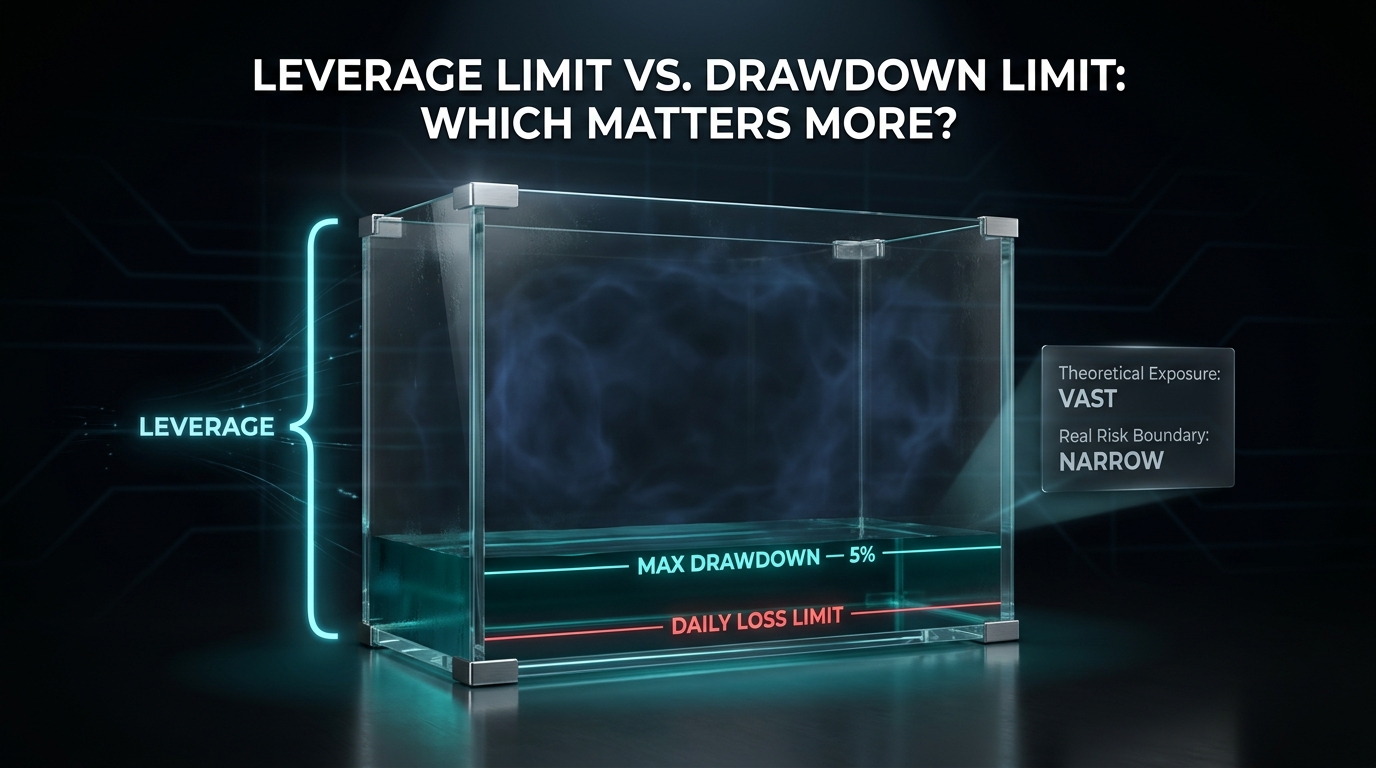
For most crypto prop traders, drawdown matters more than the advertised leverage ratio. Leverage determines how much market exposure is available, while drawdown defines how much the account can lose before a breach occurs.
A $100,000 account with 1:100 leverage may theoretically provide substantial market exposure. However, if its maximum drawdown is 5%, the total loss allowance may be only $5,000. A 2% daily loss limit could further restrict losses within one session to $2,000 or less.
In practical terms, leverage defines trading capacity, while drawdown defines the account’s risk boundary.
Daily and Maximum Drawdown
Daily drawdown limits the qualifying losses allowed during a single trading day. Maximum drawdown determines the total loss the account can absorb before it is failed or terminated.
Traders should verify whether these limits are calculated from balance or equity, whether unrealized losses and fees are included, and when the daily threshold resets. For example, an account with a $2,000 daily limit could be breached by $1,200 in closed losses and a $900 unrealized loss if the firm uses an equity based calculation.
Maximum drawdown can be structured in three common ways:
Static drawdown: The breach threshold remains tied to the initial balance.
Trailing drawdown: The threshold moves upward as balance or equity reaches new highs.
End of day trailing drawdown: The threshold is updated after the trading day rather than following every intraday high.
The exact calculation method is more important than the percentage displayed.
Calculating Usable Risk
A simplified daily risk calculation is:
Usable risk = Daily loss limit − Closed losses − Open position risk − Expected costs
If the daily limit is $2,000, closed losses are $500, open position risk is $600, and expected costs are $100, the remaining room is approximately $800. This is a boundary, not a recommendation to risk the full amount.
A firm offering 1:20 leverage with a clear static drawdown may therefore be more practical than one offering 1:100 with a restrictive equity based trailing limit.
The key principle is simple: leverage determines what a trader can open, but drawdown determines what the account can survive.
Potential Benefits of High Leverage
High leverage can improve capital efficiency, reduce margin requirements, and provide greater flexibility in position sizing. These benefits are most relevant to short term strategies that target small price movements while maintaining a predefined risk per trade.
By reducing the margin needed to open a position, higher leverage allows traders to use available capital more efficiently. For example, a $50,000 position may require approximately $5,000 in margin at 1:10 leverage but only $500 at 1:100. The market exposure remains the same; only the required margin changes.
This flexibility can be useful for scalping and intraday strategies that rely on precise entries, relatively tight stops, and short holding periods. It may allow traders to size a position according to the setup’s stop loss distance without committing a large amount of personal capital or available margin.
However, lower margin requirements do not make a position safer. Trading costs, slippage, and adverse price movements still affect the full position value. Unused margin should not be treated as permission to open unnecessary trades or increase total exposure.
The main benefit of high leverage is therefore greater position flexibility, not greater acceptable risk. It is most effective when it helps execute a predefined trading plan without changing the maximum amount the trader is prepared to lose.

Main Risks of High Leverage
The main risks of high leverage are faster drawdown, greater exposure to slippage, correlated losses, psychological pressure, and quicker account breaches. These risks depend primarily on the position size actually used, not simply on the leverage offered by the firm.
A large position can turn a small adverse move into a significant loss. For example, a 1% decline on a $200,000 position equals approximately $2,000 before fees. On an account with a $2,000 daily loss limit, that move could consume the entire daily allowance.
Execution risk also increases with position size. During volatile conditions, widening spreads, thin liquidity, and slippage can cause a stop loss to fill at a worse price than expected. Traders should therefore leave a safety buffer rather than operating close to the drawdown threshold.
Multiple crypto positions can also create hidden exposure. Long trades on Bitcoin, Ethereum, and several altcoins may all lose simultaneously during a market wide decline. Total account risk should be measured across correlated positions, not trade by trade.
High leverage can also increase emotional pressure. If normal price fluctuations lead to impulsive exits, moved stop losses, or revenge trading, the position is probably too large, even if it remains within the firm’s technical limits.
Leverage itself does not usually breach an account. A breach occurs when daily loss, maximum drawdown, position, or strategy rules are violated. However, oversized positions can make those limits much easier to reach.
The safest approach is to define the stop loss and maximum dollar risk first, calculate the appropriate position size, account for fees and correlated exposure, and use only the leverage required. Leverage should improve capital efficiency without increasing the predefined risk.
How to Compare High Leverage Crypto Prop Firms
To compare high leverage crypto prop firms, look beyond the advertised ratio. Drawdown rules, asset specific leverage, execution costs, trading restrictions, and payout conditions reveal more about a firm’s practical value than its maximum leverage alone.
Two firms may offer the same leverage and account size but provide very different trading conditions. One may use a clear static drawdown, while another counts unrealized losses toward a restrictive trailing limit. Their advertised capacity may be similar, but their usable risk can be significantly different.

Review Drawdown and Leverage Rules
Start by confirming whether drawdown is static, trailing, or updated at the end of the day. Check whether unrealized losses, commissions, and funding fees count toward the limit and when the daily threshold resets.
The advertised leverage may also vary by asset. A firm offering “up to 1:100” may provide that ratio only for Bitcoin or Ethereum, while applying lower leverage and stricter position limits to altcoins.
Evaluate Execution and Restrictions
Spreads, commissions, funding fees, and slippage can materially affect short term strategies. Traders should determine whether execution conditions remain consistent during volatility and whether the platform supports the order types their strategy requires.
Strategy restrictions are equally important. Rules may apply to news trading, weekend holding, copy trading, automated systems, or arbitrage. These conditions should be clearly defined and remain reasonably consistent between the challenge and funded stages.
Verify the Account and Payout Model
Traders should confirm whether the account is live, simulated, or hybrid and understand how prices and orders are generated. A simulated account is not necessarily inferior, but its operation should be transparent.
Payout terms should explain the profit split, first eligible withdrawal date, frequency, consistency requirements, KYC process, and reasons a payout may be denied.
Before choosing a firm, ask:
Is the drawdown model compatible with the strategy?
Does the leverage apply to the assets being traded?
Are trading costs and restrictions clearly disclosed?
Do conditions change after passing the challenge?
Are account and payout terms transparent?
The best high leverage crypto prop firm is not necessarily the one offering the highest ratio. It is the one whose leverage, risk rules, execution, and payout conditions support a consistent trading process.
Who Should and Should Not Use High Leverage?
High leverage may suit experienced traders who use tested strategies, predefined stop-losses, and consistent position sizing. It is generally unsuitable for traders who lack clear risk rules, change exposure emotionally, or use larger positions to recover losses.
High leverage is most useful for short term strategies that target small price movements and require efficient use of margin. Scalpers and intraday traders may benefit when they calculate position size from a valid stop loss and keep the dollar risk within the firm’s drawdown limits.
It is less suitable for strategies with wide stops, long holding periods, or exposure to illiquid assets. Swing traders may gain little from extreme leverage while facing greater sensitivity to overnight volatility, funding fees, and equity based drawdown.
Traders should consider high leverage only if they can:
Define the maximum dollar risk before entry
Monitor daily and maximum drawdown
Control exposure across correlated assets
Apply the same risk process after wins and losses
Leverage should solve a capital efficiency problem, not compensate for an untested strategy or limited discipline. It cannot improve poor entries, create a trading edge, or make losses easier to recover.
Funded accounts may also reduce the need for extreme leverage. A $100,000 prop account might provide sufficient position capacity at 1:10 or 1:20, even if 1:100 is available.
The key test is whether access to higher leverage changes the trader’s behavior. If it encourages larger losses, more frequent trades, or attempts to recover drawdown quickly, lower leverage is the more practical choice. The strategy should determine the required leverage, not the other way around.
Common High Leverage Prop Trading Mistakes
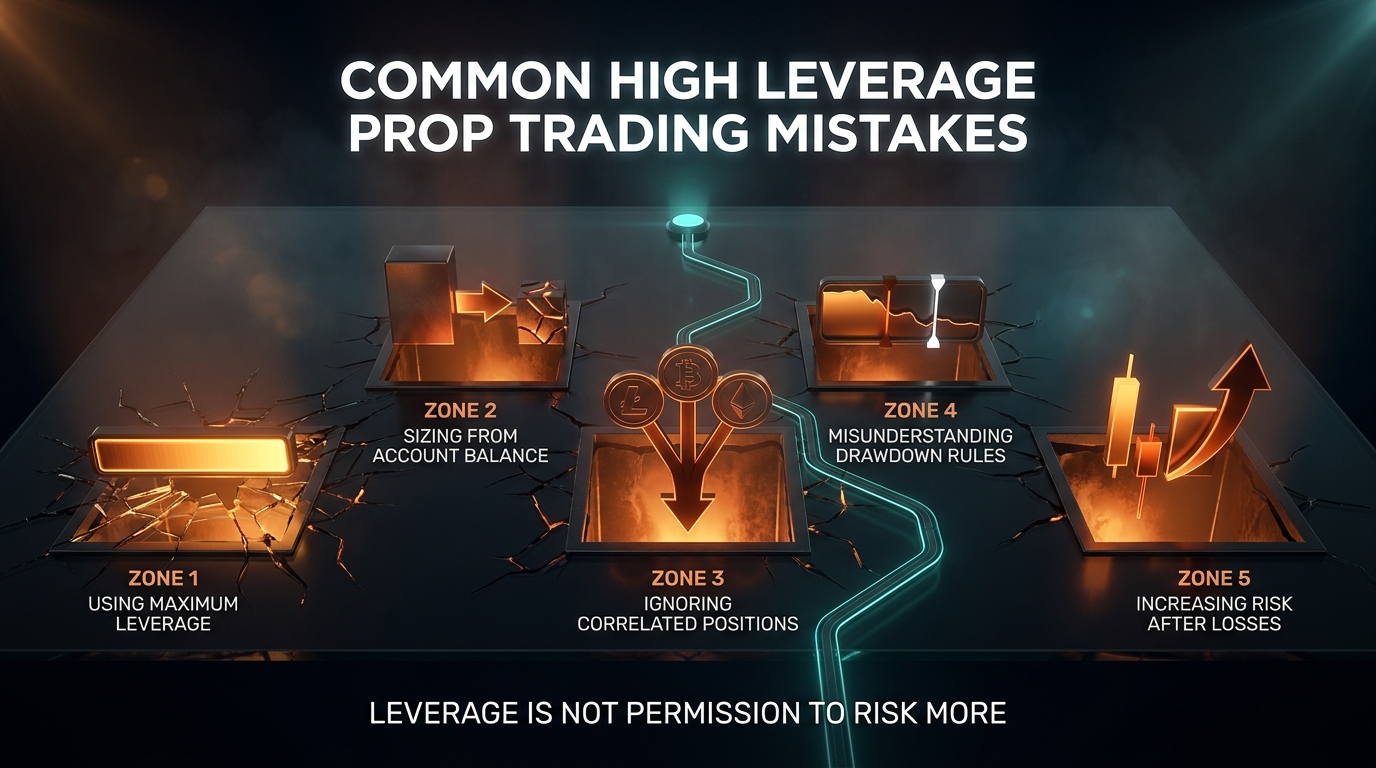
The most common high leverage prop trading mistakes include using maximum exposure, sizing positions from the headline account balance, ignoring correlated trades, misunderstanding drawdown rules, and increasing risk after losses. These errors can turn a manageable loss into an account breach.
Using Maximum Leverage
The leverage offered by a firm is a limit, not a recommended position size. Traders should calculate exposure from the amount they are prepared to lose and the distance to the stop loss, not from the maximum position the platform allows.
Sizing Risk From the Account Balance
A $100,000 prop account does not provide $100,000 of usable risk. If maximum drawdown is 5%, the effective loss allowance may be closer to $5,000. Risk per trade should therefore be compared with drawdown rather than calculated only as a percentage of the headline balance.
Ignoring Correlated Positions
Several crypto positions can create one large directional exposure. Long trades on Bitcoin, Ethereum, and multiple altcoins may all lose simultaneously during a market wide decline. Total account risk should account for correlation, not just the risk assigned to each trade separately.
Misunderstanding Drawdown Rules
A trader may breach an account before the planned stop loss is reached if the firm calculates drawdown from real time equity. Trailing thresholds, unrealized losses, fees, and daily reset times can also affect the breach level. These rules should be understood before the first trade is placed.
Increasing Risk After Losses
Using larger positions to recover drawdown is one of the fastest ways to fail a high leverage account. A loss reduces the remaining risk allowance; it does not justify increasing exposure. Each new position should follow the same sizing process regardless of previous results.
The central mistake is treating leverage as permission to risk more. Used correctly, leverage only provides position flexibility. The trader’s maximum dollar risk should remain defined by the setup and the firm’s drawdown limits.

Is a High Leverage Crypto Prop Firm Worth It?
A high leverage crypto prop firm may be worthwhile when it provides enough position flexibility for a tested strategy without encouraging the trader to exceed a predefined risk limit. Its value depends more on drawdown rules, execution quality, and payout transparency than on the advertised leverage ratio.
High leverage can benefit traders who use precise entries, predefined stop losses, and consistent position sizing. It reduces margin requirements and may make short term strategies more capital efficient.
However, extreme leverage is not always necessary. A funded account may already provide sufficient trading capacity at 1:10 or 1:20. Access to 1:100 adds flexibility, but it offers little practical benefit if restrictive drawdown rules, high trading costs, or inconsistent execution prevent the strategy from operating normally.
A prop firm is worth considering only when its leverage supports the trader’s existing process rather than changing it. If higher leverage leads to oversized positions, emotional decisions, or attempts to reach profit targets faster, a lower ratio may be more practical.
Ultimately, the best account is not the one offering the largest multiplier. It is the one that allows the trader to execute a repeatable strategy while keeping losses within clearly defined limits.
Final Takeaway
Among high leverage firms, the best option is not necessarily the one with the highest advertised leverage ratio. A strong trading environment combines adequate position flexibility with understandable drawdown rules, predictable execution, transparent restrictions, and reliable payout conditions.
Before choosing a firm, calculate how its daily and maximum drawdown limits affect your actual risk budget. Then compare that budget with your stop distance, typical position size, trading frequency, and strategy. High leverage is most useful when it improves capital efficiency without changing the amount you are prepared to lose.
About the Creator
Sophie
Trader focused on Price Action & Order Flow.
Into crypto, fast execution, controlled risk, and quality setups.
Passing funded accounts and refining my trading every day.
Enjoyed the story? Support the Creator.
Subscribe for free to receive all their stories in your feed.
Comments
There are no comments for this story
Be the first to respond and start the conversation.