
He Shut Down a ByteDance Training Run. Now Investors Have Given Him $30 million.
A ten-person startup with no name, no product, and a $200 million valuation. The bet is on the founder, not the technology.
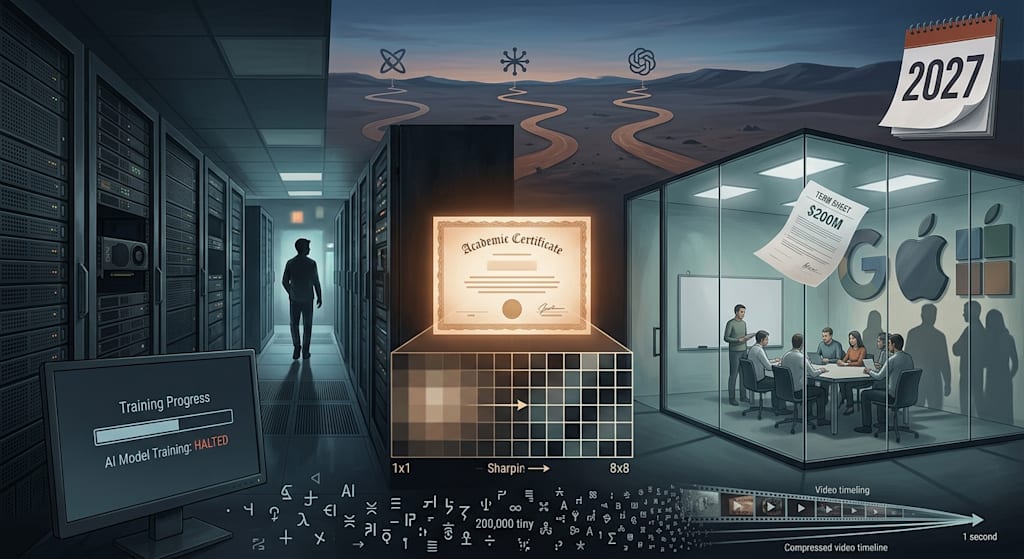
In June 2024, a program stopped running on a training server inside ByteDance’s commercialization technology department. The person who stopped it was Tian Keyu, then a master’s student at Peking University and an intern at the company. He told Bloomberg the program was occupying GPUs, and he thought his own research mattered more. He admitted the conduct was wrong. He also called it “enforcing justice on behalf of heaven.” ByteDance called it “maliciously attacking the model training task.” A court ruled that he violated his internship contract. He paid 500,000 yuan and lost all his internship wages. ByteDance said rumors of 8,000 cards and tens of millions of dollars in losses were severely exaggerated.
In December 2024, NeurIPS gave its annual Best Paper prize to a VAR paper with Tian as first author. The paper attacked a concrete problem: diffusion models generate images too slowly. VAR stopped flattening images into one-dimensional sequences and predicting pixel by pixel. It kept the two-dimensional structure, starting from a 1x1 blurry outline, then generating details at 2x2, 4x4, and 8x8. On ImageNet, FID dropped from 18.65 to 1.73. Inference speed rose twentyfold. Tian became the first first author from a mainland China research institution to win the award.
In October 2026, the world model company he founded raised nearly $30 million from 5Y Capital, IDG Capital, and others. The post-money valuation was $200 million. The company has no name, no product, and ten employees. Some of them are former ByteDance staff.
5Y Capital also backed Moonshot AI early. The firm tends to invest early and bet on people. AMD bought Fei-Fei Li’s World Labs for $8.2 billion. CEO Lisa Su said the point was “to acquire world-class talent.” Tian’s round follows that logic. Investors are betting on the odds that a young researcher with a NeurIPS Best Paper can make the right calls in a crowded field.
At least three routes are running in world models. Fei-Fei Li’s World Labs starts with 3D reconstruction and Gaussian splatting. It gets high geometric precision, but dynamic scenes are harder. Yann LeCun’s AMI Labs predicts inside an abstract representation space. The theory is elegant, but the product is distant. Tian skips explicit 3D reconstruction and abstract latent space. His team uses 200,000 AI-specific symbols to predict frames directly. He claims the method can cut the cost of generating one second of video by at least an order of magnitude.
Wang Zhongyuan, president of the Beijing Academy of Artificial Intelligence, said these explorations “still have a considerable gap from a truly physical-world foundation model.” He expects “the next three to five years” to be “a period of continuous iteration for world models.”
Tian plans to release a full model in 2027. Until then, outsiders can only trust the founder’s judgment about whether the route works. VAR has been validated on images. Video adds time, causality, and physical consistency. Those problems are harder than scale prediction in two dimensions. No public evidence yet shows that 200,000 symbols can encode physical information in video.
The ten-person team raises another question. Outsiders cannot tell how many joined for the technical vision and how many joined for the Best Paper halo. In an interview, Tian said his behavior at ByteDance came from a strong view about “what is valuable research.” That view can help in a lab. It can hurt in a company.
One person in the industry said, “You absolutely cannot invest in a company whose founder lacks character.” 5Y and IDG invested anyway. Their choice shows that some investors price technical ability and past moral flaws separately.
If Tian’s company hits another resource fight, and startups usually do, his response will be watched. The story is not a redemption arc. It is a test of how AI capital prices a person. The $200 million valuation bets on the founder. The technology remains unproven. The deadline is 2027.
The field around him explains the stakes. World models have become one of the most crowded and expensive parts of AI. AMD bought World Labs for $8.2 billion. AMI Labs raised a $1 billion seed round. In China, PixVerse, Vast, and others are building interactive world models similar to Google DeepMind’s Genie 3. Genie 3 lets users explore virtual 3D environments in real time. The race is about how machines understand physical reality.
Tian’s company remains in stealth. It has no consumer product, no business model, and no public demo. The team built a “dictionary” for AI with 200,000 symbols humans cannot recognize. The goal is to help AI process video. “You can never perfectly describe a video in human language,” Tian said. “We are first creating a language for AI, and then feeding it 100 million hours of video.” He claims the technology can cut the cost of generating one second of video by at least an order of magnitude. He plans offline live events before the full model in 2027. He says delivery comes first. He has not worked on a consumer product or a business model.
The plan is ambitious and fragile. AI history has many researchers with brilliant papers who could not build companies. A best paper award proves skill at solving a defined problem. It does not prove skill at picking the right problem, hiring, managing scarce resources, or surviving the gap between a demo and a business. Tian’s team is small. His route is unproven. The symbols might work. They might also lead nowhere.
The moral question adds uncertainty. Tian’s conduct at ByteDance was not criminal. It was a breach of trust. He interfered with another intern’s work. A court punished him. Two years later, he raised $30 million. The industry can forgive quickly. Capital can care more about technical brilliance than ethics. Investors could read it either way: a youthful mistake or a red flag. Former ByteDance colleagues joined him, which suggests he can lead. The question is whether the team shares his willingness to cross lines when he thinks the cause is just.
The round also reflects a wider trend. In AI, product-market fit is often unclear and technical routes are unsettled. Investors increasingly bet on individuals. They buy options on future judgment. That makes sense when one researcher can change a company’s direction. It also lets past misconduct fade behind present credentials. The valuation is a financial calculation. It says nothing about morality. The calculation could be right. It could also reveal how hungry capital is for credible AI talent.
For Tian, the next eighteen months matter. He must turn a paper into a prototype, a prototype into a demo, and a demo into something that justifies $200 million. He must also show he can lead without repeating his internship mistakes. If he succeeds, he could become a defining founder in world models. If he fails, he could become a warning about confusing a brilliant researcher with a capable founder. The bet is placed. The deadline is 2027. The moral ledger stays open.
About the Creator
Jin
Writer of reamstories
https://reamstories.com/jin
Enjoyed the story? Support the Creator.
Subscribe for free to receive all their stories in your feed. You could also become a paid subscriber, letting them know you appreciate their work.
Comments
There are no comments for this story
Be the first to respond and start the conversation.