
Gold Storage Costs Explained
Home Safes vs Banks vs Private Vault

Imagine buying $50,000 worth of gold only to realize that storing it safely could cost hundreds or even thousands of dollars per year. That scenario highlights a real problem. When investors research the cost of gold and precious metals investment, they often forget a crucial price consideration: how much does it cost to store gold?
Many investors do not know all their options for storing gold. Each of these options bring with them several different price ranges and considerations. If you opt for a home safe, you will likely spend between $300 and $6,000 for the safe. It is wise to insure your gold, which will also add monthly or annual fees.
It may cost between $15-$350 to store your gold in a bank safety deposit box. Most banks require you to insure your gold before storing it with them, so you will also need to factor in insurance fees.
Finally, there are third-party storage vaults. These facilities insure your gold for you, and often charge a fee that ranges from 0.30% to 1.50% of your total asset value annually.
It’s crucial for investors to know how to store their precious metals and keep them secure. So, let’s go through the three storage options, their advantages and disadvantages and their costs.
Home Safe vs Bank Box vs Private Vault
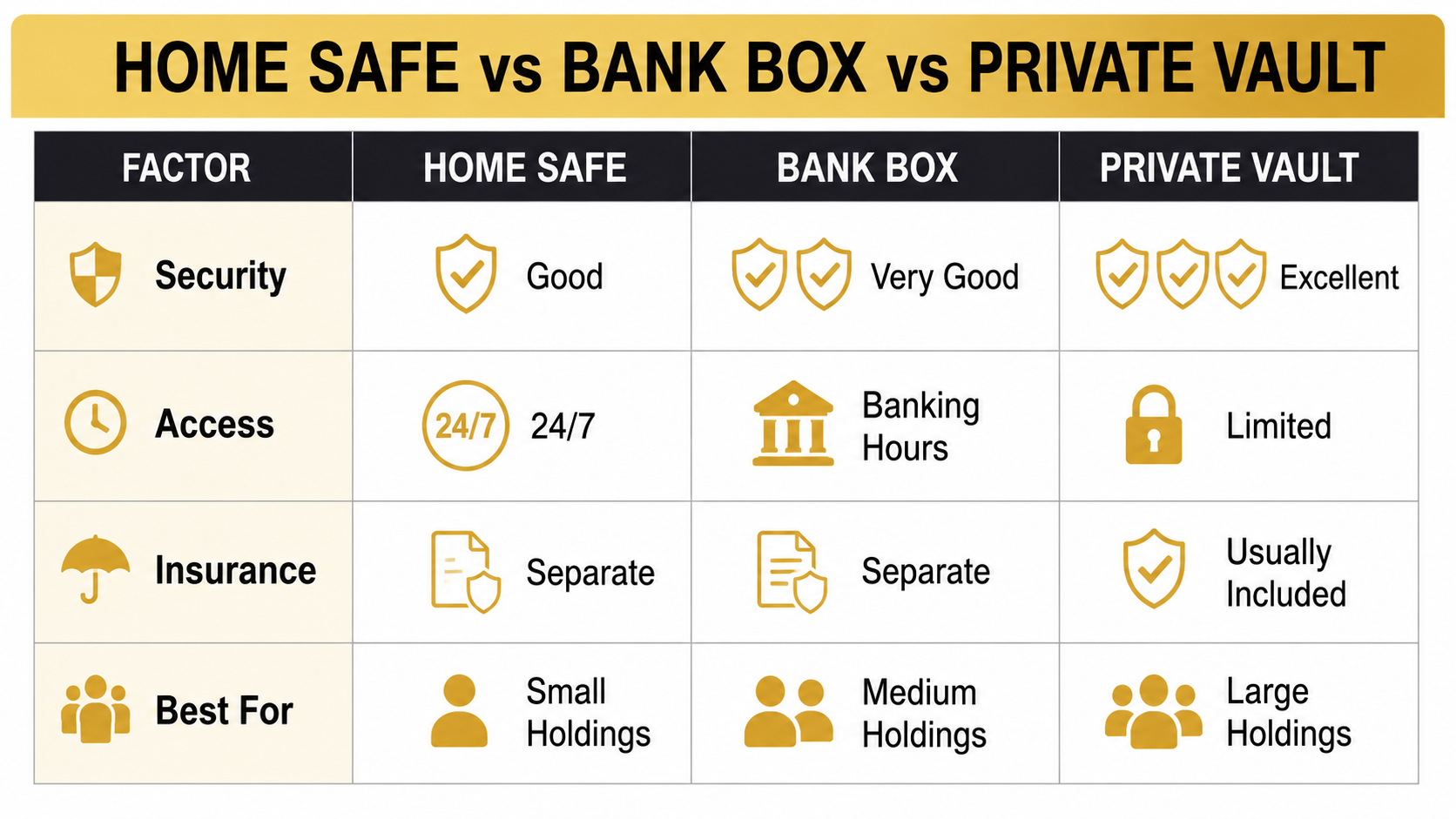
Before we examine each storage method in any detail, here’s a quick comparison of the three most common ways investors store gold.
Best Storage Method for Different Portfolio Sizes
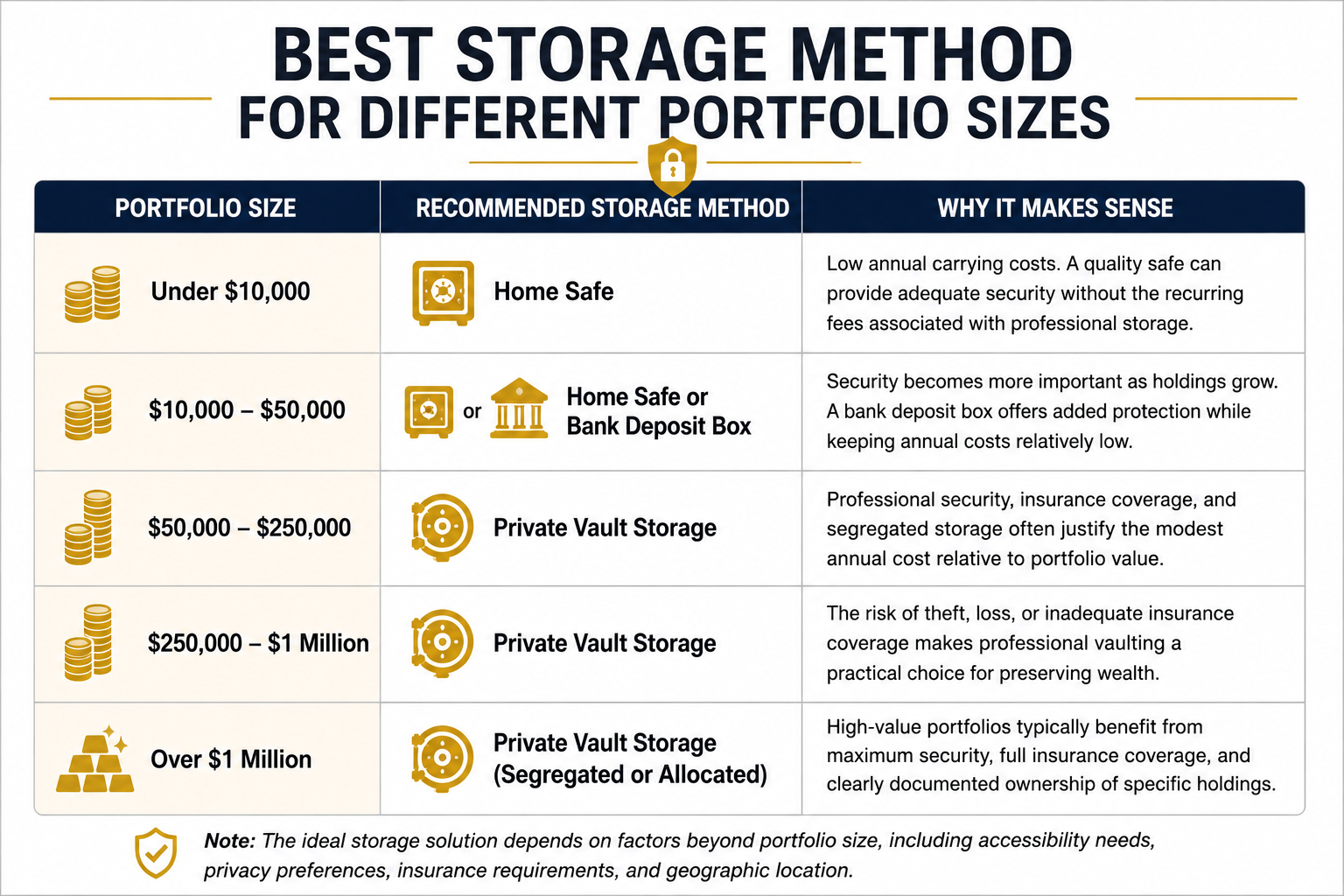
Choosing the best storage method for your gold and precious metals can often depend on your portfolio size. Fees and storage needs differ between large and small gold holdings.
As a general rule, a home safe is the likely best choice for an investor storing less than $10,000 dollars worth of gold. That would amount to roughly two troy ounces of gold under current prices, which is very easy to store at home. It does not require a large amount of space to store and the insurance fees are lower.
However, holdings that range between $10,000 and $100,000 will often find that banks offer the most reasonable fees. Likewise, they usually offer enough store space for this quantity of bullion.
Anything exceeding $100,000 is often best secured in a private vault. This way, you can avoid higher insurance fees and ensure the maximal security available for your gold holdings.
Please note, however, that this assumes your priority is finding the lowest fees for your gold holdings. If your top concern is security or accessibility, that may make a different option better for your goals.
How Much Does It Cost to Store Gold in a Home Safe?
This seems like a straightforward question. However, as noted before, home storage safes can cost anywhere from a few hundred dollars to a few thousand. That begs the question: why is there such a huge cost spread for these safes?
The answer is that safes come with varying degrees of security. If all you want is a lockbox for a couple of gold coins, you can get away with paying $300-$400.
Other safes offer a much greater degree of protection.
For example, what happens if a natural disaster strikes your home? If a fire were to catch in your gold storage room, a standard lockbox would not be able to protect your gold assets. If a severe fire damages your coins, bars, packaging, or documentation, it may reduce their resale value and make them more difficult to sell.
Other disasters could happen depending on your location. If you live in an area prone to flooding, that could also pose a serious risk to your gold and precious metals.
That’s why several safes are designed to protect your assets from natural disasters. However, these safes cost significantly more than a standard lockbox.
Another factor to consider is what metals you are storing in your safe. Environmental factors like humidity and moisture can cause silver to tarnish. Silver investors benefit from safes that protect their silver from these environmental factors.
Safes that meet all these criteria come at substantially higher costs. It’s not uncommon to spend thousands of dollars for these securities.
An additional cost you may consider is precious metals insurance. Typically, precious metal insurance costs between 0.5% and 2% of the total asset value annually. So, if you were storing $10,000 worth of gold, you could expect to pay anywhere from $50 to $200 annually.
Home storage costs are the most flexible of any precious metal storage options. Ultimately, what you pay for this solution depends on your risk tolerance. If you are not concerned about theft, fires, natural disasters, or simple misplacement of your investment, you can spend nothing on home storage.
Or, if you want more comprehensive home security, you can spend as much as is feasible for your budget.
There are tradeoffs to this approach. On one hand, truly securing your gold at home could end up being the most expensive option. Even with all of that, your home remains a much less secure storage site than a bank safety deposit box or a third-party storage vault.
However, this approach also gives you free access to your precious metals. You do not have to contend with any counterparty risk when you store your precious metals at home.
How Much Does It Cost to Store Gold In a Bank Safety Box?
Bank safety deposit boxes are a nice middle ground between home safes and independent third-party vaults. They offer greater security than private residences can provide, they are often more local, and they are relatively inexpensive.
The cost range for these storage solutions has a more narrow spread. According to MyBankTracker, the fees range from $15-$350. Usually, these are flat rates.
There are additional costs to keep in mind when you store precious metals at a bank. The first thing to note is that banks require you to insure your precious metals holdings. As a result, you will be required to pay the fees of whatever insurance policy you choose.
The second thing to note are drill fees. Drill fees are not necessarily costs you are obligated to pay. However, many banks only produce one set of keys for a safety deposit box, which is then given to you. This way, bank staff cannot open the box and tamper with your holdings.
Drill fees come in if you lose that set of keys. When that happens, the bank will have to drill into your box to open it and grant you access to your holdings again.
Drill fees likewise vary between banks, but they tend to range between $125-$400. You may also have to pay a lost key fee, which typically ranges between $25-$50. Please note that if you request a drilling, it is unlikely that it will happen on the same day you request it. Banks must hire an outside locksmith and have a branch manager present for the opening, which often causes delays.
Once again, there are a few factors that investors should consider before they store their precious metals in these places. First, the sizes of these can vary greatly.
MyBankTracker found that safe deposit boxes from branches at the top 20 U.S. banks could be as small as 1-inch by 5-inch or as large as 10-inches by 24-inches.
Another factor to consider is your location. Banks in larger cities tend to charge higher storage fees for precious metals than banks in other areas. So, for example, you will likely pay more to store precious metals in a New York City bank than you will in Spartanburg, South Carolina.
Finally, there is ease of access. Banks often have more immediate access than independent vaults. However, they also generally limit your access to bank business hours.
How Much Does It Cost to Store Gold in a Private Vault?
Renting a private vault for precious metals typically comes with percentage fees. Often, those fees range between 0.12% and 1% of your portfolio’s total value per year of storage. For smaller holdings, expect monthly minimums ranging from $10 to $25.
This usually includes full insurance coverage, which is often difficult to get through standard homeowners insurance.
Professional vaults often use a sliding scale percentage based on the market value of the metals you are storing in the vault. Gold, platinum, and palladium usually range from 0.30% to 0.70% per year.
Silver, to the surprise of some, usually costs a little more. It ranges from 0.50% to 1.00% annually. The reason for the higher cost is that silver has a higher bulk-to-value ratio.
Very small holdings may pay a flat rate instead of a percentage.
In many ways, private vaults are the simplest storage solution. They are large enough that they can store precious metals holdings of nearly any size. That makes them better for large precious metals stacks than many small security deposit boxes.
They also cover insurance costs, which saves you additional insurance premiums. They are highly secure facilities that are incredibly unlikely to fall prey to theft, fire, or other hazards.
However, there are some disadvantages to these facilities. Small precious metals holdings could make these vaults seem too expensive for their benefits. Paying hundreds of dollars a year to store a small amount of precious metals may seem too much when a home safe could store it just as well.
Another disadvantage that these facilities have is reduced access to precious metals. When you store your metals in a professional vault, it is much harder to access them than from a home safe or bank security deposit box.
Example: The Cost of Storing $50,000 in Gold
Here is a table comparing the cost of storing $50,000 in gold. This is an example scenario that compares average fees from these three storage methods. Costs may vary depending on which company you choose and your location.
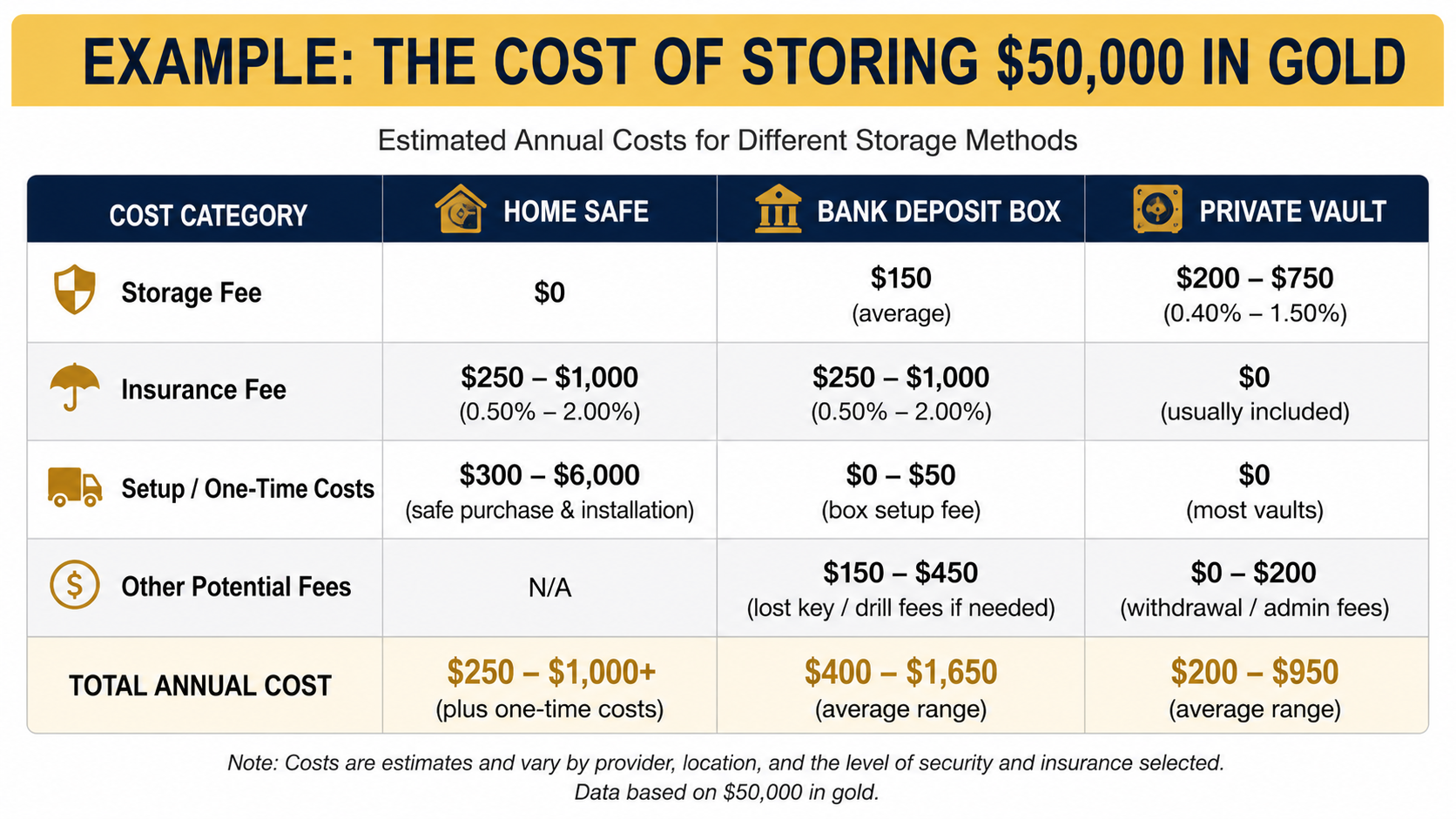
As you can see from this table, a bank deposit box is often the lowest-cost solution for this type of gold holding. However, investors who prioritize maximum security and insurance coverage may find that a private vault suits them better despite the higher annual fee. Home safes offer unmatched access to your gold holdings, but generally require the largest upfront investment.
Hidden Costs of Gold Storage
When investors compare gold storage options, they often focus on the advertised price. However, there are several additional expenses that can increase the true cost of storing precious metals.
For home storage, installation costs can add significantly to the price of a safe. A heavy-duty safe may require professional delivery, anchoring, or placement in a reinforced area of the home. Some investors also enhance their home security systems with alarms, cameras, or monitoring services, all of which add to the total cost of storage.
Insurance is another expense that is easy to overlook. Standard homeowners insurance policies often provide limited coverage for precious metals. As a result, many investors purchase separate riders or specialized insurance policies to insure their precious metal holdings.
Bank safety deposit boxes can come with unexpected fees as well. If you lose the key to your box, the bank may charge a lost key fee and require the box to be drilled open. Depending on the institution, these costs can total several hundred dollars.
Private vaults are generally straightforward, but investors should still review fee schedules carefully. Some facilities charge additional fees for withdrawals, shipments, or special handling requests. These costs may not matter for long-term investors, but they can add up for those who access their holdings frequently.
Transportation is another often-overlooked expense. Whether you are moving metals to a bank, delivering them to a vault, or transporting them after a purchase, shipping and security costs can increase your overall storage expenses.
The bottom line is that the advertised storage fee rarely tells the whole story. Before choosing a storage method, investors should consider all associated costs to determine which option truly offers the best value.
How To Choose a Storage Method
It’s perfectly fair to ask, “how much does it cost to store gold?” However, that is only one part of the equation.
When you choose a gold storage method, you also have to decide whether the storage method is worth its cost. To do that, you must decide on your priorities.
Is it more important to you that you have access to your precious metals at any time? Do you have a smaller stack that does not need a large storage area? If so, you may find home storage makes the most sense for your budget and your priorities.
If you want heightened security and a chance to grow your stack without needing to purchase a large safe, bank security deposit boxes make a great deal of sense. They provide a mix of heightened security and quick access to your precious metals.
Finally, if you are interested in consistently growing your gold holdings, want maximum security, and are willing to wait to access your metals, storage vaults are the best bet. They provide competitive fees for investors and top-notch security.
Gold storage isn't just about finding the cheapest option. It's about balancing security, accessibility, and cost. The best storage solution is the one that protects your investment without creating unnecessary expenses or risks.
About the Creator
Sound Money
Sound Money Reform
The Sound Money Defense League advocates for restoring gold and silver as constitutional money through grassroots activism, policy reform, and public education on the risks of fiat currency and the benefits of sound money.
Enjoyed the story? Support the Creator.
Subscribe for free to receive all their stories in your feed.
Comments
There are no comments for this story
Be the first to respond and start the conversation.