
Gold Just Smashed $4,700 – Why Smart Money Is Holding Fire
A Treasury buyback, a $40 trillion debt milestone, and a quiet shift in central‑bank buying have rewritten the rules. But at this price, even the bulls are hesitating.
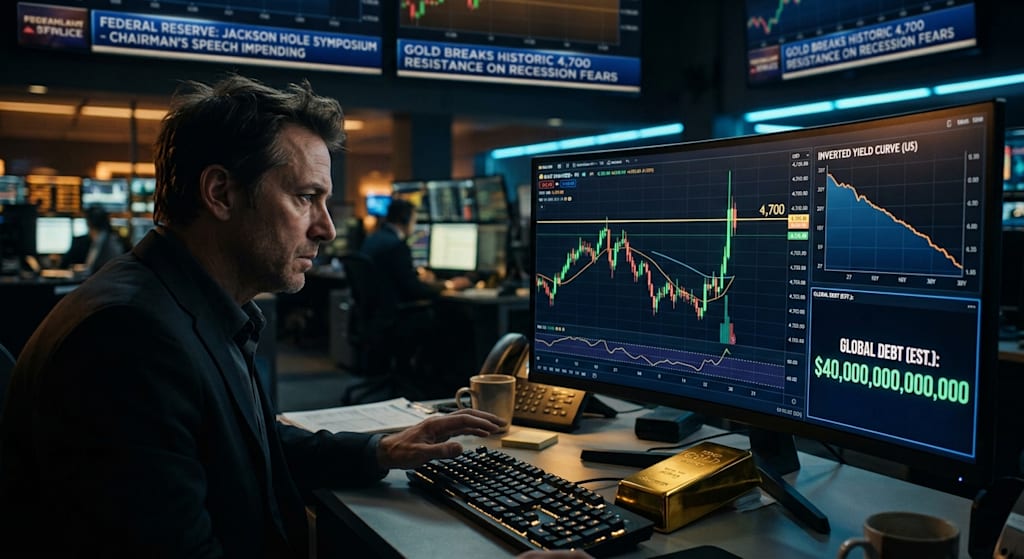
At New York midday on August 24, the COMEX gold futures front-month contract touched $4,713.8 an ounce. A rates trader at an asset manager saw the candle print on his terminal and did three things: covered the 30-year Treasury short he had built the previous week, bought an August-expiry gold call with a $4,750 strike, and fired off an instant message to risk control—"stop-loss moved up to 4,680."
He did not add to his position.
That is probably the most honest reflection of this market: bullish on direction, but hesitant at this level.
Gold's last close below $4,000 was June 30. Since then, it has rallied more than 16 percent. If you had to pin the August 24 breakout on a single trigger, the most direct one was the U.S. Treasury's long-dated buyback operation—on August 19, Treasury Secretary Bessent announced that the liquidity support repurchase program for 10- to 30-year bonds would double from $2 billion per operation to $4 billion, effective September 9. Subsequent market chatter suggested the Treasury was considering using its roughly $1 trillion TGA account to fund the buybacks on an ongoing basis.
The news sent the 30-year Treasury yield lower by about 9 basis points from its 5.34 percent peak. The dollar index weakened in tandem, falling 0.86 percent on the day.
Gold is most sensitive to a combination of falling nominal rates and a weaker dollar. The math is not complicated.
But attributing the $4,700 breakout solely to a single fiscal operation would miss too much.
Something else happened on August 19. The U.S. Treasury's outstanding debt crossed $40 trillion that day. The number appeared on the Treasury's daily statement—no press release, no official remarks, just a line of data.
The market noticed.
Nanhua Futures' analyst wrote in their weekly report: "The buyback operation reflects market concerns about the sustainability of Treasury debt servicing capacity and U.S. fiscal balances." The judgment was not complicated—an operation interpreted as "official intervention in long-end rates" happened to coincide with the week the debt crossed a round-number threshold. Two things appeared at the same time, and the market made the connection itself.
Huaxi Securities framed the core drivers of this gold bull market as "a four-factor共振"—weakening dollar credit, U.S. debt expansion, geopolitical risk, and central bank buying. That summary works in a research note, but the trader's version was more concrete: federal interest payments already exceed 20 percent of fiscal revenue, and roughly $3 trillion in short-term debt needs to be refinanced between 2027 and 2028.
Those numbers sit on the screen. Nobody needs to summarize "what this means."
On page 17 of the World Gold Council's second-quarter report, one line of data got circled in highlighter by quite a few macro fund analysts: global central banks bought a net 288.9 tonnes of gold in Q2, up 411 percent quarter-on-quarter. That is an all-time high for a second quarter. The same report noted that 89 percent of reserve managers surveyed expect global central bank gold reserves to continue rising over the next 12 months.
The People's Bank of China has now added gold for 21 consecutive months through July. This type of buying shares several common traits: price-insensitive, not prone to chasing or panic-selling, and prioritizing delivery dates over execution prices. In mid-August, one Asian central bank inquired on about three tonnes of gold through the London over-the-counter market—the trader later recalled that the other side's questions focused on "when is the earliest you can deliver," not "how much cheaper can you go."
With this kind of buyer in the room, gold's floor tends to sit a bit firmer than where technical support lines are drawn.
ETF money is also flowing back. SPDR Gold Trust holdings increased 2.31 percent last week, the largest weekly gain since October 2025. That suggests macro funds are rotating gold from "tactical allocation" back into "core positioning."
Mainstream investment banks are broadly bullish on their price targets. JPMorgan sees $6,000 by year-end with an average around $5,243; Citi raised its three-month target to $4,800 and looks for $5,000–$6,000 over 12 months; Goldman Sachs thinks its original $4,900 year-end target now looks conservative; Wells Fargo and Deutsche Bank both park their year-end ranges near $4,900–$5,100; UBS sees $5,400 over 12 months; Caitong Securities believes the medium-term can reach $6,000.
Taken together, the direction is consistent, but the spread is not trivial. The trader's stance: I believe the direction, but at $4,700, I am not putting the same size on that I would at $4,500.
The near-term problem is that gold has rallied more than 15 percent from its June low, and the RSI on technicals has entered overbought territory. There is decent resistance near $4,700, and profit-taking is accumulating.
On the two-week calendar ahead, several potential volatility triggers stand out. At the Jackson Hole symposium on August 28, Fed Chair Warsh will deliver his first keynote since taking office. The July FOMC meeting held rates steady by a 9–3 vote, with three hawkish members arguing for a 25-basis-point hike. If Warsh sounds hawkish, or if the upcoming July PCE data overshoots, gold could quickly give back some of its gains.
The bigger tail risk comes from the energy side. If Middle East tensions push oil prices higher again, an inflation rebound could force the Fed to maintain a hawkish posture or even restart hiking. In Goldman's extreme scenario, if the Fed hikes within the year, gold could retreat toward $4,400.
Ahead of Jackson Hole, implied volatility on gold options has already risen from 18 percent last week to 26 percent. The options market is pricing in roughly an ±$80 trading range. Market consensus on direction does not seem to have much disagreement, but on the roughness of the ride, the market has made more ample preparations.
After the closing bell that day, the rates trader did not shut down his computer immediately. He moved his stop-loss on the gold position from $4,580 up to $4,680, then sent a position adjustment request to compliance—an application to temporarily raise the ceiling on gold as a percentage of total assets from 8 percent to 10 percent.
Compliance's auto-reply popped up: "Your request has entered the review queue. Estimated processing time: 2–3 business days."
He glanced at 4,713.80 on the screen and turned off his terminal.
About the Creator
Jin
Writer of reamstories
https://reamstories.com/jin
Enjoyed the story? Support the Creator.
Subscribe for free to receive all their stories in your feed. You could also become a paid subscriber, letting them know you appreciate their work.
Comments
There are no comments for this story
Be the first to respond and start the conversation.