
Funded Perps at Crypto Prop Firms: The Rules Behind Every Trade
How perpetual funding, trading costs, drawdown limits, and payout rules shape a funded trading account.


A trader opens a Bitcoin perpetual position and watches the price move in the expected direction. The chart looks right. The trade is not over.
While the position remains open, funding may be charged or credited. Trading fees affect the result. At the same time, the prop firm’s loss limits continue to apply, and unrealized losses may count toward an account breach depending on the program.
That is the part a funded perps account headline cannot explain on its own. A perpetual position follows the mechanics of its market, but a trader at a crypto prop firm also operates inside a separate rulebook. Understanding both is what turns an advertised account size into a usable trading plan.
This guide explains how funded perps work, what determines the room available to trade, and which costs and conditions deserve attention before a position is opened.

What Are Funded Perps at a Crypto Prop Firm?
Funded perps are perpetual derivative positions traded within an account provided by a proprietary trading program. Traders may pay for an evaluation or another account model and must follow the firm’s rules. The account may be simulated, and payout eligibility depends on the provider’s terms.
A perpetual contract allows a trader to take a position on an asset’s price without the contract having a fixed expiration date. A crypto prop firm adds another layer: the account rules that determine how the position can be traded and whether the trader remains eligible for a payout.
What “Funded” Means in a Prop Trading Account
The word funded describes a stage in a provider’s program, but it does not always describe the same trading environment.
Some firms use simulated accounts for evaluations and for the funded stage. In that arrangement, the trader’s performance is measured in a simulated environment, while eligible payouts are handled according to the firm’s terms. Other providers may use different arrangements.
For example, one futures prop provider explicitly describes both its evaluation and funded accounts as simulated. That example does not establish how every crypto prop firm operates; it shows why the account agreement matters.
The Difference Between Account Size and Withdrawable Funds
An advertised account size is not necessarily a sum of money the trader owns or can withdraw. It may be a notional balance used to calculate position limits and account performance.
The amount available to withdraw, if any, depends on eligible profits, the profit split, fees, and payout conditions. The account’s permitted loss is governed separately by its drawdown and daily loss rules.

How Does a Funded Perps Account Work?
A funded perps account usually begins with a program selection and, in many cases, an evaluation. The trader must satisfy the provider’s requirements before moving to the funded stage. After that, trading and payout eligibility remain subject to the funded account’s rules.
From Evaluation to Funded Stage Eligibility
A typical process looks like this:
Choose a program. Review the markets, costs, account model, and rules before paying.
Start the evaluation, if required. The account may have a profit target and defined risk limits.
Meet the requirements. Reach the target, if applicable, without breaching the program’s rules.
Complete the provider’s review. The firm may check trading activity and rule compliance before granting access to the next stage.
Trade under funded stage conditions. Request a payout only after meeting the applicable requirements.
The sequence varies. Some programs advertise an instant funded model rather than a conventional evaluation. “Instant” does not mean unrestricted: the account may still have drawdown limits, trading restrictions, and payout conditions.
Simulated and Live Account Models
Before purchasing an account, check how the provider describes each stage. An evaluation can be simulated even when its prices reference live market data. A funded stage can also be simulated, depending on the provider.
The distinction matters because it affects what the balance represents and how orders are handled. Look for clear answers in the agreement, risk disclosure, or support documentation rather than assuming that “funded” means a live brokerage account.
Perpetual Contracts vs Traditional Futures: What Changes?
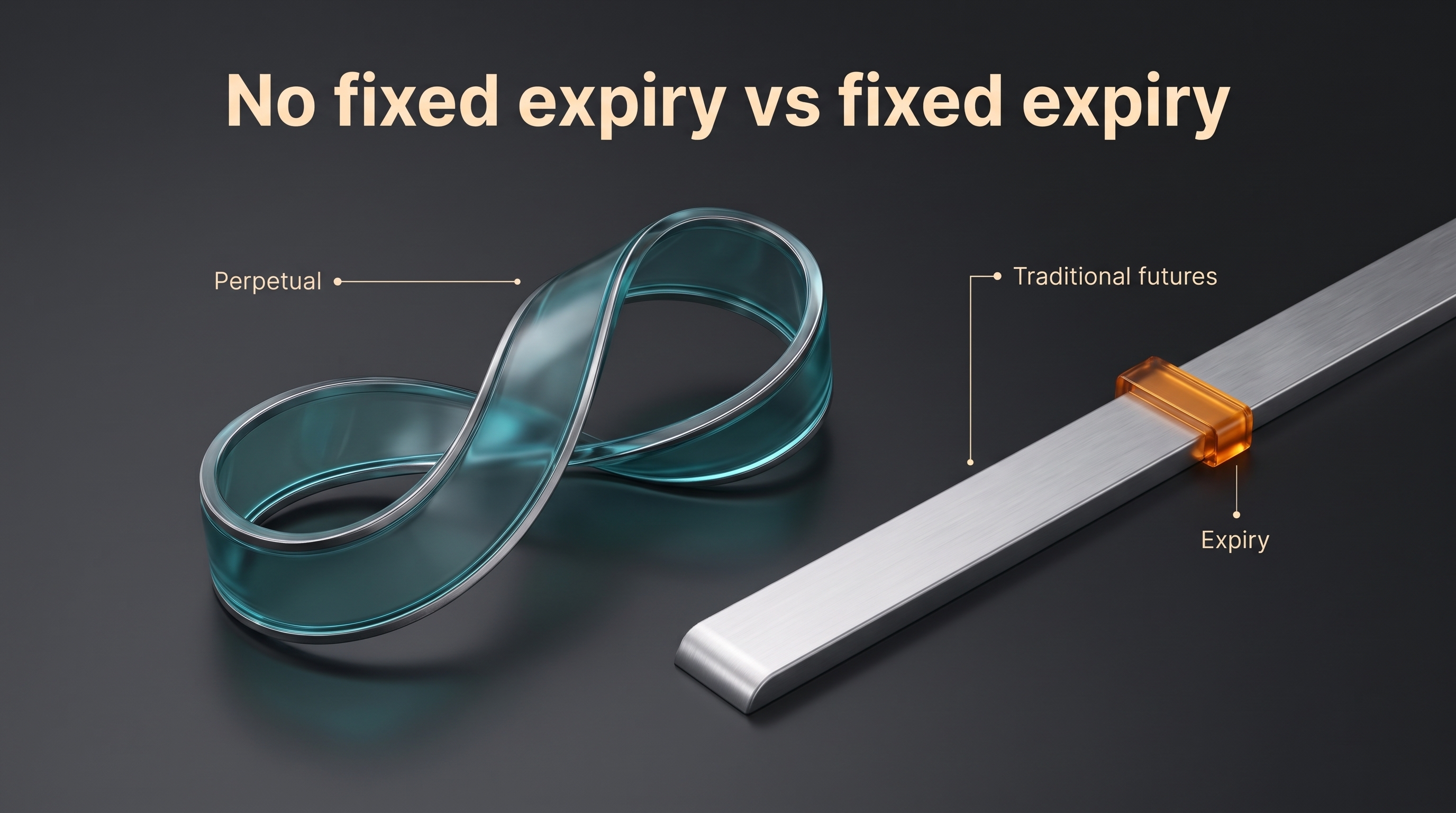
Perpetual contracts and traditional futures are both derivatives, but a perpetual contract has no fixed expiration date. Traditional futures have a defined expiry or settlement schedule. Perpetuals commonly use funding mechanisms intended to help keep their price aligned with a reference market.
Expiration, Settlement, and Position Duration
A trader holding a traditional futures contract must account for its expiry and settlement terms. Maintaining exposure beyond expiry may require moving to another contract, often called rolling the position.
A perpetual contract does not have that fixed expiry. Without an expiry date, the contract does not end on a preset day. The position can nevertheless be closed or affected by margin requirements, platform conditions, or the prop firm’s rules.
That does not mean it can be held indefinitely without cost or risk.
Fixed Expiration
Perpetual Contract: No fixed expiration.
Traditional Futures Contract: Yes, has a fixed expiration date.
Continued Exposure
Perpetual Contract: Allows continued exposure, subject to margin and account rules.
Traditional Futures Contract: May require rolling to another contract to maintain exposure.
Price Alignment
Perpetual Contract: Often uses a funding mechanism to keep its price aligned with the underlying asset.
Traditional Futures Contract: Price alignment is influenced by contract pricing and settlement mechanisms.
Ownership
Perpetual Contract: Generally does not provide direct ownership of the underlying asset.
Traditional Futures Contract: Depends on the contract and its settlement terms.
Funding Payments and Other Trading Costs
Funding is separate from the fee charged to open or close a trade. A funding adjustment can work in either direction: it may reduce the position’s result or add to it. The outcome depends on the applicable rate, the side of the trade, and how the provider applies the adjustment.
The timing is not universal. For example, some perpetual products quote funding as an eight-hour rate, even though it accrues continuously. Other products follow different schedules. Prop traders should check how each provider calculates and applies funding rather than relying on a general rule.
How Much Room Do You Really Have to Trade?
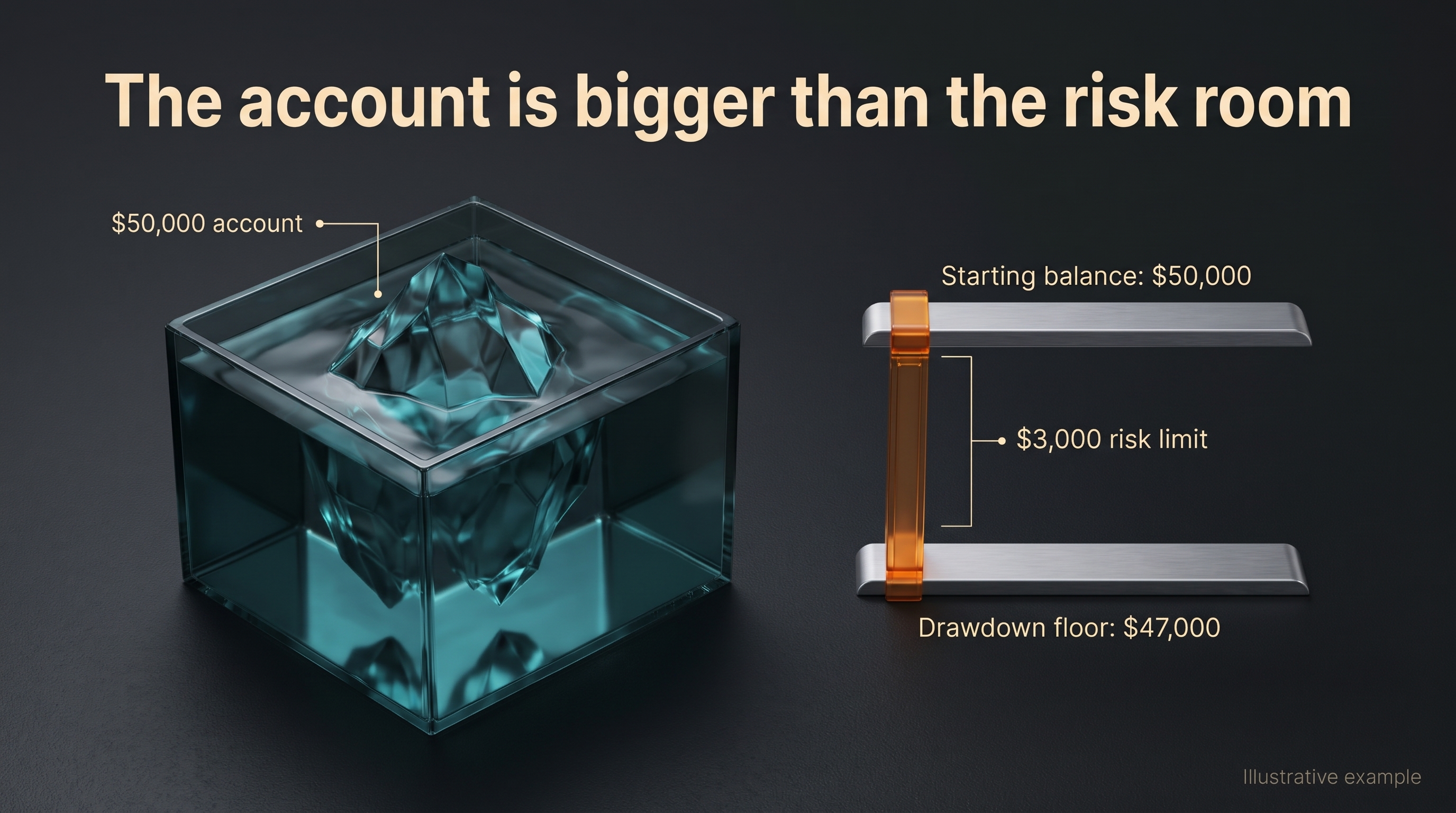
The usable risk room in a funded perps account is determined by its loss limits, not simply by the advertised balance. Daily loss rules, maximum drawdown, open position losses, and fees can interact. The exact calculation depends on the provider’s terms.
Consider a hypothetical $50,000 account with a 6% static maximum drawdown. If the floor is calculated from the initial balance and remains fixed, the total loss boundary is $3,000 below the starting balance, or $47,000.
That does not mean the trader can withdraw $50,000, nor does it guarantee that the full $3,000 can be risked in one trade. A daily limit or another rule may constrain the account sooner.
This example is illustrative. Actual rules and breach calculations vary.
Daily Loss Limits vs Maximum Drawdown
A daily loss limit defines a loss boundary for a specified trading day. A maximum drawdown defines an overall account boundary.
The details matter. A provider may include some combination of realized losses, unrealized losses, commissions, or funding in its calculation. It may also define the start of a new trading day using a particular time zone and reset time.
A position held across the reset can therefore affect the next day’s available room. Read the formula in the current rulebook, not only the percentage in the account overview.
Static vs Trailing Drawdown
A static drawdown floor remains fixed according to the provider’s definition. A trailing floor can move upward as the account reaches new balance or equity highs.
Two accounts can advertise the same maximum drawdown percentage but behave differently after a profitable trade. If one floor trails an equity high, for example, an open profit may affect the boundary before the position is closed. Other programs use different methods or stop the floor from moving at a specified level.
The useful question is not just “What is the drawdown?” but “What makes the floor move, and when?”
Balance, Equity, and Unrealized Losses
Balance generally reflects completed account transactions. Equity generally reflects balance together with the current result of open positions, subject to the platform’s calculation.
If a firm measures a limit using equity, a position can put the account near a breach before the trader closes it. Fees and funding may also affect the calculation. Traders should confirm which price and account values the provider uses.
What Costs Affect a Funded Perps Trade?
The cost of funded perps can include the program fee, transaction fees, spread, slippage, funding, and payout related charges. Some apply before a trader reaches the funded stage; others affect each trade or the amount ultimately received.
Evaluation, Reset, and Account Fees
An evaluation fee pays for access to a provider’s program; it is not necessarily a deposit into a personal trading account. Depending on the provider, there may also be reset fees, recurring charges, activation fees, or paid add ons.
A low advertised entry price is only one part of the cost. Repeated attempts can change the total paid before a trader becomes payout eligible. Check whether an evaluation fee is refundable and under what conditions, rather than assuming it will be returned.
Trading Fees, Spread, and Slippage
Trading fees may be charged when entering and exiting a position. The rate may depend on the order type or market.
The spread is the difference between available buy and sell prices. Slippage is the difference between the price expected and the price at which an order is filled. Both can matter when markets are volatile or liquidity is limited.
A strategy that targets small price moves may be especially sensitive to transaction costs. The published commission is therefore only one part of the execution picture.
Funding Payments
Funding can increase or reduce a position’s net result. Whether the trader pays or receives it depends on the rate and the position’s direction, as well as how the prop firm applies the mechanism.
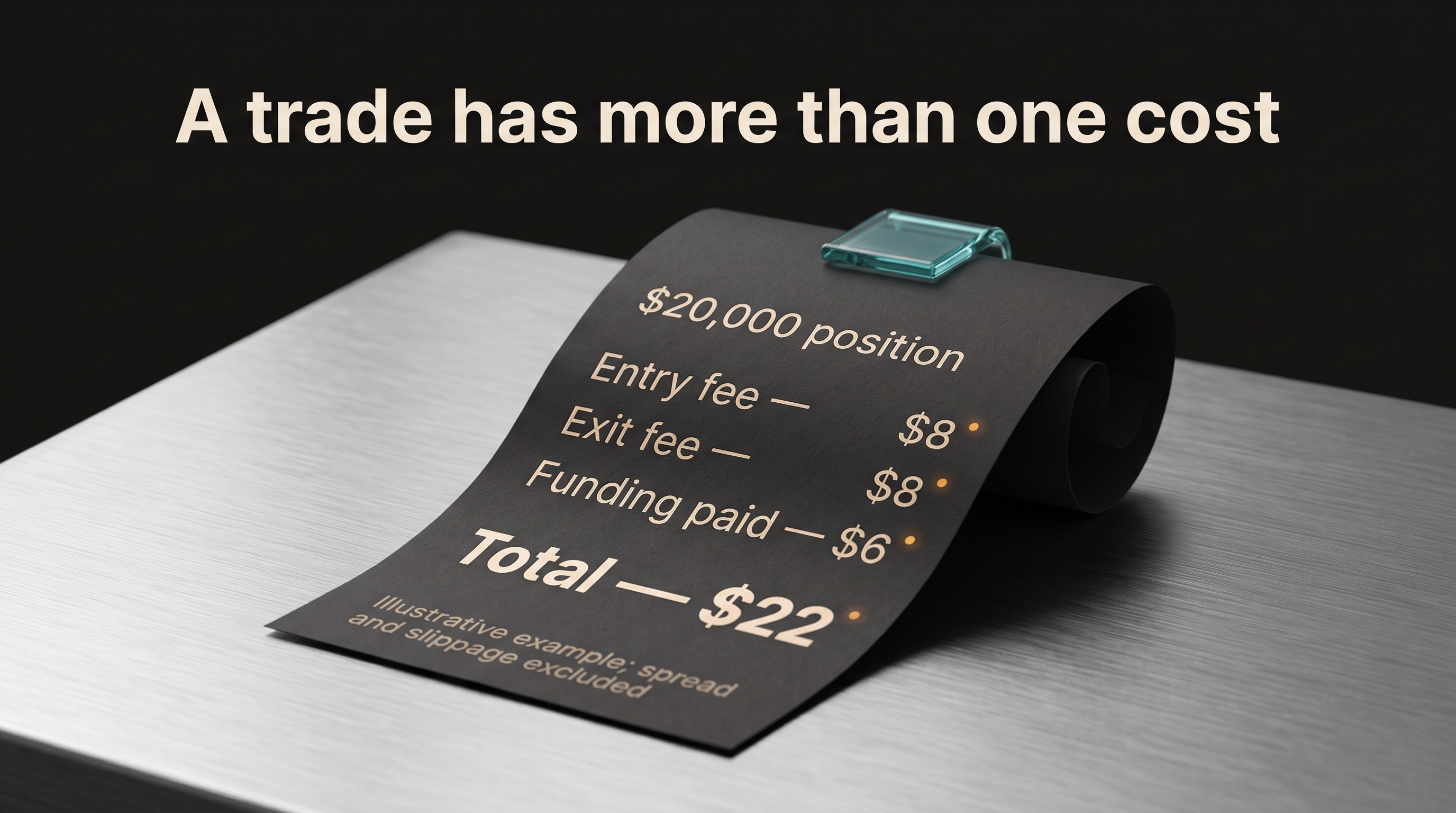
For illustration, assume a $20,000 notional position and the following hypothetical charges:
Illustrative Trading Cost Breakdown
Entry Fee
Assumption: 0.04%
Amount: $8
Exit Fee
Assumption: 0.04%
Amount: $8
Funding
Assumption: 0.01% paid at each of three settlements
Amount: $6
Illustrative Total
Excludes spread and slippage.
Total: $22
The funding rate in this example stays constant solely to make the arithmetic clear. Actual rates can change, the number or timing of settlements can differ, and funding may be credited rather than charged.
Payout Fees and Profit Split
The profit split determines the share of eligible profit assigned to the trader. It should be read alongside minimum payout amounts, withdrawal fees, network costs, payout caps, and eligibility rules.
For example, a headline split does not tell the whole story if a trader must also satisfy a consistency requirement or wait for a specific payout window. Compare the complete payout process, not just its largest percentage.

Which Markets Can You Trade With Funded Perps?
A funded account’s market list is defined by the program behind it, so access to Bitcoin perps does not necessarily mean access to currencies, stocks, or commodities. Some funded perps programs focus on crypto assets, while others offer perpetual style products linked to currencies, stocks, commodities, or indices. Availability and contract specifications should be verified for each instrument.
Crypto Perpetuals: Bitcoin, Ethereum, and Altcoins
Major crypto markets such as Bitcoin and Ethereum are common points of reference in perpetual trading. Some platforms also offer altcoin or memecoin contracts, although the available instruments and liquidity can vary substantially.
A broader list of markets is not automatically a better fit. A trader should check the actual spread, leverage limit, funding treatment, and position restrictions for the assets in their strategy.
Forex, Stock, Commodity, and Index Perpetuals
Some providers offer perpetual or perpetual style exposure to non crypto markets. These products may track an underlying reference market without giving the trader ownership of the underlying currency, share, or commodity.
The underlying market’s trading sessions and events can matter even if a platform displays a product outside conventional market hours. Earnings announcements, economic releases, market closures, and changes in liquidity may all affect pricing conditions.
Why Contract Specifications Matter Across Markets
A single account may apply different leverage and exposure limits to different instruments. Funding, trading hours, price sources, and restrictions can also differ.
Before trading an unfamiliar market, check:
What asset or index the contract references.
How the price is calculated.
When the product is available to trade.
What leverage and position limits apply.
How funding, fees, and account losses are calculated.
The label “perp” does not make every product operationally identical.

How Do Market Data and Execution Affect Funded Perps?
Market data determines which prices a platform displays or references, while execution determines how an order is filled. A funded perps account may use exchange derived data without placing the trader’s order directly on that exchange. Traders should check both the price source and the account’s execution model.
Charting Interface vs Market Data Source
A familiar charting interface can make analysis easier, but the chart’s appearance does not by itself identify the source of the displayed prices.
A provider may use a third party charting interface while obtaining market data from an exchange, another vendor, or its own pricing system. It may also calculate account risk using a different price, such as a mark or reference price.
Those distinctions can matter when a chart appears to touch a level but an order is filled differently, or when a risk limit is evaluated using a price other than the one a trader was watching.
Execution, Slippage, and Reference Prices
Ask how orders are handled in the account environment. In a simulated account, displayed fills may be generated according to the provider’s simulation rules rather than sent to a live exchange.
Check how the platform handles spread, slippage, partial fills, and volatile conditions. Also check which price is used for liquidation and which value the prop firm uses to calculate a rule breach. A liquidation event and an account rule breach are different mechanisms; either may affect a position depending on the program.
What Happens After You Pass a Funded Perps Evaluation?
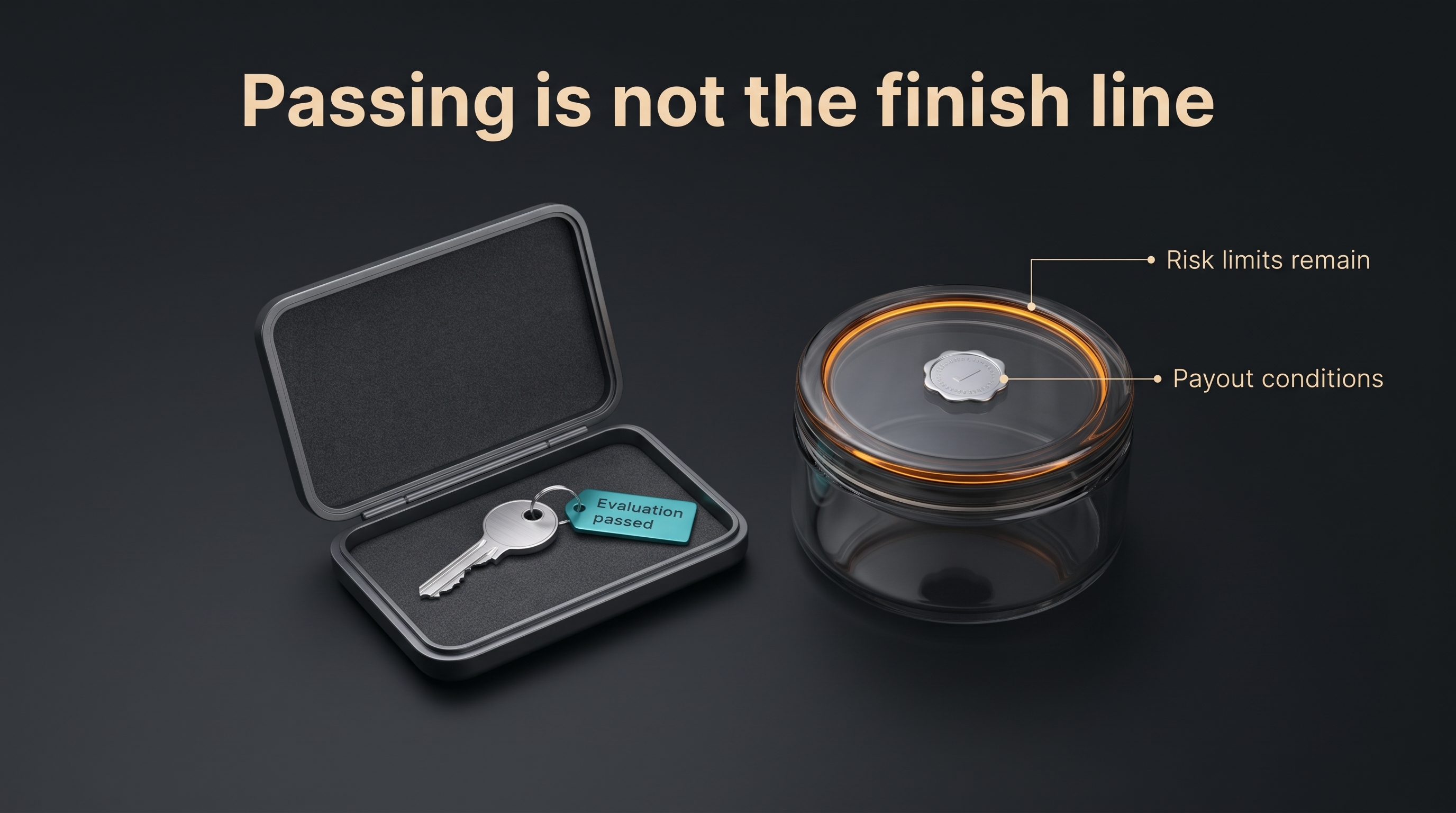
After a trader passes an evaluation, the provider may review the account before granting access to the funded stage. The trader then operates under that stage’s rules and may request a payout after meeting the firm’s eligibility requirements. Whether the account is live or simulated depends on the provider.
Funded Stage Rules and Account Status
Passing an evaluation does not necessarily remove risk limits. The funded stage may retain daily loss and drawdown rules, introduce a different calculation, or apply additional restrictions.
The objective also changes. During an evaluation, the trader may be working toward a defined target. In the funded stage, the focus can shift toward maintaining compliance and meeting payout conditions.
Before placing a trade, read the funded stage terms independently of the evaluation terms. A rule that applied during the challenge should not be assumed to remain unchanged.
Profit Splits and Payout Eligibility
A positive account result does not automatically mean an immediate payout is available. Depending on the provider, eligibility may depend on:
A minimum amount of eligible profit.
A specified number of qualifying trading days.
A payout window or waiting period.
Consistency or concentration rules.
A maximum payout amount.
Identity verification or other account requirements.
The profit split applies according to the provider’s definition of eligible profit. Review the payment method and any associated fees as well.

How to Choose a Crypto Prop Firm for Funded Perps
Choosing a crypto prop firm for funded perps means comparing the account’s rules with the strategy being traded. The most useful review covers the account model, supported markets, risk limits, costs, execution, restrictions, and payout terms, not just the advertised balance or leverage.
Compare Account Rules and Supported Markets
Start with the instrument and trading style you actually use. Confirm that the market is available and that its leverage, hours, and position limits fit the intended approach.
Then examine the account’s daily loss and maximum drawdown rules. A trader holding positions for several days may need to understand funding and equity based limits differently from a trader who usually closes positions within minutes.
There is no single rule set that fits every strategy.
Check Costs, Execution, and Strategy Restrictions
Compare the evaluation fee with potential reset or recurring costs. For trading, look at commissions, spread, slippage, and funding together.
Also read the restrictions. Rules on automated trading, news events, account sharing, hedging, or other practices vary. A method accepted by one provider may be limited by another. If an important term is unclear, treat it as unresolved until the provider explains it.
Read the Funded Stage and Payout Terms
Finally, trace the path from passing the evaluation to requesting a payout:
Is the funded stage account simulated or live?
Do drawdown rules change after the evaluation?
What makes a trading day qualify?
Is there a consistency rule or payout cap?
What fees and payment methods apply?
Can the provider change the terms, and where are updates published?
A clear answer to each question is more useful than a large account size headline.

Are Funded Perps Worth It?
Funded perps may be worth considering for a trader whose strategy fits the provider’s risk limits, markets, and costs. They may be less suitable if fees or restrictive rules undermine that strategy. A funded account does not remove market risk or guarantee payouts.
Funded Perps vs Trading With Personal Capital
With personal capital, a trader generally chooses the account funding amount and retains the result after applicable costs, although the exchange or broker still imposes its own rules.
Initial Cost
Funded Perps Program: A program or evaluation fee may apply.
Personal Trading Account: The trader deposits personal capital.
Account Rules
Funded Perps Program: Rules are defined by the provider.
Personal Trading Account: Subject to platform and market rules.
Profit Share
Funded Perps Program: Eligible payouts may be split between the trader and provider.
Personal Trading Account: The trader generally retains the trading results after costs.
Loss Boundaries
Funded Perps Program: Provider-defined loss limits may apply.
Personal Trading Account: Depends on capital, margin, and platform rules.
Account Status
Funded Perps Program: May be simulated or live.
Personal Trading Account: Depends on the chosen account and provider.
A prop program introduces a different trade off. The trader may pay a program fee instead of depositing the full notional balance, but accepts the provider’s loss limits, restrictions, and profit sharing terms.When the Account Rules Fit, or Conflict With, Your Strategy
A funded perps program may fit a trader who understands the market, has a defined process, and can operate within the account’s limits without changing that process merely to reach a target.
It may be a poor fit if the strategy relies on holding periods, position sizes, markets, or execution conditions the program does not support. Repeated evaluation fees can also become a meaningful cost when the rules and strategy do not match.
The central question is not whether a funded account offers more impressive numbers. It is whether the contract mechanics, account rules, and total costs leave enough room for the strategy to operate as intended.
Disclaimer: Educational content only, not financial advice. Leveraged crypto trading involves significant risk. Program rules, fees, and account models vary by provider. All numerical examples are hypothetical and do not represent expected results.
About the Creator
Sophie
Trader focused on Price Action & Order Flow.
Into crypto, fast execution, controlled risk, and quality setups.
Passing funded accounts and refining my trading every day.
Enjoyed the story? Support the Creator.
Subscribe for free to receive all their stories in your feed.
Comments
There are no comments for this story
Be the first to respond and start the conversation.