
Discover Best Crypto Prop Trading Strategies for Funded Accounts
Key Tactics Every Crypto Trader Should Know


Crypto prop trading strategies are everywhere online, but very few of them survive real prop firm rules, drawdowns, and crypto volatility. In this article, I break down practical crypto prop firm strategies, risk filters, and mindset shifts that helped me pass evaluations and manage funded accounts without blowing them in a single bad week.
The Most Profitable Crypto Prop Strategies I Still Rely on in 2026
I’ve been actively trading crypto for more than seven years now. During this journey, I’ve passed some prop firm challenges, completely messed up a few early on, and gradually moved into trading in funded environments instead of just a small personal account.
Nearly everything I trade with today comes from real experience: blowing up accounts, learning from painful mistakes, testing different approaches, and slowly refining my crypto prop trading strategies through constant trial and adjustment.
I’ve traded through all kinds of brutal situations, those wild 3 a.m. Bitcoin wicks that liquidate overleveraged traders in seconds, sudden flash crashes that wipe out unprepared accounts in minutes, and countless stressful moments where I was one or two trades away from passing a challenge, only to watch it slip away.
After mentoring other traders trying to pass crypto prop firm evaluations, one thing became very clear to me: most traders don’t fail because they can’t read charts or find setups. They fail because their strategy simply isn’t built for the strict rules, drawdown limits, and psychological pressure of prop firm trading.
In this guide, I’m going to walk through how I think about building a prop firm ready trading approach, from the basic foundations of risk and execution up to a more structured strategy. I’ll also share one of the main approaches I rely on in 2026, a precision scalping style built on real market structure, and explain how I adapt it to crypto prop firm conditions rather than just casual spot trading.

What Crypto Prop Firms Actually Want From Your Strategy
Before getting into specific crypto prop trading strategies, it helps to be very clear about what prop firms are actually looking for. Most crypto prop firms have relatively similar and strict risk rules, for example:
- daily drawdown limits (often around 4-6%)
- maximum overall drawdown (usually in the 8-12% range, either static or trailing)
- profit targets (commonly 8–12% for evaluation phases)
- Restrictions on high risk methods, many prop firms discourage or ban things like martingale, aggressive grid trading, or very risky hedging approaches.
They don’t care how flashy your indicators look, how many hours you sit in front of the charts, or even how high your win rate appears on paper. What actually matters is whether your strategy shows:
- solid risk control,
- reasonably consistent results,
- the potential to scale to larger capital,
- and disciplined execution under pressure.
If your approach can’t operate inside those risk boundaries, you’re not really trading in a way that fits prop firm conditions, you’re just taking oversized risks with a bigger account.
Five Principles Behind My Crypto Prop Strategy
In my own trading, there are a few core principles I keep coming back to when I’m trading for or preparing for prop firm conditions. When I mentor traders, I usually start with these same ideas. If a strategy can’t pass all five, I don’t feel comfortable using it for a prop firm challenge.
Fixed and Measurable Risk Per Trade
Risk per trade has to be clear, consistent, and tied to a fixed percentage of the account, not to emotions or how strong a setup feels in the moment. This is the base layer that everything else sits on.
For funded accounts, I generally stay within ranges like:
- 0.25–0.5% per trade for high frequency scalping
- 0.5–0.75% for more typical intraday or swing trading
- Rarely going up to 1% only on rare, high conviction setups
Those numbers aren’t magic, but they make it much easier to stay within daily and overall drawdown limits, especially during rough patches.
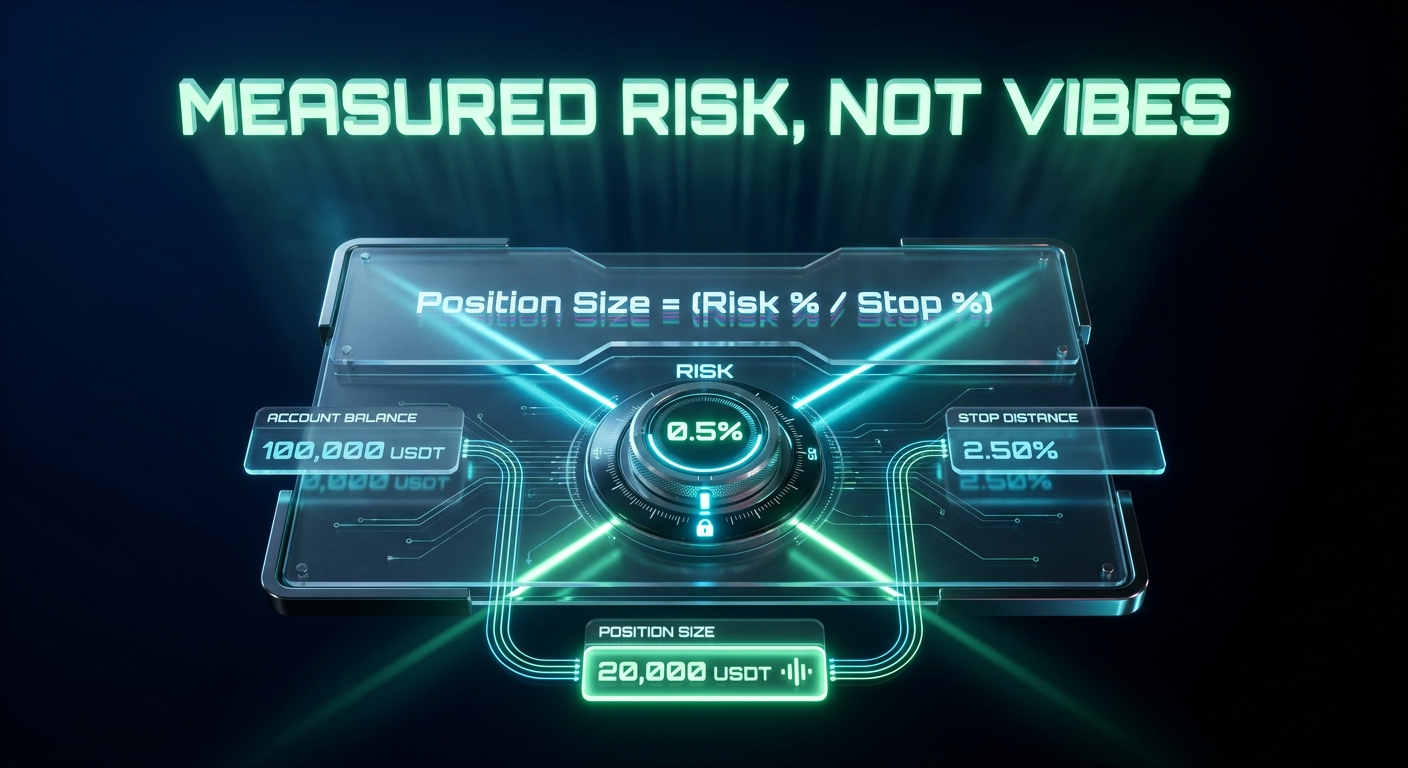
A Simple Position Sizing Formula:
Before every trade, I use a very simple position sizing formula:
Position Size = (Account Balance × Risk %) ÷ (Stop Loss Distance in %)
A quick example:
If you’re trading a $100,000 account and want to risk 0.5% (that’s $500) on a BTC setup with a 1% stop loss distance, the position size comes out to $50,000.
I like to write this number down in my journal or on my trading plan before I even open the position. The key for me is that I don’t increase size just because a setup feels strong. Sticking to that rule is a big part of what keeps me inside daily drawdown limits, even on days when the market really doesn’t cooperate.
A Realistic Risk to Reward Ratio
If you regularly risk $500 just to make $500 or less, you’re quietly putting yourself at a disadvantage over time, even if your win rate looks decent.
In prop trading environments, I try to avoid taking trades with a risk to reward below about 1:2, and I feel much more comfortable when a setup offers something closer to 1:2.5 or 1:3 and above.
That kind of structure matters because it gives you a bit of a cushion during losing streaks and makes it easier to reach profit targets without constantly pushing size or taking desperate trades.
In my own trading, I focus on approaches that, when tested properly, show an average reward that’s clearly larger than the average loss over a large enough sample of trades.
Back testing standard I Aim For:
I’m very cautious about risking real prop firm capital on a completely new strategy. Before I bring anything into a live challenge, I like to see it tested thoroughly across a meaningful number of trades, often several hundred, and ideally across different market conditions.
When I’m reviewing those tests, I pay attention to a few key things:
- The average risk to reward is generally at or above roughly 1:2–1:2.5
- The worst drawdown stays comfortably inside typical prop firm limits
- The overall expectancy remains positive after including spreads, commissions, and some realistic slippage
If a strategy can’t handle that level of testing, I treat it as something that still belongs in the experimental or demo phase rather than on a live prop firm account.

Built Around Daily & Max Drawdown Rules
Crypto prop firms usually enforce strict risk limits, for example, daily drawdown caps somewhere around 4–6% and maximum overall drawdown in the 8–12% range (either static or trailing). Because of that, I try to design my strategies from the ground up to sit comfortably inside those boundaries instead of fighting them.
In practice, that means I:
- Keep total open risk generally below about 2–3% at any one time.
- Avoid adding to losing positions just to average down.
- Use a personal rule: if I’m down roughly 2% on the day, I call it a day and stop trading instead of trying to win it back immediately.
This isn’t about being perfect; it’s about protecting the account when things are clearly out of sync.
I also like to stress test every strategy in my journal or back tests:
- What if I hit 5–7 losses in a row?
- What if volatility spikes suddenly?
If the worst case scenarios regularly break typical prop firm rules, I treat that as a sign that the strategy needs more work before I trust it with real prop capital.
Repeatable in Different Market Conditions
A prop friendly strategy shouldn’t only look good in a straight up bull market or in crazy high volatility weeks. It has to be usable across different environments: trending moves, choppy ranges, and those uncertain periods in between.
I don’t try to force one single setup to fit every possible condition, but I do rely on a consistent set of core ideas, things like market structure, liquidity, and order blocks, and then adapt how I apply them in bull, bear, and sideways markets.
I also pay attention to different sessions (London, New York, Asia), because crypto can behave very differently depending on who’s active.
From what I’ve seen, prop firms care a lot about this kind of repeatability. They want traders who can survive and still perform reasonably well across changing conditions, not just when Bitcoin is trending hard in one direction.

Zero Dependence on Luck, News, or Social Media
If your edge disappears the moment you close Twitter or Telegram, it’s probably not a real trading edge.
For prop trading, I’ve found that the most reliable strategies are built on clear, mechanical rules that can be explained simply and that show a positive expectancy over a large sample of trades, not just during one lucky week.
One personal filter I use is straight forward: if I can’t explain why I’m taking a trade in one clear sentence, I skip it.
A trade explanation that passes this test might sound something like:
“I’m buying a liquidity sweep into a strong order block after a confirmed break of structure, targeting the next obvious liquidity pool.”
By contrast, something like this doesn’t qualify as a valid reason on its own:
“Everyone on Crypto Twitter is bullish and it feels like it’s going up.”
Most prop firms are understandably cautious about strategies that lean heavily on hype, celebrity tweets, meme coin frenzies, or random news headlines. Those things can move price in the short term, but they’re very hard to build a consistent, rule based edge around, especially under strict risk limits.
Building a Crypto Trading Strategy for Prop Firm
In this section, I’ll walk you through a process that I’ve seen work well for traders who are starting close to zero and want to pass crypto prop firm challenges. It’s the same general path I’ve followed myself and used with traders I’ve worked with.
Getting the Basics Right:
Before worrying about passing any challenge, you need a foundation that doesn’t fall apart under pressure. At this stage, focus on:
- Understanding market structure: higher highs, lower lows, trends, and ranges
- Learning risk management: realistic risk to reward ratios and position sizing
- Getting comfortable with order types: limit orders, stop orders, and how they actually execute
- Knowing the basics of crypto perpetual futures: funding rates, leverage, and how they affect your risk
By the end of this stage, you should have a simple but clear trading plan that includes your preferred timeframes, the pairs you’ll trade, your risk percentage per trade, and a basic entry and exit model.
Choose a Strategy That Fits Prop Firm Rules:
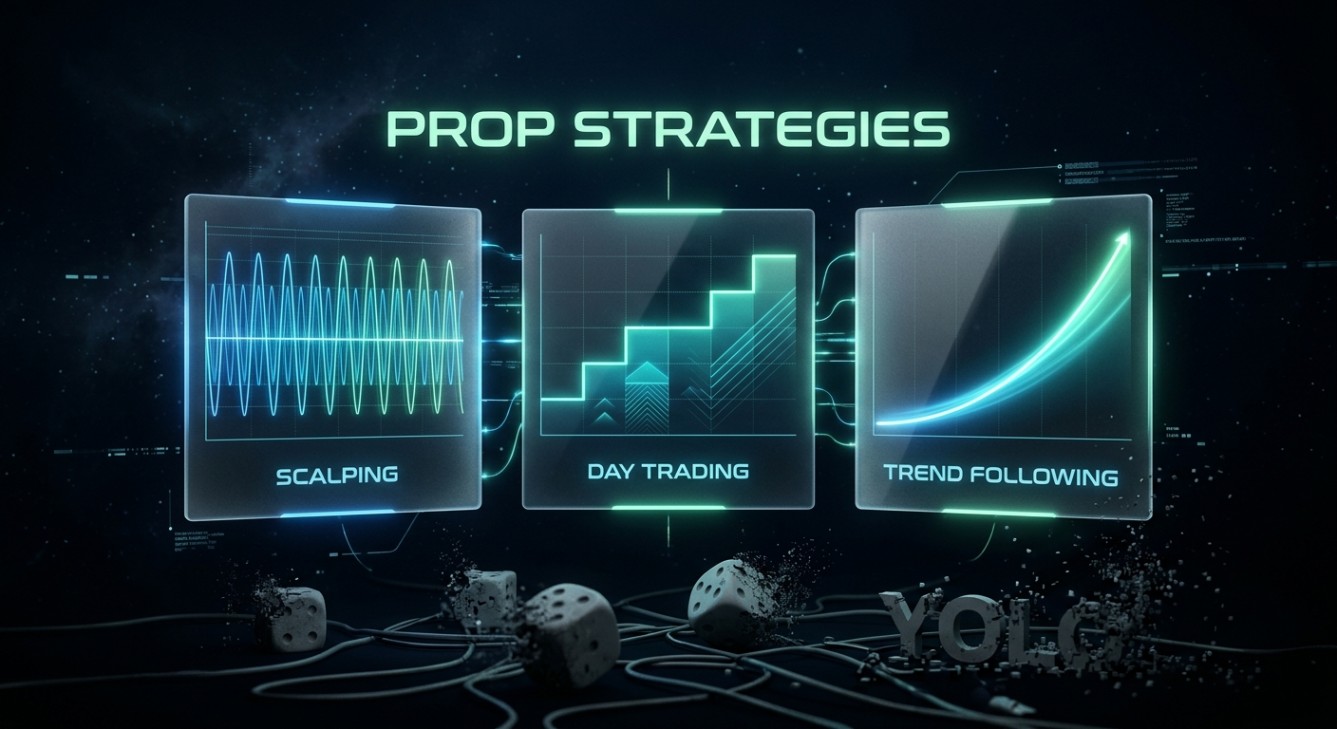
Once your basics are in place, the next step is picking a trading style that naturally works with typical prop firm restrictions, instead of constantly fighting against them. Some of the styles that tend to fit well are:
- Intraday/Scalping Strategies: Several small, structured trades per day. This approach can make it easier to manage daily drawdown and stay within tight risk limits.
- Intraday Swing / Day Trading: Usually somewhere around 1–5 trades per day, often targeting roughly 2–5 times your risk, with a focus on key sessions and important liquidity areas.
- Momentum / Trend Following: Fewer but higher conviction trades that try to capture larger moves when the market is clearly trending.
Avoid high risk styles like martingale, grid trading, YOLO meme coin trades, or using extremely high leverage, most prop firms either ban them or they quickly violate drawdown rules.
Set Clear Trading Rules
At this stage, you need to write down crystal clear rules for your strategy. This includes:
- Exact setup criteria (what must happen before you even consider a trade)
- Precise entry triggers
- Where you place your stop loss
- Take profit plan and logic
- Risk percentage per trade
- Maximum number of open trades and total risk allowed
- Daily stop trading rules (for example, when to close the platform)
Having everything clearly defined removes emotional decisions like this looks good, I’ll risk more or I’m in loss, let me move the stop. This level of clarity is what separates amateur traders from those who consistently pass and keep funded accounts.
Test the Strategy, Back testing and Forward Testing
Once your rules are clearly defined, the next step is to test them in a serious, structured way. Start with back testing your strategy across different types of market conditions, strong bull runs, deeper bear phases, and choppy ranging environments.
As a rough guideline, I like to see at least a couple of hundred trades logged before I start trusting the numbers. The more varied the conditions you cover, the more meaningful your stats become.
When the back test results look reasonably solid, move on to forward testing. Run the strategy on a demo account or with very small real capital for a few weeks. During this phase, keep track of key metrics such as:
- Win rate
- Average risk to reward ratio
- Maximum drawdown
- Longest losing streak
- How the strategy behaves in different sessions and on different days of the week
This helps you see whether the strategy holds up in real time conditions and whether it still fits your personality and schedule.
Tune Your Strategy for Prop Firm Challenges
Before you pay for any prop firm challenge, take the time to make sure your strategy lines up with that firm’s specific rules and limits.
A few things I like to double check:
- My maximum daily loss stays comfortably inside their daily drawdown limit
- My total open risk doesn’t push me close to violating rules, even on a bad day
- In stress scenarios, for example, several losses in a row, I still remain within both daily and overall drawdown thresholds
The goal is simple: when you finally start a live challenge, it should feel like a natural extension of what you’ve already been doing in testing, not like a high pressure experiment you’re improvising on the fly.
Precision Scalping in Crypto Prop Trading
Now let’s get into one of the main strategies I keep coming back to in crypto prop trading:
Precision Scalping, short term trading built on real market structure and institutional logic.
This isn’t about randomly chasing candles with 50x leverage, jumping on every RSI signal, or panic buying during crazy spikes.
The whole point is to have a structured, rule based approach built on Smart Money Concepts (SMC): liquidity, order blocks, and breaks of structure, all wrapped inside tight risk control that actually respects prop firm rules.
Over time, I’ve found that this style of scalping fits funded environments surprisingly well.

Why Precision Scalping Works So Well for Crypto Prop Firms
This approach is particularly effective for prop trading for several practical reasons:
- Small, realistic Targets: Most trades aim for roughly 0.5–2% moves on major pairs like BTC, ETH, or SOL. You’re not relying on huge home run winners every week.
- Decent opportunity flow: On active days, it’s not unusual to see several good setups, especially around the London session and the London–New York overlap. You don’t need to force trades during dead hours.
- Short holding time: Many trades last somewhere between 5 and 30 minutes. That keeps your exposure to sudden news, random wicks, or overnight risk fairly limited.
- Manageable drawdown profile: With risk per trade often in the 0.3–0.8% range, even a small losing streak usually stays comfortably inside typical prop firm daily loss limits.
Crypto’s natural volatility and frequent liquidity sweeps can be a problem if you’re trading emotionally or without a plan. With a structured scalping system, that same volatility can become an advantage instead of a constant threat to your funded account.
A Step by Step Guide to Precision Scalping
In this part, I’ll walk through the framework I use myself for precision scalping in crypto, and how I’ve adjusted it to fit typical prop firm risk and consistency rules. It’s not the only way to trade, but it’s a structure that has made sense for me and for other traders I’ve worked with.
Start With Liquidity Sweeps (The Main Trigger):
I don’t enter a trade just because price taps a level I’ve drawn. The first and most important filter is a liquidity sweep. What I’m usually looking for:
- Price aggressively takes out equal highs or equal lows
- A sweep of the previous session’s high or low
- A spike through obvious stop loss zones like clean swing highs/lows or round numbers
For a bullish idea, I want to see price dip below a recent low, leave a sharp rejection wick, and then close back inside the previous structure. That often clears out stops and traps late sellers before price flips back up. For a bearish idea, the same logic applies in the opposite direction.
As a personal guideline: If there’s no clear liquidity sweep, I usually skip the trade.
Just this one filter removes a surprising number of low quality setups and random entries.
Refine the Zone: Order Blocks (OB) and Points of Interest (POI)
After a valid liquidity sweep, the next step is to narrow down where price is most likely to react, this is where Order Blocks and Points of Interest come in.
For a bullish Order Block, I look for:
- The last meaningful bearish candle before a strong upward move
For a bearish Order Block, I look for:
- The last meaningful bullish candle before a sharp downward move
Then I map that candle’s body and wick as my zone. Sometimes I’ll refine it further by focusing on the most reactive part of the candle, often around the middle 50%.
To strengthen the zone, I like to see at least one of these nearby:
- A Fair Value Gap (FVG) or obvious imbalance
- A significant higher timeframe level (4H or daily highs/lows, weekly opens, key session highs/lows)
The basic idea is simple:
Price sweeps liquidity → reacts at a refined Order Block / POI → then continues in the expected direction.
Wait for Break of Structure (BOS) or Change of Character (CHOCH)
Once you have a liquidity sweep and a solid Order Block, drop down to a lower time frame (usually 3-minute or 5-minute) for confirmation.
For a long trade, you want to see the price react inside the bullish Order Block and then break previous lower timeframe highs (a clear BOS or CHOCH).
My entry usually comes on the pullback:
Into the same Order Block, or into a nearby Fair Value Gap created by the move that broke structure.
I place the stop loss just below the liquidity sweep low. For shorts, I simply invert the idea:
- Sweep above a recent high
- Reaction at a bearish Order Block / POI
- Break of previous lows on the lower timeframe
- Entry on the pullback, with stop just above the sweep high
For targets, I focus on the next obvious liquidity pools or key levels and aiming roughly for at least 1:2.5 to 1:3 risk to reward on the full idea.
In practice, I often take partial profits around 1:1.5–1:2 and let a remaining portion run toward 3–4R if structure still supports the move. Consider trailing the stop once price has cleared important liquidity areas.
This kind of scaling out helps me stay aligned with prop firm drawdown rules while still giving the best setups room to perform.
Risk Management Rules That Keep You Funded
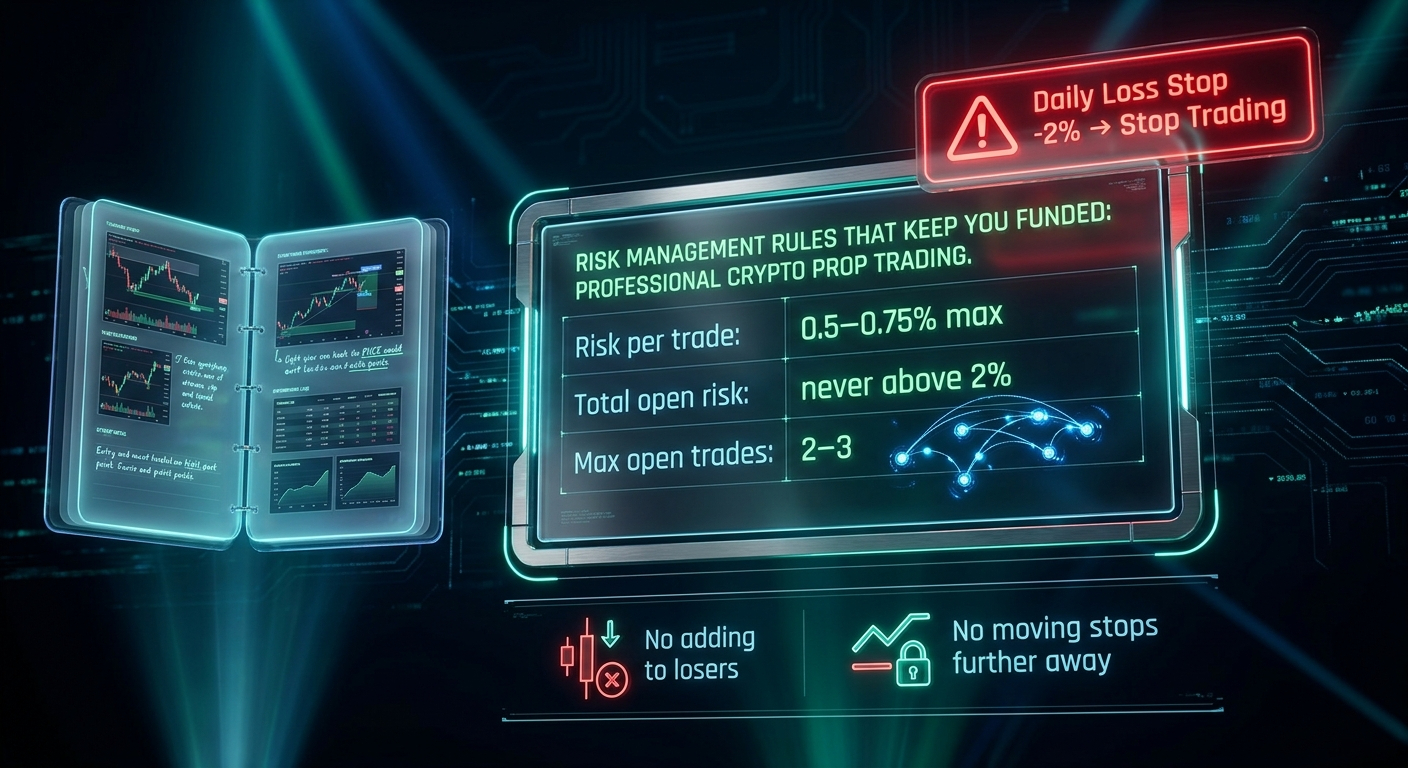
The entry pattern is important, but these risk rules are what actually keep your account alive and funded:
- I usually risk around 0.5–0.75% of the account on each trade. That’s enough to make progress without letting a single loss hurt too much.
- I try not to let my total open risk go above about 2%. If I’m in multiple trades, their combined risk still needs to sit comfortably inside firm rules.
- I generally cap it at 2–3 open trades at the same time, and I do pay attention to correlation. Three BTC correlated longs are basically one big directional bet.
- If I’m down around ‑2% for the day, I stop trading. For me, that’s the line where emotions start to creep in and prop rules become easier to break.
- I avoid adding to losing positions or moving my stop further away. If the trade is invalid, I’d rather take the loss and wait for the next clean setup.
I journal every trade with before/after screenshots, notes on the liquidity sweep, why the Order Block was valid, the BOS/CHOCH confirmation, and the final result. This review process is how you improve from an average trader to a consistently funded one.
Advanced Optimization for Prop Firm Performance
Once your core system is stable and working, then it starts to make sense to optimize it for prop firm performance instead of just max profit. Two of the biggest levers I’ve found are session filters and pair selection/volatility management.
In my experience one of the most important optimizations is using Session Filters.
Although crypto trades 24/7, not all hours are equal. London Open and New York sessions usually offer the best liquidity and cleanest moves, while the Asian session is often slower and better suited for planning or mean reversion setups.
Many successful funded traders focus mainly on London and early NY sessions and avoid low liquidity periods to reduce overtrading.
Pair Selection and Volatility Management
Not every crypto pair is a good fit for prop firm challenges. Some coins are fun to trade on a personal account, but they can be brutal when you’re dealing with strict daily and max drawdown limits.
For safety and consistency, I’ve had better results by focusing on: Major, high liquidity pairs, mainly BTC perpetuals, ETH perpetuals and occasionally SOL when it’s active.
I suggest creating a simple tier list for yourself:
- Tier 1: BTC and ETH (main focus)
- Tier 2: SOL and other large cap coins
- Tier 3: Smaller altcoins and meme coins (only trade with smaller size and under very specific conditions)
This structure helps me avoid unnecessary slippage and violent volatility spikes that can break drawdown rules in a single bad move. It also keeps my focus on a small watchlist I actually know well, instead of constantly chasing the latest coin that just pumped on social media.
Trade Management Profiles
You don’t have to manage every trade exactly the same way. You can define different trade management profiles based on the strength of the setup.
For example, one conservative profile where you take partial profits earlier with tighter trailing stops, and another where you hold longer and scale out later during strong moves.
The most important thing is that all profiles strictly follow your risk rules and the prop firm’s limits.
Common Reasons Traders Fail Crypto Prop Challenges
Even if you have a solid strategy, most traders still fail prop firm challenges because of behavioral issues and poor discipline, not because of bad technical analysis.
Here are the most frequent killers I’ve seen both in myself early on and in traders I’ve mentored:
- Increasing position size after losses to recover faster
- Trading outside your planned hours (especially late night FOMO)
- Ignoring daily loss limits and continuing to trade
- Overtrading right after making early profits
- Breaking your own tested rules when emotions take over
When you treat a prop firm challenge like a lottery ticket instead of a professional, risk managed process, it shows up in your stats. Most firms can see that behavior in your trading metrics long before you get the email saying your account has been reset.
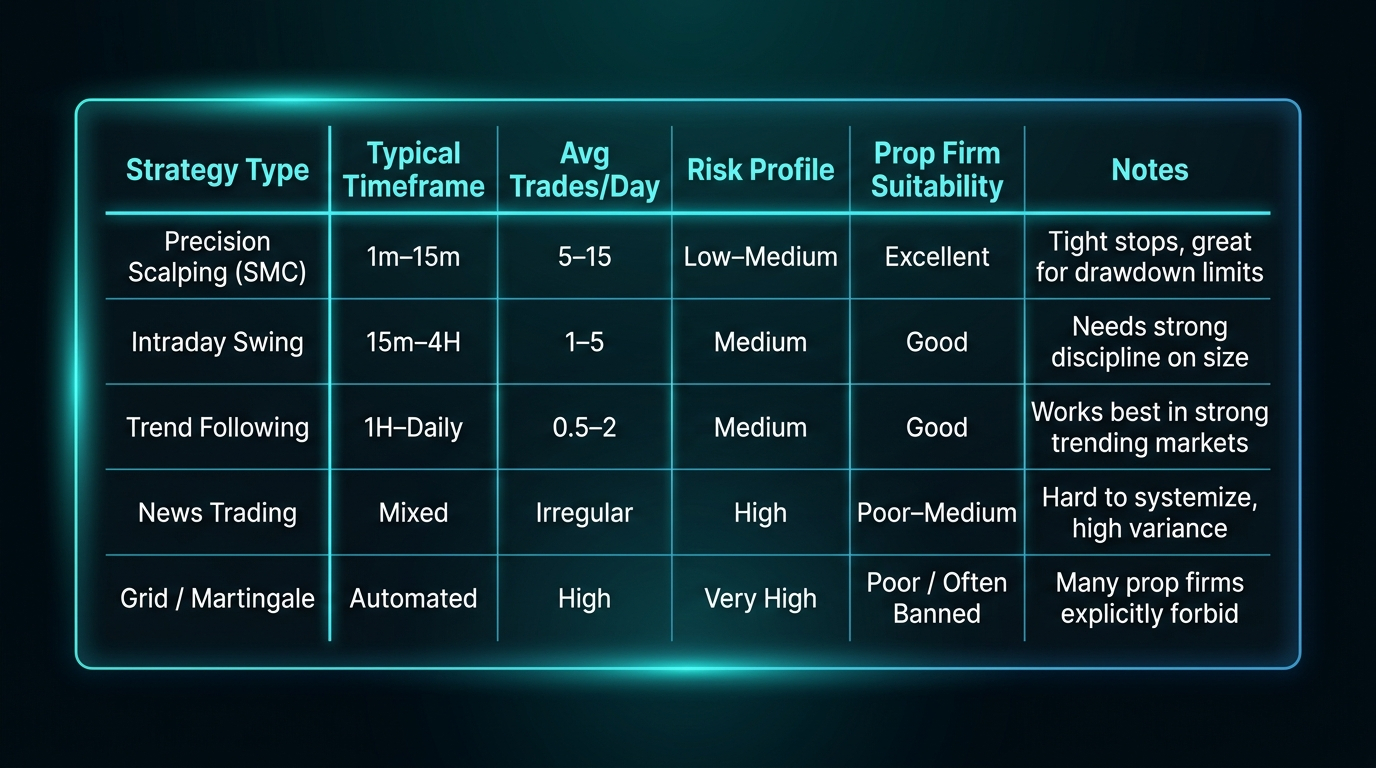
Comparing Common Crypto Strategies for Prop Firm Use
Here’s a quick comparison of different strategy types and how well they usually perform inside crypto prop firms:
Final Thoughts: Turning Your Crypto Strategy Into a Prop‑Firm‑Approved Edge
Building a strategy that truly works for crypto prop firms starts with solid structure, not flashy signals. You need fixed risk per trade, clear risk to reward ratios, and rules that are simple enough to follow even under pressure.
The strategy must be designed to naturally stay within the firm’s daily and maximum drawdown limits. It should work reasonably well across different market conditions with only small adjustments, not complete overhauls.
Most importantly, you must prove it works through serious back testing, forward testing, and stress testing before using real challenge capital. Discipline in execution is what ultimately decides success.
About the Creator
Sophie
Trader focused on Price Action & Order Flow.
Into crypto, fast execution, controlled risk, and quality setups.
Passing funded accounts and refining my trading every day.
Enjoyed the story? Support the Creator.
Subscribe for free to receive all their stories in your feed.
Comments