
Crypto Trading Profit Split: How Much Do Funded Traders Really Keep?
A practical guide to profit sharing percentages, payout rules and fees


Two funded traders generate the same $5,000 in eligible profit. One receives $4,000, while the other takes home $4,750. The difference does not come from account size, trading strategy, or market performance. It comes entirely from the profit split.
This is why the percentage offered by a crypto prop firm matters. A higher split allows the trader to retain a larger share of the same eligible profit, and that difference can become increasingly meaningful across multiple payouts.
The calculation itself is straightforward, but comparing profit split offers requires more than reading the largest number on a program page. Traders also need to understand which profits qualify for the split, when the percentage becomes active, and whether trading costs or account conditions affect the amount available for withdrawal.
This guide explains how crypto trading profit splits work, compares common payout structures, and shows how to estimate the amount a funded trader may receive.
What Is Profit Split in Crypto Trading?
A profit split is the percentage of eligible funded account profit allocated to the trader. With a 90% split, the trader receives 90% of eligible net profit and the firm retains 10%. Trading costs and payout rules may affect which profits qualify.
This arrangement allows traders to access an account with defined notional buying power without committing the full account size as personal capital. The firm provides the account structure and trading environment, while the trader contributes analysis, execution, and risk management.
The split does not determine whether a trader will be profitable, nor does it increase the account balance automatically. It only determines how the qualifying profit is distributed. A higher percentage therefore creates a clear financial advantage: when two accounts generate the same eligible profit under otherwise equal conditions, the account with the higher split pays more to the trader.
The word “eligible” is important because not every gain displayed on a trading platform is necessarily ready for withdrawal. Open positions, applicable trading costs, minimum trading day requirements, and payout rules may need to be considered before the trader’s share is calculated.

Profit Split vs. Reward Split
Profit split and reward split generally refer to the same payout arrangement. Both terms describe the portion of eligible trading profit allocated to the funded trader.
The difference is mainly one of wording. Profit split emphasizes the division of profit between the trader and the firm, while reward split presents the trader’s payment as a reward for profitable and rule compliant performance.
Using a different label does not necessarily change the financial structure. When comparing programs, traders should focus on the actual percentage, the point at which it becomes active, and the rules used to calculate eligible profit. These details matter more than whether the payment is called a profit split, reward split, or performance reward.
How Is a Crypto Profit Split Calculated?
The trader’s payout can be estimated with a simple formula:
Trader payout = Eligible net profit × Trader profit split percentage
Suppose a trader generates $2,000 in eligible net profit and the account offers a 90% split:
$2,000 × 0.90 = $1,800
The trader receives $1,800, while the prop firm retains the remaining $200.
The same formula can be used with any eligible profit amount or profit split percentage. The important step is identifying the correct eligible net profit before applying the agreed rate.

What Counts as Eligible Net Profit?
Eligible net profit is the amount of closed trading profit that qualifies for the profit split after relevant trading costs and account adjustments have been applied.
In most cases, unrealized gains from open positions are not included because their value can still change. A trade generally needs to be closed before its result can become part of a payout calculation. Commissions, spreads, swap charges, or other execution related costs may also reduce the net result.
Eligibility can also depend on the funded account’s rules. A trader may need to complete a minimum number of trading days, wait until the next payout window, or pass a routine account review. Profits linked to prohibited strategies or a rule violation may not qualify for withdrawal.
Consider a trader whose closed positions produced $5,200 in gross gains while commissions and overnight costs totaled $200. The eligible net profit would be $5,000, assuming all other payout requirements had been met. With a 90% split, the trader’s share would be calculated from that $5,000 and would equal $4,500.
Understanding this distinction prevents traders from applying the advertised percentage to a balance that may not yet be fully eligible for withdrawal.
Is a 95% Profit Split Good?
Yes. A 95% profit split is one of the most trader friendly payout structures. Under equal conditions, it gives the trader a larger share of eligible net profit than an 80% or 90% split.
It can be especially valuable for traders who generate larger or recurring payouts. The practical consideration is how the percentage becomes available: it may be included from the beginning, offered as an upgrade, or unlocked through account progression.
These conditions do not reduce the mathematical advantage of 95%. They simply help the trader determine when the higher percentage applies and how it fits into the total account cost.

Does Drawdown Affect Profit Split?
Drawdown does not normally change the agreed profit split percentage. However, it can affect whether the trader keeps the account active long enough to reach a payout.
Funded account programs generally define a maximum loss threshold. If the account breaches that limit, it may be closed before eligible profits can be withdrawn. Drawdown therefore affects the path to a payout rather than the percentage used to divide the profit.
It also influences how much flexibility the trader has when managing open positions. A narrow loss limit may require tighter exposure, while a more manageable buffer can give a strategy more room during normal market volatility.
The profit split and drawdown structure serve different purposes. The split determines how eligible profit is distributed, while drawdown determines how much loss the account can absorb before it is breached.
How Does a Crypto Profit Split Work After Funding?
A crypto profit split becomes relevant after the trader completes the evaluation process and receives access to a funded account. From that point, the trader can generate profits under the firm’s funded stage rules and become eligible for a payout.
The process generally follows five steps:
The trader generates closed profit. Trades must be completed within the account’s risk limits and permitted trading conditions.
The account reaches a payout window. The trader completes any required waiting period, minimum trading days, or other eligibility conditions.
The trading results are reviewed. The firm verifies the account activity and confirms which portion of the profit qualifies for withdrawal.
The profit split is applied. Eligible net profit is multiplied by the trader’s agreed percentage.
The approved payout is processed. The trader receives the allocated share through one of the available payment methods.
Once the account activity has been approved, the agreed percentage is applied to eligible net profit. The trader receives the allocated share, while the remaining portion belongs to the firm. Any costs already included in the net profit calculation should not be deducted for a second time.
Is an 80%, 90%, or 95% Profit Split Better?
When account rules, fees, and trading conditions are identical, the higher profit split is financially better for the trader. Among the three structures compared here, 95% provides the largest share of eligible profit, followed by 90% and then 80%.
The difference becomes more meaningful as eligible profit grows or the trader completes multiple payout cycles. However, the percentage should still be considered within the full account agreement, particularly if the higher rate requires an upgrade.

80% Profit Split
An 80% split gives the trader the majority of eligible profit while allocating a larger share to the firm than the other two structures.
It can provide a practical starting point when included in a lower cost account with clear rules and reliable payout terms. Its primary disadvantage is that the trader retains a smaller portion of each eligible payout.
90% Profit Split
A 90% split increases the trader’s share and reduces the portion retained by the firm. It can offer a favorable balance between profit retention and account cost.
Traders should confirm whether the rate applies from the first eligible payout or becomes available after an account milestone.
95% Profit Split
A 95% split provides the highest direct payout among the three structures compared in this guide. It can be particularly valuable for traders who generate larger or recurring eligible payouts, since a greater portion of each qualifying profit remains with the trader.
How Profit Split Percentages Change the Payout
The examples below apply three common profit split percentages to the same eligible profit amounts. This shows how the percentage alone changes the trader’s payout when all other conditions remain equal.
Example 1: $1,000 Eligible Profit
With $1,000 in eligible profit, an 80% split pays $800 to the trader. A 90% arrangement increases the payout to $900, while a 95% split produces a $950 payout.
At this level, choosing 90% instead of 80% adds $100 to the trader’s share. Choosing 95% instead of 80% adds $150.
The difference is relatively modest in a single $1,000 payout, but it would repeat every time the trader generates the same amount of eligible profit.
Example 2: $5,000 Eligible Profit
At $5,000 in eligible profit, the trader receives $4,000 with an 80% split, $4,500 with a 90% split, or $4,750 with a 95% split.
The difference between 80% and 95% is now $750. A trader completing four payouts of this size would retain a total of $3,000 more under the 95% arrangement.
This illustrates why higher splits become more valuable for traders who can produce multiple eligible payouts rather than viewing the percentage through a single withdrawal.
Example 3: $10,000 Eligible Profit
With $10,000 in eligible profit, an 80% split pays $8,000, a 90% split pays $9,000, and a 95% split pays $9,500.
The 95% option gives the trader $1,500 more than the 80% option and $500 more than the 90% option. The trading result is identical in each case; the difference comes entirely from how the profit is distributed.
For traders generating larger eligible profits, even a five percentage point improvement can have a meaningful effect on total retained earnings.
These are mathematical illustrations, not expected or guaranteed trading results.

What Else Affects the Final Profit Split Payout?
A higher profit split gives the trader a larger payout whenever eligible profit and account conditions are the same. Among the three structures examined in this guide, 95% allocates the largest share to the trader.
Its practical value can be assessed alongside the account’s execution environment, risk rules, costs, and payout process. When these elements are transparent and reliable, the higher percentage can provide a meaningful financial advantage.
Trading Infrastructure and Execution Quality
The practical value of a profit split also depends on the quality and transparency of the trading environment. Platform stability, consistent order execution, clear pricing, and accurate account records can all affect a trader’s ability to follow a strategy and evaluate performance.
Execution models may differ between crypto prop firms. Some programs may use simulated environments, while others may follow different pricing or order processing models. Traders should therefore review how prices are generated, how orders are filled, and whether commissions, spreads, and slippage are clearly documented.
Technical reliability is especially important in crypto markets, where prices can move quickly. Platform interruptions, delayed order processing, or inconsistent pricing may affect entries and exits during volatile periods. A dependable system cannot eliminate normal market risk, but it can provide a more consistent environment for executing and reviewing trades.
The account rules should also be compatible with the trader’s approach. Conditions covering scalping, automated strategies, news trading, or overnight positions should be clearly available before the evaluation begins.
When a 95% profit split is supported by transparent execution terms, stable technology, and accurate account reporting, it can offer strong value to funded traders. The higher percentage allows the trader to retain more eligible profit, while the supporting infrastructure helps make the trading and payout process clearer and more predictable.
Drawdown Structure
Drawdown rules define how much an account can lose before it is breached. Although they do not normally change the profit split percentage, they affect how the trader must manage risk before reaching a payout.
A static drawdown is generally based on a fixed account threshold, making the available loss limit easier to monitor. A trailing drawdown may move upward as the balance or equity reaches new highs, which can reduce the remaining risk buffer after a profitable period.
Neither model should be judged only by its name because the exact calculation can vary between programs. Traders should confirm whether drawdown is based on balance or equity, when the threshold moves, and whether it eventually stops trailing.
A clearly explained drawdown structure helps traders understand how much room they have to manage positions before reaching a payout.
Trading and Account Costs
The profit split is applied to eligible net profit, so commissions, spreads, slippage, and overnight financing charges may affect the amount available for distribution. These costs should be reviewed before comparing the expected payout from different accounts.
The cost of entering the funded program should be considered separately. This may include the evaluation fee and any optional charge for upgrading to a higher profit split. If an upgrade is required, the trader can calculate how much eligible profit is needed to recover its cost.
Suppose upgrading from a 90% split to a 95% split costs $250. The additional five percentage points provide $50 more for every $1,000 in eligible profit. The break even calculation would be:
$250 ÷ 0.05 = $5,000
The trader would need $5,000 in eligible profit for the additional share to equal the $250 upgrade cost. After that point, further eligible payouts would benefit more fully from the higher rate. This is only a mathematical break even calculation and does not guarantee that the required profit will be generated.
When a 95% split is included without an extra charge, its financial advantage begins with the first eligible payout.
Payout Eligibility and Reliability
Payout frequency describes how often a trader may have an opportunity to withdraw profit. Payout eligibility refers to the conditions that must be completed before a request can be submitted. Processing time begins after an eligible request has been reviewed and approved.
These timelines are related but not identical. A program may offer weekly payout opportunities while requiring a minimum number of trading days or an account review. Once the trader becomes eligible and submits the request, additional time may be needed to verify the activity and transfer the approved amount.
Reliable payout operations turn the advertised split into accessible earnings. The program should clearly explain when requests can be made, which profits qualify, how accounts are reviewed, what payment methods are available, and how long approved transfers generally take.
Any profit split becomes more meaningful when the path from eligible profit to withdrawal is transparent and consistent. Combined with strong infrastructure and practical account rules, it allows the trader to benefit from both higher profit retention and predictable access to eligible earnings.
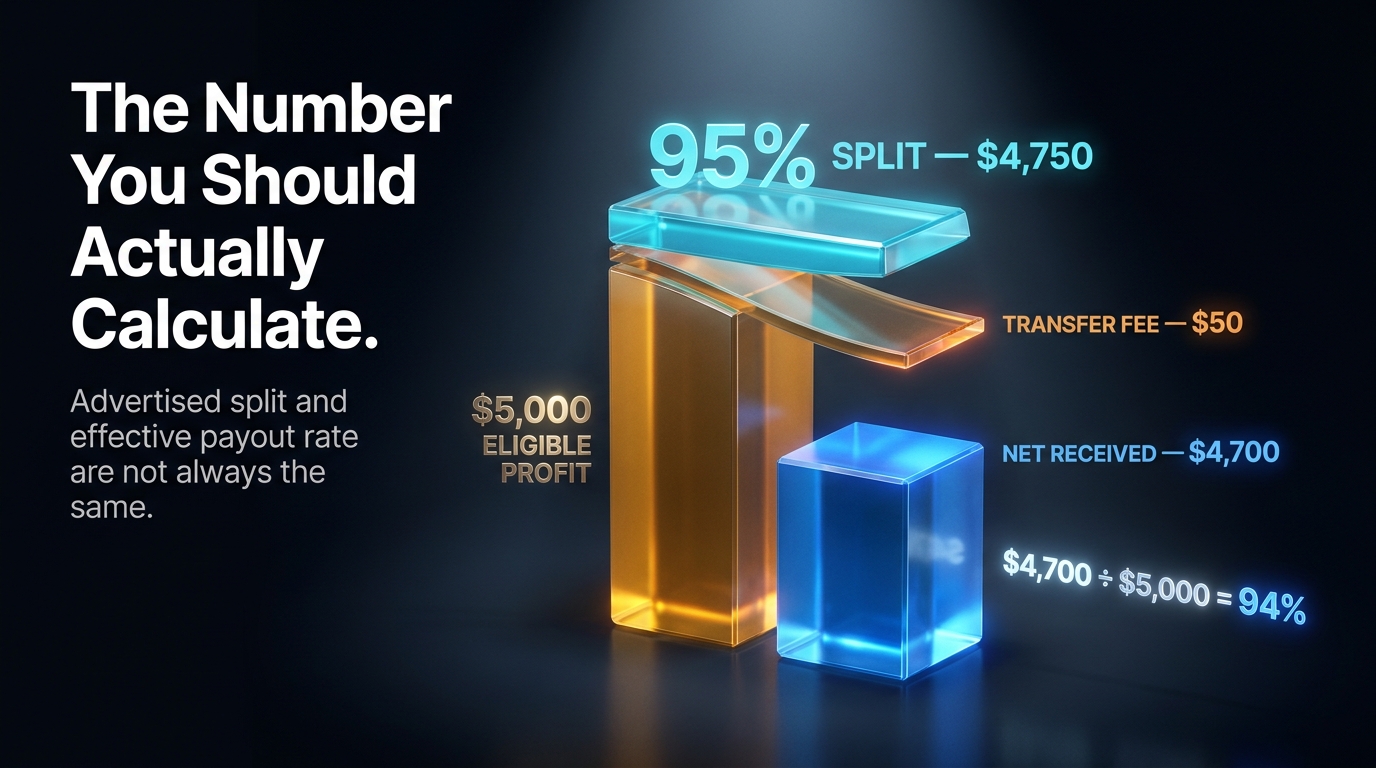
How to Calculate Your Effective Payout Rate
The advertised profit split shows the percentage of eligible profit allocated to the trader. The effective payout rate shows how much of that profit ultimately reaches the trader after any applicable payout level charges. Effective payout rate is used here as a personal comparison metric rather than a standardized prop trading term.
It can be calculated with the following formula:
Effective payout rate = Net amount received ÷ Eligible trading profit × 100
Suppose a trader has $5,000 in eligible profit under a 95% split. The contractual payout is $4,750. If a clearly disclosed $50 transfer charge applies, the trader receives $4,700:
$4,700 ÷ $5,000 × 100 = 94%
The effective payout rate is 94%, while the contractual profit split remains 95%.
To use this calculation accurately, the trader should distinguish between trading costs and payout level deductions. Commissions, spreads, and overnight charges may already be reflected in eligible net profit. If they have already been deducted, they should not be counted again when calculating the effective payout rate.
Challenge and upgrade fees should also be evaluated separately. They are costs of accessing the funded program rather than deductions from an individual payout. Keeping these costs separate makes it easier to compare the contractual split, the amount received, and the total cost of participating in the program.
The effective payout rate is most useful when comparing similar accounts. It provides an additional layer of information, but it should not replace the advertised split or the funded account agreement.
Five Questions to Ask Before Choosing a Profit Split
Before comparing profit split offers, traders should understand how each percentage is applied in practice. These five questions cover the calculation basis, activation requirements, costs, payout timing, and account rules.
Which profit amount is used in the calculation?
Confirm whether the split is applied after standard trading costs have been included. This makes it easier to estimate the expected payout accurately.When does the 95% profit split become active?
Some programs apply the higher rate from the first eligible payout, while others introduce it at a later account stage. Knowing the activation point helps the trader plan future payouts.How can the trader access the highest profit split?
The 95% rate may be included with the account, selected as an optional upgrade, or unlocked through account progression. Each model can provide value depending on the trader’s expected profit and long term plans.When can eligible profit be withdrawn?
Minimum trading days, payout windows, and processing schedules determine when the trader can access the allocated share. Clear timing makes cash flow planning easier.Which account rules should be followed before requesting a payout?
Understanding the drawdown limits, verification process, and permitted trading conditions helps the trader protect the account and remain eligible for the full payout.
Clear answers to these questions make it easier to compare profit split offers on equal terms. A 95% split provides the largest trader share among the three structures discussed here, while the surrounding account terms determine how and when that percentage applies.
Final Takeaway
Profit split determines how much eligible funded account profit is allocated to the trader. While 80% and 90% arrangements allow traders to retain most of their eligible profits, a 95% split provides the largest direct share among the three structures compared in this guide.
The practical value of a higher split becomes clearer when it is combined with dependable trading infrastructure, transparent costs, manageable risk rules, and consistent payout processing. Under these conditions, the percentage becomes a meaningful financial advantage rather than simply an attractive headline figure.
For traders who prioritize higher profit retention, a 95% split can provide a highly competitive outcome when the account terms are clear and the trading environment is reliable.
Editorial note: This article discusses profit split structures generally and does not evaluate or endorse a specific crypto prop firm.
About the Creator
Sophie
Trader focused on Price Action & Order Flow.
Into crypto, fast execution, controlled risk, and quality setups.
Passing funded accounts and refining my trading every day.
Enjoyed the story? Support the Creator.
Subscribe for free to receive all their stories in your feed.
Comments
There are no comments for this story
Be the first to respond and start the conversation.