
Crypto Prop Firms With No Consistency Rules: What Traders Should Know
How to verify consistency rules across evaluation and calculate the hidden profit gap created by a best day limit.


Your account shows $10,000 in total profit, and your best trading day produced $6,000 of it. You’ve hit the profit target, stayed within every loss limit, and your dashboard is green. Yet under a 50% best day threshold, that profit may still not qualify for a payout.
The reason is mathematical. If your $6,000 winning day can account for no more than half of your total profit, you need at least $12,000 in total profit, not $10,000. You’re profitable, but the account still falls $2,000 short of the required profit distribution.
This is where the phrase no consistency rules can become misleading. It may describe an evaluation account while saying nothing about the funded account or payout stage. So the useful question isn’t simply whether a crypto prop firm uses the label. The key is to understand where each restriction applies, how it’s calculated, and whether it can affect your ability to receive a payout.
A meaningful comparison therefore requires checking three separate stages: the evaluation, the funded account, and the payout policy.
What Changes When There’s No Consistency Rule?
Removing a consistency rule doesn’t remove the other requirements of a trading account. It simply means that one specific restriction no longer applies at the stage where the rule has been removed.
That can give traders more flexibility in how their profits are generated, but the impact depends on where the rule applies. An evaluation account, funded account, and payout stage may each have different requirements, so no consistency should never be interpreted as a blanket removal of trading conditions.

What Does No Consistency Rules Mean at a Crypto Prop Firm?
A no consistency rules crypto prop firm does not restrict how much of a trader’s profit can come from one day or trade during a specified account stage. The phrase does not necessarily cover funded trading or payouts, so each stage must be checked separately before assuming concentrated profits are unrestricted.
A consistency rule normally controls the distribution of positive performance. It may limit the percentage of total profit generated on the trader’s best day, require profits to be spread across several days, or introduce a minimum number of profitable sessions.
For example, a trader might earn $500 on Monday, lose $200 on Tuesday, and make $4,000 during a strong Bitcoin breakout on Wednesday. A consistency rule could make the $4,000 day relevant to evaluation completion or payout eligibility, even if the account remains within every loss limit.
Without that requirement, the uneven profit distribution would not create an additional condition at the specified stage. The trader would still need to meet the profit target and remain within the account’s risk limits.
However, the exact language matters. A rulebook may never use the word “consistency” while imposing a similar restriction through terms such as:
Best trading day
Profit concentration
Profit distribution
Maximum profitable day percentage
Minimum profitable days
The absence of one phrase is not proof that the underlying restriction does not exist.
How Consistency Rules Change Across Account Stages
A prop account should not be treated as if it has one continuous rulebook. Evaluation conditions, funded account rules, and payout requirements may differ substantially.
A no consistency claim can be accurate at one gate and incomplete at the next.

Can a Consistency Rule Return After the Evaluation?
An evaluation may have no best day or profit distribution limit, while the funded account introduces one before a payout. This means a trader could pass with concentrated profits but later need to generate additional returns before those profits become eligible for withdrawal.
The three gates should be reviewed independently.
During the evaluation, the main question is whether one strong day can represent most of the profit target. Minimum trading days must also be checked, because they are separate from consistency. A trader may reach the target in one session but still need activity on additional qualifying days.
At the funded stage, the firm may introduce a new best day percentage or activity condition. If that happens, the strategy used to pass may no longer fit the account in the same way. A system built around infrequent high conviction trades may suddenly require a wider distribution of profits.
At the payout stage, the calculation may change again. A payout policy can define eligible profit differently from the profit displayed on the account. It may consider the best trading day, profitable days, withdrawal cycle, or other conditions before approving a request.
That creates an important distinction:
“No consistency during evaluation” and “no consistency before payout” describe two different account structures.
A trader who checks only the challenge page could miss a restriction that matters later, when real payout eligibility becomes the objective.
How the Best Day Consistency Calculation Works
A best day consistency rule is ultimately a calculation based on two numbers: how much you made on your strongest trading day and how much total profit the account has generated. Once you understand the formula, it becomes easier to see why a profitable account can still fall short of a consistency threshold.

How is a Consistency Rule Calculated at a Prop Firm?
A best day consistency rule divides the profit from the trader’s strongest day by their total profit. If the result exceeds the permitted percentage, the trader usually needs to generate more profit on other days. The profit from the best day doesn’t change; instead, its share of total profit needs to fall below the threshold.
The basic formula is:
Best Day Percentage = Best Day Profit ÷ Total Profit × 100
Suppose a trader makes $6,000 on their best day and has $10,000 in total profit:
$6,000 ÷ $10,000 × 100 = 60%
If the permitted threshold is 50%, the account has not yet satisfied the condition. The best day must represent no more than half of the trader’s total profit.
To find the total profit required, the calculation can be reversed:
Required Total Profit = Best Day Profit ÷ Allowed Best Day Percentage
In this example:
$6,000 ÷ 0.50 = $12,000
The account currently has $10,000 in total profit, leaving a $2,000 difference. This can be referred to as the consistency gap:
Consistency Gap = Required Total Profit − Current Total Profit
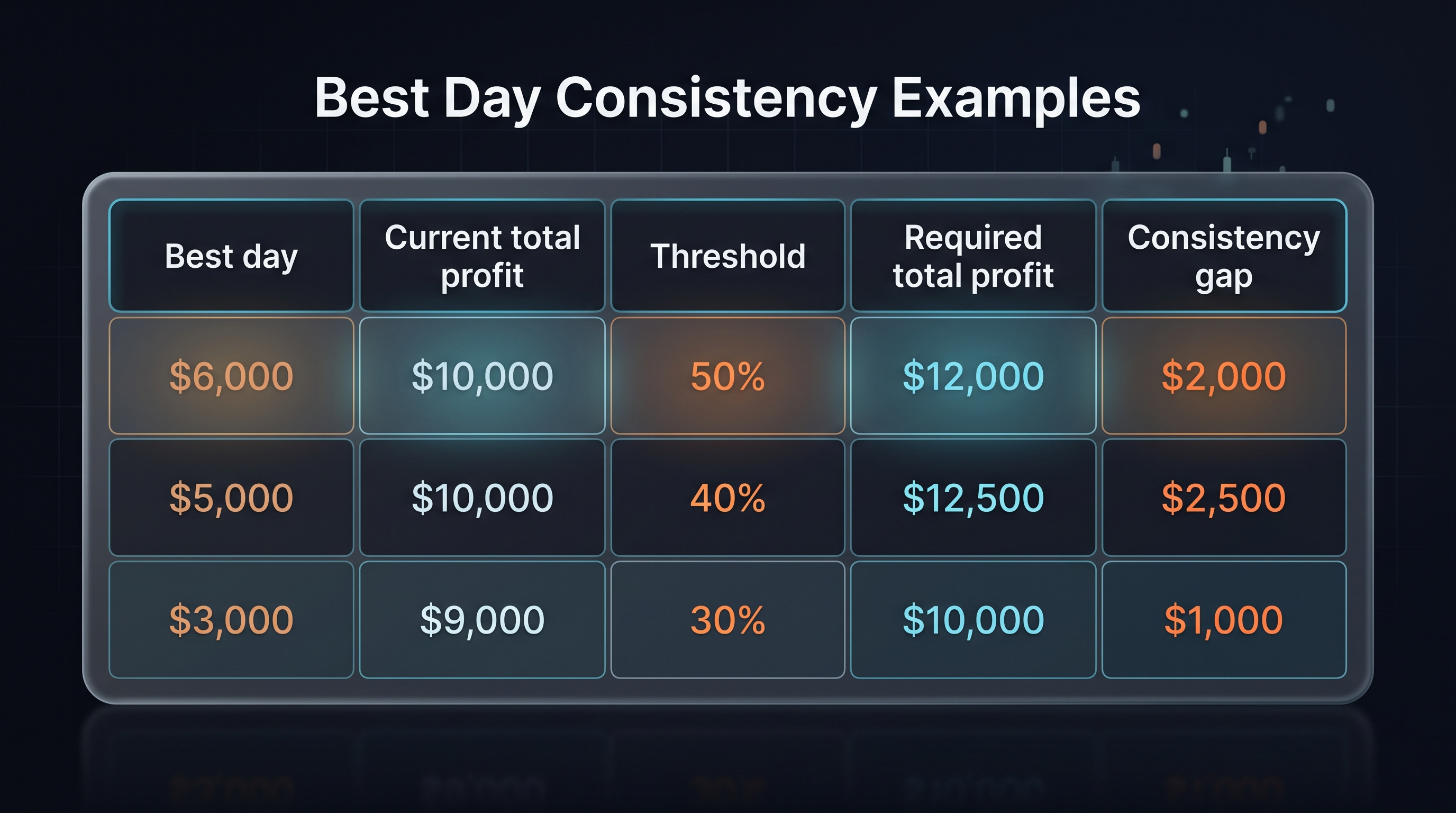
This table shows why the percentage matters. With the same $5,000 best day, a 50% threshold requires $10,000 in total profit. A 40% threshold requires $12,500. The lower percentage demands a wider distribution of gains.
That does not automatically make one threshold fairer or safer. It simply changes how much additional profit must surround the strongest day.
The Hidden Cost of Closing a Consistency Gap
A consistency gap is not a recorded trading loss. It is the additional profit required before the existing performance satisfies a distribution condition.
The account may be profitable, but the trader remains exposed to the market while attempting to make that profit eligible.
Can a Consistency Rule Delay a Payout?
A trader may reach the original profit objective but remain ineligible for a payout because one day represents too much of the total return. The trader must then continue trading while daily loss and drawdown limits remain active, creating additional exposure after the financial objective appeared to be complete.
This creates a difficult incentive. The trader may feel pressure to trade even when no valid setup exists. If the extra trades lose money, total profit falls while the best profitable day remains unchanged. The best day percentage can therefore rise rather than fall.
Consider an account with $10,000 in total profit and a $6,000 best day. Under a 50% threshold, the trader needs to reach $12,000. But if the next trade loses $1,000, total profit falls to $9,000.
The best day percentage is now:
$6,000 ÷ $9,000 × 100 = 66.7%
The account remains profitable, but the consistency gap has become larger.
This is the hidden cost of a profit distribution rule. It may extend the period during which capital remains exposed to the market. It can also encourage three damaging behaviors:
Taking low quality trades to generate additional profit
Increasing position size to close the gap faster
Changing a tested strategy solely to satisfy the calculation
A disciplined response is not to force evenly sized winning days. It is to know the rule in advance and decide whether the strategy’s normal return distribution is compatible with it.
No Consistency Doesn’t Mean No Trading Rules
Removing a consistency condition changes how winning performance is measured. It does not remove the account’s downside controls.

Does No Consistency Mean the Account Has Fewer Restrictions?
A crypto prop account with no consistency requirement may still enforce a profit target, daily loss limit, maximum drawdown, minimum trading days, leverage limits, position caps, and strategy restrictions. Removing one profit distribution rule does not make the complete account permissive.
A firm could remove its best day limit while offering a narrower maximum drawdown. Another could provide wider loss limits but require profits to be distributed more evenly. The second account might offer more usable risk capacity despite having a consistency rule.
The interaction between rules matters more than the number of rules.
A daily loss limit controls how much the account can lose within a defined trading day. A maximum drawdown limits the total decline permitted before the account is breached. Neither rule measures how profits are distributed.
Minimum trading days are also different from consistency. They control participation rather than profit concentration. A trader may be allowed to generate most of the target in one session but still need to place qualifying trades on additional days.
Other conditions may affect weekend positions, news trading, automated systems, copy trading, position size, or total exposure. A strategy can therefore be compatible with the consistency policy while conflicting with another part of the rulebook.
The relevant question is not, “Which account has the fewest rules?” It is, “Which rules directly interfere with the way this strategy enters, manages, and exits trades?”
When Uneven Returns Become a Rule Fit Problem
Uneven returns are not automatically evidence of inconsistent trading. Market opportunities are not evenly distributed, particularly in crypto.
Bitcoin and other digital assets can remain range bound for days and then move sharply after a macroeconomic announcement, liquidation event, regulatory development, or break of a major technical level. A rule based trader may legitimately earn most of a week’s profit during one session.
The important distinction is whether the concentrated result came from a repeatable process or from uncontrolled risk.
Who Benefits Most From No Consistency Rules?
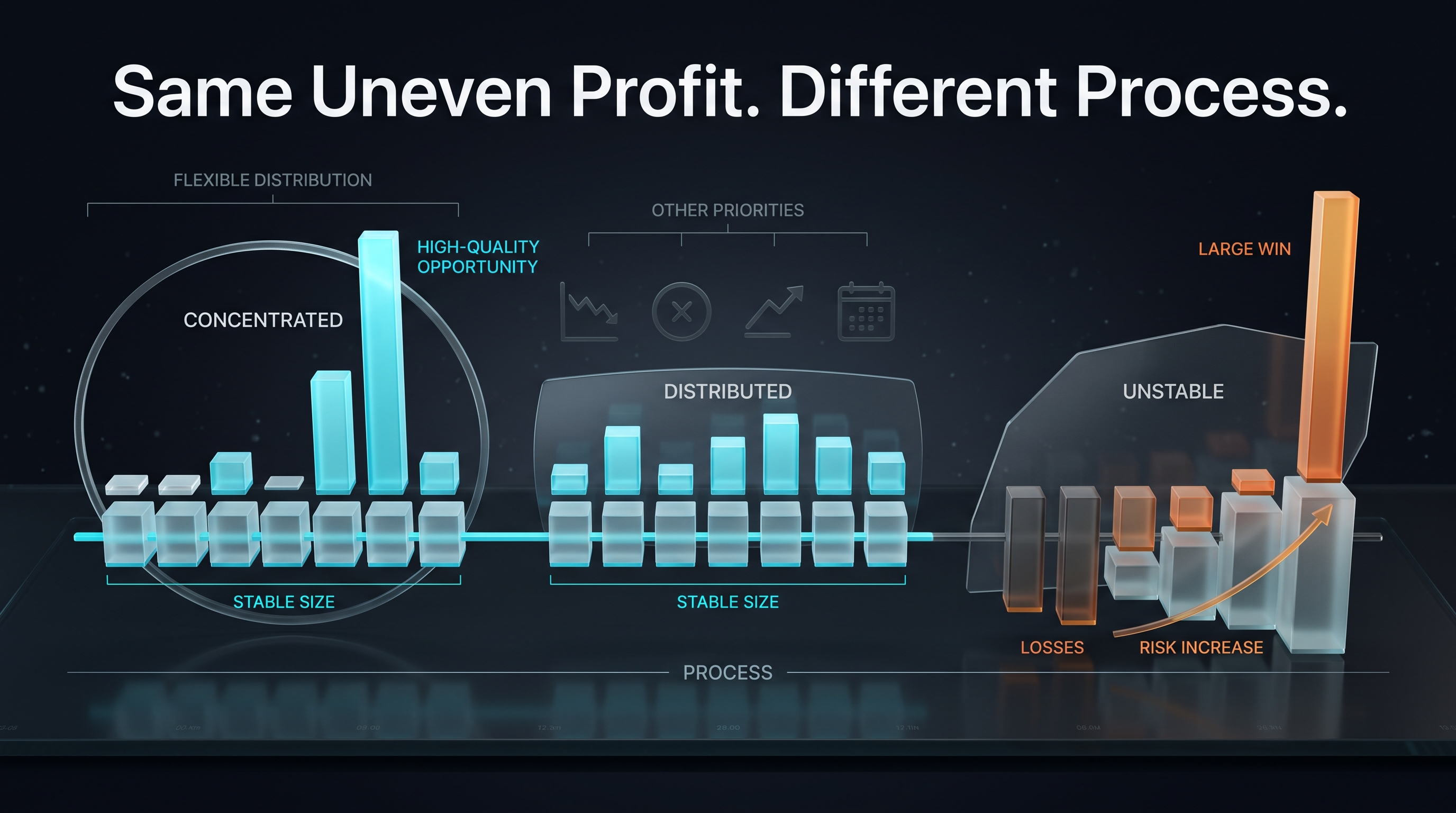
No consistency conditions are more relevant to traders whose tested strategies naturally produce concentrated returns. This can include breakout, momentum, swing, or event driven systems that wait for a small number of high quality opportunities rather than targeting similar profits every day.
A concentrated return profile might include several inactive or low profit sessions followed by one larger winning day. If position sizing remains stable and the setup follows a defined process, the uneven result may reflect the opportunity rather than a change in discipline.
A distributed return profile behaves differently. It generates smaller profits across a larger number of sessions. This type of strategy may rarely come close to a best day threshold. For that trader, drawdown structure, execution quality, leverage, or payout timing may matter more than consistency.
An unstable return profile should not be confused with either. If one large winning day results from suddenly increasing risk after losses, removing the consistency rule does not solve the underlying problem. A more flexible profit distribution policy cannot create a repeatable edge.
A useful question is:
Did the strong day result from a better market opportunity under the same risk process, or from a larger risk process created for that day?
No consistency conditions can preserve the first profile. They cannot make the second profile sustainable.
How to Verify a No Consistency Claim
Marketing labels and comparison pages often simplify account conditions. Verification requires reading the rules for the exact account type rather than assuming one statement applies to every stage.

How Can You Check Whether a Crypto Prop Firm Really Has No Consistency Rules?
Check the evaluation, funded account, and payout documents separately. Search for consistency, best day, profit distribution, profit concentration, and profitable day requirements. Confirm the calculation method, the stage where it applies, and whether minimum trading days or payout conditions create a similar practical restriction.
A short verification process should cover seven points:
Open the current rules for the exact account model.
Search for alternative terms, not only “consistency.”
Check whether the evaluation limits profit concentration.
Read the funded account conditions separately.
Review how eligible payout profit is calculated.
Separate minimum trading days from profit distribution.
Confirm the rules again before paying for an evaluation.
The date of the rulebook also matters. Conditions described in an old review, community post, or comparison article may no longer apply. A provider can change the percentage, calculation method, or stage where the restriction begins.
Screenshots and saved rule pages may help document what was published at a particular time, but current official terms should remain the primary reference.
The purpose of this audit is not merely to find the words “no consistency.” It is to determine whether one unusually profitable day can delay evaluation completion, funded account eligibility, or a withdrawal.

What to Consider Beyond No Consistency Rules
A no consistency model can fit strategies with naturally concentrated returns, but another account may offer wider drawdown, clearer loss calculations, better execution conditions, or more practical payout rules. The value of one missing restriction depends on the rest of the account structure.
Imagine three hypothetical models.
The first has no consistency requirement during evaluation but introduces a 50% best day rule after funding. The second uses a 40% threshold throughout the account lifecycle but offers more drawdown room. The third has no best day percentage at any stage but uses a trailing drawdown and a minimum profitable days requirement.
None is universally better.
The first may help a trader complete the evaluation without artificially spreading profits, yet later create a payout gap. The second restricts profit concentration earlier but may provide more space for normal losing sequences. The third removes the percentage calculation while introducing a loss floor that moves as the account becomes profitable.
The right comparison therefore includes:
Where the consistency rule applies
Whether drawdown is static or trailing
How daily loss is calculated
Which strategies or holding periods are restricted
What must happen before profit becomes withdrawable
A trader with infrequent, high conviction setups may place more value on flexible profit distribution. A trader with frequent and relatively stable returns may gain little from that feature and should focus on risk capacity or execution instead.
“No consistency” is not a quality rating. It is one structural characteristic of the account.
The Label Matters Less Than the Full Rule Structure
A no consistency rules crypto prop firm may allow one strong session to produce most of an evaluation target. That can be valuable when a strategy naturally generates uneven returns. But the same account may introduce a best day calculation after funding or before approving a payout.
The claim is useful only when the missing restriction applies at the stage that matters.
Before choosing an account, separate the process into evaluation, funded trading, and payout. Calculate the potential consistency gap, identify the risk required to close it, and compare that exposure with the account’s drawdown and daily loss conditions.
The objective is not to find the firm with the shortest rulebook. It is to find a rule structure that allows a tested strategy to operate without being redesigned around a hidden profit distribution requirement.
Disclaimer: This article is for educational purposes only and does not constitute financial advice. Crypto and leveraged trading involve substantial risk. Prop account rules vary by provider and can change. All numerical examples are hypothetical and do not represent offers, guarantees, or typical results.
About the Creator
Sophie
Trader focused on Price Action & Order Flow.
Into crypto, fast execution, controlled risk, and quality setups.
Passing funded accounts and refining my trading every day.
Enjoyed the story? Support the Creator.
Subscribe for free to receive all their stories in your feed.
Comments
There are no comments for this story
Be the first to respond and start the conversation.