
Crypto Prop Firm With Low Spread: The 6 Step SPREAD Test
Compare costs, risk, and execution before you buy.


Firm A advertises a 0.02% BTC/USDT spread and charges 0.05% per side. Firm B shows a wider 0.04% spread but charges 0.01% per side. Before slippage, their approximate round trip costs are 0.12% and 0.06%. In this hypothetical example, the “low spread” firm costs twice as much.
That is the problem with comparing crypto prop firms by headline spreads alone. A trader does not trade an advertisement; they trade a specific pair, at a specific time, through a specific platform, under a specific set of drawdown rules.
Finding a crypto prop firm with low spread therefore requires more than sorting firms by their best displayed quote. The meaningful question is: How much does a complete trade cost under the conditions you actually trade?
This guide answers that question with the six step SPREAD test: Source, Pairs and periods, Round trip cost, Execution, Account conditions, and Drawdown impact.
What Is a Low Spread Crypto Prop Firm?
A low spread crypto prop firm keeps the bid ask gap consistently tight on liquid trading pairs while charging transparent commissions and limiting slippage. Traders should compare the all-in round trip cost, execution quality, and evaluation rules, not a single advertised minimum, before purchasing a crypto prop challenge.
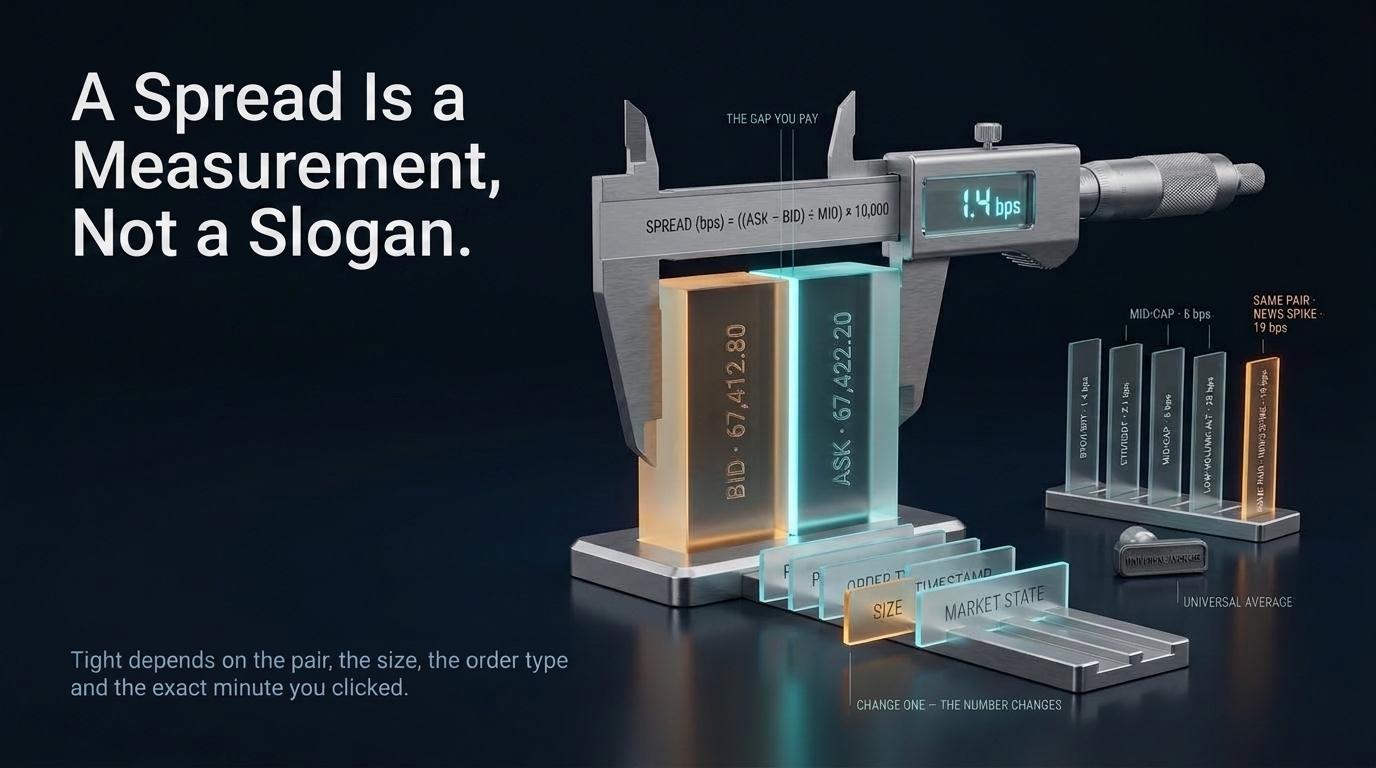
The bid ask spread is the difference between the lowest price at which a seller is willing to sell and the highest price at which a buyer is willing to buy. Because cryptocurrency prices vary widely, spreads are often easier to compare as a percentage or in basis points, rather than as a raw dollar amount.
Spread (bps) = ((Ask − Bid) ÷ Mid price) × 10,000
The mid price is the average of the bid and ask. One basis point equals 0.01%.
There is no universal number that qualifies as a low spread across every cryptocurrency. BTC/USDT may have a much tighter market than a low volume altcoin, while the same pair may widen during a sharp market move. A useful comparison must therefore control for the pair, position size, order type, timestamp, and market condition.
The 6 Step SPREAD Test at a Glance
Source: Identify where prices come from and separate market data from order execution.
Pairs and periods: Test the pairs and market conditions you actually trade.
Round trip cost: Add spreads, entry and exit commissions, slippage, and applicable fees.
Execution: Compare displayed prices with actual fills.
Account conditions: Check whether evaluation and funded accounts use the same pricing and rules.
Drawdown impact: Estimate how trading costs affect stops, profit targets, and loss limits.
This framework replaces a vague “low spread” claim with six questions that can be checked before paying for an evaluation.

Where Does the Pricing Come From? (Source)
The first step is to understand what the platform’s prices represent. Three terms that are often used interchangeably should be separated:
Market data source: The venue or provider supplying the displayed bid, ask, chart, and order book data.
Execution model: The process used to determine how a submitted order is filled.
Liquidity source: The market depth or pricing inputs used to model available size and price impact.
A platform may display data from a major exchange without routing a trader’s order to that exchange. This distinction is especially important in prop firm evaluations, where trading often takes place in a simulated environment.
Exchange referenced data can make prices easier to compare with the broader crypto market. However, it does not by itself prove that fills will match the exchange, that slippage will be minimal, or that the quoted spread will remain stable. Those outcomes depend on the firm’s execution logic and how accurately the simulation accounts for order book depth and position size.
Before choosing a firm, determine whether the account is simulated or connected to live trading and identify the exchange or provider supplying its prices.
Confirm whether the spread comes from a live order book or is generated internally, and whether position size affects the expected fill. You should also check whether the platform displays spread and estimated costs before confirmation and clearly documents how slippage is calculated.

Test What You Actually Trade (Pairs and Periods)
A firm can show competitive BTC spreads and still be expensive for a trader who focuses on SOL or lower liquidity altcoins. Testing should therefore reflect the strategy you intend to use.
A simple 3×3 spread test uses three markets and three conditions:
Three Markets
Start with BTC/USDT as the primary major market benchmark, then use ETH/USDT as a second liquid reference. The third market should be a pair that appears in your actual strategy, so the test reflects the costs you are likely to experience rather than only the platform’s strongest market.
Three Conditions
Observe each market during a normal, liquid period, a quieter period with less activity, and a volatile period or sharp market move. For every observation, record the pair, date and time, bid and ask, spread in basis points, intended position size, order type, and prevailing market condition.
Do not base a decision on one screenshot. A single quote may represent the best moment of the day rather than the typical experience. The median observed spread, the widest spread, and the time required for pricing to normalize provide a more useful picture.
This approach also prevents an unfair comparison. BTC/USDT on one platform should be compared with BTC/USDT on another platform at approximately the same time, not with a different pair or a quote captured under different volatility.

Calculate the Real Cost of a Trade (Round Trip Cost)
A spread is only one component of trading cost. The number that matters to a trader is the cost of opening and closing the position.
Estimated round trip cost = bid ask spread impact + entry commission + exit commission + slippage + applicable funding or platform fees
If a platform applies a separate spread or depth charge to every fill, use its published calculation rather than assuming the generic formula captures the full cost.
Consider this hypothetical comparison. Firm A displays a 0.02% spread and charges a 0.05% commission per side. After including the entry and exit commissions, its approximate round trip cost is 0.12% before slippage, funding, or other applicable fees.
Firm B displays a wider 0.04% spread but charges only 0.01% per side. Its approximate round trip cost is therefore 0.06% before the same additional costs.
Although Firm A advertises the tighter spread, its estimated round trip cost is twice as high in this example. Presenting the figures in this way makes the main point clear without relying on a table: the narrowest displayed spread does not necessarily produce the lowest overall trading cost.
For a complete cost review, include the bid ask spread or spread fee, commissions on both entry and exit, expected slippage, swap, overnight or funding charges, and any platform specific transaction fees. Separately, account for the evaluation price, any activation or upgrade fee, reset or retry costs, and applicable withdrawal charges.
Evaluation and activation fees are not charged on every trade, so they should be tracked separately from execution costs. They still matter when calculating the total cost of reaching a funded stage.
To compare firms fairly, convert every trading cost into both a percentage and a dollar amount for the same position size. A fee that appears small as a percentage can become meaningful when repeated across dozens of trades.

Compare the Quote With the Fill (Execution)
A tight quote has limited value if the order is regularly filled at a worse price. Execution analysis measures the gap between what the platform displayed and what the trader actually received.
A simple test is to:
Capture the displayed bid and ask before submitting the order.
Record the order type and position size.
Save the actual fill price and timestamp.
Calculate the difference between the expected and actual execution.
Repeat the test under normal and volatile conditions.
Market orders are designed to prioritize execution, not a guaranteed price. They may experience greater slippage when volatility rises or available depth is limited. Limit orders provide price control, but they may remain unfilled or receive only a partial fill, depending on the platform’s execution model.
Execution quality should therefore be assessed using several trades rather than one favorable or unfavorable example. Warning signs include recurring negative slippage, fill quality that deteriorates sharply as position size increases, large differences from the reference market, execution delays during active periods, and platform instability when volatility rises.
For active traders, a consistently accurate fill can be more valuable than the narrowest displayed spread.
Read the Rules Behind the Spread (Account Conditions)
Trading costs do not exist separately from prop firm rules. A pricing model that works for one strategy may be unsuitable for another because of drawdown calculations, holding restrictions, or differences between account stages.
Before purchasing an evaluation, verify whether spreads and commissions remain the same in the evaluation and funded stages and whether pricing changes by account type or platform. Review whether scalping is permitted, whether a minimum holding time applies, and whether news trading, overnight positions, weekend holding, or specific automated techniques are restricted.
Finally, establish whether drawdown is static, trailing, balance based, or equity based, when the daily loss limit resets, and whether unrealized losses can trigger a breach.

A low spread does not compensate for a rule that conflicts with the strategy. For example, a short term trader should not choose a firm based only on BTC pricing if the program imposes a holding time requirement that invalidates the intended approach.
The same principle applies to evaluation and funded accounts. If the fee schedule, execution logic, or available markets change after a trader passes, evaluation stage tests may not predict funded stage conditions. The rulebook should state whether those elements remain consistent.
Does the Cost Fit Your Strategy? (Drawdown Impact)
Prop evaluations combine a profit target with strict loss limits. Trading costs reduce the distance between current equity and those limits, even when the strategy itself is executed correctly.
Consider a hypothetical $10,000 account with a 3% daily loss limit, equal to $300. If a trader repeatedly uses $10,000 of notional exposure and pays an all-in cost of 0.10% per round trip, each completed trade costs approximately $10 before profit or loss. Ten round trips would consume about $100, one third of the daily loss allowance, before considering strategy performance.
The example is simplified, but it demonstrates why turnover matters. A scalper making frequent trades may be highly sensitive to spread, commission, and slippage. A swing trader may care less about the entry spread but more about overnight fees, funding charges, weekend rules, and the treatment of open equity.
Before buying a challenge, estimate:
Average gross profit target per trade
Average all-in cost per trade
Number of expected trades
Cost as a percentage of expected gross profit
Cost as a percentage of daily and maximum drawdown
A strategy should be tested after costs, not only on ideal chart entries. If the expected edge becomes marginal after realistic fees and slippage, the account may not suit the strategy even if its advertised spread looks competitive.

When a Low Spread Is Not the Lowest Cost Choice
A tight spread can reduce the cost of entering and exiting a position, but it represents only one part of the trading environment. Once commissions, slippage, account restrictions, and risk rules are included, the firm advertising the narrowest spread may no longer be the lowest cost option. The following situations show why a headline spread should never be evaluated in isolation:
Commission is high. A narrow spread can be offset by charges on both entry and exit.
Slippage is frequent. Poor fills can erase the benefit of a tight quote.
The strategy is restricted. Minimum holding periods or execution rules may make short term trading impractical.
Funded conditions differ. Pricing experienced during the evaluation may not continue after passing.
The risk model is unsuitable. An equity based daily limit can make open position costs and momentary volatility especially important.
The advertised number is a best case minimum. A “from” spread says little about the median cost during the trader’s actual session.
A low spread is valuable only when it remains competitive after commissions, execution costs, and account restrictions are included.
60 Second Checklist Before Buying a Challenge
Identify the market data and execution model.
Record BTC/USDT and ETH/USDT spreads.
Test at least one pair used in your strategy.
Calculate commissions on both entry and exit.
Compare displayed prices with actual fills.
Test normal and volatile market conditions.
Confirm evaluation and funded stage pricing.
Check strategy, holding time, and news restrictions.
Model total cost against the profit target and drawdown limits.
Save dated screenshots or trade records as evidence.
Final Takeaway
A low spread is not a badge that a crypto prop firm earns by publishing its best quote. It is a measurable outcome produced by the pricing source, traded pair, market condition, commission schedule, execution model, and account rules.
Before purchasing a challenge, use the SPREAD test to check the Source, test relevant Pairs and periods, calculate the Round trip cost, measure Execution, review Account conditions, and model the Drawdown impact.
The right firm is not necessarily the one with the smallest number on a landing page. It is the one whose documented and tested all-in conditions fit the way you trade.
Disclosure: This article is for educational purposes only and does not constitute financial advice. Crypto trading and prop firm evaluations involve substantial risk. Fees, spreads, execution conditions, and program rules can change, so verify the latest terms before purchasing an evaluation.
About the Creator
Sophie
Trader focused on Price Action & Order Flow.
Into crypto, fast execution, controlled risk, and quality setups.
Passing funded accounts and refining my trading every day.
Enjoyed the story? Support the Creator.
Subscribe for free to receive all their stories in your feed.
Comments
There are no comments for this story
Be the first to respond and start the conversation.