
Crypto Prop Firm Funded Accounts: What the $100,000 Promise Really Means
Beyond account balances: the rules and risks every trader should know.

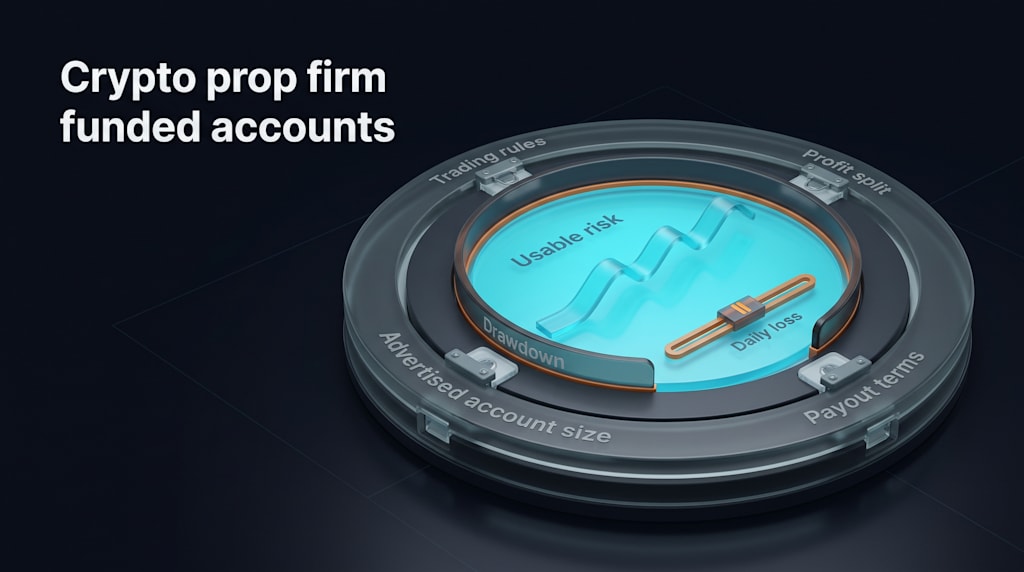
A $100,000 trading account sounds like a remarkable opportunity, especially for someone who has spent years developing trading skills but has limited capital to work with. Imagine being able to trade with a six figure balance without depositing that entire amount yourself. For many aspiring cryptocurrency traders, this is exactly what makes proprietary trading firms so appealing.
However, there is an important distinction between having access to an account displaying $100,000 and actually controlling $100,000 in personal trading capital.
The difference becomes clear when you examine the conditions behind these programs. A trader might receive access to an account with a large advertised balance but face strict restrictions on losses, position sizes, trading strategies, and withdrawals. Exceeding just one of those restrictions can result in losing access to the program, even if the trader has previously made profitable trades.
Traditional cryptocurrency trading requires individuals to use their own money, accept the risks of market fluctuations, and manage their capital independently. Funded trading programs introduce another arrangement: traders typically pay to participate in an evaluation process and, if successful, become eligible to trade under a firm's rules.
The appeal is understandable. Someone with a relatively small amount of personal capital may find the possibility of accessing a larger trading framework attractive. But the arrangement also introduces costs and contractual obligations that do not exist in exactly the same way when trading a personal account.
This creates a situation that deserves more attention than the headline account size usually receives. A large balance can make an opportunity appear more substantial than it really is, particularly when advertisements emphasize trading capacity without explaining the limitations attached to it.
That is why understanding funded accounts in crypto prop firm programs requires looking beyond promotional numbers. The real question is not how impressive an account balance appears on a dashboard. It is how the program operates, how much risk is actually available, and whether the conditions support a trader's long term strategy.
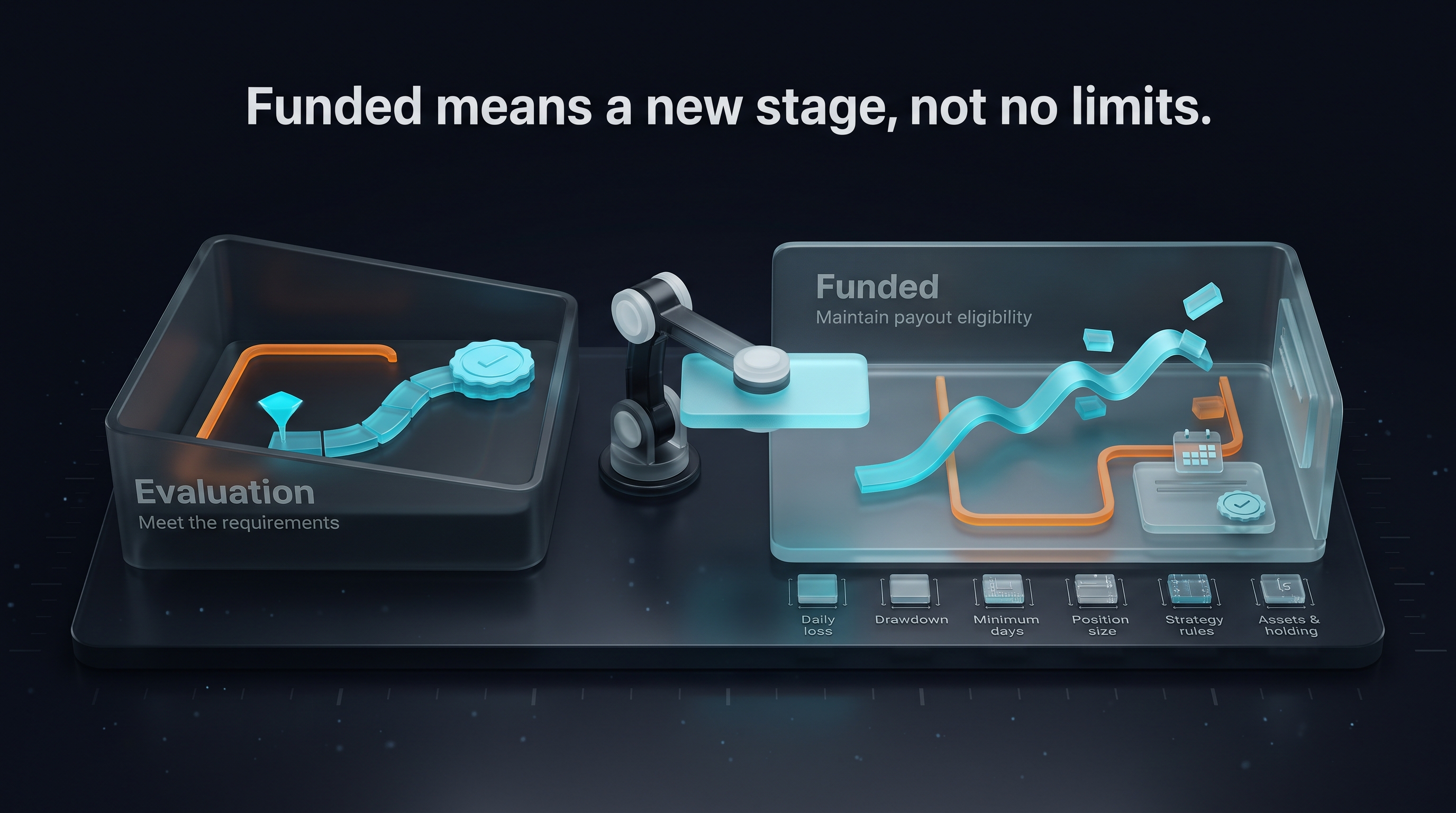
What Is a Crypto Prop Firm Funded Account?
A crypto prop firm funded account offers access to a trading arrangement governed by a company's performance requirements and risk limits. Understanding the underlying model is essential because not every program provides actual live trading capital.
Understanding the Funded Trading Model
A crypto proprietary trading firm is a company that provides traders with access to a structured trading program, usually involving an evaluation process and specific risk management requirements.
In many cases, participants begin by selecting an account size and paying a program fee. They then receive access to an evaluation account where they must demonstrate their ability to meet a performance objective without violating the firm's trading rules.
Successful participants may qualify for what the company calls a funded account.
However, the term "funded" does not have one universal meaning across the industry. The structure depends on the provider, its business model, and the agreement governing participation.
The account typically comes with restrictions on maximum losses, position sizes, permitted trading instruments, and payout eligibility. These restrictions help determine what the trader can actually do with the advertised balance.
Simulated Accounts Versus Live Trading Capital
Some firms provide simulated trading accounts and make contractual payouts based on eligible trading performance. Other companies may use live market execution, hybrid arrangements, or internal systems that replicate selected trading activity.
This distinction matters because a simulated balance is not the same thing as a bank deposit or personal investment account.
For example, a firm might advertise a $50,000 funded account. That figure may represent the nominal balance assigned to a trader within the firm's trading environment. It does not necessarily mean the company transfers $50,000 into an account owned by that trader.
Instead, the participant gains access to a particular set of conditions and potential contractual benefits.
Understanding what the account represents is therefore essential before paying an evaluation fee.

Why a $100,000 Account May Offer Less Risk Than Expected
A large advertised account balance does not necessarily translate into equally large trading flexibility. The actual amount of risk available depends on drawdown thresholds, daily loss restrictions, and how the firm calculates account performance.
Advertised Balance Versus Actual Loss Allowance
Consider a hypothetical trader who qualifies for a funded account displaying a $100,000 balance.
Now suppose the program imposes a maximum drawdown of 5% of the initial balance.
That would establish a loss threshold of $5,000, assuming the firm uses a fixed drawdown calculation.
The trader is not free to lose the entire displayed balance. Depending on the program, reaching that threshold could result in an immediate account breach.
This changes how the opportunity should be interpreted.
The advertised account size describes one aspect of the trading arrangement, while the maximum permitted loss determines how much negative performance the program can tolerate.
A trader who focuses exclusively on the displayed balance might underestimate how quickly several unsuccessful trades could threaten account eligibility.
How Daily Loss Limits Change Trading Decisions
Many programs also impose a separate daily loss limit.
Suppose the same hypothetical account permits a maximum daily loss of 2%, calculated from its starting balance. That would create a $2,000 daily loss threshold.
Even if the account remains above its overall drawdown threshold, exceeding the daily restriction could still end the evaluation or funded stage.
Daily limits may account for closed trades, open positions, commissions, or other costs. Some firms calculate them from the day's starting equity, while others use different reference points.
The precise formula can be more important than the percentage itself.
Understanding these calculations allows traders to assess whether their normal position sizes and expected losing streaks are compatible with the account.

The Evaluation Process: More Than Reaching a Profit Target
Most challenge based funded programs require traders to demonstrate profitable performance without breaking predefined rules. The evaluation therefore tests a combination of trading results, risk management, and the ability to follow instructions consistently.
How Trading Challenges Typically Work
Many crypto prop firms use evaluations to determine whether participants qualify for funded stage access. These challenges generally combine a performance objective with predefined risk restrictions.
For example, a program might require a trader to achieve an 8% profit target while remaining below its maximum daily loss and overall drawdown limits.
Other conditions may include minimum trading days, restrictions on specific strategies, or limitations on position sizes. Reaching the profit target does not necessarily guarantee success. A participant might achieve the required return but still fail the evaluation because a separate trading condition was violated.
This is why the complete evaluation agreement deserves attention before participation.
A seemingly attractive profit target may become difficult to achieve when combined with restrictive position limits or an unusually small drawdown allowance.
Why Rushing an Evaluation Can Backfire
Evaluations can create psychological pressure because traders often want to complete the challenge quickly.
Imagine someone who is approaching an 8% profit target after several successful trades. Feeling confident, they increase their position size in an attempt to finish the evaluation.
A sudden market reversal then causes the account to exceed its daily loss threshold. Even though the trader previously generated substantial gains, the violation may invalidate the entire attempt.
This illustrates the difference between producing short term profits and demonstrating consistent risk management.
Aggressive trading may occasionally produce fast results, but it can also make an account more vulnerable to ordinary losing streaks. An evaluation should not be interpreted as a reason to abandon the risk controls that support a trader's established strategy.
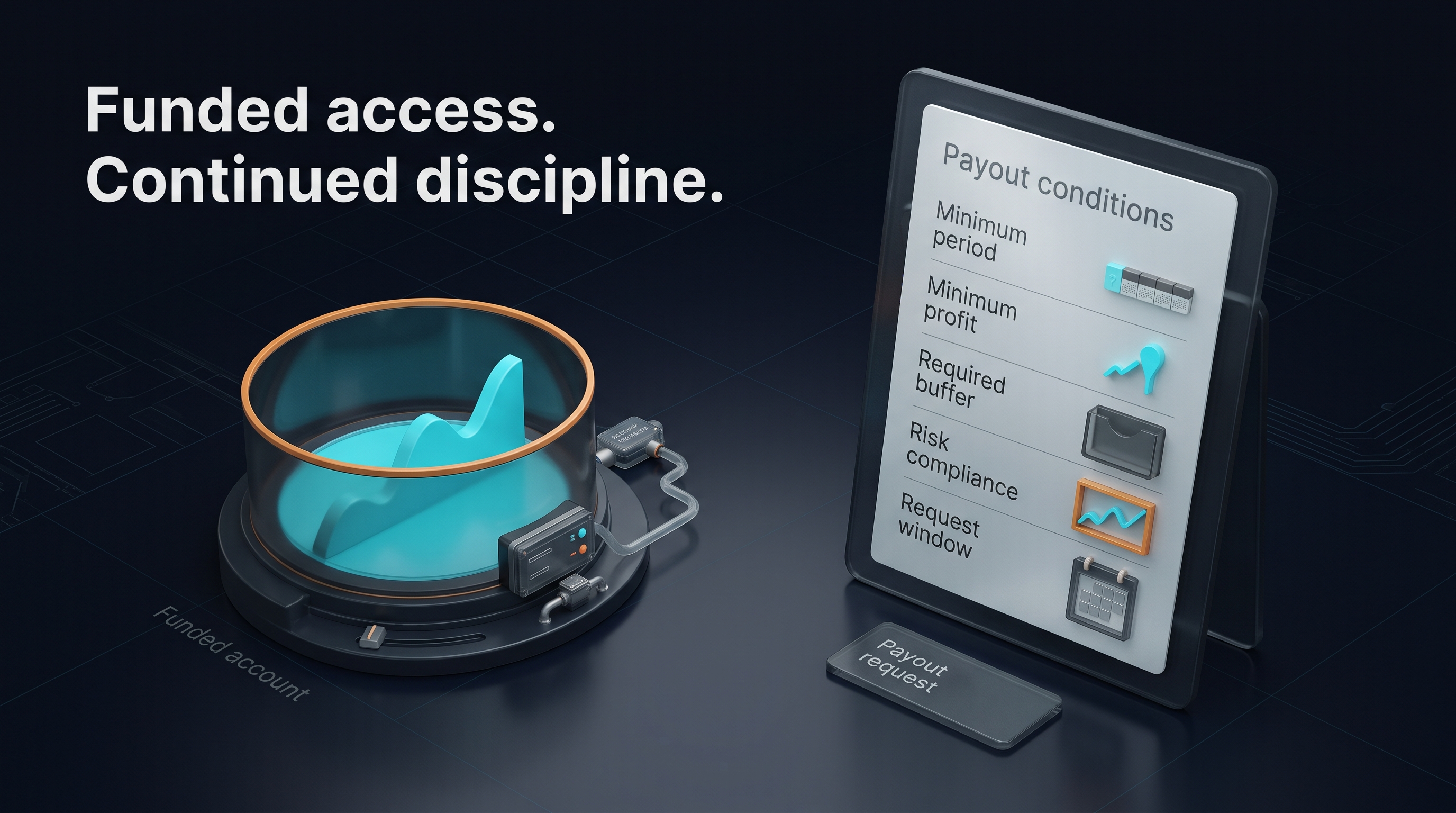
What Changes After a Trader Passes the Evaluation?
Qualifying for the funded stage changes the trader's immediate objectives, but it does not remove the need to manage risk. Account preservation and payout eligibility often become more important than reaching a single performance target.
Moving From Performance Targets to Account Preservation
Passing an evaluation is often presented as the major milestone in a funded trading journey.
In practice, it usually marks the beginning of a different stage.
During the evaluation, a trader works toward a particular performance target. After qualifying, the priorities often shift toward preserving account access, generating eligible profits, and satisfying payout requirements.
Some programs retain similar trading restrictions in both stages, while others introduce additional conditions.
For example, a funded stage account may require a minimum number of trading days before a withdrawal request can be submitted.
Other programs may apply consistency requirements or establish specific payout windows.
These conditions can influence how a trader manages positions and decides when to reduce exposure.
Why Funded Trading Requires Consistency
A strategy developed around completing an evaluation may not be appropriate for managing an account over an extended period.
A trader who qualifies through several unusually large positions might struggle to repeat that performance without violating risk limits.
Consistency becomes particularly important when losses occur.
In a personal account, losing trades directly reduce the trader's capital. In a funded program, losses may also move the account closer to a contractual threshold that could terminate access.
That creates an additional reason to monitor available drawdown carefully.
The funded stage requires more than the ability to identify profitable trading opportunities.
Participants must also demonstrate that they can operate within the same restrictions repeatedly, including during difficult market conditions.

Static and Trailing Drawdown: A Critical Difference
Drawdown calculations define the boundaries within which a funded trader must operate. Two programs offering identical account sizes and loss percentages may behave very differently depending on whether their limits are static or trailing.
How Static Drawdown Works
Maximum drawdown is one of the most important concepts in funded trading. It determines how far an account may decline before a breach occurs, but firms do not always calculate it in the same way.
A static drawdown typically uses a fixed threshold based on the starting balance or another predetermined reference point.
For example, a hypothetical $100,000 account with a static 5% maximum drawdown might have a breach threshold of $95,000. In this simplified arrangement, the threshold remains unchanged even if the account generates additional profits.
Static drawdown can make the risk boundary easier to understand because the reference level does not continuously move with performance.
However, traders must still confirm whether the firm measures losses using balance, equity, or another calculation method.
Why Trailing Drawdown Can Be More Restrictive
Trailing drawdown operates differently. Under this model, the loss threshold may increase as the account reaches new profit levels.
Imagine a trader starts with a $100,000 account and a hypothetical $5,000 trailing drawdown allowance. If the program measures the threshold from the highest account balance and that balance rises to $104,000, the breach level may increase to $99,000.
The trader's earlier profits have effectively changed the account's minimum permitted value. Some systems stop trailing after a certain point, while others use intraday equity highs or end of day balances.
These variations matter because a strategy with substantial temporary fluctuations may be more difficult to manage under certain trailing rules. A trader should understand exactly when the threshold moves and whether unrealized gains or losses influence the calculation.
The Real Cost of Joining a Funded Trading Program
The advertised evaluation fee is only one part of the financial commitment associated with funded trading. Traders should consider both the possibility of unsuccessful attempts and the additional expenses that may affect their results.
Evaluation Fees and Repeated Attempts
Funded trading can appear financially accessible because participants generally do not need to deposit the full advertised trading balance.
However, participation still involves costs. Most evaluation based programs charge an entry fee that depends on the account size, evaluation structure, or additional features.
The fee generally provides access to the program rather than ownership of the displayed balance.
If a participant fails the evaluation, the payment may be nonrefundable. Consider a hypothetical challenge costing $150. A trader who purchases three separate attempts and fails each one has spent $450 without reaching the funded stage.
If additional reset fees or platform charges apply, the total expense could be higher. Repeated evaluation attempts should therefore be viewed as a possible financial cost rather than an investment guaranteed to produce future income.
Trading Expenses Beyond the Entry Price
The evaluation fee is not always the only expense that matters.
Depending on the program, participants may encounter commissions, spreads, funding payments, platform charges, and other trading related costs.
These expenses can reduce trading returns and influence compliance with loss limits.
For example, a strategy that appears profitable before transaction costs may become less attractive once commissions and execution differences are included. A lower evaluation fee also does not necessarily indicate better value.
One program may charge less but impose restrictive drawdown conditions, while another may cost more and offer rules that better accommodate a particular strategy.
The relevant comparison involves the full cost structure and the conditions provided in return.

How Profit Splits and Payouts Actually Work
Profit sharing percentages often receive considerable attention in funded trading advertisements. However, the amount a trader can actually withdraw depends on how eligible profits are calculated and which payout conditions apply.
Understanding the Trader's Share of Profits
Profit sharing is a defining feature of many funded trading arrangements. Instead of retaining all eligible profits, participants typically receive an agreed percentage.
Suppose a hypothetical program offers an 80% profit split. If a trader generates $2,500 in eligible profit, their calculated share would be $2,000 before any additional deductions or conditions.
The remaining amount would be allocated according to the company's agreement. A higher profit split may appear attractive, but the percentage alone does not establish the practical value of a program.
Traders should also consider transaction costs, minimum profit requirements, payout schedules, and any restrictions that affect which profits are eligible for withdrawal. The actual agreement matters more than the promotional percentage.
Why Positive Trading Results May Not Be Withdrawable
A profitable account does not automatically mean that the trader can immediately request a payout. Some firms establish minimum trading day requirements or scheduled withdrawal windows.
Others require a particular profit threshold or impose consistency rules.
A participant could therefore finish a trading period with a positive balance while remaining ineligible to withdraw the calculated profit share.
Another consideration is what happens after a payout. Depending on the firm's rules, withdrawing profits may affect the account's available balance buffer or its relationship to the drawdown threshold.
These details can influence how much flexibility remains after receiving compensation. Before joining, traders should understand what qualifies as withdrawable profit and which conditions could cause a payout request to be delayed, reduced, or rejected.
Why Cryptocurrency Volatility Makes Funded Trading Challenging
The cryptocurrency market can create additional difficulties for traders operating under strict loss thresholds. Sudden price movements and changes in execution conditions may affect account eligibility even when a trading strategy appears reasonable under normal circumstances.
Rapid Price Movements and Execution Risk
Cryptocurrency markets can experience significant price movements over relatively short periods. For leveraged positions, relatively small market changes can create substantial fluctuations in account equity.
Liquidity conditions may also vary across trading venues and digital assets. During fast markets, an order may execute at a different price from the one a trader expected.
This difference, known as slippage, can increase the size of a loss. Spreads may also widen during periods of uncertainty or reduced liquidity. For traders operating under strict drawdown limits, these factors can be especially important.
A position may remain manageable according to the trader's original market analysis while becoming problematic under the funded program's risk calculations.
How Unrealized Losses Can Trigger Violations
Unrealized losses occur when an open position moves against the trader but has not yet been closed.
Some funded trading programs include these losses when calculating daily or maximum drawdown. That means a temporary market movement may trigger a rule violation even if the position later recovers.
Consider a trader who holds a leveraged position during a sudden period of cryptocurrency volatility. The position temporarily declines enough to cross the firm's equity based loss threshold.
If the program treats that event as a breach, a subsequent price recovery may not restore account eligibility. This highlights an important distinction between surviving a market movement and complying with the firm's risk limits.
Traders need to understand how open position fluctuations are measured before deciding whether their strategies are suitable for a particular program.

Choosing a Program That Fits Your Trading Strategy
A funded account should be evaluated according to the strategy a trader already uses rather than the strategy they hope to develop after joining. Holding periods, execution requirements, and restrictions on particular trading methods can determine whether a program is practical.
Different Strategies Require Different Conditions
Not every trading method is compatible with every funded program. A swing trader may hold positions for several days or weeks.
If a program prohibits overnight or weekend exposure, that trader's normal approach may not be practical. A short term trader might depend on rapid order execution and competitive spreads.
For that person, platform performance and trading costs could matter more than the advertised account balance. An algorithmic trader has another set of concerns.
Some firms allow automated trading systems, while others restrict certain forms of automation, copy trading, arbitrage, or high frequency strategies. Program selection should therefore begin with an examination of the strategy itself.
A trader should not assume that a method suitable for a personal account will automatically be permitted under a proprietary trading agreement.
Comparing Two Hypothetical Funded Accounts
Imagine two programs that both advertise a $100,000 account.
Program A charges a lower evaluation fee and offers a relatively high profit split, but it uses trailing drawdown and restricts overnight positions.
Program B has a higher entry cost and a slightly smaller profit split, but it offers static drawdown and allows longer holding periods.
Which program provides better value? The answer depends on the trader.
Someone who focuses on short term opportunities may be comfortable with Program A.
A trader who routinely holds positions through temporary market fluctuations may prefer Program B.
Other factors could still change the decision, including commissions, supported assets, evaluation targets, payout requirements, and platform reliability.
The example demonstrates why no single account characteristic should determine the choice. The most suitable program is the one whose complete operating conditions are compatible with the trader's actual method.

The Psychological Pressure Behind Funded Trading
Funded trading involves managing market uncertainty while complying with external performance requirements. This combination can influence a trader's behavior, particularly when approaching evaluation targets or recovering from losses.
When Profit Targets Encourage Excessive Risk
Trading already involves uncertainty, but evaluation programs can create additional psychological pressure. A trader is not simply responding to market conditions.
They are also trying to satisfy a performance objective while remaining inside contractual boundaries. This combination can encourage impatience.
Someone who is close to completing an evaluation may increase their position size unnecessarily. Another trader who experiences several losses may feel compelled to recover them immediately.
Such decisions can introduce risks that would not otherwise be part of a disciplined trading plan. The evaluation structure does not change the uncertainty of cryptocurrency prices.
It adds another set of consequences to decisions made under that uncertainty.
Developing Discipline Beyond the Challenge
A structured trading plan can help participants avoid making decisions solely in response to evaluation pressure.
The plan might define maximum risk per position, limits on daily trading activity, and circumstances under which trading should stop. A journal can also help traders assess their behavior.
Alongside trade entries and exits, participants may record remaining drawdown allowance, transaction costs, rule related mistakes, and emotional responses.
These records can reveal whether difficulties arise from the trading strategy, the program's restrictions, or inconsistent decision making. The objective is not to avoid every losing trade.
Losses are an unavoidable possibility in speculative trading. The objective is to manage exposure so that ordinary market fluctuations do not unnecessarily threaten the account or encourage impulsive behavior.
What Happens When a Funded Account Rule Is Broken?
A rule violation can have consequences beyond the immediate trading loss. Depending on the firm's policies, it may affect account access, evaluation status, or eligibility for future payouts.
Understanding Account Breaches and Termination
Rule violations can have serious consequences in funded trading. Depending on the provider and the type of breach, a violation may terminate an evaluation, suspend account access, invalidate particular trades, or affect payout eligibility.
Some companies distinguish between minor and major violations. Others apply strict termination conditions when specific loss thresholds are reached.
For example, exceeding a maximum daily loss limit might automatically end an account under one program. Another provider may offer corrective procedures for certain nonfinancial violations.
Because these policies vary, traders should review the relevant contractual terms before participating. Understanding the consequences of a breach is as important as understanding the profit target.
Technical Problems and Disputed Trading Results
Technical issues introduce another source of uncertainty. A platform interruption, delayed market data feed, or execution problem could affect trading performance.
It would be unwise to assume that every firm handles these situations in the same way. Some providers may have documented investigation procedures, while others may give the company substantial discretion under their terms.
Before purchasing an evaluation, traders should examine the procedures for reporting technical problems and challenging disputed results.
Clear rules cannot eliminate every disagreement, but they can help participants understand how a company is expected to respond.
Transparency is particularly valuable when account termination or payout eligibility depends on calculations performed by the platform.
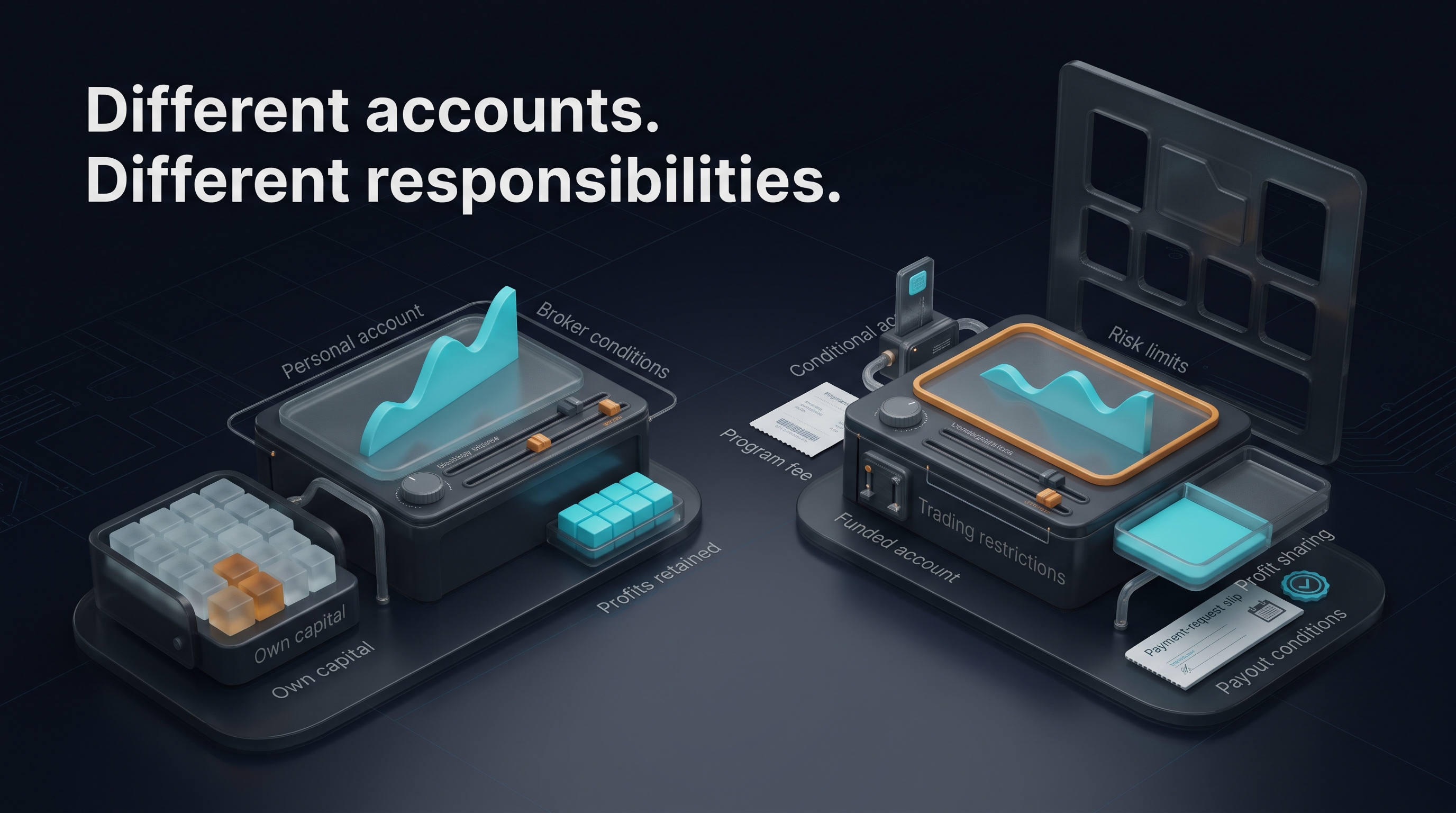
Funded Accounts Versus Personal Crypto Trading Accounts
Personal trading accounts and funded programs provide different combinations of capital access, flexibility, costs, and financial responsibility. Comparing these arrangements helps traders understand the practical compromises involved in each approach.
Greater Flexibility With Personal Capital
A personal trading account generally allows traders to use their own capital and retain the resulting profits or losses.
Subject to exchange rules, broker requirements, and applicable laws, traders may have more flexibility over their strategies and holding periods.
They do not ordinarily need to complete a proprietary evaluation to continue trading their own funds.
However, personal accounts also expose traders directly to financial losses. Someone who funds an account with $10,000 may lose part or all of that capital through unfavorable market movements, depending on the instruments and circumstances involved.
Greater flexibility does not mean lower risk. It means the trader operates under a different financial arrangement.
The Trade Offs of a Funded Program
Funded trading may allow someone to participate in a larger nominal trading environment without personally depositing the advertised balance.
However, the arrangement introduces evaluation fees, contractual restrictions, profit sharing, and the possibility of losing access after a violation.
These tradeoffs can make funded programs more attractive to some experienced traders than to others. Someone with sufficient personal capital might prefer the freedom of managing an independent account.
Another trader might value a predefined risk framework, provided the agreement is transparent and the fees are affordable.
Neither model automatically produces better financial outcomes. The choice depends on trading experience, financial resources, strategy compatibility, and tolerance for restrictions.
Who Should Consider a Crypto Prop Firm Funded Account?
Funded trading is not equally suitable for traders at every experience level. The ability to follow a tested strategy, understand risk limits, and absorb possible evaluation costs can influence whether participation is appropriate.
When Funded Trading May Be Worth Evaluating
Funded trading may be worth considering for individuals who already have experience following a structured trading strategy. Such traders may understand position sizing, losing streaks, transaction costs, and the importance of controlling exposure.
They may also possess trading records that help them estimate how their strategies could behave within a firm's drawdown limits.
Even then, participation should not be automatic. The evaluation cost must be affordable, the trading conditions must support the strategy, and the payout agreement should be clear.
A trader should also understand that successful performance during a short evaluation period does not guarantee continued success. The relevant question is whether the entire arrangement makes practical sense under realistic market conditions.
Why Beginners Should Approach Challenges Carefully
Beginners face additional difficulties. Someone still learning how cryptocurrency markets operate may struggle to manage both trading decisions and complex program restrictions.
The desire to reach an evaluation target can distract from developing a consistent trading process. Repeatedly purchasing challenges while testing an unproven strategy may also become expensive.
For inexperienced traders, practicing in a simulated environment without significant participation fees may provide a more suitable starting point.
Learning to manage risk, record trading decisions, and evaluate performance can be valuable before entering a restrictive program. A funded account should not be viewed as a shortcut around the experience needed to trade responsibly.
Five Questions to Ask Before Paying an Evaluation Fee
Reviewing a program's terms before making a payment can prevent misunderstandings about trading conditions and financial obligations. Five questions provide a useful starting point for assessing the structure, restrictions, and payout arrangements.
Questions About Account Structure and Trading Rules
Before purchasing an evaluation, traders should investigate three fundamental issues.
1. What does the advertised account balance represent?
Determine whether the program uses simulated trading, live execution, or another arrangement. Understand whether the balance represents actual allocated capital or a notional figure.
2. How are daily loss and maximum drawdown calculated?
Check whether the limits use balance or equity, how unrealized losses are treated, and whether the drawdown is fixed or trailing.
3. Are the trading restrictions compatible with the strategy?
Review limits involving leverage, holding periods, position sizes, automated systems, supported assets, and prohibited activities.
These questions establish whether the account can realistically accommodate the trader's approach.
Questions About Payouts and Account Protection
Two additional questions address the financial and operational consequences of participation.
4. What conditions must be met to receive a payout?
Examine profit splits, minimum thresholds, payout schedules, applicable fees, and circumstances that could affect eligibility.
5. What happens after a rule violation or technical dispute?
Read the policies relating to account termination, evaluation resets, platform problems, and dispute resolution.
If a provider does not clearly explain these conditions, that uncertainty should influence the decision.
A trading program should be assessed through its documented terms rather than assumptions about how funded accounts normally operate.
The Most Important Lesson About Crypto Funded Accounts
The attractiveness of a funded trading program should be measured by the opportunities and limitations created by its actual rules. Looking beyond the account balance helps traders make more informed decisions about costs, risk, and strategy compatibility.
Why Account Size Is Not the Best Measure of Value
The popularity of funded trading programs reflects an understandable desire to access greater trading opportunities without committing an equally large amount of personal capital.
However, the apparent simplicity of these offers can be misleading.
A $100,000 account is not necessarily $100,000 in personally owned funds.
A successful evaluation does not guarantee future profitability.
A high profit split does not ensure that every positive trading result will qualify for withdrawal.
Behind every advertised account is a set of rules that determines how the program actually operates.
Those rules influence the amount of risk available, the strategies permitted, and the conditions under which a trader may receive compensation.
The account's practical value comes from these conditions rather than its headline balance.
Making a Decision Based on Rules, Not Promises
For experienced traders with established methods and realistic expectations, a funded trading program may offer a structure worth evaluating.
For traders who are still developing their skills, the same arrangement may introduce unnecessary expenses and psychological pressure.
There is no universally suitable funded account.
The decision depends on whether the program's costs, trading environment, drawdown calculations, restrictions, and payout conditions match the individual's circumstances.
That assessment requires more than reading promotional claims or comparing advertised account sizes.
It requires examining the agreement and understanding how the rules will affect real trading decisions.
Ultimately, the value of a funded account cannot be measured by its headline balance alone.
In crypto funded trading, the rules behind the account are often more important than the size of the account itself.
Disclaimer: This article is for educational and informational purposes only and does not constitute financial or investment advice. Cryptocurrency trading involves substantial financial risk. Funded trading program conditions vary by provider, and all numerical examples are hypothetical. Readers should independently review any program's current terms and consider their financial circumstances before participating.
About the Creator
Sophie
Trader focused on Price Action & Order Flow.
Into crypto, fast execution, controlled risk, and quality setups.
Passing funded accounts and refining my trading every day.
Enjoyed the story? Support the Creator.
Subscribe for free to receive all their stories in your feed.
Comments
There are no comments for this story
Be the first to respond and start the conversation.