
Crypto Prop Firm Earnings: What Traders Actually Keep After Fees and Rules
The real numbers begin where advertised profits end.


A trading dashboard displays $3,200 in profit. The figure is green, the positions are closed, and the month appears to have ended successfully. Yet the amount visible on that screen may be different from the amount a trader can request, and different again from the money ultimately received.
There might be a contractual profit split. The firm might require a particular payout date, a minimum number of trading days, or another eligibility check. The trader may also have paid for an unsuccessful evaluation before qualifying for the current account. None of those details necessarily appears beside the headline profit figure.
This creates a distinction that matters more than any impressive screenshot: trading performance is not the same thing as personal income. A crypto prop arrangement may provide a way to participate in a performance based trading program, but the financial outcome depends on the complete contract, not just the return shown by a platform.
Imagine that the $3,200 figure belongs to a hypothetical participant whose agreement awards 80% of eligible net trading profit. If the full amount qualifies, the contractual share is $2,560. Suppose the trader previously spent $300 on evaluation attempts and incurs $40 in other personal expenses. The amount remaining after those costs is $2,220, before any personal taxes. If the account is not eligible for a withdrawal yet, however, $2,220 is not money the trader has received. It is only an illustrative estimate contingent on payment.
That distinction is the starting point for understanding crypto prop firm earning. A large account allocation, an attractive split, and an outstanding trading week can all appear promising without answering the practical question: what can the trader actually keep? The answer requires separating hypothetical trading profit from qualifying rewards, completed payouts, personal costs, and the possibility of receiving nothing at all.

What Counts as Crypto Prop Firm Earnings?
The word earnings can refer to several different figures within the same trading program. Before estimating income, it helps to identify which figure is being discussed and whether it has actually become payable.
Trading Profit vs Eligible Payouts
Trading profit is the gain recorded by an account over a defined period, subject to how that platform measures realized and unrealized results. A positive account statement does not automatically establish a right to withdraw the same amount. In many programs, contractual rules determine whether a result qualifies for a reward and when a payment can be requested.
Three stages are worth distinguishing. Recorded profit is a performance measurement. Eligible payout is the amount the provider determines may be requested under its rules. Received payout is the money actually delivered through an accepted payment method. A trader can reach the first stage without reaching the second or third.
Why Funded Account Size Is Not Personal Income
A program advertised as a $100,000 funded account does not normally mean that $100,000 is transferred to the participant as personal property. Account sizes may represent a simulated allocation, notional buying capacity, or another contractual trading arrangement. Some providers use simulated trading and calculate rewards from eligible performance; others may operate differently.
Likewise, an account designation tells readers little about the funds available for losses. A $100,000 account with a strict loss floor can offer substantially less room for adverse price movement than the headline number suggests. The actual threshold depends on whether limits are static, trailing, balance based, or equity based.
How Are Crypto Prop Firm Earnings Calculated?
A basic estimate begins with eligible trading profit and the trader's contractual percentage. To estimate what remains after participation, however, a separate calculation must account for expenses and distinguish expected payment from a completed one.
Understanding Gross Profit and Profit Splits
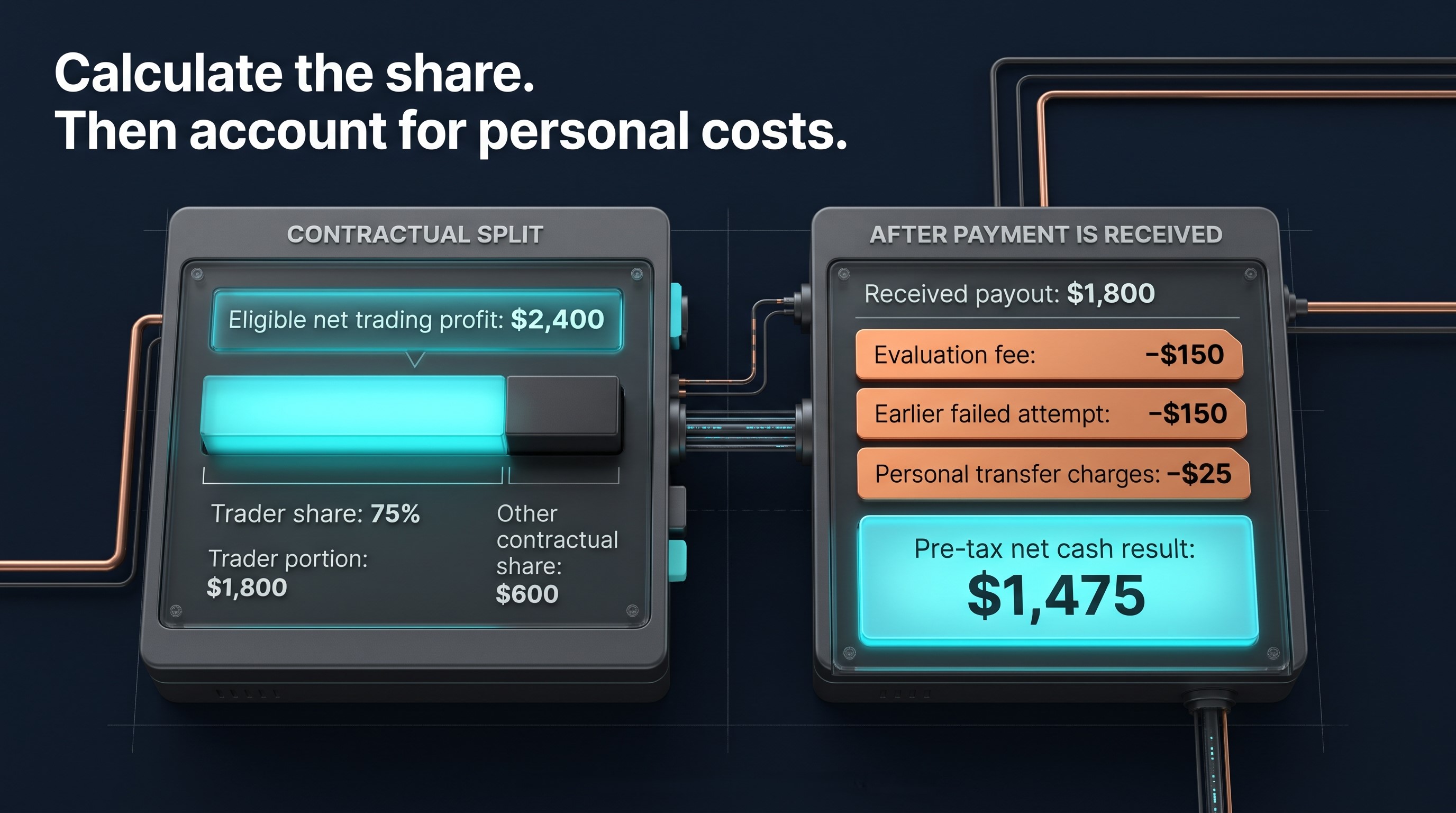
For a simple hypothetical example, suppose a funded arrangement records $2,400 of eligible net trading profit and offers the trader a 75% share. The calculated trader portion is $2,400 × 0.75 = $1,800. The remaining $600 belongs to the other side of the contractual split, assuming no additional adjustments.
It is also important to know what net trading profit means in that particular program. Trading commissions, spreads, and funding charges may already be reflected in the platform result. Subtracting them again would double count expenses. Conversely, a marketing illustration based on gross returns might omit costs that reduce the relevant profit figure.
A meaningful estimate starts with a clearly defined profit base. The split should be applied only to the amount the contract treats as eligible.
Calculating Net Earnings After Costs
Personal net earnings answer a different question: after the trader's own relevant costs, how much value remains? Consider an entirely hypothetical case in which an eligible payout of $1,800 is actually received. The participant paid a $150 evaluation fee, another $150 for a failed earlier attempt, and $25 in personally borne transfer charges. Their remaining amount is $1,475 before taxes.
That calculation should not be confused with the firm's account profit. Evaluation fees are typically a participant's personal expense, not a loss automatically deducted from trading equity. Transfer charges, currency conversion, and local tax obligations also need separate treatment where applicable.
The essential formula is simple: received payouts minus personally incurred costs equals a pre tax net cash result for the chosen period. If no payout was received, a positive account performance figure does not change cash received into income.
The Costs That Can Reduce Funded Trading Income
Costs can accumulate before an account ever reaches the reward stage. Ignoring them can make a profitable month look more financially meaningful than it is when viewed across the full participation history.
Evaluation Fees, Resets, and Failed Challenges
Some providers charge a one time fee to enter an evaluation. Others offer different prices for account tiers, resets, or repeated attempts. Refundability varies and may depend on reaching specific milestones; no fee should be presumed refundable without explicit terms.
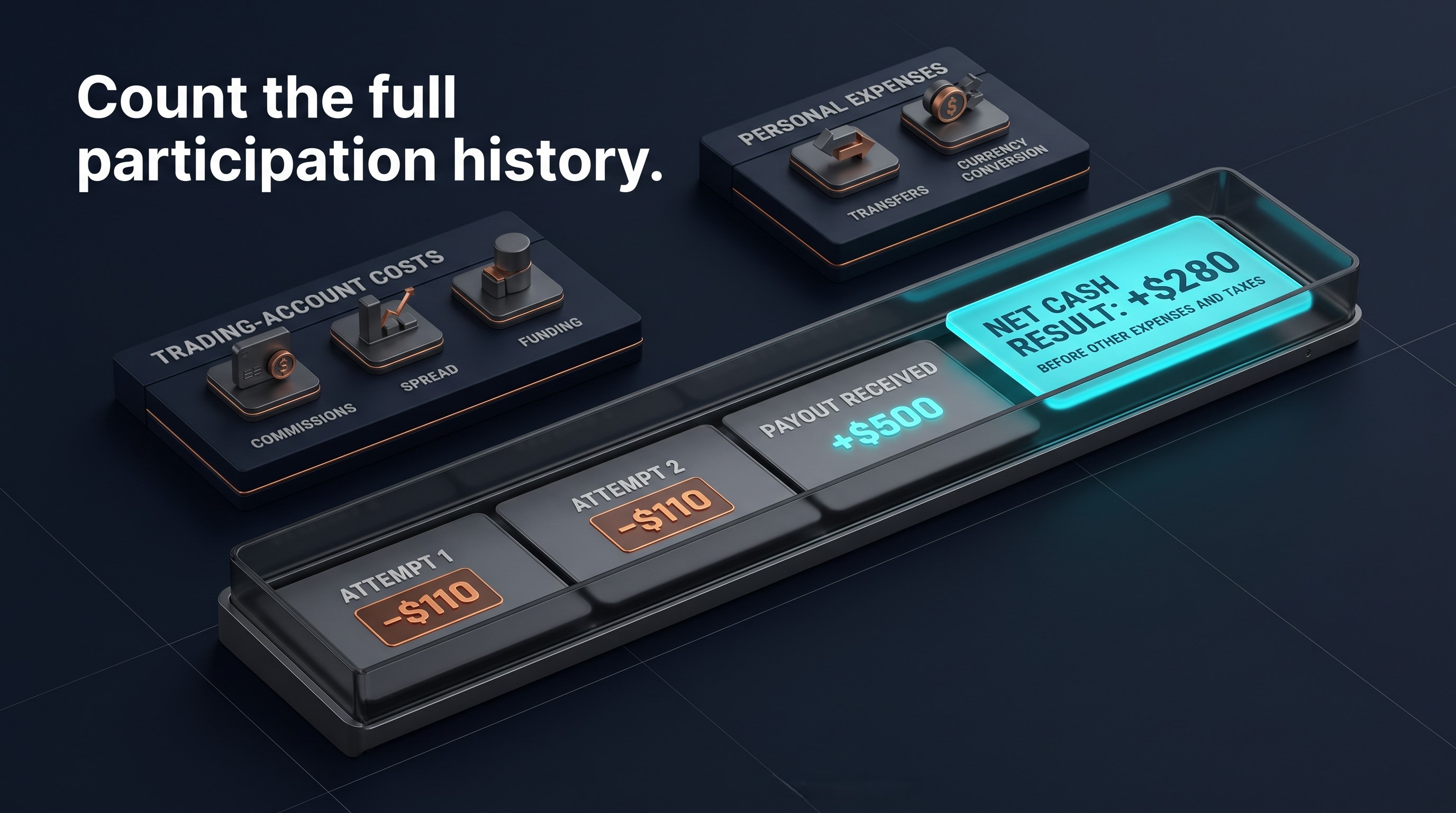
Suppose a person pays $110 for an evaluation that ends after a rule violation, then purchases a second attempt for $110. If that second attempt eventually produces a $500 received payout, the total pre tax cash result from this simplified sequence is $280 before other expenses. The example is not a prediction of the number of attempts someone will need. It shows why the entire cost history matters.
Trading Expenses and Withdrawal Related Costs
Crypto trading may involve commissions, bid ask spreads, and, for certain perpetual contracts, funding payments. Depending on the provider's accounting method, these costs can reduce the account result that is used to calculate qualifying profit. A small advantage before expenses may become negligible after them.
Withdrawal arrangements introduce another layer. Payment processors or blockchain networks may charge fees, and moving between currencies can involve conversion costs. Whether the firm or the recipient bears those costs depends on the payout method and contract.
Traders should ask for a complete fee schedule and distinguish trading account deductions from out of pocket expenses. The same expense should never be deducted twice in an earnings estimate. Equally, a payout calculation should not quietly ignore fees incurred before that payout became possible.
Why Profitable Months Do Not Always Produce Payouts
A positive account result may coexist with an unpaid or ineligible reward. That is why earnings discussions should include the operational path from performance to payment, not only the profit percentage.
Payout Eligibility and Withdrawal Conditions
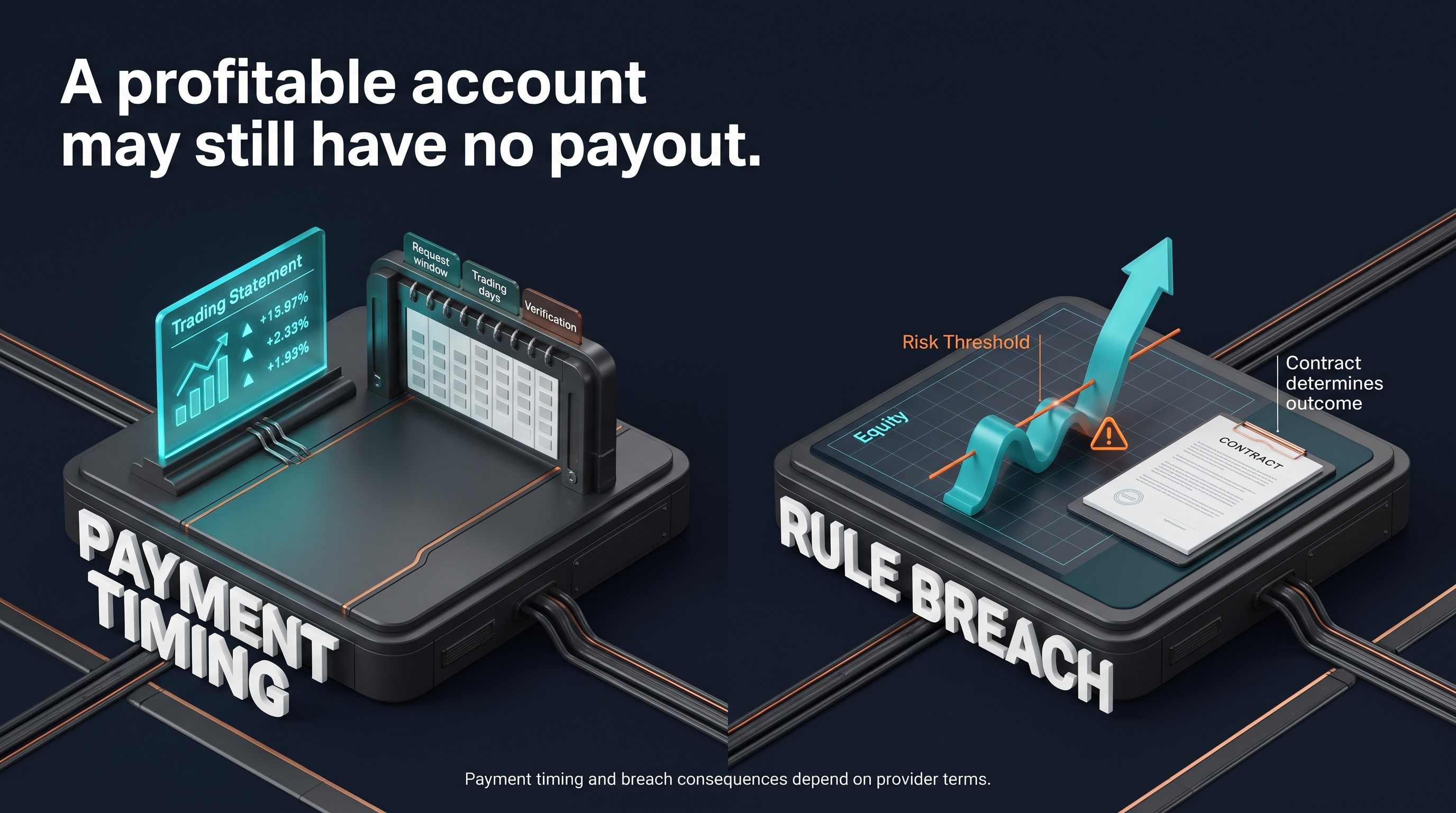
Some programs use scheduled payout windows, minimum eligible profit amounts, minimum trading days, or additional review periods. Others restrict requests while particular positions are open or while account verification is incomplete. Exact requirements differ, so no single payout calendar applies to the entire industry.
Consider a trader who finishes a hypothetical month with $900 in qualifying profit but has not yet reached the next permitted request date. The account may show a potential reward, yet the trader cannot count it as received cash that month. If the rules require another condition to be met, even the qualifying status may remain uncertain.
How Drawdown Violations Affect Earnings
Drawdown limits are especially important because they can invalidate an account even after a period of profitable trading. Daily loss limits may use a session specific reference point, while maximum loss limits may apply across the account's lifespan. Some rules track open position equity, meaning temporary unrealized losses can count toward a breach.
Imagine an account that begins a day at a stated reference value and later shows a sharp unrealized loss. If its equity falls below the contract's daily threshold, the program may classify the account as breached, even if the market subsequently reverses. The precise consequence depends on the agreement; it is not safe to assume that a recovery erases the earlier violation.
What Do Realistic Crypto Prop Trading Income Scenarios Look Like?
A single profitable month is a poor basis for assuming regular income. Comparing different outcomes across several periods makes the uncertainty visible without pretending to know a typical trader's future returns.
Comparing Profitable, Flat, and Losing Months
Imagine a hypothetical participant who receives $1,000 during one month, $0 the following month, and $600 in the third. The three month total received is $1,600, or approximately $533 per month when averaged. Neither the $1,000 best month nor the $533 average guarantees what happens next.
A flat trading month might produce no payout despite incurring personal overhead. A losing month could leave the account active, trigger a reset, or cause a breach, depending on its size and the agreement. These possibilities cannot be captured by multiplying a fixed positive monthly return by twelve.
For readers comparing income opportunities, the most informative figure is often not a percentage return but a timeline of money actually received, alongside costs and periods with no payment. Even a historical timeline remains descriptive rather than predictive.
A Six-Month Hypothetical Payout Example
The following illustration tracks money received, not simulated account returns. Assume a participant incurs $240 in evaluation fees during month one and $20 in personally paid transfer fees during month four. All values are invented solely to demonstrate cash flow variability.
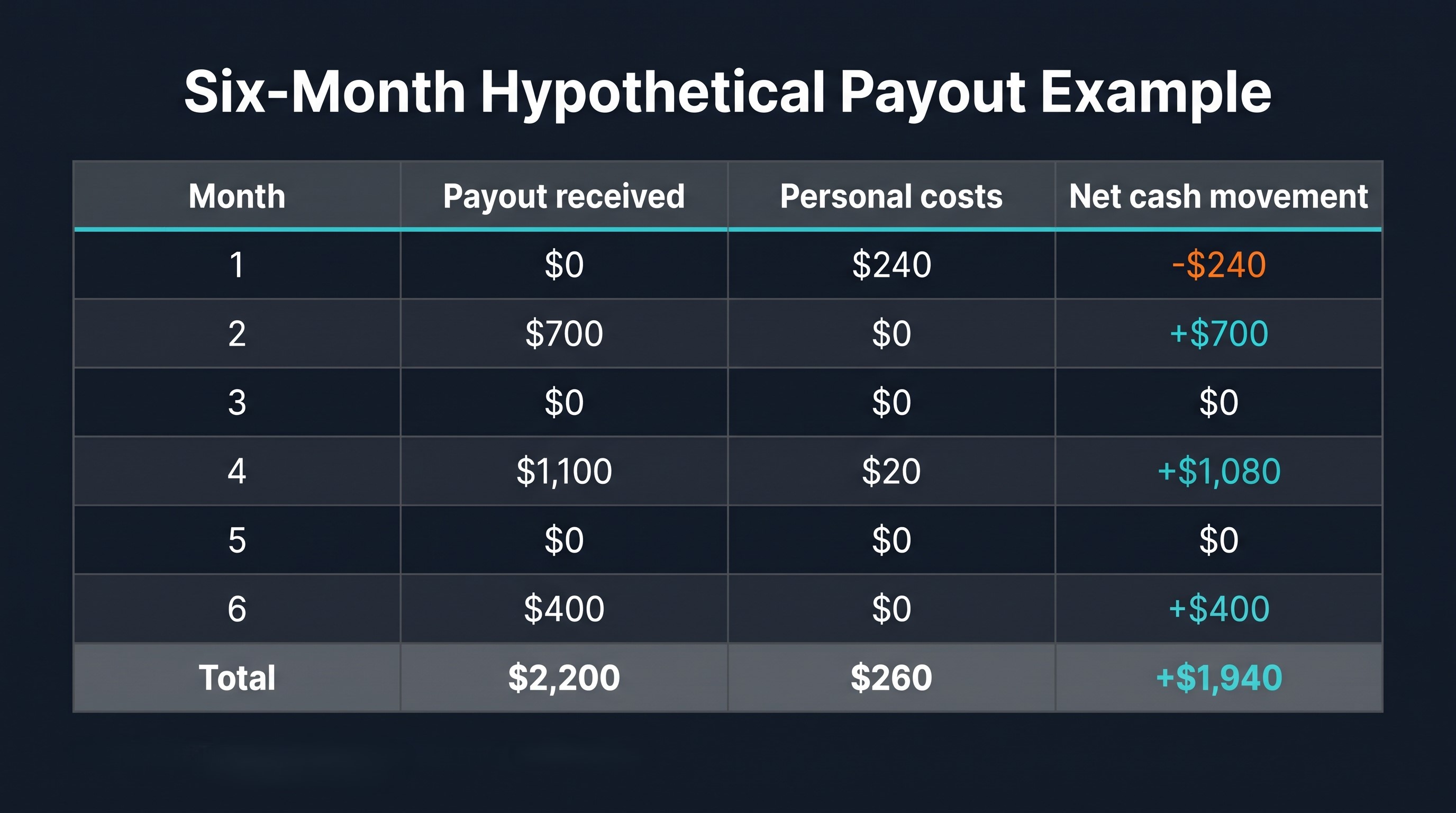
The hypothetical net cash result is $1,940 before taxes over six months. That is roughly $323 per calendar month when averaged, despite a single payout exceeding $1,000. The gap illustrates how selecting only the strongest month can exaggerate the appearance of dependable income.
Can Crypto Prop Firm Earnings Become Reliable Income?
Some participants may receive repeated payouts, but reliability cannot be inferred from a program's advertised account size or split. Assessing trading as a source of living expenses requires examining uncertainty, timing, and downside risk together.
Income Volatility and Irregular Payouts
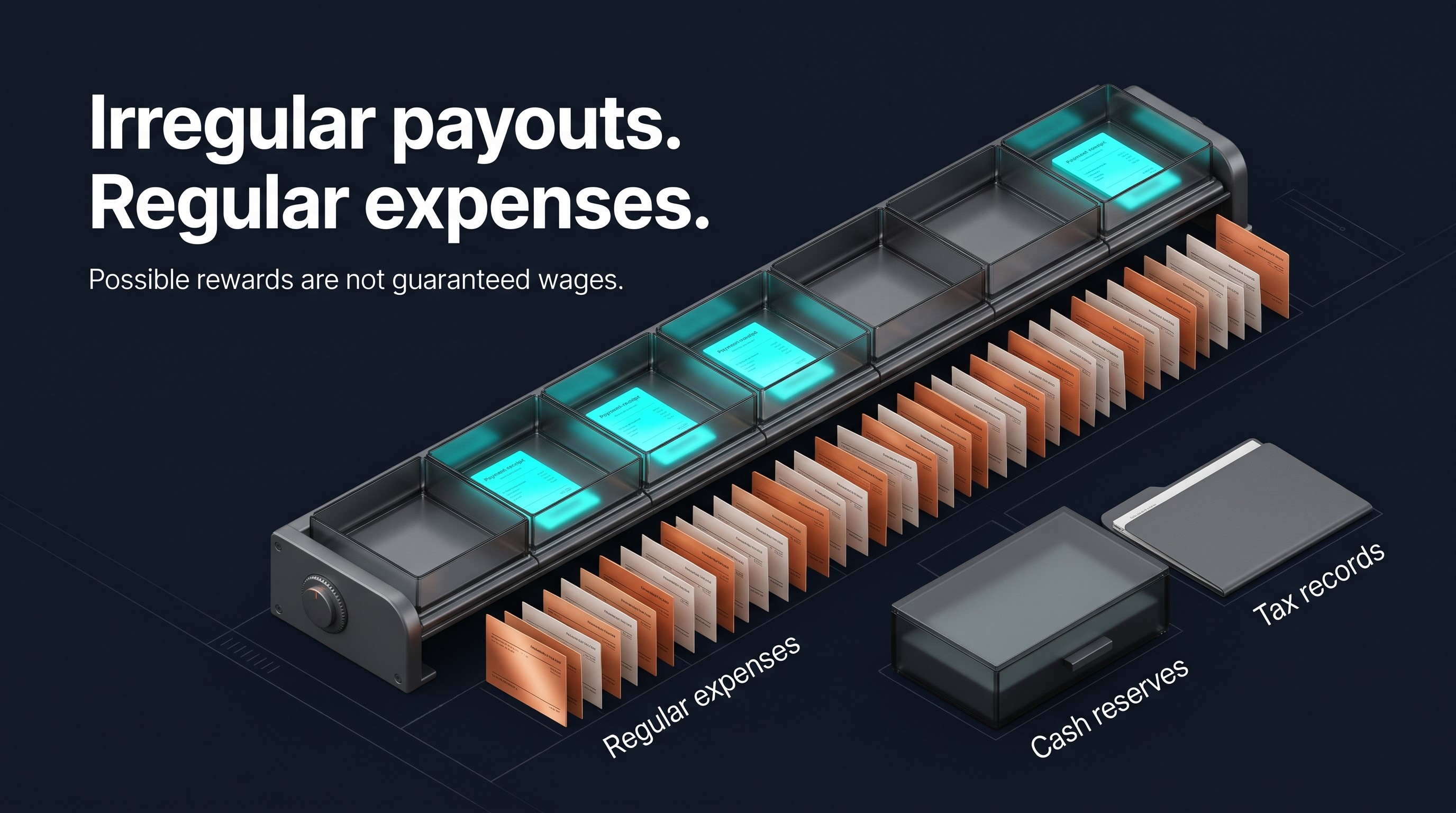
Trading outcomes vary because market conditions, strategies, and execution results vary. Payment timing may also be affected by provider specific rules or administrative review. Even profitable trading activity does not ensure that cash arrives on a predictable schedule.
A person considering funded trading alongside employment or freelance work should distinguish between recurring contractual wages and contingent performance rewards. A trading arrangement generally does not promise payment merely because the participant spends time at a screen. Some months may produce a reward; others may produce none.
Why Financial Reserves and Taxes Matter
Irregular receipts can create financial pressure when fixed living expenses arrive on predictable dates. That mismatch deserves attention before trading proceeds are described as a replacement for ordinary income. Money that may or may not arrive after a future review is not equivalent to cash already available for rent, bills, or emergencies.
Tax treatment also depends on the person's jurisdiction, contractual relationship, and nature of the payment. Performance based compensation should not automatically be assumed to receive the same treatment as personal capital gains. Keeping accurate records of received payments, costs, and account agreements can make later reporting easier.
No universal income or tax projection is appropriate without individual details. The safer analytical habit is to separate pre tax contractual rewards, actual cash receipts, and obligations that may reduce disposable income.
Does a Larger Funded Account Mean Higher Earnings?
Increasing the nominal account allocation can change the arithmetic of potential rewards. It does not automatically improve a trader's decision making, increase the percentage of profits that qualify, or reduce the chance of breaching an account rule.
Account Allocation vs Usable Risk Allowance
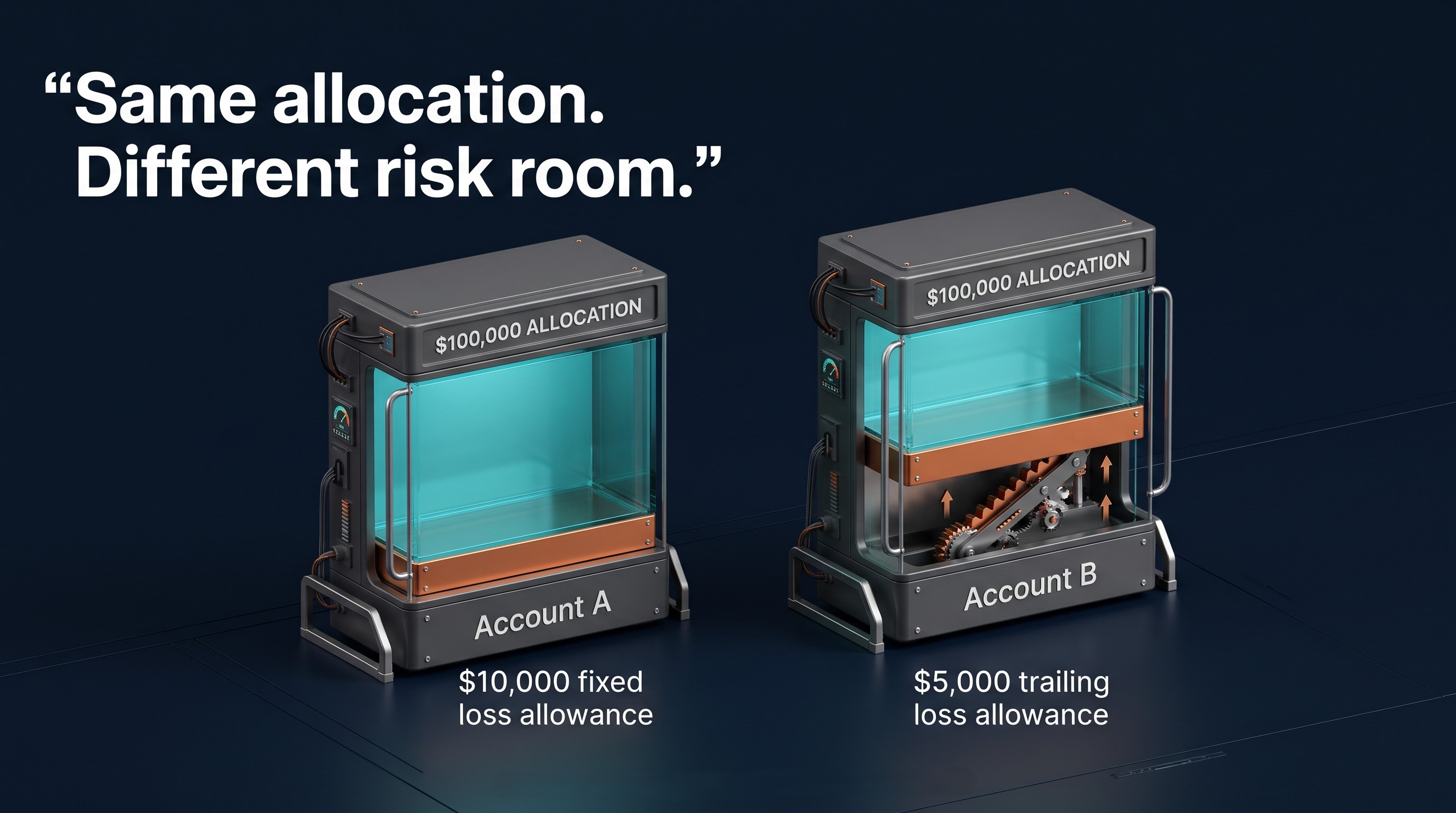
Compare two entirely hypothetical accounts, both labeled $100,000. Account A has a fixed overall loss allowance of $10,000. Account B has a $5,000 trailing allowance that may rise after new account highs. The label is the same, but their risk capacity and loss floor behavior are not.
What matters to a particular trading approach is how normal fluctuations interact with those restrictions. A strategy that allows large unrealized swings could encounter a trailing equity threshold much sooner than a fixed balance threshold. Position sizing may need to be substantially different across the two programs.
Account size can also obscure ownership. Even when trades are described as taking place in a funded account, the participant may not own the stated allocation. It is better to discuss contractually permitted exposure and reward eligibility than to imply that account size is available personal wealth.
Scaling Programs and Their Limitations
Some providers describe scaling opportunities under which a participant may qualify for a larger account allocation after satisfying performance and conduct conditions. These arrangements vary widely, including eligibility periods, maximum allocations, and continuing risk rules.
A larger allocation could raise the dollar amount of a future eligible gain if all other assumptions remain unchanged. Yet the trader must still produce that gain, respect applicable limitations, and satisfy payout requirements. Scaling is therefore a conditional feature, not a promise of increasing personal income.
Crypto Prop Firm Earnings vs Personal Trading Profits
Proprietary trading programs and trading with personal capital involve different ownership arrangements and cost structures. Neither can be evaluated fairly by comparing percentage returns alone.
Profit Ownership and Capital Exposure
A self funded trader generally trades assets or account equity they own, subject to exchange terms, leverage obligations, and market risks. Their realized gains and losses affect their own capital directly. By contrast, a participant in a prop program typically acts under a contract that defines evaluation fees, account conditions, and a possible share of qualifying performance.
This can change the form of financial exposure. Someone paying only an evaluation fee may have a defined initial participation expense under a particular agreement, while a self funded trader risks personal trading capital and may face additional liabilities if leverage arrangements allow them. Neither description should be assumed without checking the applicable contract.
The financial trade off is not simply access to a larger number on a dashboard. It includes who owns the underlying funds, who bears trading losses, what fees are charged, and whether gains become withdrawable under clear conditions.
Comparing Net Outcomes Under Different Conditions
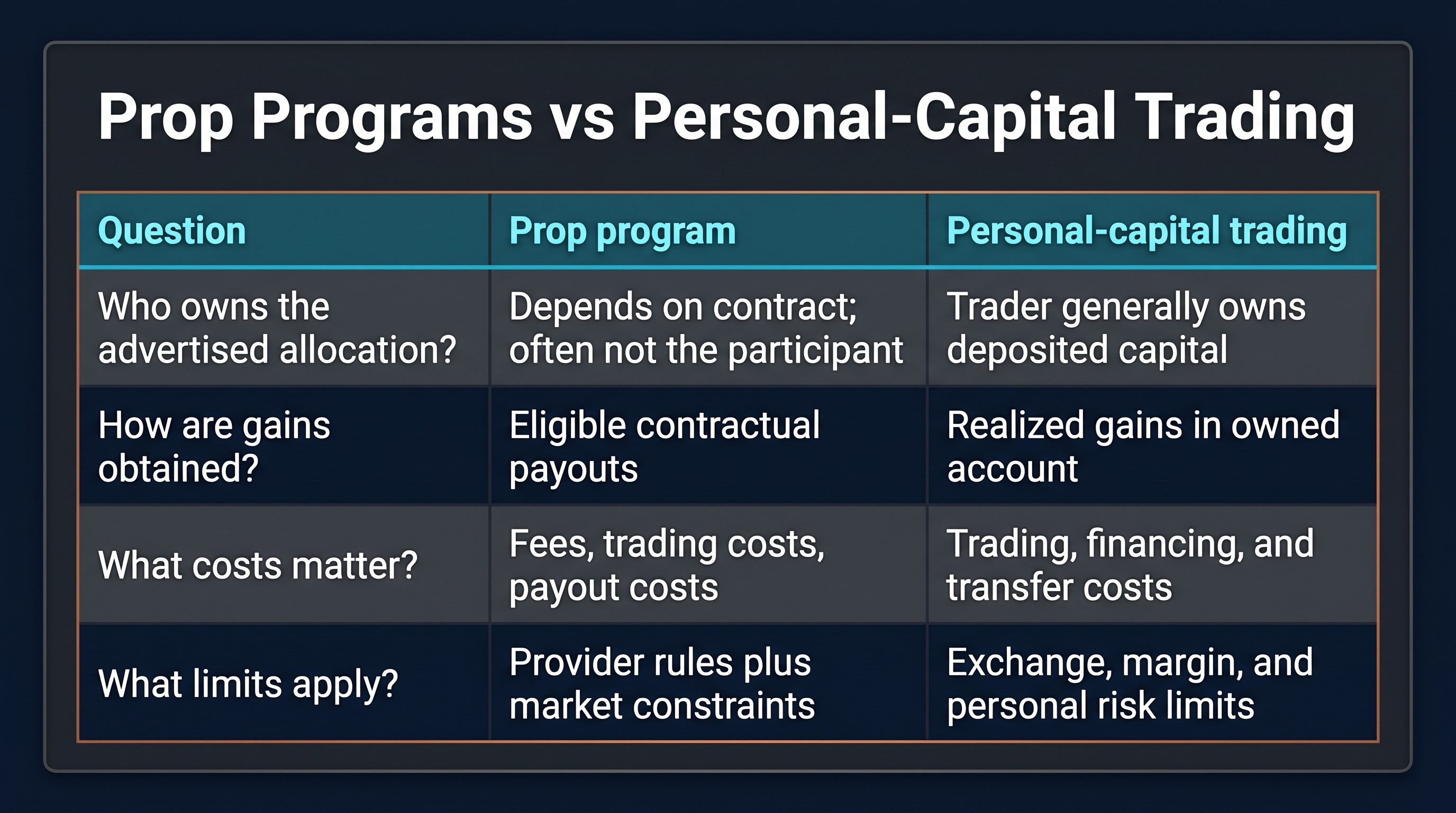
Suppose a hypothetical self funded account and a hypothetical prop account each report $1,000 in eligible or realized trading profit over a comparable period. The self funded trader's result belongs to their account before associated costs and taxes. The prop participant may receive only a contractually defined percentage, and only if all payout conditions are met.
On the other hand, the capital committed, loss exposure, and fees may differ significantly. Comparing the two models responsibly therefore requires looking at actual cash invested or spent, permissible risk, ownership rights, and realized receipts, not just the two profit figures.
A compact comparison captures the distinction:
How to Evaluate Crypto Prop Firm Earning Potential
A useful estimate should be built from verifiable contract terms and cautious assumptions. It should also survive a scenario in which trading is flat, a challenge fails, or a payout is delayed.
Questions to Ask Before Paying for a Challenge
Start with the agreement rather than the marketing headline. Ask what the account balance actually represents, whether performance is simulated, and how trading profit becomes an eligible payout. Confirm the profit split, any minimum payout amount, the timing of requests, and conditions that could disqualify a withdrawal.
Risk rules deserve equally close attention. Determine whether daily and maximum loss limits are based on balance or equity, whether a trailing threshold moves with new highs, and whether prohibited strategies or inactivity requirements apply. These rules may have a greater effect on practical eligibility than a small difference in the published profit split.
Finally, identify all participation costs and inspect the provider's operational transparency. Understand the consequences of failed evaluations, fee refund language, dispute procedures, and supported payment methods. If important terms remain unclear, the calculation is incomplete; a precise looking earnings estimate cannot repair missing contractual information.

Building a Risk Aware Earnings Estimate
A practical estimate can use three scenarios rather than one optimistic figure. First, calculate a hypothetical reward from qualifying profit under the stated split. Second, consider a flat outcome with no payment but with any unavoidable participation costs. Third, consider a failed attempt in which fees are lost and no reward becomes payable.
Keep these as separate possible outcomes rather than presenting their simple average as an expected return. Assigning probabilities would require reliable evidence that is generally unavailable to an individual reader. Personal trading history can offer context but cannot prove that future markets or program conditions will behave the same way.
For decisions about affordability, cash received is more informative than projected account growth. For evaluating provider terms, the clarity of payout rules and risk restrictions matters more than a headline percentage. Combining those perspectives creates a fuller picture of potential benefits and possible losses, without pretending that either is predictable.
Beyond the Profit Figure
Crypto prop firm earnings are best understood as a sequence, not a single dashboard number. An account may record profit, a contract may define an eligible share, and a provider may ultimately issue a payout—but each stage has conditions that deserve separate attention.
Evaluation fees, trading costs, drawdown restrictions, payment schedules, and personal obligations can all change the financial result. The most useful question is therefore not how impressive a funded account looks, but how transparently its rules explain what a trader may receive, what can prevent payment, and what money is at risk along the way.
Disclaimer: This article is educational information, not personalized financial, tax, or legal advice. All numerical examples are hypothetical and are not typical return estimates. Crypto and leveraged trading can involve substantial losses. Proprietary trading terms differ by provider, and no reward, withdrawal, or future trading result is guaranteed.
About the Creator
Sophie
Trader focused on Price Action & Order Flow.
Into crypto, fast execution, controlled risk, and quality setups.
Passing funded accounts and refining my trading every day.
Enjoyed the story? Support the Creator.
Subscribe for free to receive all their stories in your feed.
Comments
There are no comments for this story
Be the first to respond and start the conversation.