
China’s Second Globalization: Can the World’s Factory Become the World’s Company?
The old bargain is nearly spent. The next one runs through engineers, overseas factories, and a race China may not win.
2026 marks the twenty-fifth anniversary of China’s entry into the WTO. A quarter century is brief in historical terms. For China, it produced one of the fastest rises of any large economy. Urbanization climbed from 26 percent to 66 percent. Manufacturing value added reached roughly 30 percent of the global total. Foreign exchange reserves went from scarce to the world’s largest. Yet exports still grow, GDP still grows, and opportunities for young people shrink. The gap between official data and daily life is now too wide to ignore.
So the question is direct: Will China’s second globalization succeed?
Answering it requires more than hope. We have to look at how globalization works, what China traded in its first round, what it can offer in the next, and where the roadblocks sit.
1. Globalization Is Arbitrage
Remove ideology and geopolitics. Since the Age of Discovery, globalization has run on arbitrage.
Economies differ in labor, land, technology, and capital. Those differences create price gaps. Price gaps create profit opportunities. Merchants chase profit, goods move, and a division of labor spreads. That network becomes globalization.
At the end of the fifteenth century, Vasco da Gama sailed around the Cape of Good Hope to India. Pepper he brought back to Europe cost one twenty-fifth of the going price. The voyage was not driven by curiosity. It was driven by a price gap of dozens of times between the spice source and the European table. In the nineteenth century, Britain used steam power to profit from the gap between colonial raw materials and its own factories. In the twentieth century, multinationals used container ships to profit from the gap between capital and technology in rich countries and labor in poor ones.
Arbitrage has a fate. The act of arbitraging destroys the opportunity. When enough money and capacity pour into one channel, the price gap narrows and closes. In the sixteenth century, Portugal controlled the spice route around the Cape of Good Hope and earned huge profits. When the Dutch and English opened more routes, prices collapsed. The long spice boom faded.
Every arbitrage model ends this way. It is also why globalization moves in cycles. A boom happens when a set of price gaps is discovered and exploited at scale. When those gaps close, trade growth and capital flows slow. Talk of deglobalization returns. In 1930, global trade shrank by two-thirds during the Great Depression. In 1970, the Bretton Woods system broke apart, fixed exchange rates ended, and the postwar trade order shook. Both times, people said globalization was finished. In hindsight, the Depression broke the colonial trade system and multinationals became the new core. After Bretton Woods, capital moved faster to developing countries, manufacturing shifted, and the Asian Tigers and then China rode the wave.
What people call deglobalization today is better described as a transition. The old arbitrage model is failing. The new one has not fully formed.
2. The First Globalization: What China Traded and What It Cost
China entered globalization at a rare moment.
In 1991, the Cold War ended. The internet revolution was beginning. The United States and Europe entered a long boom. Consumer demand was strong. China, which had opened further in the early 1990s, had two resources global capital could not refuse. It had nearly one billion working-age people. The average daily wage was about one dollar, one-fiftieth of the American level. It also had large amounts of land not yet touched by a real estate cycle. Local governments offered negative land prices to attract investment, plus infrastructure and tax breaks.
A lighter that cost 1.5 euros to make in Italy could cost 0.5 yuan once production moved to China. After China joined the WTO in 2001, tariffs fell and most-favored-nation status locked in. The channel for Chinese goods into global markets widened.
Multinationals put factories in China and watched margins rise. Chinese firms only had to produce. A global market waited. From 2001 onward, ocean freight rates hit thirty-year highs. Iron ore, copper, and crude oil soared together. Global trade grew faster than global GDP for years. Apple used China’s supply chain to cut the cost of the iPhone. Walmart used Chinese suppliers to build its retail dominance. Economists called the boom hyper-globalization.
China gained a great deal. Foreign investment poured in. Foreign firms created jobs and pulled supply chains with them. Hundreds of millions of rural workers entered urban factories. The country moved from an agricultural society to an industrial one. Urbanization rose from 26 percent in 1990 to 66 percent in 2023. China went from a foreign exchange shortage to the world’s largest reserves.
The costs were hidden for years.
Labor rights. For a long time, hundreds of millions of migrant workers supported China’s price advantage with low wages, long hours, and unstable jobs. Those costs did not appear in export prices. They fell on workers and their families.
Fiscal strain. Local governments built huge infrastructure to attract investment. The payback periods were long. In the short run, this made Chinese manufacturing look cheaper than it was. It did not cancel the bill.
Environment and society. Pollution, resource use, and regional imbalance from rapid industrialization later became open pressure.
These hidden costs shared one feature. In the short term, they lowered surface costs. In the long term, the full cost kept rising.
3. The Old Model Hits a Ceiling
Around 2010, China passed the Lewis turning point. The growth of migrant labor peaked. Manufacturing wages kept rising. Today, China’s manufacturing hourly wage is no longer one-fiftieth of America’s. It is several times that of Vietnam, India, and Mexico. Industrial land prices in major manufacturing cities are close to or above those in some developed countries.
At the same time, costs that were once pushed outward became open social pressure. Workers wanted better protection and more stable lives. That demand moved from individual complaints to a national issue. The model of local governments supporting infrastructure with debt now faces hard limits.
Chinese manufacturing has done what it can to hold prices down. It automated. It cut waste. It optimized supply chains to the edge. Every tool has a ceiling. When every link has been squeezed, there is little room left.
The result is a low-level stock game. That is what many people feel as involution.
4. The New Offer: Production Organization, Not More Goods
History shows that when one globalization dividend fades, the next one is often forming.
China’s offer for the next round is manufacturing capability and the people who carry it. More export goods alone will not be enough.
Over decades as the world’s factory, China built more than export capacity. It built a system for organizing production: research and development, engineering, supply chains, line management, and quality control. That system lets Chinese factories move from design to delivery with speed rivals struggle to match. Line changeovers can go from days to hours. The cycle from blueprint to mass production is one-third that of competitors elsewhere.
Inside China, this capability has been competed down to near-zero returns. When every supplier can deliver in fifteen days, fifteen days is no longer a premium. It is the entry ticket. The more common the capability, the less it is worth.
Globally, the same capability is scarce.
Many emerging markets are pushing industrialization. Multinationals are shifting supply chains. They can buy equipment. They can hire workers. What they cannot easily find are manufacturing systems, engineer groups, and production managers that run well at scale. Even countries with ambitious industrial policies have spent years and huge sums without producing a manufacturing base that matches China’s delivery speed.
What is standard in China is a luxury abroad.
In 2001, China’s GDP was $1.3 trillion. Manufacturing alone could support the country. Today, China’s GDP is about 70 percent of America’s and larger on a purchasing-power-parity basis. At that size, even if China took every manufacturing order in the world, the profit would not support the whole economy.
China’s place in the global division of labor has to move up. Manufacturing often earns about 5 percent margins. Organizing global production can earn more than 20 percent. Walmart does not make goods, yet it is one of the most profitable retailers in the world. In China’s second globalization, firms need to use their industrial skill to profit globally. They need to move from selling products overseas to exporting the ability to organize production. That means marketing, research, and local manufacturing abroad. It means earning the decision-making margin.
5. The Export of Capability Has Started
This is not only theory.
CATL is building a large battery plant in Debrecen, Hungary. It is one of the biggest Chinese manufacturing projects in Europe. XPeng and other Chinese automakers are testing local assembly and research in Southeast Asia and Europe. They are extending China’s electric vehicle supply chain outward. Putailai, HiTHIUM, Envision Energy, and other new-energy suppliers are building bases in Malaysia, Spain, Vietnam, and elsewhere. They export products. They also export lines, management, supply chains, and engineers.
The 2025 China Top 500 Private Enterprises report from the All-China Federation of Industry and Commerce put overseas operating revenue for the top 500 private firms at 3.70 trillion yuan, up 11.23 percent year on year. Overseas assets rose 17.61 percent. Outward direct investment remains among the world’s largest.
A workshop manager who ran a line in China for five years can be sent to Vietnam or Hungary as a production director. The team is bigger. The pay can be two to three times the domestic salary. The skill did not change. The market did. The stock game at home comes from an old arbitrage model that no longer creates enough new ground. When Chinese firms organize production abroad, each new overseas plant creates jobs for engineers, managers, and skilled workers.
6. Why Vietnam and Mexico Cannot Simply Replace China
When Chinese firms move capacity to Vietnam and Mexico, local costs rise too.
Over the past five years, land and rents in manufacturing belts around Ho Chi Minh City and Hanoi have climbed. Core industrial zones are tight. Rents in some areas now match the Yangtze River Delta. Vietnam’s labor cost has risen from about $200 per worker per month to $300 or more. Some China presidents of multinational companies say Chinese firms that moved abroad are slowly moving part of their capacity back.
China’s manufacturing strength does not come only from factor prices. Much of it comes from a system that is hard to copy: dense supplier networks, a large pool of engineers, fast line changeovers, and efficient logistics. Vietnam and Mexico cannot replace those in the short term.
7. The Real Roadblocks
The direction is right. The path is not smooth.
First, geopolitics. During the first globalization, China faced an open system that welcomed manufacturing shifts. Today, Chinese firms abroad face investment screening, trade limits, and technology export controls. The United States keeps broad restrictions on direct investment by Chinese firms. Europe’s merger reviews are tighter. In developed markets, Chinese firms often choose greenfield projects instead of acquisitions. The path is heavier, slower, and riskier.
Second, international experience. Chinese firms have invested abroad at scale for only about two decades. The money is large. The operating skill is younger. Rules on law, tax, environment, labor, and intellectual property differ country by country. Those differences are a main source of risk.
Third, the domestic clock. China’s second globalization depends on labor rights and fiscal limits at home no longer being pushed aside. As hidden costs become open, demands for better protection rise. The model of local governments backing infrastructure with debt faces limits. That will push up the full cost of Chinese manufacturing. If domestic change moves slower than overseas expansion, firms can face a double squeeze. Costs rise at home. Roots abroad stay shallow.
8. A Race Between Two Clocks
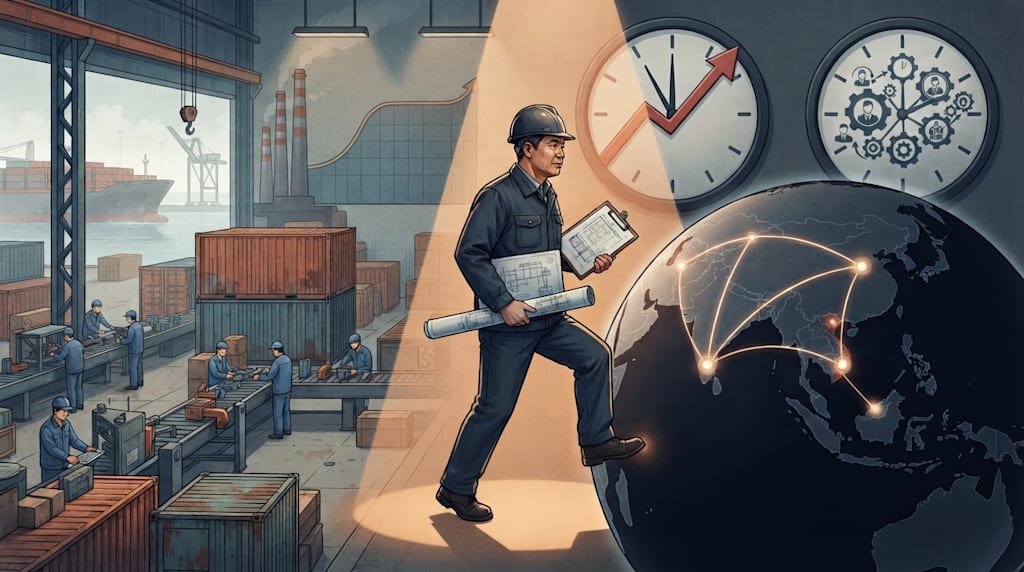
China’s second globalization will succeed or fail on a race between two clocks.
The speed at which industrial capability moves abroad must beat the speed at which the domestic cost base changes.
If overseas profits flow back and become jobs, spending, and industrial upgrading at home, new ground opens. Competition can shift from a stock game to a positive-sum game. If overseas profits sit in offshore structures or are captured by local policy, the link breaks.
In the optimistic case, Chinese firms organize production worldwide. They move from world’s factory to world company. They gain more say in brands, research, and standards. In the middle case, some firms globalize and others stay trapped in domestic competition. Social division widens. In the pessimistic case, geopolitical barriers keep rising, overseas expansion stalls, domestic change lags, and the second globalization becomes a show for a few firms.
Conclusion
China’s first globalization made the country the world’s factory. The second is about becoming the world’s company.
That direction is correct. The change may take longer and prove less certain than many expect. It depends on whether China can turn manufacturing skill honed at home into pricing power that is scarce abroad. It depends on whether overseas gains become chances for ordinary people at home. It depends on whether China can replace an exhausted arbitrage model with a new set of advantages.
The history of globalization has not ended. The chips have changed. China is no longer betting only on labor and land. It is betting on industrial capability and the organization of people. Whether that bet wins will not be settled by opinion. It will be settled over the next decade by every overseas plant, every overseas research center, and every workshop manager sent to a foreign country.
About the Creator
Jin
Writer of reamstories
https://reamstories.com/jin
Enjoyed the story? Support the Creator.
Subscribe for free to receive all their stories in your feed. You could also become a paid subscriber, letting them know you appreciate their work.
Comments
There are no comments for this story
Be the first to respond and start the conversation.