
CATL Made $240 Million a Day Last Quarter. Then Its Stock Fell 6%.
China's battery giant pays suppliers in 265 days and collects from automakers in 54. That 211-day gap built a fortress of profit — and the automakers now funding its competitors are about to test how deep the moat really goes.
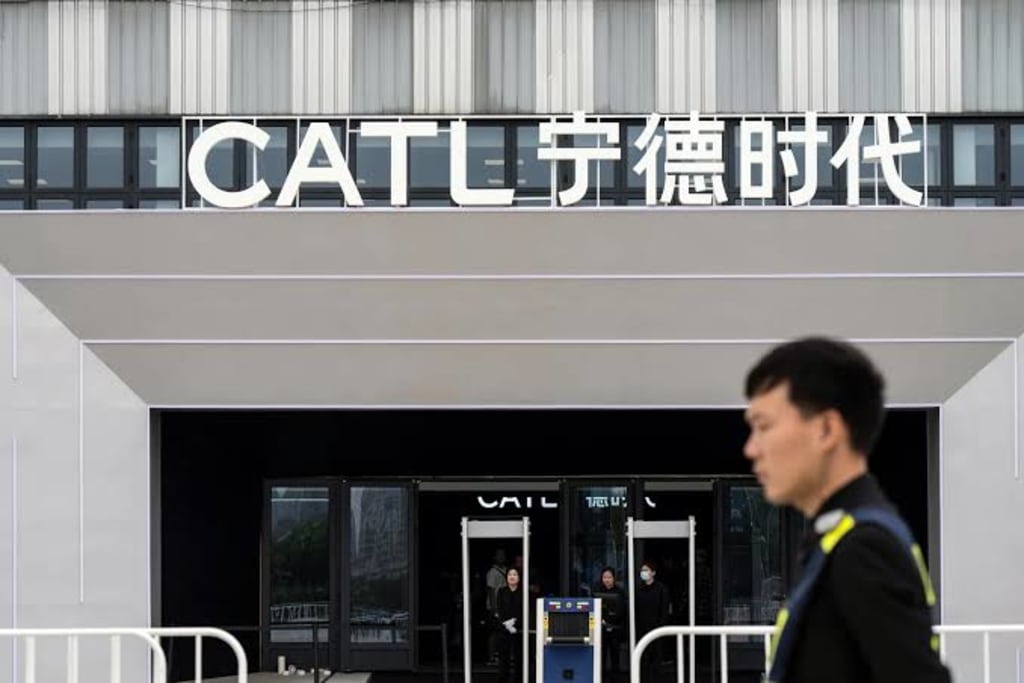
CATL: 265 Days and 54 Days
On September 15, 2026, CATL's A-shares fell more than 6%, hitting a near one-year low. Its Hong Kong-listed shares fell in tandem, closing down more than 6%. The combined A+H market capitalization dropped below RMB 1.5 trillion. From its May peak, the stock has retraced more than 30%, wiping out about RMB 700 billion in market value.
Two months earlier, the company reported first-half results: net profit attributable to shareholders of RMB 43.284 billion, up 41.98% year on year. Nearly RMB 240 million a day.
Profits are rising. The share price is falling. What the market is pricing now is how long CATL can keep earning at this rate.
I
CATL's days payable outstanding in the first quarter of 2026 was about 265 days. Its days sales outstanding was about 54 days.
Put those two numbers together. It takes CATL nearly nine months on average to pay upstream suppliers. Downstream automakers must pay CATL in less than two months. The gap is 211 days.
By June 30, notes payable and accounts payable totaled RMB 355.487 billion, up RMB 91.881 billion in six months. Cash and cash equivalents stood at RMB 372.053 billion, RMB 16.567 billion more than total payables.
The cash on its books exceeds what it owes suppliers. It can pay. It chooses not to.
The delay is structured. CATL uses banks' supply chain finance platforms to arrange reverse factoring, which lets suppliers holding its electronic creditor's rights certificates get paid early. At midyear, supplier finance arrangements totaled RMB 57.764 billion, up 55.19% in six months. Reverse factoring alone rose from RMB 13.320 billion to RMB 37.373 billion, an increase of about 180%.
Suppliers that want early payment bear financing costs. CATL keeps the time value of the money on its books. In 2025, interest income was RMB 10.6 billion and interest expense RMB 2.7 billion, a net interest spread gain of RMB 7.9 billion. Bad debt provisions for accounts receivable under supplier finance arrangements were RMB 1.659 billion, a provision ratio of 2.87%.
On the late-August earnings call, an institutional investor asked about payment terms. Management responded that days payable outstanding is affected by business expansion, increased project construction, and note settlement methods, and that the company does not deliberately lengthen payment terms by exploiting its market dominance. It also said CATL is implementing policy requirements and promoting reasonable payment of supply chain obligations.
Upstream waits nine months. Downstream pays in 54 days.
II
Power batteries account for about 30% to 40% of vehicle cost. When raw material prices fluctuate, automaker profits are the first to be eroded.
In the first half of 2026, Li Auto reported revenue of RMB 48.65 billion, down 13.4% year on year. Net loss attributable to shareholders was RMB 3.994 billion, against a profit of RMB 1.743 billion a year earlier. Overall gross margin was 9.5%, down 10.8 percentage points.
CATL earned RMB 43.284 billion over the same six months. Cui Dongshu, secretary-general of the China Passenger Car Association, said not controlling batteries is a major reason automaker profits are thin.
Li Auto's answer was to invest RMB 2.65 billion in Sunwoda Power for an 11.17% stake, becoming its second-largest shareholder. A year earlier, the two sides had formed a joint venture, Shandong Li Auto Battery Co., Ltd., with registered capital of RMB 300 million, each holding 50%.
The new-generation Li L8 runs entirely on Sunwoda cells, with battery packs assembled by the joint venture. CATL is off the model's supply list. MIIT new vehicle filings show the 2026 Li i6 drawing cells from Sunwoda and CALB. The Li i6 delivered more than 120,000 units in the first half, more than half of Li Auto's sales.
In its own statement, Li Auto said its self-developed batteries are now installed in the L8, L6, and i8, and that all subsequent new models will complete the switch. The first batches of the new-generation Li MEGA and the all-new Li i9 still offer CATL batteries.
Xiaomi's newly launched Pengcheng N70 and N90 use the Dragon Armor Battery system, with cells from CALB and Sunwoda, dropping the CATL packs used in the SU7 and YU7. Xpeng made CALB its largest battery supplier across the full lineup, keeping CATL in a few high-end long-range versions. Some HIMA models draw on multiple suppliers.
Geely consolidated its battery business into Jiyao Tongxing, planning 70GWh of capacity by 2027. GAC brought in CALB and developed its own Yinpai battery. Great Wall, SAIC, Chery, and Changan have all moved into power batteries through in-house programs or joint ventures.
III
On installation data alone, CATL's position has not loosened. Global power battery installations in the first half reached 242.7GWh, up 25.3% year on year, with CATL at 39.9% share. Its domestic passenger vehicle share was 46.7%, up 5.6 percentage points. In ternary batteries, it held 75.2%.
CALB ranked fourth globally, its share rising from 4.4% to 5.1%. Sunwoda is growing quickly, though the gap in scale and accumulated capability remains wide.
In the short term, automakers' "de-CATLization" shows up in bargaining dynamics more than in share transfer.
Li Auto and Xiaomi together account for about 13.6% of CATL's domestic installations. Losing that share is survivable. The signal is what hurts: leading customers are turning "CATL is the default" into "CATL is one option."
That signal shows up in the margin numbers. CATL's gross margin in the second quarter of 2026 was 23.15%, down 2.42 percentage points year on year and 1.66 points quarter on quarter, its second consecutive quarterly decline. CLSA attributed it to intense downstream price competition that blocked cost pass-through.
Once automakers begin supporting second suppliers and splitting orders across several, the first thing CATL loses is the ability to push the full cost pressure downstream.
IV
From September 1, 2026, lithium-ion batteries carry a 2% consumption tax. From September 1, 2027, the rate returns to 4%. Sodium-ion and solid-state batteries are exempt until the end of 2028.
After more than a decade of exemption, the lithium battery industry is facing a tax adjustment. At the start of the year, the purchase tax shifted from full exemption to half. Vehicle and vessel tax preferences are on an exit path.
Haitong International's research report judged the adjustment a routine phase-down as the industry matures. The core effect is a redistribution of supply chain profits and a reshuffling of industry structure; demand holds up. Liu Yanlong, secretary-general of the Global Energy Storage and Battery Council, said the consumption tax will accelerate market differentiation and push out backward capacity.
Subsidy phase-out, equal treatment of fuel and electric vehicles, and accelerated consolidation are keeping automaker profits under pressure. That pressure travels up the supply chain. The less money automakers make, the more reason they have to diversify battery sourcing and build batteries in-house.
Overseas, CATL was added to the U.S. Department of Defense's 1260H "Chinese Military Companies" list. Its Debrecen plant in Hungary received a local government fine citing systemic gaps in hazardous waste management across the full process. Hungary's new government has said it does not support CATL's expansion plan next to the existing site and is applying stricter regulation than before.
V
Operating cash flow grew less than 3% in the first half. Net profit grew 42%. The two are separating.
The technology moat is still there. R&D spending reached RMB 22.1 billion in 2025, and cumulative R&D investment exceeds RMB 68.7 billion. Global market share has ranked first for nine consecutive years. The Shenxing, Kirin, and Naxtra lines cover more chemistry and format ground than any competitor's, and vertical integration keeps costs down. No second-tier player can replicate the whole package in the short term.
But the depth of a moat does not set the boundary of bargaining power. When customers have enough reason to fund alternatives, the technology gap narrows with each order and each capital injection. The price concessions CATL makes to hold share land directly on the profit line. Two consecutive quarterly declines in gross margin are where that starts.
At the late-July earnings call, CATL said it would raise its interim dividend payout to 20% of net profit attributable to shareholders and planned a further increase for the full year.
The dividend covers part of the gap. The rest depends on how long the 265-day and 54-day numbers hold.
About the Creator
Jin
Writer of reamstories
https://reamstories.com/jin
Enjoyed the story? Support the Creator.
Subscribe for free to receive all their stories in your feed. You could also become a paid subscriber, letting them know you appreciate their work.
Comments
There are no comments for this story
Be the first to respond and start the conversation.