
Binary Options Trading Platform Compliance Report
USA, UK, EU, and Asia Overview

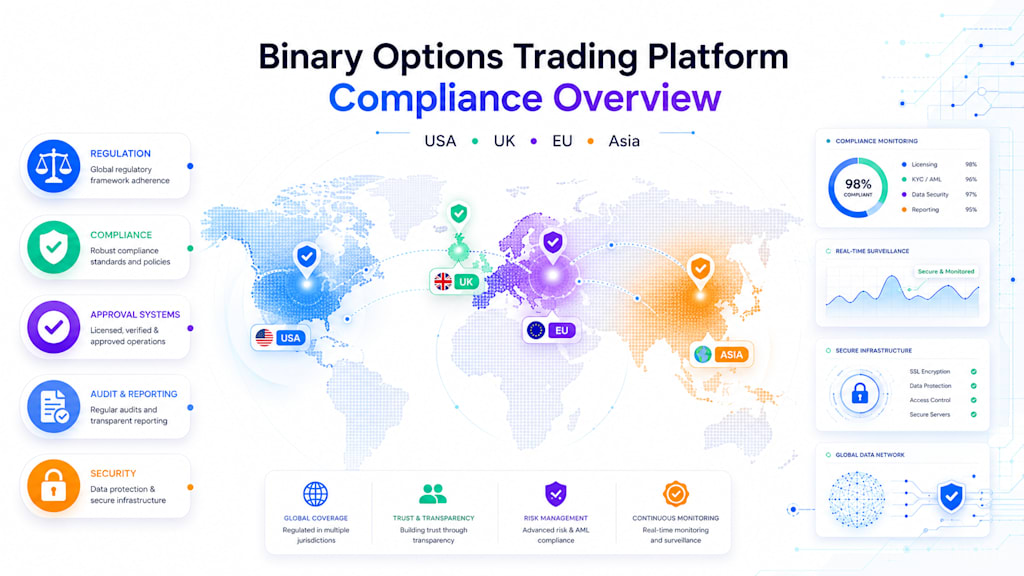
Binary options trading platforms operate in one of the most fragmented regulatory environments in global fintech.
While some regions impose strict bans or heavy restrictions, others allow limited access under financial derivatives regulation.
This report outlines compliance requirements across the USA, UK, EU, and Asia, and explains how platform architecture must adapt to meet regional legal frameworks.
Binary Options Trading Platform Compliance in the United States
The United States has one of the strictest regulatory environments for binary options trading.
Regulatory Authorities
Key regulators include:
- Commodity Futures Trading Commission (CFTC)
- Securities and Exchange Commission (SEC)
Binary options are generally treated as financial derivatives and must operate under approved regulatory frameworks.
Compliance Requirements
Platform operators must:
- Register with the relevant authorities where required
- Follow strict reporting standards
- Implement Anti-Money Laundering (AML) programs
- Conduct Know Your Customer (KYC) verification
- Maintain transaction records
- Monitor suspicious trading activity
Business Impact
Many offshore binary options platforms cannot legally offer services to U.S. residents. Businesses targeting the U.S. market must invest heavily in regulatory compliance, legal review, and ongoing monitoring.
Binary Options Trading Platform Compliance in the United Kingdom
The United Kingdom has adopted a restrictive approach toward binary options trading for retail investors.
Regulatory Authority
The primary regulator is the Financial Conduct Authority (FCA).
Current Position
Binary options products have been largely prohibited for retail consumers because regulators consider them high-risk and potentially harmful.
Compliance Considerations
Businesses operating in the UK should:
- Review FCA product restrictions
- Verify customer eligibility
- Maintain strong consumer protection controls
- Implement risk disclosures
- Monitor marketing communications
Business Impact
Platforms seeking access to UK markets must carefully assess whether their products fall within restricted categories and ensure compliance with current FCA requirements.
Binary Options Trading Platform Compliance in the European Union
The European Union has implemented significant restrictions on binary options through financial market regulations.
Regulatory Framework
The European Securities and Markets Authority (ESMA) has played a major role in limiting binary options trading across EU member states.
National regulators may also enforce additional rules.
- Compliance Requirements
- Businesses must focus on:
- Investor protection measures
- Risk disclosures
- Customer suitability assessments
- AML and KYC procedures
- Transparent pricing and reporting
Business Impact
Many EU countries have introduced strict controls or prohibitions on offering binary options to retail investors. Businesses should evaluate country-specific regulations before entering any EU market.
Binary Options Trading Platform Compliance Across Asia
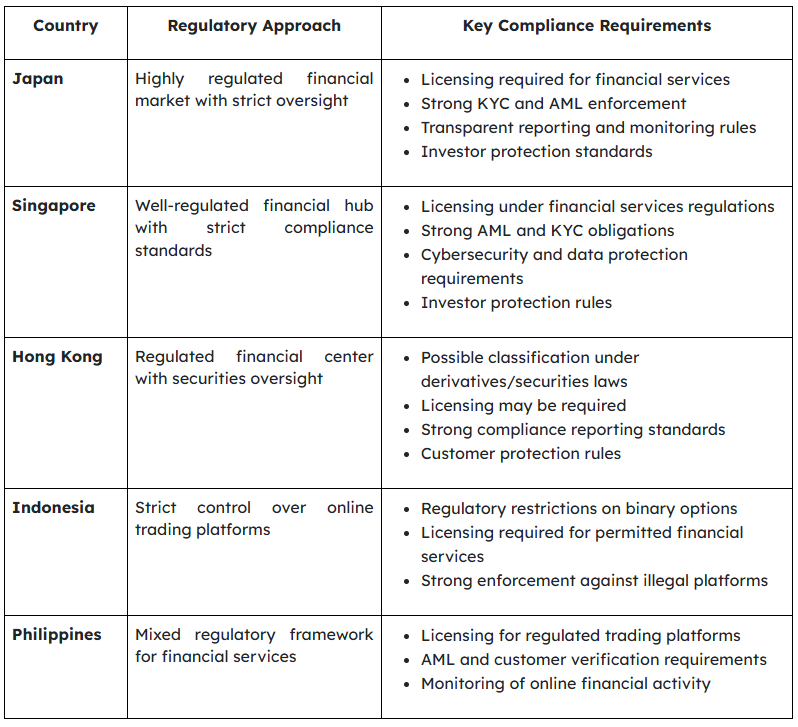
Business Impact
Companies entering Asian markets should conduct country-specific legal reviews instead of relying on a single regional compliance strategy.
How Platform Architecture Must Support Compliance
Technology infrastructure plays a major role in maintaining compliance across multiple jurisdictions.
- Geo-Restriction Controls: IP based blocking, country-wise access restrictions, automated compliance rules
- Identity Verification (KYC): User onboarding verification, document checks, automated identity validation
- Compliance Monitoring: Real-time transaction tracking, fraud detection, suspicious activity alerts
- Audit & Reporting: Transaction logs, user activity records, compliance reports, risk documentation
- Regulatory Adaptability: Flexible system updates, modular compliance design, easy rule changes without rebuilds
Conclusion
Build a binary options trading platform with compliance built into its foundation from day one. Strong identity verification, AML monitoring, geo-restrictions, and secure data handling are essential to operate in regulated markets.
Since rules differ across the USA, UK, EU, and Asia, your system should be flexible enough to adapt without major structural changes. This makes it easier to expand while staying aligned with local regulations.
In the end, success comes from combining solid technology with a clear understanding of regulatory expectations, so that the platform can grow safely across global markets.
About the Creator
Augustin
Sharing easy-to-follow content about trading platforms, trading tech, modern fintech and blockchain development.
Enjoyed the story? Support the Creator.
Subscribe for free to receive all their stories in your feed.
Comments
There are no comments for this story
Be the first to respond and start the conversation.