
Better Trade Entry Confirmation in Crypto Prop Firm Trading
A seven step CONFIRM checklist for filtering false breakouts and knowing when not to trade.


At 14:27 UTC, Bitcoin pushes above yesterday’s high. The candle looks strong, volume expands, and the breakout appears obvious. Minutes later, price closes back inside the range. What looked like confirmation was only urgency.
In crypto prop firm trading, a rushed entry does more than create a possible losing trade, it also consumes part of a limited drawdown allowance. Better trade entry confirmation does not come from adding more indicators. It comes from answering three questions before accepting risk:
What evidence must appear?
What would invalidate the setup?
Does the trade still fit the account rules?
This guide introduces the seven step CONFIRM method: a pass or fail process for deciding whether an entry deserves risk or should be skipped.
What Is Trade Entry Confirmation in Crypto Prop Firm Trading?
Trade entry confirmation in crypto prop firm trading is a rule based process for validating market context, price location, entry trigger, invalidation, risk limits, and execution conditions before placing an order. A setup is confirmed only when every mandatory filter matches the trader’s plan and the firm’s drawdown rules.
A confirmed entry is not a guaranteed winner. It is an entry that satisfies predefined conditions before risk is accepted.
Confirmation therefore serves two purposes. It filters setups that have not yet produced the required price behavior, and it prevents technically attractive trades from bypassing account level risk controls. The goal is not certainty. The goal is a decision that can be repeated, documented, and reviewed.
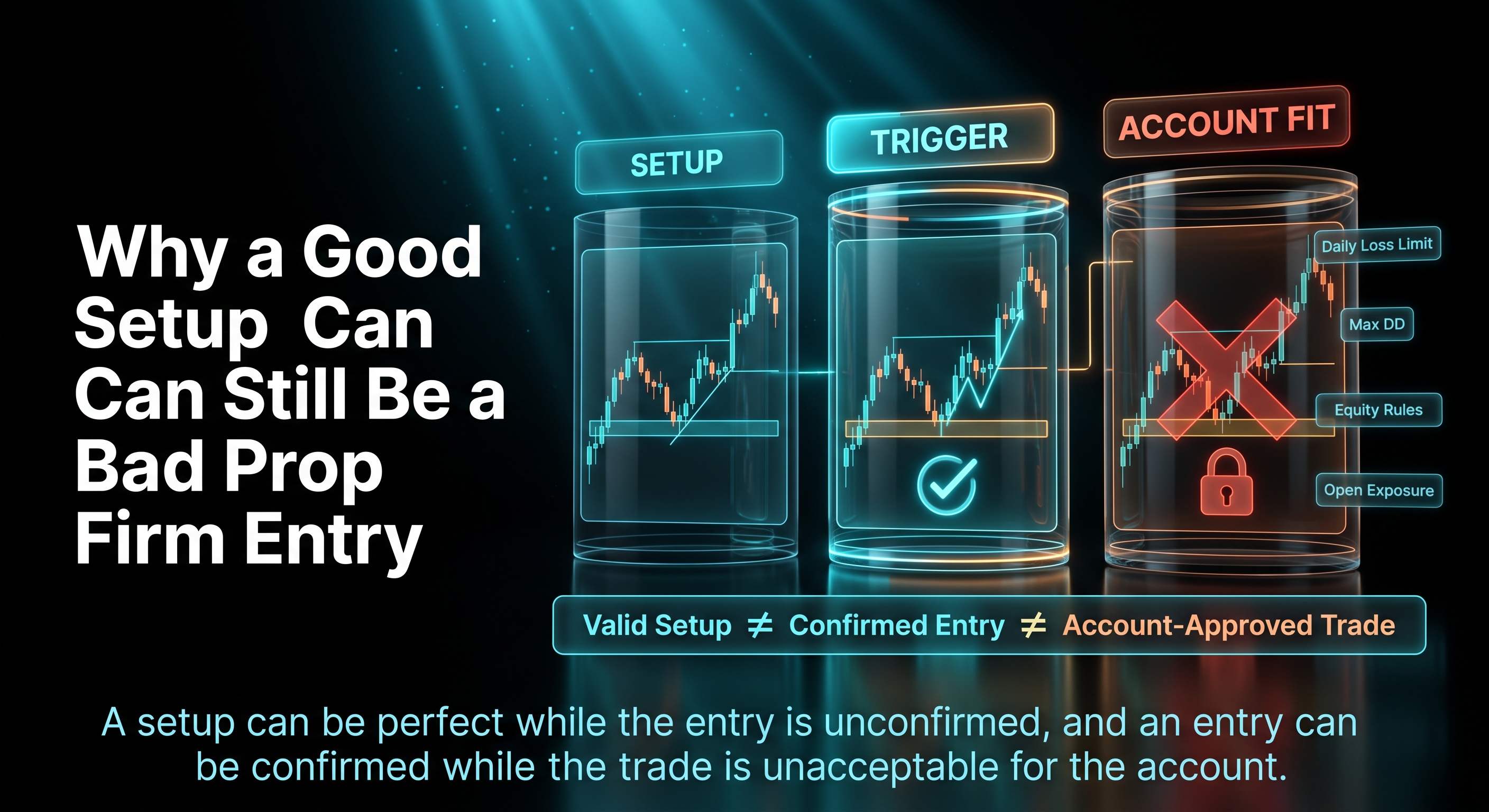
Why a Good Setup Can Still Be a Bad Prop Firm Entry
A trading idea has three separate layers: the setup, the trigger, and the account fit. Treating them as one decision is a common source of premature entries.
The setup describes the market context and location. For example, price may be approaching a previous day low while the higher timeframe structure remains bullish.
The trigger is the observable event that permits execution. It might be a close back above the level, a break and retest sequence, or a local structure shift. Price merely reaching a zone is not the same as confirming an entry.
The account fit determines whether the trade is acceptable under the evaluation rules. A technically valid stop may still require more risk than the remaining daily loss allowance can support. Existing positions may also create correlated exposure that is larger than it first appears.
This distinction produces a useful rule:
A setup can be valid while the entry is unconfirmed, and an entry can be confirmed while the trade is unacceptable for the account.
Crypto prop programs add constraints that do not appear on a chart. Daily loss limits, maximum drawdown, equity-based calculations, trailing thresholds, reset times, commissions, and open-position exposure can all change the decision. The confirmation process is incomplete until those variables are checked.

The 7 Step CONFIRM Method for Better Trade Entries
The CONFIRM method uses seven independent gates. Each gate answers a different question, so five weak signals should not be used to compensate for one failed mandatory condition. Define which conditions are required by the strategy, then score them as pass, fail, or not applicable.
1. Check The Higher Timeframe Context First
Start by identifying the environment in which the setup is forming.
Is the market trending, ranging, or transitioning between the two?
What is the relevant higher timeframe structure?
Is price near an important boundary or in the middle of a range?
Does the current session normally provide enough liquidity for the strategy?
Is the planned trade aligned with the tested market regime?
Context does not mean that every trade must follow a higher timeframe trend. Countertrend models can be valid, but the conditions for taking them must be defined in advance. The purpose of this gate is to prevent a lower timeframe pattern from being judged in isolation.
A bullish candle at resistance, for example, does not carry the same information as the same candle after a failed breakdown at support. The pattern may look identical; its location and surrounding structure are not.
2. Entry Level Defined in Advance
A confirmation needs a reference point. Mark the decision level before price reaches it rather than drawing a zone around a move that has already happened.
Possible reference levels include:
Previous day or previous week highs and lows
Clearly defined support or resistance
Range boundaries
A tested supply or demand area
A breakout level awaiting a retest
An order block or fair value gap, if those concepts are part of a tested model
The level should be specific enough to answer two questions: Where is a reaction expected, and when is the original idea no longer valid?
If price is moving through the middle of an unstructured range, a dramatic candle alone may not create an objective entry. The correct result of this gate can be “no level, no trade.”
3. Entry Confirmation Signal
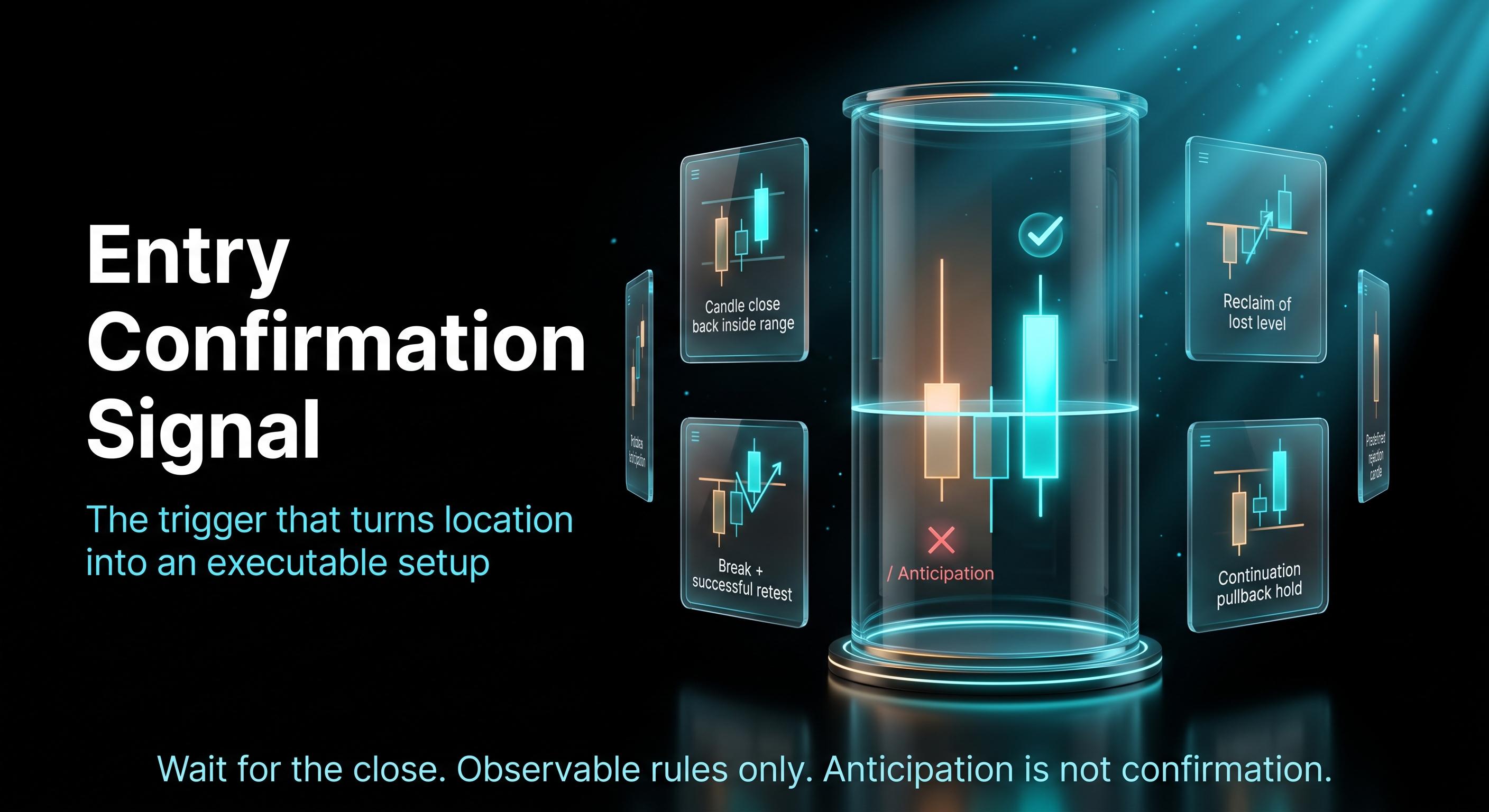
The necessary trigger is the event that converts an interesting location into an executable setup. It should be selected before the trade, not invented after price begins moving.
Common triggers include:
A candle closing back inside a range after briefly trading beyond it
A break of local structure followed by a successful retest
A reclaim of a previously lost level
A rejection candle that closes according to predefined criteria
A continuation pullback that holds above or below the breakout level
Waiting for a candle close matters because intrabar movement can change before the period ends. A long wick may disappear, a breakout candle may close back inside the range, or apparent momentum may weaken. Entering before the required close replaces confirmation with anticipation.
The trigger should also be observable. “The move feels strong” cannot be audited later. “The five-minute candle closed above the level and the retest held” can.
4. Find Evidence of Follow Through
Flow evidence asks whether participation supports the price behavior. Depending on the strategy and available data, this may include volume, order book behavior, momentum, or the speed of follow through.
Useful questions include:
Did volume expand on the break or on the rejection?
Did price move away from the level efficiently, or stall immediately?
Was the level reclaimed and defended on a retest?
Does the order book show usable liquidity, or is it unusually thin?
Are several indicators providing independent information, or measuring the same momentum in different ways?
Volume and order flow are supporting evidence, not proof of who is buying or selling. Labels such as “smart money” or “stop hunt” are interpretations of price behavior; a chart cannot identify the motives of individual market participants.
If reliable flow data is not part of the strategy, do not invent a requirement simply to create more confirmation. A smaller set of independent, testable filters is more useful than a large collection of overlapping indicators.

5. Identify What Invalidates the Trade Setup
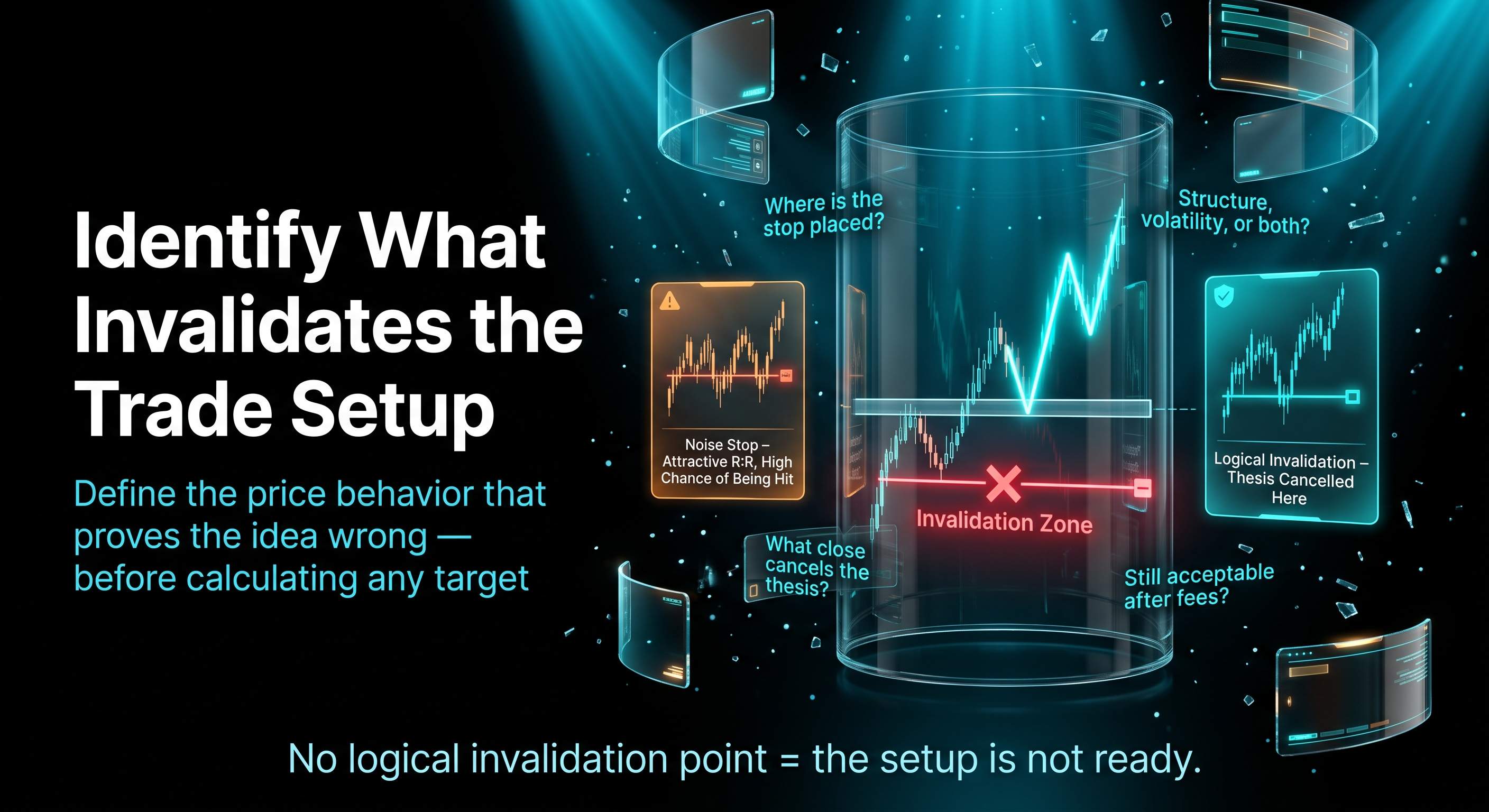
Before calculating a target, define the price behavior that would prove the setup wrong.
For a reversal after a sweep, invalidation may sit beyond the sweep extreme, subject to the strategy’s tested buffer. For a break-and-retest model, invalidation may occur when price closes back through the reclaimed level. The exact rule should come from the trading plan rather than from a desire to make the stop look small.
An arbitrarily tight stop can create an attractive theoretical reward to risk ratio while sitting inside normal market noise. An excessively wide stop can make the trade incompatible with the account’s risk budget. If there is no logical invalidation point, the setup is not ready.
The invalidation rule should answer:
Where is the stop placed?
Is the stop based on structure, volatility, or both?
What close or price action cancels the thesis?
Would the setup still offer acceptable room to the planned objective after fees and likely execution costs?
6. Respect Drawdown Limits Before Sizing the Trade
Risk must be confirmed at the account level, not only at the chart level. Start with the rules of the specific program and determine how much loss capacity remains before sizing the position.
A simplified planning sequence is:
Remaining risk budget = Daily loss allowance − realized losses − open position risk − safety buffer
Then:
Allowed cash risk = The lower of planned trade risk and remaining risk budget
Finally:
Position size = Allowed cash risk ÷ entry to stop distance
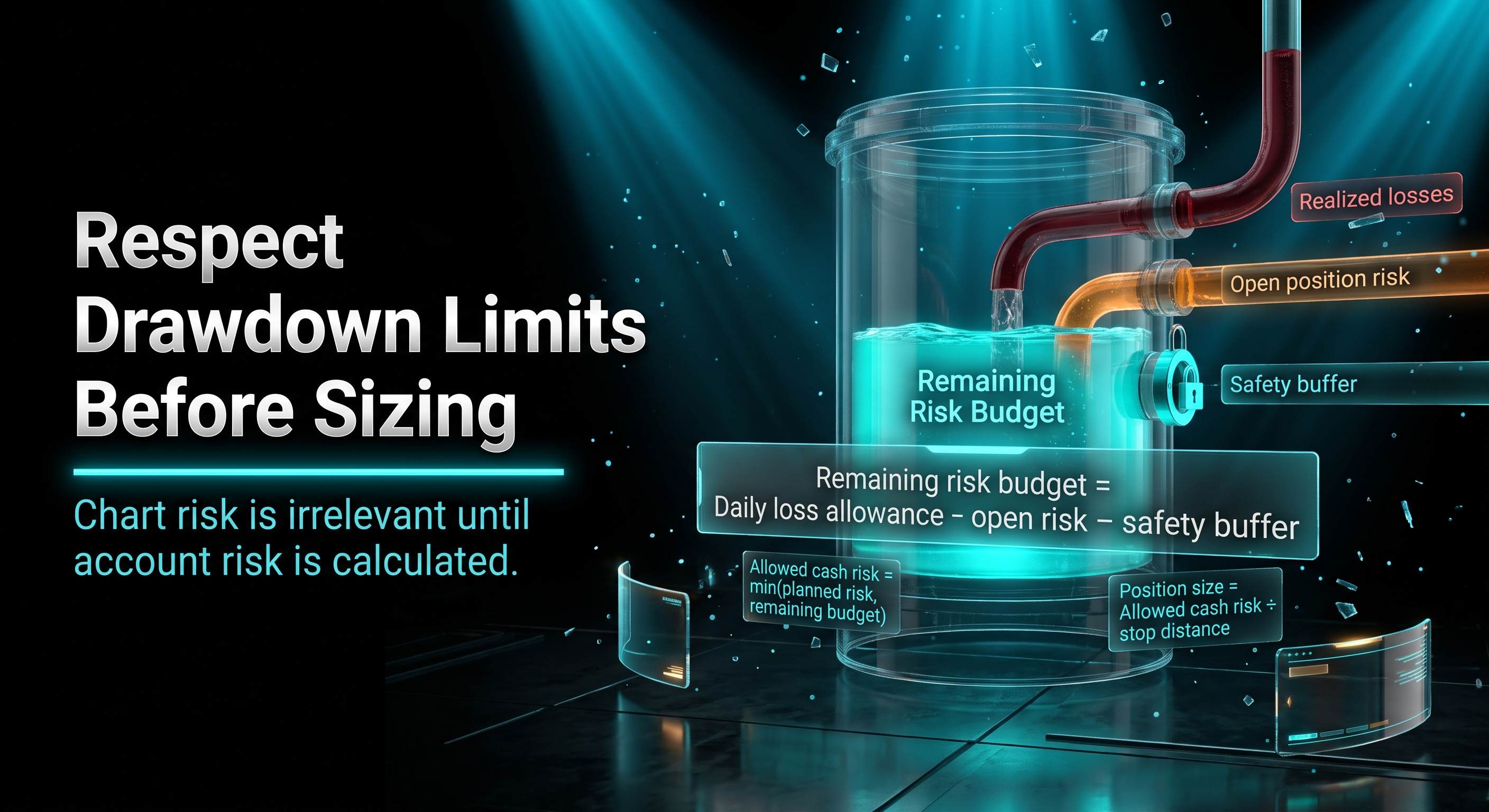
The final position calculation must be adjusted for the instrument’s contract size, leverage model, fees, and platform specifications. The simple formula is a planning concept, not a universal order size calculator.
Also examine correlated exposure. Long positions in Bitcoin and several highly correlated altcoins may behave like one larger directional bet. Counting each position separately can understate the account’s true sensitivity to a single market move.
There is no universal percentage that every crypto prop trader should risk. The appropriate amount depends on the drawdown model, strategy variance, number of simultaneous positions, stop distance, and evidence from a meaningful sample of past trades.
7. Measure Market and Execution Conditions
The final gate checks whether the planned order can be executed under acceptable conditions.
Review:
Current spread and quoted fees
Expected slippage during the present volatility
Available liquidity at the intended order size
Market, limit, and stop order behavior
Funding or holding costs, when relevant
Scheduled events that may change liquidity or volatility
Daily reset or settlement timing
Platform stability and the treatment of rejected or partially filled orders
A market order prioritizes execution but not the exact fill price. A limit order controls price but may not fill. Neither is automatically better; the order type must match the setup and the platform’s rules.
If execution conditions have changed materially since the setup was planned, the entry should be reassessed. Confirmation belongs to the current market, not to the chart screenshot captured several minutes earlier.
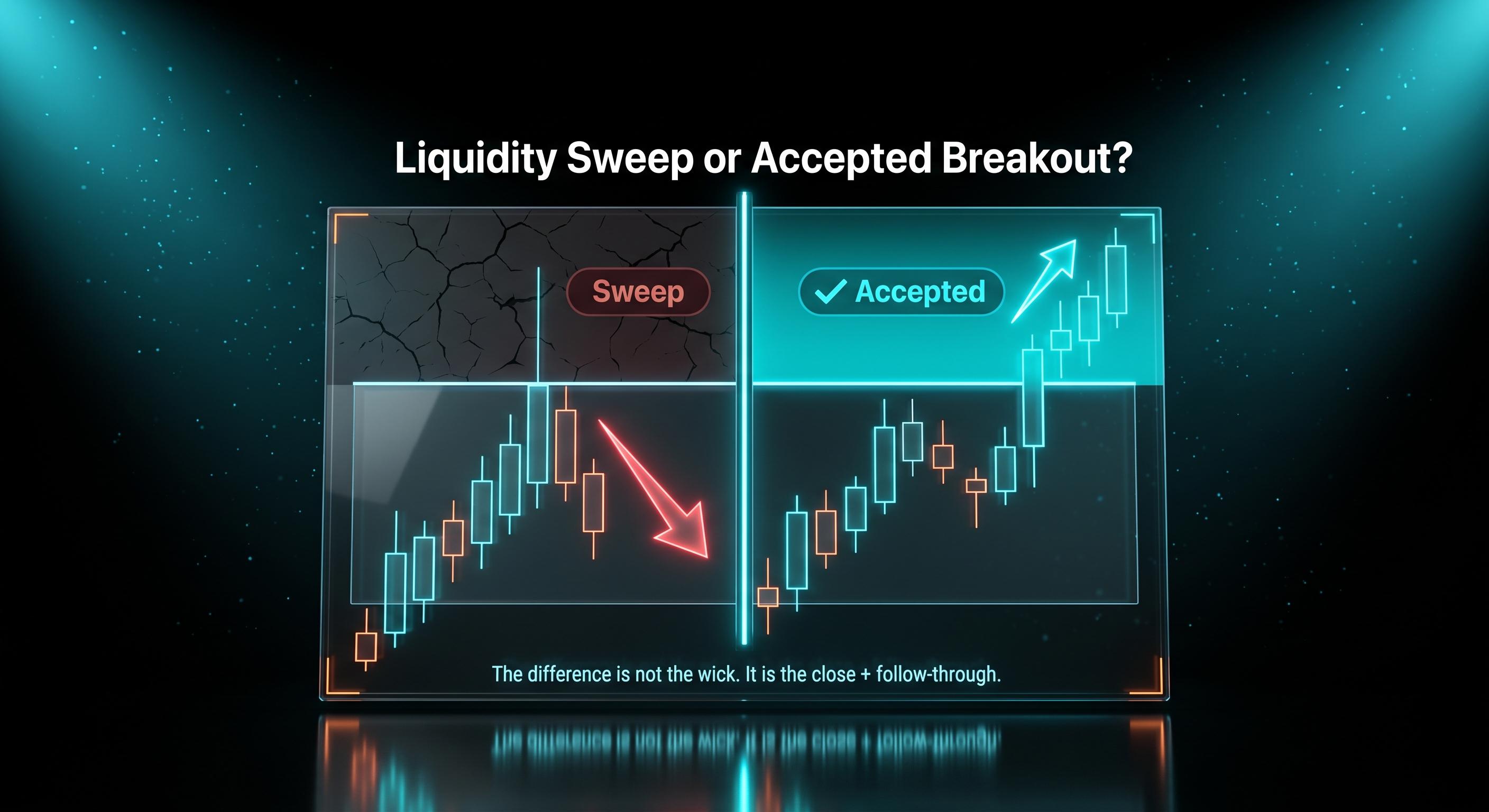
Liquidity Sweep or Accepted Breakout?
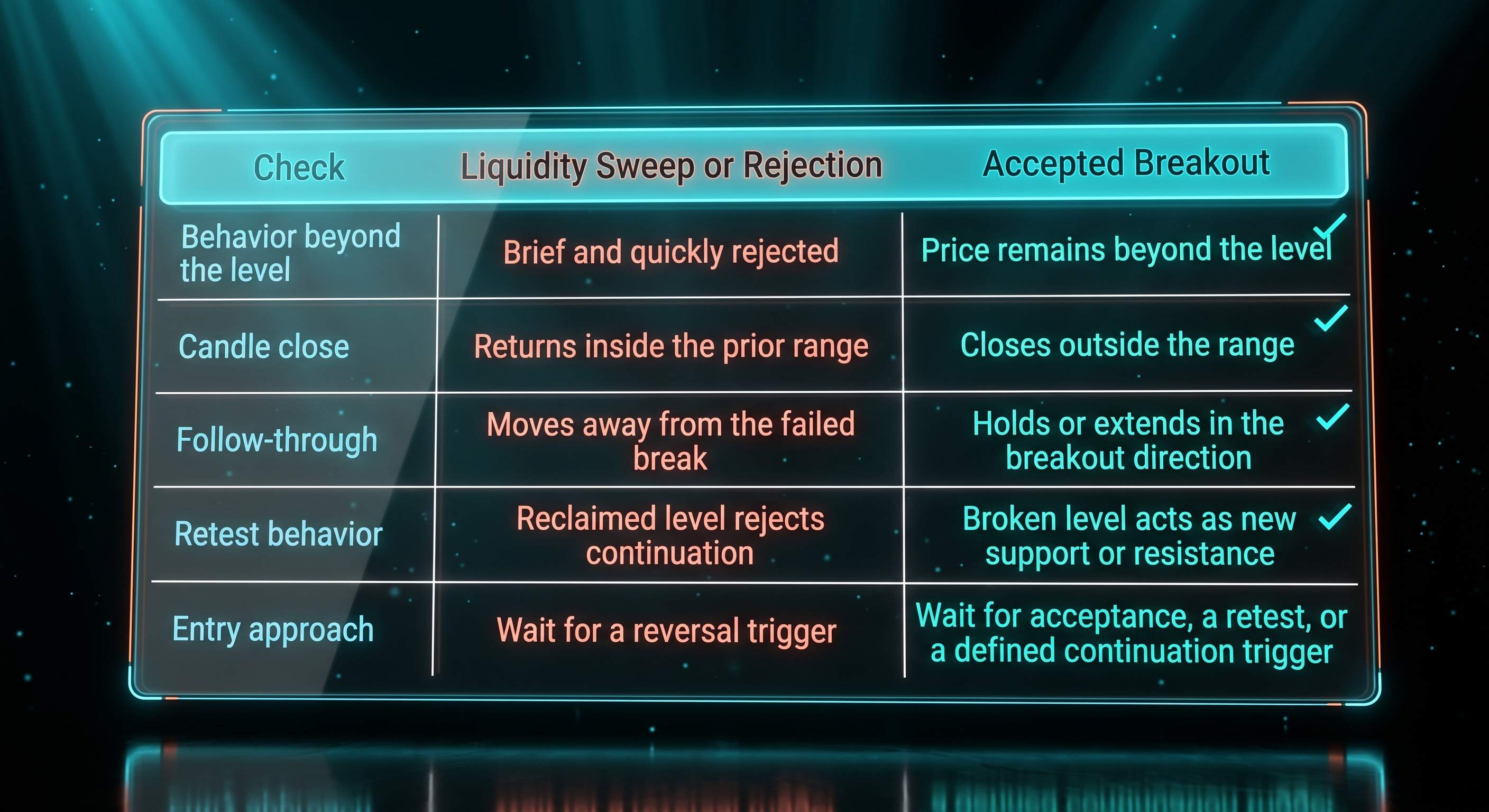
A liquidity sweep is commonly described as a brief move beyond an obvious high or low followed by a return into the previous range. An accepted breakout moves beyond the level and continues to hold outside it. The difference is not the wick alone; it is the close, follow through, and subsequent behavior around the level.
Liquidity sweep or rejection: Price briefly moves beyond a key level but closes back inside the previous range. It then moves away from the failed break, while the reclaimed level blocks continuation. Wait for a clear reversal trigger before considering an entry.
Accepted breakout: Price closes and holds beyond the key level. If a retest occurs, the broken level begins acting as new support or resistance, and price continues in the breakout direction. Wait for acceptance, a successful retest, or a predefined continuation trigger.
In short: A sweep rejects the level; an accepted breakout holds it. In both cases, the first move beyond the level is not enough confirmation on its own.
Not every wick is a sweep, and not every close beyond a level creates a durable breakout. Thin liquidity, temporary volatility, and different exchange price feeds can produce misleading shapes. A practical decision sequence is:
Wait for the relevant candle to close.
Compare the close with the predefined level.
Observe whether price accepts or rejects the area.
Require the strategy’s structure or retest trigger.
Define invalidation and verify account risk before entering.
This approach avoids treating a single candle pattern as a complete trading model.
Confirm the Risk Before You Confirm the Trade
A technically confirmed setup can still be untradeable. Suppose the chart provides a valid trigger, but earlier losses have reduced the remaining daily-loss allowance. Taking the normal position size may create breach risk even if the stop is respected.
The calculation becomes more complex when the program uses equity based or trailing drawdown. Open profit may change the reference point, open loss may count immediately, and the daily limit may reset at a time that differs from the trader’s local day. These details must be checked in the current program terms.
Tightening the stop solely to preserve position size is not a solution. If the tighter stop sits inside normal volatility, it changes the setup rather than reducing its risk. A smaller position or no trade may be the more consistent decision.
The same caution applies to moving a stop to breakeven. Moving it after a fixed profit multiple can reduce downside, but it can also remove a valid trade during an ordinary retest. Breakeven management should be supported by testing for the specific setup, timeframe, and market, not treated as a universal rule.
Reward to risk multiples also need context. A target of 2R or 3R describes the potential reward relative to initial risk; it does not describe the probability of reaching that target. Expectancy depends on both payoff and win rate, after costs.
A Hypothetical Entry Confirmation Example
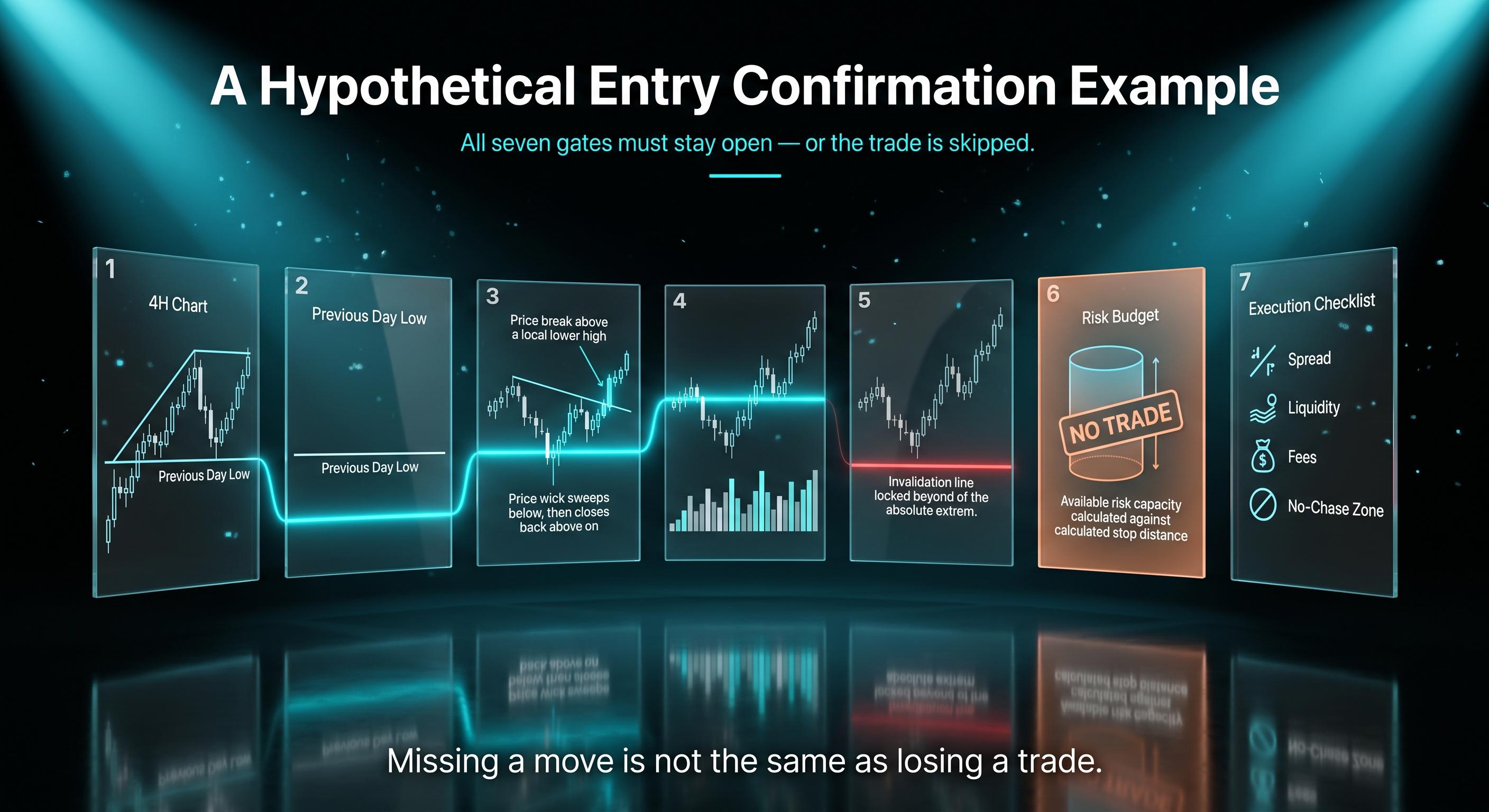
Consider a hypothetical Bitcoin setup. The four hour structure is rising, and price pulls back toward the previous day’s low, which also overlaps a support area identified before the session.
1- The higher timeframe market remains constructive, but the lower timeframe is pulling back. The strategy permits longs only after evidence that the support area has been reclaimed.
2- The previous day low is the decision point. The plan does not authorize an entry in the middle of the decline.
3- On the execution timeframe, price trades below the previous day low, closes back above it, and later breaks a local lower high. The trigger is the reclaim plus structure shift, not the initial wick.
4- Activity increases as price moves away from the low, and the first retest does not immediately collapse. This supports the setup but does not guarantee continuation.
5- The thesis fails if price trades through the sweep extreme according to the strategy’s stop rule or closes back below the reclaimed area under the predefined criteria.
6- Position size is calculated from the entry to stop distance and the account’s remaining loss capacity. If another correlated long position is already open, total exposure is reduced or the new trade is rejected.
7- Spread, liquidity, fees, scheduled events, and order behavior are checked immediately before execution.
The trade passes only if all mandatory gates remain valid. It becomes a no-trade decision if the trigger appears but the remaining risk budget is insufficient, the spread expands beyond the tested range, or price runs too far from the planned entry before the order can be placed.
That final point matters: missing a move is not the same as losing a trade. Once the valid entry location has passed, chasing price creates a different setup with a different stop and reward profile.
Can Execution Quality Invalidate a Confirmed Entry?
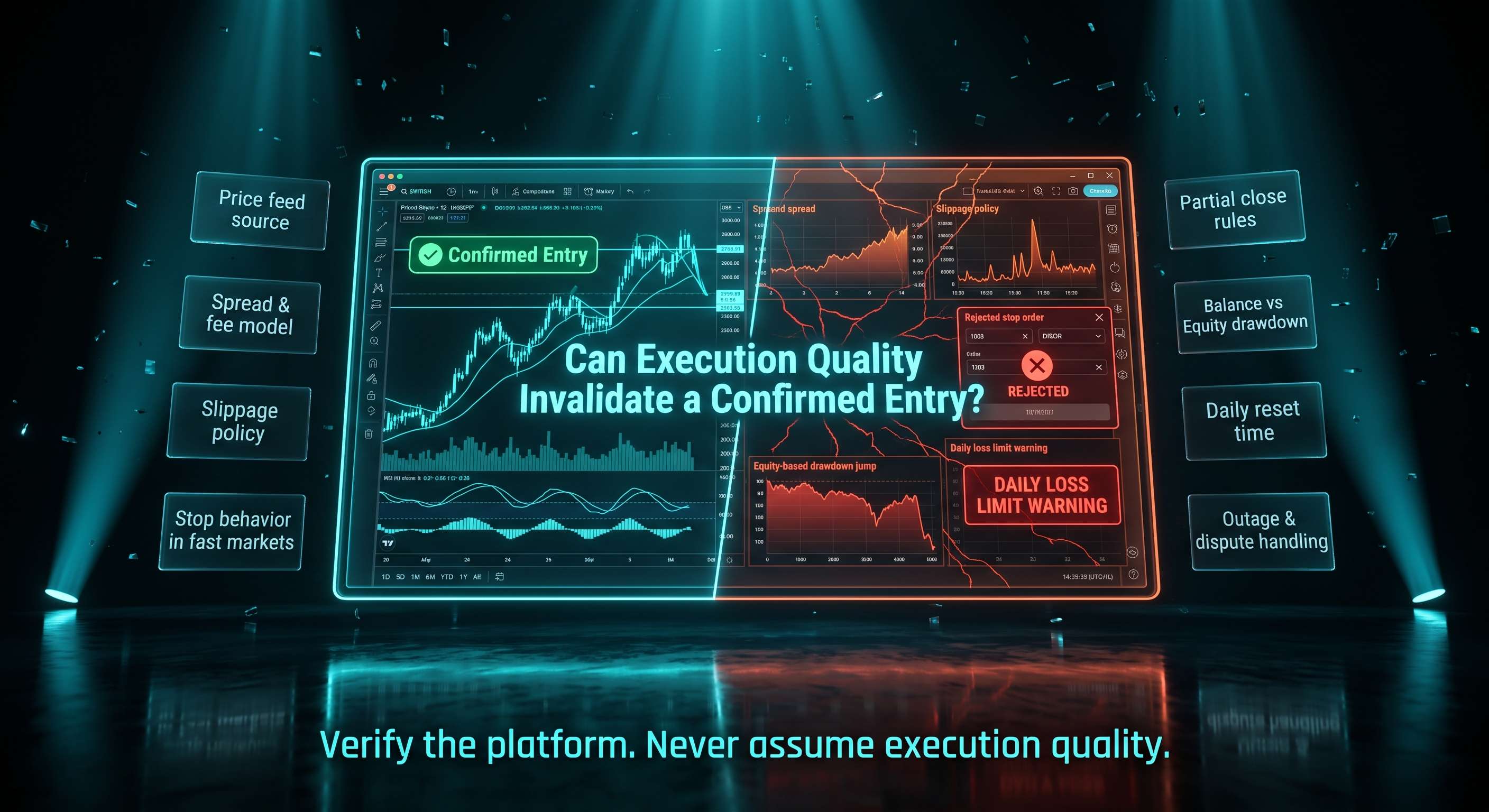
Entry quality depends not only on chart analysis but also on execution conditions. Before using any crypto prop evaluation platform, verify its price feed source, spread and fee model, slippage policy, order types, partial close behavior, and drawdown calculation. If a test environment is available, use it to compare planned and actual order behavior rather than relying on performance claims.
A neutral platform review should answer these questions:
Is the environment simulated, connected to live execution, or structured differently?
Which price source determines entries, exits, and drawdown?
How are spread, commissions, funding, and slippage calculated?
What happens to stop orders during fast markets or price gaps?
Are partial exits and scale ins supported under the rules?
Is drawdown measured from balance, equity, a fixed starting point, or a trailing high?
When does the daily loss limit reset?
How are outages, rejected orders, and pricing disputes handled?
Features such as chart integration, market depth, or a test environment can improve workflow, but they do not create a trading edge by themselves. Claims such as “zero spread” or no slippage should be checked against written terms and observed order records. Execution quality is something to verify, not assume.
The 7 Point Pre Trade Confirmation Checklist
Confirm the higher timeframe context.
Mark an objective decision level.
Wait for a closed candle trigger.
Check liquidity or flow evidence.
Define the invalidation point.
Fit position risk to drawdown limits.
Verify spread, timing, and execution conditions.
If any mandatory condition fails, the correct decision is to skip the trade.
Common Entry Confirmation Mistakes
Entering Before the Trigger Candle Closes
An unfinished candle can display a breakout, rejection, or volume surge that no longer exists at the close. If the strategy requires a closing condition, entering early means the trigger has not occurred.
Treating Every Long Wick as a Liquidity Sweep
A wick only shows that price traded through an area and returned before the candle closed. It does not prove manipulation or predict the next move. Location, close, follow through, and invalidation still matter.
Counting Correlated Indicators as Separate Confirmation
Several momentum indicators may react to the same price change. Agreement between them can look persuasive without adding independent information. Confirmation is stronger when each filter addresses a different dimension: context, location, trigger, risk, or execution.
Placing the Stop to Manufacture a Better R:R
A stop belongs where the setup becomes invalid according to the tested model. Moving it closer simply to display a larger reward multiple can increase the chance of being stopped by ordinary noise.
Moving to Breakeven Automatically
Breakeven management changes the trade’s distribution of outcomes. It may protect capital in some models and cut valid trades short in others. Test the rule rather than applying it to every setup.
Increasing Size Because a Setup Looks Perfect
Confidence is not a risk metric. A setup that meets every rule can still lose. Position size should come from the risk plan and remaining account capacity, not from how convincing the chart appears.
Chasing a Move After the Planned Entry Has Passed
A late entry changes the stop distance, potential reward, and probability profile. If the market leaves without the required trigger or retest, record the missed setup and wait for a new one.

Final Entry Confirmation Principles for Crypto Prop Traders
Before an entry is accepted, the chart and the account must agree. The following principles bring the most important confirmation questions, and the final lesson of the CONFIRM method, into one practical reference.
No Single Signal Is the Best Confirmation
There is no single confirmation that works best in every market. A useful process combines independent evidence about context, price location, trigger behavior, invalidation, account risk, and execution. The strongest combination is the one defined clearly and supported by testing for the specific strategy and timeframe.
A liquidity sweep is therefore not a complete entry signal by itself. It may become relevant when followed by a close back inside the range, a reclaim, a local structure shift, or a successful retest. The required trigger and invalidation should be specified before price reaches the level.
Use Independent Evidence, Not More Indicators
The quality and independence of the filters matter more than the number. Three indicators measuring similar momentum do not provide three independent confirmations. A compact process that checks context, level, trigger, invalidation, risk, and execution is easier to test and repeat than a long checklist of overlapping signals.
Match the Timeframes to the Trading Plan
The appropriate timeframe depends on the strategy’s holding period and test results. Higher timeframes can provide context and important levels, while a lower execution timeframe can define the trigger and stop. Dropping too far down may introduce additional noise, so the relationship between timeframes should be fixed in the trading plan.
Let Drawdown Rules Define the Risk
No risk percentage is appropriate for every trader or program. Position risk should reflect the program’s daily and maximum drawdown rules, the strategy’s historical variance, stop distance, number of open positions, correlated exposure, and remaining loss capacity. Relevant fees and execution costs should also be included.
Know When Confirmation Still Means “No Trade”
Skip a technically confirmed setup when the remaining risk budget is insufficient, execution costs are abnormal, liquidity is poor, correlated exposure is too high, the planned entry has passed, or current conditions violate a program rule. Confirmation must apply to both the chart and the account.
If the required close, retest, or structure trigger never appears, do not convert the missed setup into a chased entry. Record the observation and wait for another qualifying setup. Missing a move is less damaging than abandoning a repeatable process.
Treat Execution as Part of the Entry
A platform does not make a chart setup valid, but its price feed, spread, order handling, fees, and drawdown calculations affect the realized trade. A valid analysis can produce a different result when the actual fill or account level risk differs materially from the plan. Execution conditions must therefore pass the same pre entry review as the chart.
The Final Rule: Protect the Process, Not Every Opportunity
Better entry confirmation is not a search for certainty. It is a disciplined way to reject incomplete setups before they consume risk.
The CONFIRM method checks seven distinct areas: Context, Objective level, Necessary trigger, Flow evidence, Invalidation, Risk fit, and Market mechanics. When these gates are defined in advance, every entry can be reviewed using the same questions, and “no trade” becomes a valid outcome rather than a missed opportunity.
In crypto prop firm trading, the strongest confirmation process is not the one that produces the most signals. It is the one that remains clear, testable, and compatible with the account’s rules under pressure.
Educational disclaimer: This article is for educational purposes only and does not provide financial or investment advice. Entry confirmation cannot eliminate trading risk, and crypto prop program rules vary by provider. Verify current terms and test every method against your own strategy, market, and account conditions before using it.
About the Creator
Sophie
Trader focused on Price Action & Order Flow.
Into crypto, fast execution, controlled risk, and quality setups.
Passing funded accounts and refining my trading every day.
Enjoyed the story? Support the Creator.
Subscribe for free to receive all their stories in your feed.
Comments
There are no comments for this story
Be the first to respond and start the conversation.