
Bankruptcy Is Neither Heaven Nor a Kill Line
America’s fresh start comes with years of credit damage and debt you cannot discharge. China’s enforcement rules protect a roof, not the debt. The argument is about who pays when a debtor fails.
Two claims are popular on the Chinese-language internet when it comes to personal bankruptcy. One says American bankruptcy is a “one-click debt wipeout and a fresh start.” The other says bankruptcy is a “kill line”: once you fall below it, you never get back up. Each claim contains half a fact. As an institutional judgment, neither is honest enough. The first ignores Section 523(a)(8) and the Brunner test for student loans. The second treats the worst outcome as the norm. The more useful move is to separate two questions: what can American bankruptcy actually do, and what can it not do? What does China’s enforcement procedure actually protect, and what does it lack?
I. American bankruptcy: a costly, limited fresh start
The core mechanism of Chapter 7 liquidation bankruptcy is this: the debtor keeps property exempt under state law, non-exempt property is turned over to the trustee for sale and distribution, and at the end of the proceeding ordinary unsecured debts are discharged in principle. The phrase “in principle” carries a large number of exceptions.
Student loans are the most stubborn category. Under Section 523(a)(8) of the Bankruptcy Code, student loans are presumed non-dischargeable, and the debtor must prove “undue hardship.” Most circuits apply the Brunner test: the debtor cannot maintain a minimal standard of living; additional circumstances indicate that the hardship will persist; and the debtor has made good-faith efforts to repay. All three prongs must be proven by a preponderance of the evidence, and the practical pass rate is extremely low. Recent taxes, alimony, support, and debts incurred through fraud are likewise non-dischargeable or extremely difficult to discharge.
Deficiency judgments on mortgages are often misdescribed as “creditors continuing to pursue debts after bankruptcy.” The rule is this: when the proceeds from a foreclosure sale are insufficient to pay off the remaining loan balance, whether the creditor can pursue the deficiency depends on state law. California, Nevada, and some other states have anti-deficiency statutes that restrict or prohibit lenders from obtaining a deficiency judgment after foreclosure. Other states allow it, but distinguish between judicial and nonjudicial foreclosure. More important, even if state law allows a deficiency judgment, if the debtor’s personal liability has been discharged in bankruptcy, the creditor cannot continue to pursue the deficiency against the debtor personally. A mortgage may still attach to the property. The broad claim that “creditors keep chasing debts after bankruptcy” does not hold legally. The effect of bankruptcy discharge lies in cutting off personal recourse.
Medical bills, by contrast, have been placed in the wrong category. Medical debt in bankruptcy is generally ordinary unsecured debt and can be fully discharged under Chapter 7 unless fraud is involved. The problem of medical debt driving Americans into bankruptcy is serious. Some studies estimate that a considerable share of consumer bankruptcies are connected to medical spending or income loss due to illness. But “medical debt cannot be discharged” is a factual error. The problem is that many families are pushed into the abyss by medical bills before bankruptcy, and that outside bankruptcy there is no universal health care floor.
The time frame for net-worth recovery needs to be cited with caution. Federal Reserve research finds that bankruptcy filers still lag behind comparable non-filers in wealth accumulation for a considerable period after bankruptcy. Access to credit and borrowing costs improve over time, but many bankruptcy families do not obtain the effective fresh start that the law intends. Zagorsky’s study, based on a nationally representative random survey, gives a more specific range: on more complex measures such as total income and net worth, bankruptcy filers need “more than a decade to more than two decades” to catch up with comparable non-filers. That range is more reliable than “26 years,” and it makes the point more clearly: recovery is long, but it is not permanent exclusion.
The employment effect also needs qualification. A bankruptcy record stays on a credit report for ten years under Chapter 7 and seven years under Chapter 13. Employers, landlords, and insurers may check credit records. But “career death sentence” is rhetoric, not an empirical fact. The causal identification study by Dobbie, Goldsmith-Pinkham, Mahoney, and Song, using variation in the timing of bankruptcy-flag removal under Chapter 13 and Chapter 7, finds that flag removal has clear positive effects on credit scores and borrowing, but no statistically or economically meaningful effect on job transitions or worker earnings. This does not mean discrimination does not exist. It means the claim that “a bankruptcy record necessarily causes permanent exclusion from the labor market” lacks systematic evidence. Legally, Section 525 prohibits employers from discriminating solely because of bankruptcy, but its coverage of private employers and its enforcement are limited.
Put together, the picture of American personal bankruptcy is this: a costly, limited fresh start. It liquidates non-exempt assets, preserves non-dischargeable debt, damages credit for several years, and makes recovery slow. It also provides discharge, stops collection, and, under Chapter 13, offers the possibility of keeping some assets through a three-to-five-year repayment plan. It is not heaven, and it is not a uniform kill line either.
II. China’s enforcement procedure: protecting housing rights without extinguishing debt
China currently has no nationwide personal bankruptcy system. Shenzhen has implemented its Personal Bankruptcy Regulations since March 2021. Xiamen implemented China’s second local personal bankruptcy regulation in November 2025. Zhejiang, Jiangsu, Shandong, and other places have carried out pilot programs for the centralized cleanup of personal debts within the existing enforcement framework.
The popular saying that “sole housing is generally not disposed of, and only if the creditor insists will rent be deducted” needs correction. The logic of Article 20 of the Supreme People’s Court’s Provisions on Several Issues Concerning the Handling of Enforcement Objection and Reconsideration Cases is this: in the enforcement of a monetary claim, when the person subject to enforcement objects that “the sole housing is a house necessary for basic living,” the court will not sustain the objection when the following statutory circumstances are met: a person obligated to support the person subject to enforcement owns other housing; the person subject to enforcement transferred other housing to evade debt; the applicant for enforcement provides housing according to the local low-rent housing guarantee area standard, or agrees to deduct five to eight years’ rent from the proceeds of sale by reference to local rent standards. In other words, the law protects the right to reside, not ownership of the house. The “five to eight years’ rent” is one of the conditions for enforcement to proceed, not a concession by the creditor. Sole housing can be sealed and, when conditions are met, auctioned.
The significance of this buffer should not be underestimated. In a system without personal bankruptcy discharge, enforcement procedure is the only formal channel for debt cleanup. Its limitations are equally clear. Natural-person debtors cannot use the “enforcement-to-bankruptcy” transfer available in enterprise bankruptcy. A large number of cases with no property available for enforcement can only pile up through termination of the current enforcement procedure. The debt is not extinguished, interest continues to accrue, courts cycle between “termination of current enforcement” and “resumption of enforcement,” and debtors are caught for long periods between “inability to enforce” and “debt that does not end.” Shenzhen’s pilot exploration of “enforcement-bankruptcy integration” seeks to channel some terminated enforcement cases into personal bankruptcy proceedings. As of July 2025, Shenzhen had accepted 600 personal bankruptcy applications and resolved 210 million yuan in debt. By the fifth year of the pilot, it had accepted 810 applications. More than 65% of applicants were entrepreneurs, 72% owed less than 2 million yuan, and no bankruptcy fraud was found in concluded debt-reduction cases. The scale is limited. The direction is clear: personal bankruptcy is not opening the door to deadbeats. Outside the enforcement procedure, it provides a supervised, conditional exit with defined discharge boundaries for people who cannot repay but have a possibility of rebuilding.
III. The power and limits of the “kill line” narrative
Using “kill line” to describe the situation after bankruptcy in the United States has rhetorical force. It reminds people that in a society in which health care, housing, credit, and employment are deeply financialized, a single bankruptcy can trigger a chain reaction: loss of housing, collapse of credit scores, rejection by landlords, a turn to high-cost credit, and higher insurance premiums. These mechanisms are real. Federal Reserve research also confirms that bankruptcy filers still lag in wealth accumulation years later and that difficulty in making debt payments may recur. For debtors who are middle-aged, have low savings, and lack family support, this chain reaction is especially lethal.
As an institutional judgment, “kill line” has two logical problems.
First, it treats the worst outcome as the institutional norm. Some bankruptcy filers remain poor for a long time. Others keep their homes through Chapter 13 and obtain broader discharge after completing repayment plans. Still others gradually repair their credit after several years. Research from Cornell notes that Chapter 7 bankruptcy outcomes are “mixed”: a considerable share improve, but a “considerable minority” remain in financial distress similar to or worse than when they filed. “A considerable minority” and “most likely” are different empirical claims and cannot be substituted for each other.
Second, the comparison is not between like cases. The “subsistence protection” in China’s enforcement procedure and the “cost of discharge” in U.S. bankruptcy are not institutional functions at the same level. When a debtor cannot repay in China, the enforcement procedure protects basic housing, but the debt is not extinguished. In the United States, bankruptcy gives a discharge after liquidation but requires surrendering non-exempt assets, bearing credit losses, and retaining non-dischargeable debt. A society can acknowledge both the costs of U.S. bankruptcy and the suffering of debtors in China’s enforcement procedure who face “debt that does not end.” The question is how a society decides to allocate the cost of debtor failure: how much to creditors, how much to debtors, and how much to absorb through social security.
The case of Jim Filbird needs to be put back in its proper place. His experience, a toy company going bankrupt, his design appropriated by a business partner, arriving in China near age fifty with limited funds, and years later finding a turn of fortune as a specialty actor, is a compelling story. What it shows is that an individual turnaround depends on contingency that cannot be replicated. It does not show an institutional law that “U.S. bankruptcy necessarily kills and China necessarily saves.” Using his story to argue for the superiority or inferiority of institutions would be rebutted by survivorship bias. Using his story to show that “life after bankruptcy may involve prolonged hardship and that rebuilding often requires external opportunities” is appropriate.
Conclusion: the question is not heaven or hell, but supporting rules
The warning “do not try to build heaven on earth” targets the utopianism that imagines personal bankruptcy as “one-click debt wipeout and automatic life restart.” That warning is right. No bankruptcy system is heaven. It must liquidate property, distinguish dischargeable from non-dischargeable debt, confront the long cycle of credit repair, and prevent fraud and moral hazard.
Rejecting utopian imagination does not mean accepting the opposite extreme. Personal bankruptcy is a costly, conditional, and unevenly effective institutional tool. Its operation in the United States shows that discharge does not equal rebuilding, liquidation does not equal relief, credit repair is measured in years, and non-dischargeable debt may follow a person for a long time. It does provide some debtors with a path to stop collection, restructure debt, and obtain broader discharge after several years.
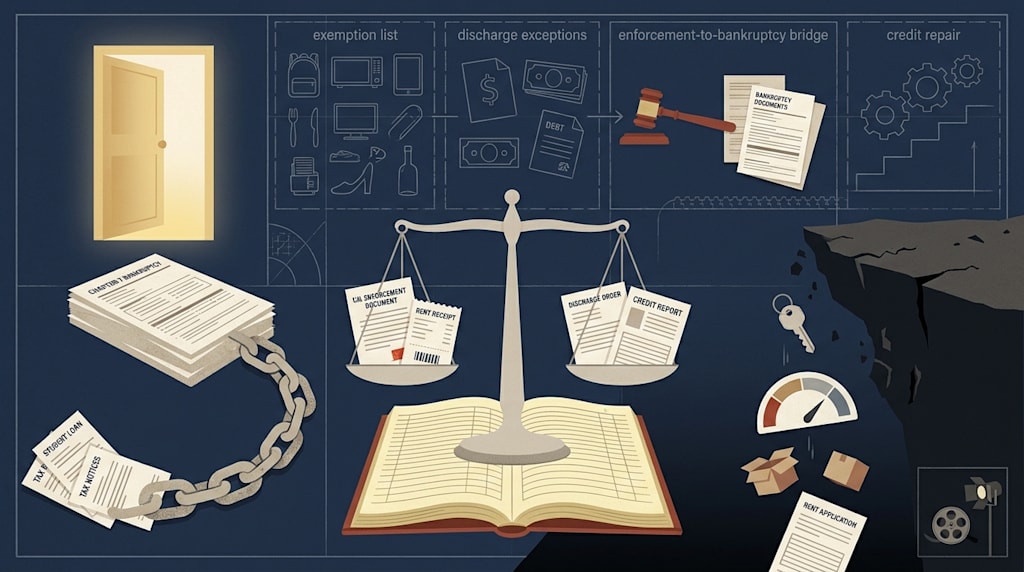
For China, the discussion should center on four specific parameters: how to set the standard for exempt property, how to draw the exceptions to discharge, how to connect enforcement procedure with bankruptcy procedure, and how credit repair and social assistance can catch those who remain unable to rebuild even after bankruptcy. The Shenzhen and Xiamen pilots provide limited but real experience. The scale is not large. Fraud has not become widespread. Entrepreneurs account for a high share. There is urgent demand for combined handling of enterprise and personal debt. These experiences are not enough to declare a nationwide system mature. They are enough to show that leaving the issue at the rhetorical confrontation between “heaven” and “kill line” helps neither creditors nor the debtors who need an institutional exit.
Do not fantasize that bankruptcy can build heaven on earth. Do not portray bankruptcy as hell on earth. Treat it as an institutional technology that requires carefully designed supporting rules. Its value lies in the connections among exemption lists, discharge exceptions, enforcement-bankruptcy linkage, and credit repair.
About the Creator
Jin
Writer of reamstories
https://reamstories.com/jin
Enjoyed the story? Support the Creator.
Subscribe for free to receive all their stories in your feed. You could also become a paid subscriber, letting them know you appreciate their work.
Comments
There are no comments for this story
Be the first to respond and start the conversation.