
Are Prediction Markets Really Accurate? Bloomberg Raises Serious Questions
Bloomberg is questioning whether prediction markets are truly accurate. Explore the growing debate around forecasting platforms, market reliability, and industry trust.

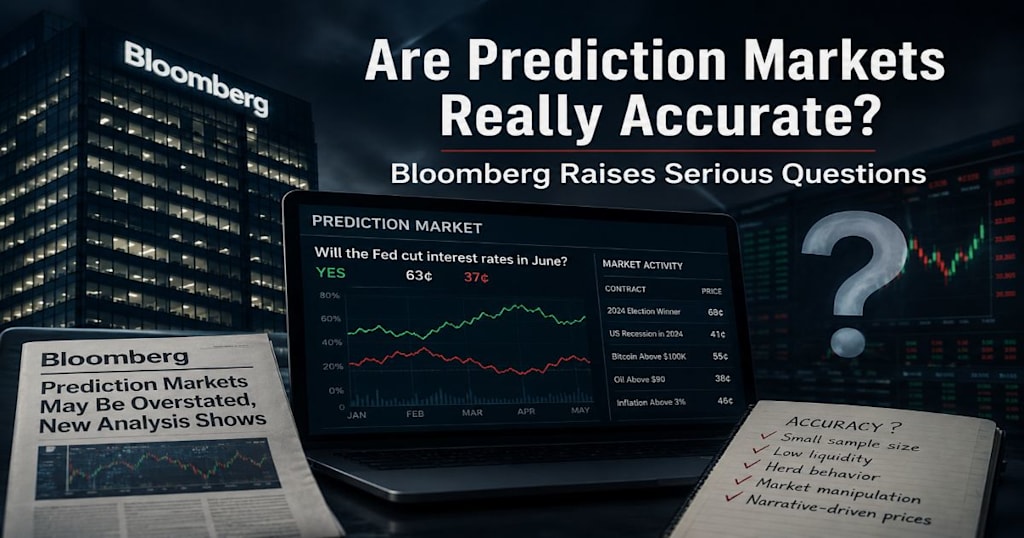
Prediction markets are growing rapidly across politics, sports, finance, crypto, and global news. Supporters believe these platforms are smarter than traditional polling because they react instantly to new information and reflect collective market sentiment in real time.
But Bloomberg recently raised important questions about whether prediction markets are truly as accurate as many people claim.
As these platforms continue expanding, the debate around forecasting reliability is becoming more serious.
Are prediction markets actually powerful forecasting tools, or are they simply another form of speculation driven by hype and emotion?
Why Prediction Markets Became So Popular
Prediction markets allow users to trade contracts based on future outcomes.
These markets cover:
elections
sports events
economic indicators
crypto movements
entertainment news
global developments
The market price reflects the probability of an outcome happening.
For example, if a contract trades at 70 cents, the market is effectively assigning a 70% chance to that event.
One major reason for their popularity is speed. Unlike traditional polls, prediction markets update instantly whenever new information appears.
This real-time nature has attracted:
traders
analysts
journalists
betting communities
financial media audiences
Several successful predictions in recent years also helped build the reputation that prediction markets may outperform traditional forecasting methods.
However, Bloomberg’s criticism suggests the industry may not be as reliable as supporters believe.
Bloomberg’s Main Concern About Accuracy
Bloomberg questioned whether prediction markets are sometimes viewed as more accurate than they actually are.
One major issue is liquidity.
Some prediction markets appear highly active, but in reality only a small number of traders may influence pricing. If participation is limited, the probabilities shown may not represent broader public sentiment at all.
Another concern involves emotional trading.
When social media narratives or news coverage strongly favor one outcome, traders often react emotionally instead of analytically. In these situations, market prices can become driven by hype rather than objective forecasting.
Bloomberg also highlighted a psychological issue known as selective memory.
People often remember the times prediction markets were correct while ignoring inaccurate predictions. This creates the perception that these platforms are almost always reliable, even when forecasting failures occur regularly.
For readers interested in a full Bloomberg prediction market breakdown, more detailed industry analysis is available on Poly Punter.
Forecasting or Gambling?
One of the biggest debates surrounding prediction markets is whether they function more like forecasting tools or gambling platforms.
Supporters argue that prediction markets aggregate collective intelligence. Critics believe many traders simply chase trends and emotional narratives.
The difference matters because trader behavior directly impacts accuracy.
If users:
analyze data
study trends
evaluate probabilities
follow economic developments
then markets can provide useful forecasting insights.
But when traders follow hype, viral opinions, or emotional reactions, prediction accuracy may decline significantly.
As prediction markets continue entering mainstream culture, maintaining credibility will become increasingly important.
Can Prediction Markets Be Manipulated?
Another growing concern is market manipulation.
Compared to traditional financial markets, many prediction platforms still operate with lower liquidity. This makes it easier for large participants to temporarily influence prices.
A well-funded trader may push odds in a specific direction and create misleading signals for smaller users.
Online communities can also influence sentiment around political events, sports outcomes, or viral news stories.
That does not mean every prediction market is manipulated. However, it shows why transparency and trader diversity are essential for long-term credibility.
Prediction markets are only as trustworthy as the structure supporting them.
Why Many People Still Trust Prediction Markets
Despite criticism, prediction markets continue growing rapidly.
The biggest reason is responsiveness.
Markets react instantly to:
breaking news
debates
economic reports
scandals
injuries
global developments
This creates a constantly evolving reflection of public sentiment.
Supporters also argue that financial incentives improve forecasting quality because users risk real money instead of casually sharing opinions.
In several high-profile situations, prediction markets successfully outperformed traditional polling and expert analysis.
That success is one reason investors and media organizations continue paying close attention to the industry.
The Future of Prediction Market Credibility
Prediction markets are entering a major expansion phase, but increased visibility also brings greater scrutiny.
The industry’s biggest challenge moving forward will be trust.
If prediction platforms want to be viewed as serious forecasting systems rather than speculative entertainment products, they must improve:
transparency
liquidity
market integrity
user education
Most importantly, users need to understand that probabilities are not guarantees.
Prediction markets can reflect collective intelligence, but they can also reflect emotion, hype, misinformation, and crowd psychology.
Bloomberg’s criticism may not stop the growth of prediction markets, but it does highlight an important reality:
These platforms are powerful forecasting tools — not perfect ones.
About the Creator
Poly Punter
Poly Punter covers prediction market news, Polymarket trends, crypto forecasting, trader insights, and real-time event trading. We publish informative content about decentralised prediction markets and forecasting culture.
Enjoyed the story? Support the Creator.
Subscribe for free to receive all their stories in your feed.
Comments
There are no comments for this story
Be the first to respond and start the conversation.