
Anthropic's $1 Trillion IPO Is Really About Paying the Bills
The AI giant's public debut is a stress test for the circular money loop connecting it to its own suppliers.
I. Three numbers
$78. $1.02 trillion. 5.7%.
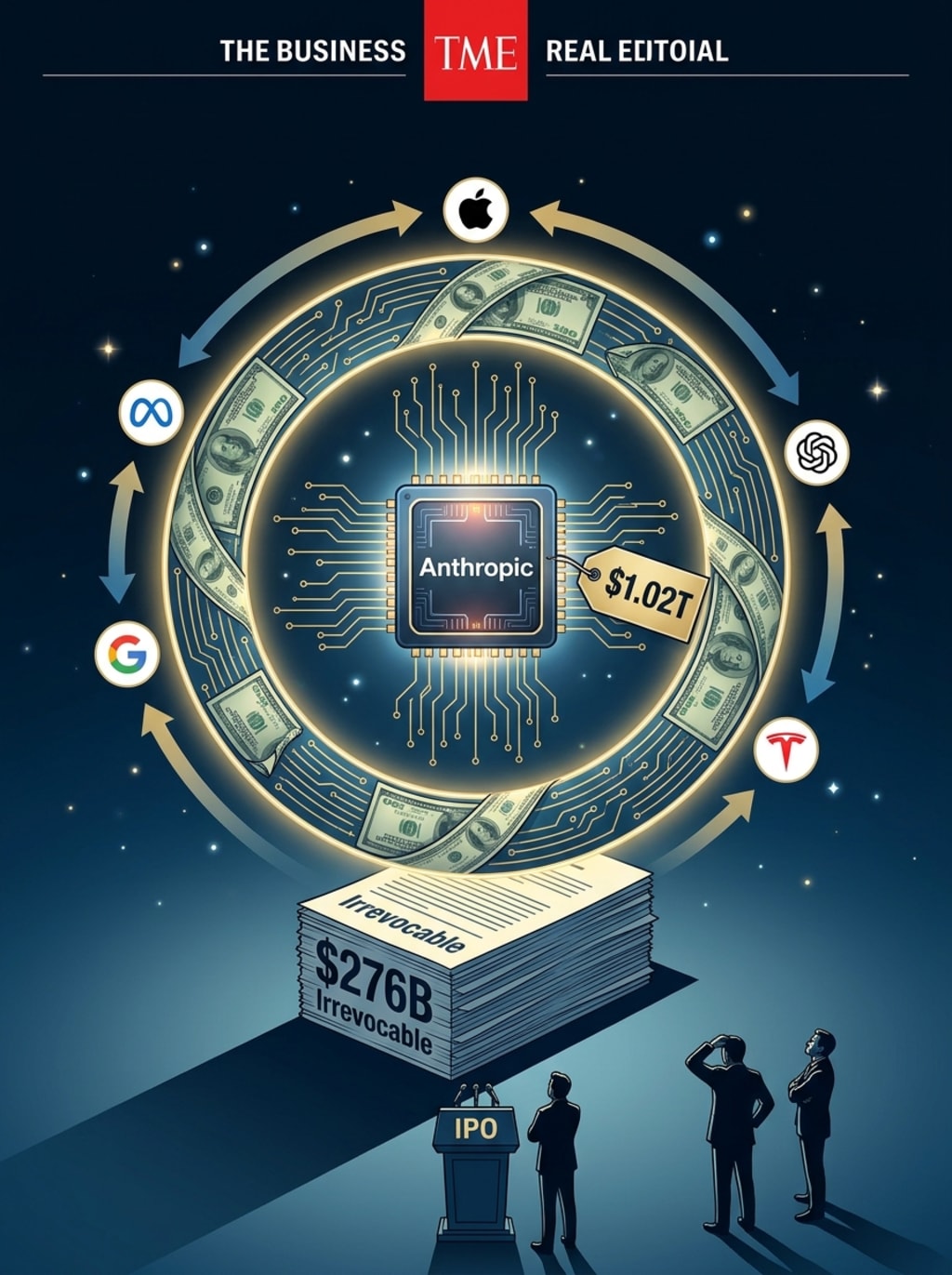
These three numbers frame Anthropic's IPO plan. The upper end of the offering price is $78 per share; based on total shares in the prospectus, the target valuation ceiling is about $1.02 trillion. Its last private round this year valued it at more than $965 billion. The IPO premium: 5.7%.
For a company with $81 billion in annualized revenue and regarded as being in the global AI first tier, that premium cannot be explained away with "the market is bad." A more accurate reading: the public market's pricing logic for AI companies is shifting from narrative premium to bill constraints. The private market can pay for an AGI story; the public market first asks how much you will have to spend.
The prospectus discloses about $895 billion in compute and infrastructure purchase commitments, of which about $276 billion is irrevocable. Put that number next to the $965 billion private valuation, and the 5.7% premium makes sense. The IPO's primary purpose is bill financing.
II. Are the last-round private investors losing money?
Conclusion first: no paper loss from a break below the issue price, but unattractive on a risk-adjusted basis.
The 5.7% premium cannot cover three things. First, the lock-up. Private-round investors usually have a six-month lock-up. At an annualized cost of capital of 8%, the six-month opportunity cost is about 4%. Subtract 4% from 5.7%, and 1.7% remains. Second, post-listing volatility. If the public market's valuation center for AI companies keeps moving down, the price at the end of the lock-up may be below the IPO price. Third, risk compensation. They bore uncertainty before the listing; 5.7% does not compensate for that uncertainty.
The risk-return ratio is ugly. The accounting is not. They are betting that post-listing results will continue to beat expectations and push the valuation up. If the market no longer pays a premium for the closed-loop narrative, they will be the last group to take the baton at a high valuation.
Cornerstone investors follow another logic. The $26 billion cornerstone investment enters at the IPO price, with a cost identical to the public market. The list is Google, Microsoft, Nvidia, AMD, Broadcom, Micron, and TSMC. It covers almost all of Anthropic's compute supply chain. For them, the primary purpose is locking in customers, orders, and the ecosystem. Financial return comes second. Short-term stock moves are not their only calculation.
III. Funders and payees: the same list
The purchase commitments disclosed in the prospectus can be matched one by one with the cornerstone list.
About $161 billion to Broadcom. About $115 billion to Google. About $110 billion to Amazon. About $45 billion to Microsoft. All four are on the cornerstone investor list. Broadcom put in cornerstone money and simultaneously received $161 billion in purchase commitments. Google put in cornerstone money and simultaneously received $115 billion. Funders and payees are the same list.
The structure is a subsidy loop. Suppliers use $26 billion of investment to subsidize Anthropic's future payments to them of nearly $900 billion in purchases. For suppliers, the logic is: keep the big customer ordering. Belief in independent growth is secondary.
The risk of the closed loop lies in its coupling. When suppliers' revenue and the customer's valuation support each other, once end-demand growth slows, the loop will reverse: Anthropic finds financing harder → compute purchases slow → supplier revenue expectations are cut → supplier stocks fall → Anthropic's valuation comes under pressure. The $276 billion in irrevocable commitments is the hardest link in this loop. It cannot be stopped at will.
IV. Will the data centers still be built?
At the contract level, most must be executed. At the construction level, execution will not be linear.
The $276 billion in irrevocable commitments carries steep default costs. Google's more than $200 billion long-term cloud commitment accounts for a large share of its unrealized revenue backlog and is an important support for financial expectations. The probability of Anthropic unilaterally defaulting is very low.
But "must be executed" does not mean "executed on the original plan, at the original pace, and at the original cost." In 2026, at least 47 large data center projects in the U.S. have been delayed, withdrawn, or blocked. Bernstein analysts estimate that only about 35% of the planned U.S. data center project pipeline is credible. Rising borrowing costs, power interconnection limits, and community opposition are all slowing construction. The growth rate of compute capex by overseas mega-caps is expected to fall from over 80% in 2025 to 60%–70% in 2026. Slower growth does not mean an absolute decline, but the phase of "expanding at any cost" is passing.
The hundreds of billions in commitments will not disappear, but they will become a war of attrition in which the bill must be paid and the pace can be adjusted. Anthropic's IPO financing is meant to ensure it can pay these commitments that are already creating financial pressure. The money honors old contracts. It does not tell a new story.
V. Not dead, stratified
The judgment that "AI mega-infrastructure in the U.S. is dead" is premature.
A more accurate description: from a race into a war of attrition, from story-driven expansion into cash-flow constraints. Top projects, top cloud providers, and top chip companies will keep investing because the contracts and backlog are there. Lower-tier projects, projects lacking power infrastructure, and projects supported by high leverage will be delayed, canceled, or cleared out.
Stratification is the right word. Over the past two years, the market was willing to pay for any capex with "AI" attached to it. Now the market is starting to ask: where does the power come from? Who is the customer? How long is the collection cycle? Is the supplier also a shareholder? Once these questions are on the table, AI infrastructure will not disappear, but it will look more like a hard battle of capital strength and engineering capability.
Anthropic's IPO is the first public stress test of that battle. The test is whether the public market will pay a higher premium for a company that needs to put almost its entire valuation into future compute purchases. The future of AI is a separate question.
VI. A cold question
A $1.02 trillion valuation buys a position that must keep running. Ahead are $895 billion in purchase commitments, of which $276 billion is irrevocable. Behind are private investors waiting to exit. Beside it are orders locked in by supplier-shareholders. Underfoot is the public market's increasingly cautious pricing.
If the stock rises after listing, the closed loop can keep telling its story. If it moves sideways or falls, last-round investors will recalculate, suppliers will reassess the cost-effectiveness of "investment for orders," and data center projects will be rescheduled.
By then, the market will no longer ask whether Anthropic is worth $1 trillion. It will ask a colder question:
Before the $276 billion in irrevocable commitments comes due, how many more quarters can this loop keep turning?
About the Creator
Jin
Writer of reamstories
https://reamstories.com/jin
Enjoyed the story? Support the Creator.
Subscribe for free to receive all their stories in your feed. You could also become a paid subscriber, letting them know you appreciate their work.
Comments
There are no comments for this story
Be the first to respond and start the conversation.