
AI Can Read Every Earnings Report. It Still Can't Find the Signal That Makes You Money.
A 3 a.m. job posting, a gradient descent blind spot, and the human judgment that still decides who wins in the market.
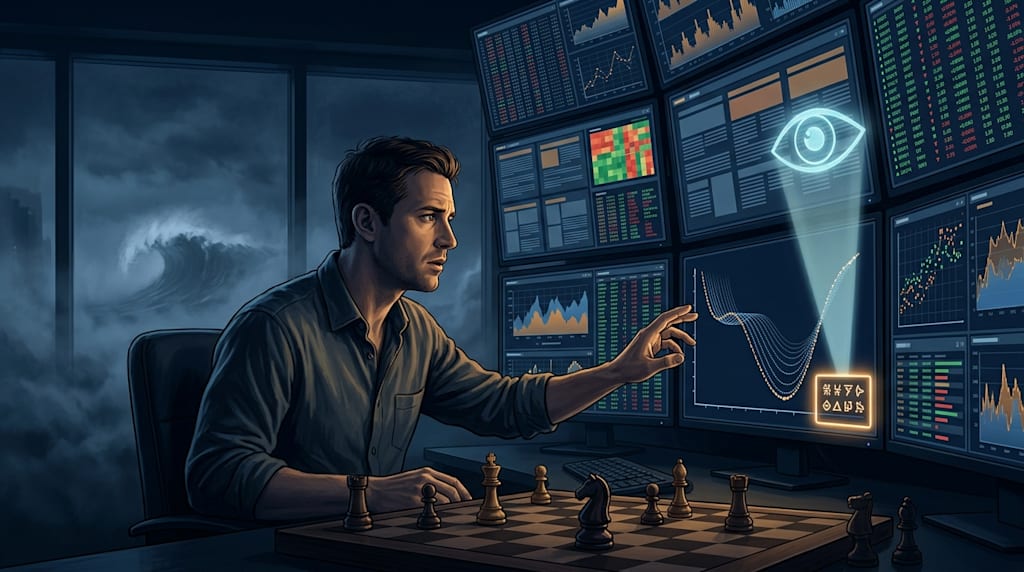
Can AI discover information the market has not yet priced?
A trader stares at the screen at three in the morning. He is not looking at prices. He is looking at a job posting. A semiconductor company has listed a position for an "advanced packaging process engineer," and the requirements mention a technical acronym he has never heard before. The posting has been online for three months. Thousands of people browse it every day. No one has made a cent from it. He screenshots it, closes the screen, and goes to sleep.
Three months later, that acronym appears in the titles of seven brokerage research reports.
This is not a story about what AI can do, because the one who found the job posting was not AI. It was the trader. But if you take that scene apart, you will find two different abilities hidden in his actions. First, he read the information. Second, he judged that it mattered. The first action: AI can do it ten thousand times faster than he can. The second: why this job posting, and not the other three thousand? Why does "advanced packaging" plus that acronym mean something? That is the entrance to the question.
What a statistical machine can and cannot do
The training process of a large language model is essentially doing one thing: given the previous words, predict the next word. This task of predicting the next word, at the scale of trillions of parameters, forces out certain surprising abilities. The model learns grammar, facts, reasoning patterns, and even what sounds right in what context.
But one detail is worth noticing. The training objective is cross-entropy loss, which measures the gap between the model's output probability distribution and the true next word. What gradient descent does is minimize that gap. This process has an implicit preference: it favors patterns that appear frequently in the training data, because frequent patterns contribute most to reducing average loss. Conversely, a pattern that has appeared only a few times contributes almost nothing to the loss. Gradient descent will barely adjust parameters for it.
This means AI's understanding of the world is formed under the constraint of being correct on average. It is best at things that repeat and have statistical regularity. The structure of an earnings report, the argumentative style of a research report, the habitual phrasing of management on an earnings call: these appear hundreds of thousands of times in training data, and the model learns them well. But an early signal of a never-before-seen technology route, an acronym that surfaces only once in some engineer's job requirements, has a frequency in training data of zero or near zero. Gradient descent will allocate no parameters to it.
This is not to say AI cannot see the job posting. It can read the entire job site and extract that posting and put it in front of you. But it will not feel that the posting matters, because mattering has no corresponding gradient signal in the statistical framework.
Why did the trader feel it mattered? Because he has embodied experience. He has been in this industry for ten years, lived through three technology route shifts, and the early signals of every shift looked like this: a strange job title, an acronym no one had heard of, a company quietly hiring. His body remembered the pattern, even though he could not say why. This cannot-say-why judgment is precisely what the statistical framework is least able to reproduce.
Where information the market has not priced hides
To answer whether AI can discover unpriced information, we first have to ask: what does unpriced information look like?
The first kind: private information. Insider knowledge, exclusive data, firsthand supply-chain intelligence. AI does not create this kind of information. It can be a tool for processing private information. For example, integrating supply-chain data, satellite images, and credit-card flows into a signal. But only if someone feeds that data in. Without data, even the largest model is empty.
The second kind: public but unprocessed information. This kind exists because human attention is limited. The whole market produces hundreds of thousands of documents every day. An analyst team can cover only a few hundred. Here AI has an overwhelming advantage. It can read all the documents in minutes, extract key variables, and cross-check them. This processing edge can translate into excess returns, but the window is short. Once everyone uses AI to read documents, the advantage is gone.
The third kind: public but misinterpreted information. The same earnings report: one person sees revenue growth, another sees deteriorating receivables. The same policy: one sees a positive, another sees implementation difficulty. This difference comes from narrative frames, discount-rate assumptions, and risk preferences. AI can help discover the blind spots of consensus through multi-perspective analysis, counterfactual reasoning, and narrative monitoring. But it cannot decide for you which perspective is right, because right requires real-world verification.
The fourth kind: structural changes that have not yet happened. Model shifts, technological mutations, shocks that have never occurred. This kind of information is not in the training data. What AI can do is generate hypotheses from combinations of known patterns, such as "if A and B happen at the same time, C may hold." But it cannot verify the hypothesis. Verification requires the real world to give feedback, and the real world does not move to the rhythm of gradient descent.
The fifth kind: information that can only be generated through experiments. New data obtained through active probing, surveys, experiments, simulations. AI can design experiments and analyze results, but the experiment itself requires interaction with reality. Without interaction, there is no new information.
Put these five kinds together, and AI's ability distribution is extremely uneven. On processing-type information, it is almost impeccable. On combinatorial-type information, it is strong. On hypothesis-type information, it is useful but unreliable. On original-type information, it is powerless.
A concrete example
Suppose there is a company that makes industrial robots. Its earnings report shows 20% revenue growth, stable margins, and management says on the call that "demand is strong." A human analyst reads it and gives a "buy" rating.
What does AI do? It extracts all of the company's earnings-call transcripts from the past eight quarters and calculates a sentiment score for management's wording. It finds an anomaly: the frequency with which management mentions "demand" is rising, but the frequency with which it mentions "delivery" is falling. It pulls the company's job postings and finds that the number of "after-sales engineer" positions it has been hiring over the past three months is three times the year-earlier level. It brings in supply-chain data and finds that purchases of core components are declining. It pulls satellite images and finds that vehicle density in the parking lot of the main factory is falling.
Then it gives a signal: the company's actual shipments may be declining, and revenue growth may come from price increases or channel stuffing.
Is this signal valuable? Yes. It comes from public information, but human analysts do not have time to simultaneously look at eight quarters of transcripts, job postings, supply-chain data, and satellite images. AI pushes processing edge and combinatorial edge to the limit.
But can this signal be traded directly? Not necessarily. Because the market may have already partially priced it. The stock may already have fallen. Or the market may not have priced it at all, because no one has done this cross-validation. AI does not know which case it is, because it does not know what the market knows. It only knows what is in the data.
Why can the trader judge? Because he knows what the market's narrative is. He knows what sell-side analysts are pushing, what buy-side investors are worried about, which research report has been forwarded around the circle recently. This perception of market consensus comes from his embodied experience in the circle: drinking, chatting, listening to roadshows, reading social feeds. AI does not have this perception, because it has no body, no social life, no immersion in the same circle.
The trap of causal inference
The most dangerous misuse of AI in financial research is mistaking correlation for causation.
Suppose AI discovers a pattern: over the past ten years, whenever a certain type of job posting increases, the company's stock price rises by an average of 15% six months later. The pattern performs well in backtests. So AI gives a signal: buy.
But there is a problem. Why does this pattern hold? Is it because the increase in hiring causes the stock price to rise? Or because the company is about to expand, so hiring increases, and expansion causes the stock price to rise? Or because after the stock price rises, the company has money to hire? Or is it purely a statistical coincidence that will disappear out of sample?
AI does not know. It only knows correlation. And market pricing is driven by causal chains. If you do not know the causal mechanism, you do not know when the pattern will fail. When the competitive landscape changes? When the macro environment changes? When enough people discover and trade away the pattern?
More troublesome: AI may discover fake causation. For example, it finds that a company's stock price has a 0.7 correlation with the temperature in some remote region. The correlation holds in backtests, but it has no causal basis. If AI incorporates this signal into its model, it may lose money out of sample.
What do human investors do? They ask why. They look for mechanisms, do counterfactual reasoning, and wait for reality to verify. This process is slow, but it is necessary. AI can accelerate it. It can generate hypotheses, design verification plans, monitor verification results. But it cannot replace real-world verification.
What exactly is the trader's intuition?
Back to the trader at three in the morning. Why did he feel that job posting mattered?
He himself may not be able to explain clearly. But if pressed, he would say: "I have seen it." He has seen job postings for touch-screen engineers at Apple before the 2007 iPhone launch, job postings for battery-management engineers at Tesla around 2015, job postings for CUDA engineers at Nvidia around 2020. Every time, the job posting appeared before the stock price took off. His body remembered the pattern, even though he could not say why.
This intuition is called pattern recognition in cognitive science. But it is not statistical pattern recognition. Statistical pattern recognition requires large samples, clear features, and an optimizable objective function. Human intuitive pattern recognition can work with small samples, fuzzy features, and an unclear objective. It relies on embodied experience. You have been immersed in a field long enough that your body remembers those signals that you cannot explain but just feel are right.
Can AI learn this intuition? To some extent, yes. Through multi-agent systems, memory banks, reinforcement learning, and world models, AI can approximate certain intuitive functions. But it has a fundamental limitation: it has no survival constraint. It will not lose money from a wrong judgment, will not feel anxious about missing an opportunity, will not suffer from being slapped in the face by the market. Without these constraints, the concept of mattering lacks a foundation.
The rational boundary of human-machine division of labor
So what is AI's reasonable role in financial research?
It is an induction engine. It extracts patterns from massive data, generates hypotheses, cross-validates, and monitors anomalies. It does breadth, speed, and consistency. It can read a thousand earnings reports in seconds, monitor an anomalous job posting in the middle of the night, and update supply-chain data into the model while human analysts sleep.
But it is not a prophet. It cannot create information that has never appeared out of thin air, cannot verify causation, cannot judge whether market consensus has already priced a signal, and cannot bear the consequences of a wrong judgment.
What is the human investor's role? Problem definition, causal judgment, risk budgeting, position decisions, and responsibility-bearing. Humans decide what is worth paying attention to. AI is responsible for finding all relevant information. Humans decide whether this signal is credible. AI is responsible for laying out all relevant data. Humans decide whether to bet. AI is responsible for calculating the odds under various scenarios.
The boundary of this division of labor will move as technology advances. What AI cannot do today, it may do tomorrow. But some things may forever belong to humans: the ability to wait in ambiguity for structure to emerge, the ability to build connections between seemingly unrelated fields, the ability to stay alert to tail risk, and most importantly, the ability to bear the consequences of a judgment.
Back to that early morning
After the trader screenshotted the posting at three in the morning, he did not place an order immediately. He waited three days. He talked with two friends in the industry and confirmed that the technical acronym was not a typo. He checked the company's patents and found that they had begun laying out in this direction two years earlier. He looked at sell-side research reports and found that none mentioned the technology. He judged: the market had not yet priced it.
Then he bought.
Six months later, that technology became a market hotspot. Seven brokerage research reports began pushing the direction. The stock price rose.
What did he do right? He read the job posting. AI can do that too. He judged that the posting mattered. AI cannot do that. He waited three days to confirm. AI would not do that, because it does not have the feeling of uncertainty. He bet. AI cannot do that, because it has no money.
AI can help him read the job posting faster. AI can help him integrate all related patents, supply-chain data, and job postings into one interface. AI can help him monitor whether people have begun discussing the technology. But that moment of feeling it matters, that restraint of waiting a little longer, that decision to bet, belongs to him.
Conclusion
Can AI discover information the market has not yet priced?
If discover means extract information from public data that has not been fully processed, yes. That is what it does best. Processing edge, combinatorial edge, and monitoring edge are all tradable advantages with a window.
If discover means generate original information that has never appeared, no. It can only generate new combinations of known patterns, not unknown patterns themselves.
If discover means judge whether a signal has already been priced by the market, it cannot reliably do so. It does not know what the market knows, because it is not in the market.
If discover means wait in ambiguity for structure to emerge, stay alert to tail risk, and make a responsible judgment when information is incomplete, no. That requires embodied experience, emotional navigation, motivational framing, and the ability to bear consequences.
So the rational attitude is: treat AI as a powerful induction engine, a hypothesis generator, and an information-processing lever. Let it do breadth, speed, cross-validation, and anomaly monitoring. Let humans do problem definition, causal judgment, risk budgeting, position decisions, and responsibility-bearing.
Investing is a judgment contest, not an information contest. AI has driven the cost of information raw material close to zero, but the step from raw material to judgment, the gap that must be crossed with intuition, experience, and responsibility, still belongs to humans.
That trader at three in the morning was not competing with AI over who could read faster. He was competing with the market over who could see more accurately. AI can help him read faster, but it cannot help him see more accurately. Seeing accurately requires him to immerse himself in the market, to feel with his body those things he cannot explain, and then, at a certain moment, to make a judgment he is willing to be responsible for.
What AI can do is give him more time to do that.
About the Creator
Jin
Writer of reamstories
https://reamstories.com/jin
Enjoyed the story? Support the Creator.
Subscribe for free to receive all their stories in your feed. You could also become a paid subscriber, letting them know you appreciate their work.
Comments
There are no comments for this story
Be the first to respond and start the conversation.