
Why Trump Put Himself Above Lincoln — And What It Says About His Fear
He ranked himself first, but historians rank him last. The gap between those two lists is the real story.
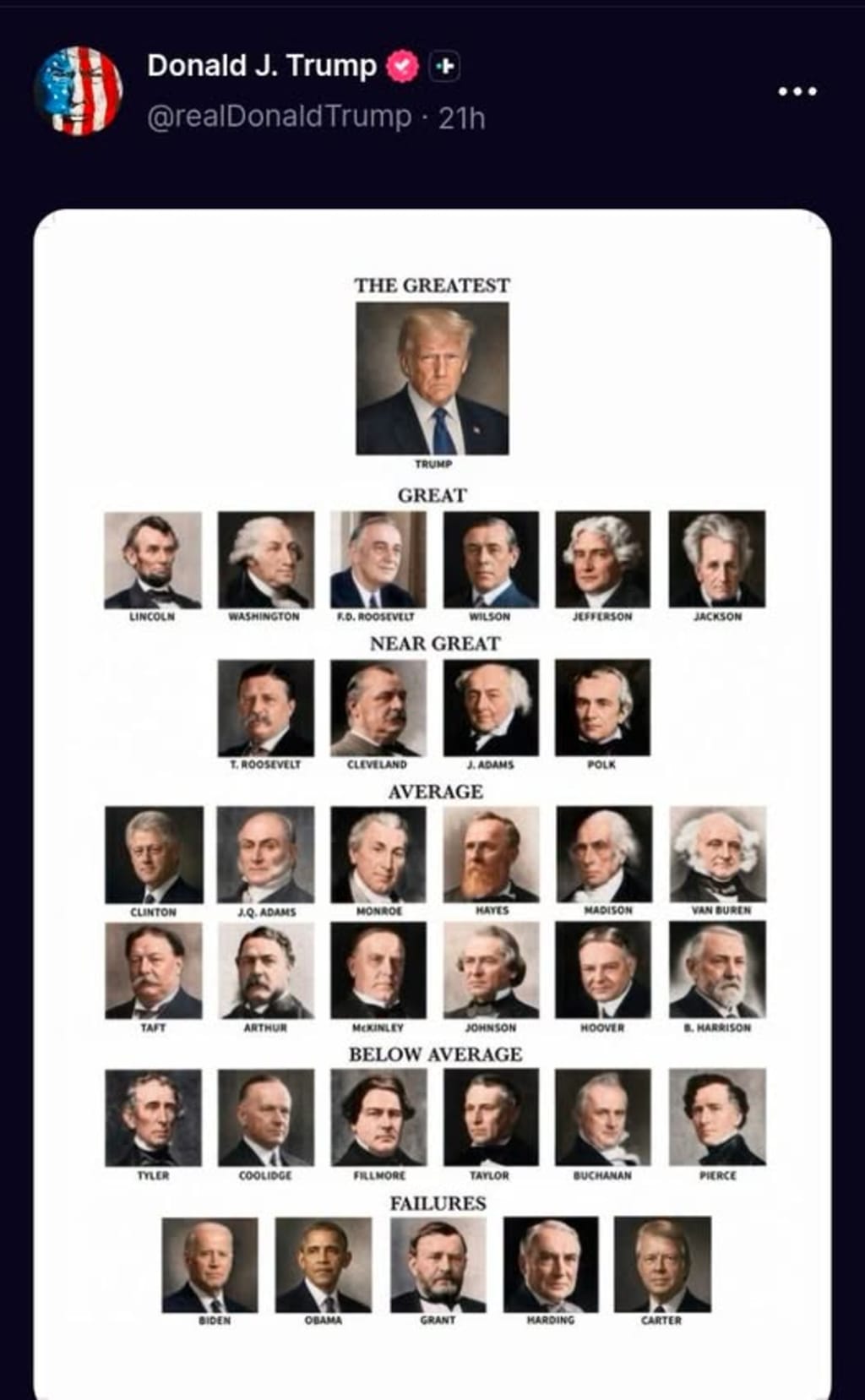
What This Ranking Reveals About Trump's Deepest Fear
On September 6, Donald Trump posted an image on social media.
It was a tier chart of U.S. presidents, ranked from "Greatest" to "Failures" across six levels. He placed himself alone at the very top. Below him, Lincoln, Washington, Franklin Roosevelt, Jefferson, and Jackson were packed into the second tier. Reagan and Eisenhower landed in the third. Obama, Biden, and Carter were shoved into the bottom "Failures" section.
Trump didn't design this chart himself.
It was adapted from a 1948 Life magazine survey of historians. Trump's team took the original table, deleted most of the names, inserted his own at the apex, demoted recent Democratic presidents to the failure zone, and posted it. The original logic was replaced by a new algorithm: Do I like this president? Did he "win"?
Whom to elevate and whom to bury depends on whether they served "me"
The second tier holds five names. Lincoln is the founding father of the Republican Party, the man who preserved the Union. Conservatives need that symbol. Andrew Jackson is also there. The seventh president did two things: he pushed through the Indian Removal Act, driving Native Americans from the Southeast, and he openly defied the Supreme Court, saying, "John Marshall has made his decision; now let him enforce it." Trump's elevation of Jackson to "greatness" is less a historical judgment than a political statement: executive power should not be handcuffed by the courts.
Reagan sits in the third tier. Trump's admiration for Reagan has never been about policy specifics; it's about an atmosphere—optimism, swagger, American victory. The televised speeches and flag-waving collective narrative of the 1980s are exactly what Trump wants to recreate.
Eisenhower nearly made the second tier. But in 2025, Trump tried to borrow a ceremonial sword from the Eisenhower Presidential Library to give to the British king. The director refused and was forced out. On this ranking, Eisenhower slid down a notch.
Nixon was placed in the third tier. As a young man, Trump wrote to Nixon, calling him "one of America's great figures." Nixon wrote back, saying, "The more the media attacks you, the more I stand with you." Nixon's 1990 line—"If you run for president, you will succeed"—stayed with Trump for years. Yet Nixon still didn't make the second tier. Trump had criticized Nixon for being "soft on China." Personal affection counts, but policy lines must be drawn. So the old idol ended up in the middle, neither here nor there.
Scholars rank a very different table
If Trump's table asks "Do I like him?", the academic logic asks "What did you achieve, and did you undermine institutions?"
In 2024, the Presidential Greatness Project surveyed 154 scholars. Trump ranked dead last. In Siena College's survey, he placed last in both "integrity" and "intelligence." Not just low—rock bottom.
A Reuters/Ipsos poll in August 2024 put Trump's approval at 33 percent—his lowest of his second term.
A president with 33 percent approval, rated last by scholars, posts a chart naming himself the greatest of all time. That is a retreat, not confidence.
What this table is saying
Burying Obama and Biden in the "Failures" zone isn't history-writing; it's score-settling. The 2024 election had just ended. Trump needed his supporters to believe one thing: the past eight years were all wrong, and only he is right. That's not a historical conclusion. It's political fuel.
But he didn't go all the way. Clinton is in the third tier. So is Kennedy. Both are Democrats, but Clinton presided over overwhelming U.S. global military dominance, and Kennedy carries the Camelot myth. They weren't dumped into failure. Why? Because they have "win" in them. For Trump, party affiliation isn't primary—"Did you win?" is.
Wilson was placed in the lower-middle tier. Wilson did one thing: after his stroke in 1919, he refused to concede, refused to yield power, dragging his half-paralyzed body through the rest of his term while his party fell into chaos. Trump ranking Wilson low feels like an avoidance—or perhaps an acknowledgment.
The irony sits beside the "first" place, not in it
Trump puts himself in a class above Washington and Lincoln. That's what he wants—to tower over everyone, a solitary peak.
But there's a detail he misses: even on this chart he made, Lincoln and Washington still have to be there. He needs them to prove he belongs in their company.
And Washington and Lincoln are remembered precisely because they never ranked themselves. Washington stepped down after two terms. Lincoln, in his second inaugural, on the eve of victory, said, "With malice toward none, with charity for all."
This isn't about posture. It's about two fundamentally different views of power—one that sees power as an instrument to be constrained, the other as a medal to be confirmed.
The academic rankings that place Trump at the bottom may not keep him awake at night. What might keep him awake is this: on the afternoon of September 6, 2026, he sat at his computer, had a 1948 survey dug up, erased other people's names, filled in his own, and clicked "post."
That act, more than any scholarly survey, tells you where he actually belongs in history.
About the Creator
Jin
Writer of reamstories
https://reamstories.com/jin
Enjoyed the story? Support the Creator.
Subscribe for free to receive all their stories in your feed. You could also become a paid subscriber, letting them know you appreciate their work.
Comments
There are no comments for this story
Be the first to respond and start the conversation.