
Who Really Owns Venezuela’s 65 Billion Barrels of Oil?
A deal with no signature, a president with no details, and a country with no power to say no.
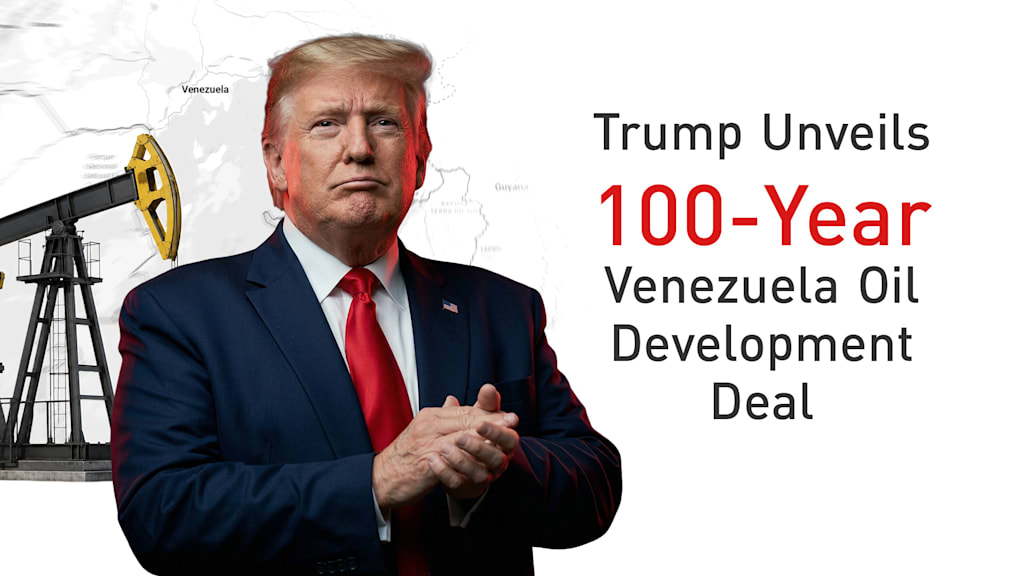
I. The Gap Between Two Announcements
On August 28, 2026, two messages appeared almost simultaneously on social media.
Trump's wording sounded like a victory declaration: "American taxpayers will not bear any cost," "majority control," "more than double our petroleum reserves." He released no text of the agreement. He did not mention where it was signed. He did not answer the most basic question—whether Venezuela's National Congress had ever voted on it.
Later that same day, Venezuela's acting president, Delcy Rodríguez, confirmed the agreement: 17 strategic oilfields, 65 billion barrels of proven reserves, and an investment scale exceeding $100 billion. Her announcement read more like a survival memo—no applause, only the flat statement that "an agreement has been reached."
The real story lies in the gap between these two announcements.
II. An Oil Engineer's Hand Speaks More Honestly Than a Presidential Statement
To understand the true nature of this agreement, one might bypass the White House and the presidential palace and instead look at a hypothetical scene:
In Venezuela's Orinoco heavy oil belt, next to a drilling rig idle for three years, stand a field manager from a U.S. oil company and a veteran engineer from Venezuela's state oil company, PDVSA. The manager holds a draft equity agreement. The engineer grips a wrench. The manager says, "We'll handle the restart. You'll produce the oil. We split the revenue according to a new ratio."
The engineer does not ask about "sovereignty" or "control." He asks only one question: "Who pays for the spare parts? And do we settle in dollars or bolívars?"
This concrete, oil-stained, exchange-rate-anxious dialogue comes closer to the deal's essence than any label like "hegemonism" or "power politics." The deal is a transaction, but it takes place against the backdrop of a country in economic collapse, where even spare-part procurement has lost its pricing power. Venezuela's "consent" is written in the diesel generators that have stopped running and in the office districts with only four hours of electricity per day—not in any so-called "free choice."
III. Blank Pages in the Legal Text
If an international energy lawyer received this agreement, the first thing they would do is not look at the revenue split, but flip to the "governing law" and "dispute resolution" clauses.
Venezuela's constitution, Article 12, states that the country's mineral resources belong to the people, and any development agreement requires approval from the National Congress. Yet the legitimacy dispute between the current National Congress (controlled by the opposition) and the Maduro government has lasted for years. If the Maduro government signed it, the U.S. has not recognised its legitimacy. If the opposition signed it, they lack constitutional authority.
This creates a legal Möbius strip. No matter which side you enter from, you cannot find a legitimate surface on which to put pen to paper.
Trump claims that "taxpayers won't pay," but private companies cannot invest without returns. In what form will those returns be realised? Will oil export revenues flow directly into U.S. company accounts, or first into Venezuela's central bank and then be split? If a future regime change occurs, can the new government renegotiate? These blank pages remain empty not because of oversight, but because filling any one of them would instantly invalidate the word "free."
IV. The Market Has No Emotions, Only Indicators
On August 28, Brent crude futures fluctuated less than 0.5%.
Traders did not cheer for "65 billion barrels under control." The reason is simple: Venezuela's oil production has fallen from an average of 3.2 million barrels per day in 2008 to less than 800,000 today. Restoring production would require three to five years and over $50 billion in infrastructure reconstruction. And Chevron has issued no shareholder statement on this matter. Capital's silence speaks louder than any president's declaration.
What actually moved that day was the Venezuelan black-market bolívar-to-dollar exchange rate, which fell 7% within three hours of the announcement. What the market believed in was not an oil production increase, but that the country's sovereign credit had grown another layer thinner.
V. Chinese Companies There: Dusk and Dawn
In Venezuela, the camps of Chinese oil companies and engineering contractors still have their lights on. Over the past fifteen years, China has provided more than $50 billion in financing through "loans-for-oil" agreements, with partial repayment in physical crude.
If U.S. companies gain control of the 17 oilfields, will those blocks overlap with existing China-Venezuela contracts? How will the existing debt repayment priority be reordered? These are not problems that diplomatic rhetoric can solve. They are a series of specific contractual clauses, loading plans for oil tankers, and accounts receivable ageing schedules updated daily by finance staff.
In its response, the Chinese foreign ministry did not use strong language. It reiterated the principles of "respecting each country's legitimate rights over its own resources" and "mutual benefit and equality." This is not weakness. It is a prudent stance grounded in existing contracts and tangible interests. On the ground, Chinese drilling rigs are still running, and they need stable electricity, security, and right-of-way access—not a round of applause on social media.
VI. An Ending That Does Not Need a Conclusion
Trump says this will lower U.S. gasoline prices. Venezuelans say it will bring $100 billion in investment. Both statements can be true. Both can also fall flat.
After August 28 passes, what may have truly changed is not the global oil supply pattern, but a simpler reality: when an agreement involving 65 billion barrels of oil has so few details that it cannot fill one page, it ceases to be a contract and becomes a performance.
Every performance needs an audience. The price of admission to this one—whether through the continued devaluation of the bolívar or yet another loosening of international legal precedents—will ultimately be paid by someone. The agreement does not say who.
If one must find an image to remember this event, it is not a signing ceremony. It is a gas station attendant on the banks of the Orinoco River on the evening of the 28th, staring at a price board that has not changed at all. He picks up a rag and wipes a smear of oil off the pump nozzle.
That gesture represents no one and takes no side.
About the Creator
Jin
Writer of reamstories
https://reamstories.com/jin
Enjoyed the story? Support the Creator.
Subscribe for free to receive all their stories in your feed. You could also become a paid subscriber, letting them know you appreciate their work.
Comments
There are no comments for this story
Be the first to respond and start the conversation.