
What the Xi-Trump White House Meeting Put on the Table
From youth exchanges and trade to artificial intelligence, Taiwan and the Middle East, people interviewed by Xinhua focused on one recurring theme: keeping the U.S.-China channels open.
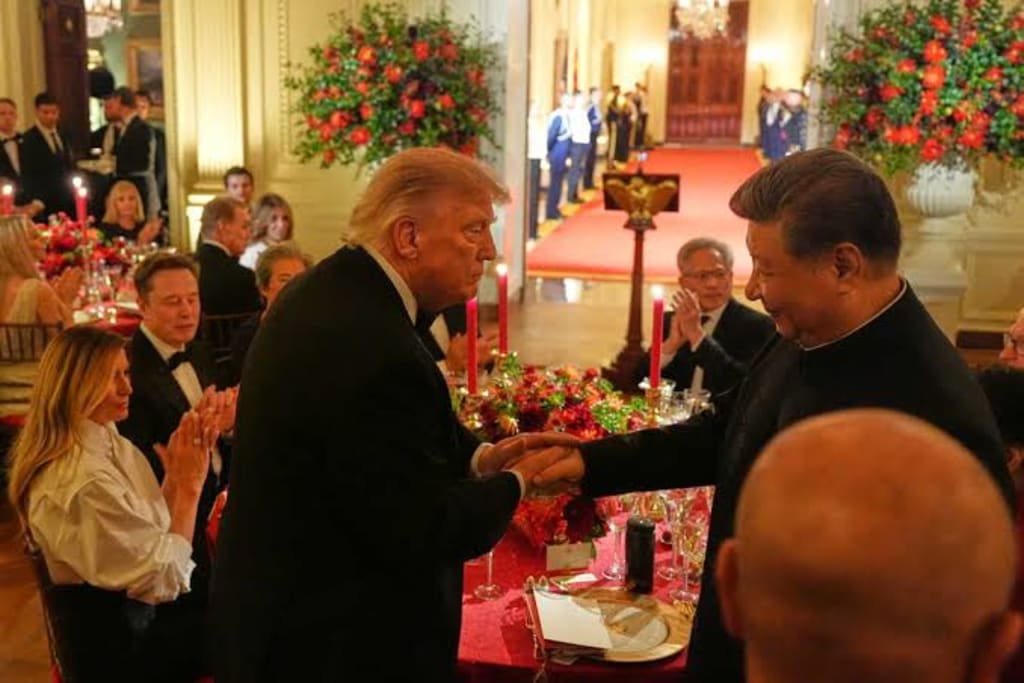
WASHINGTON, Sept. 24, 2026 — Chinese President Xi Jinping and U.S. President Donald Trump met at the White House on Thursday, with discussions ranging from trade and artificial intelligence to Taiwan and major international conflicts.
The meeting was part of Xi's state visit to the United States. In the Chinese government's account, the two leaders also discussed the Middle East, the Ukraine crisis and the Korean Peninsula, and agreed to support each other in hosting the 2026 APEC Economic Leaders' Meeting and G20 summit.
What followed was less a single reaction than a collection of views from people in different countries. In interviews with Xinhua, former officials, academics, business leaders and students returned repeatedly to the same question: whether sustained dialogue can keep competition between the world's two largest economies from turning into wider confrontation.
The value of simply talking
Vincent Meriton, former vice president of Seychelles, described the meeting as necessary at a time of heightened geopolitical and economic uncertainty.
"The fact that the leaders of the world's two largest economies can sit down and speak directly is significant in itself," he said.
Xi said during the meeting that China and the United States have different national conditions, but that candid and sustained dialogue can improve understanding, manage differences and build trust. China's Foreign Ministry says Xi framed the relationship around a combination of cooperation, competition and the management of disagreements.
Meriton agreed that rivalry between the two countries is unlikely to disappear, and argued that the more practical question is how disagreements are handled.
"Competition will not disappear, and it does not need to disappear," he said. "The question is how the differences are managed when they arise. That requires respect and treating each other on an equal footing."
Melaku Mulualem, an international relations and China expert at the Ethiopian Foreign Relations Institute, said regular contact between the two governments could reduce the risk of miscalculation.
At a time when competition extends across trade, technology and security, he said, direct communication can help keep disagreements within limits that both sides can manage.
Azmi Hassan, a senior researcher at Malaysia's Nusantara Strategic Research Institute, said Xi's call for communication, cooperation and peaceful coexistence could also matter beyond the bilateral relationship.
His view was that a more stable relationship between Washington and Beijing would affect not only the two countries but also governments and businesses elsewhere that have to operate in an economy shaped by U.S.-China ties.
100,000 young Americans
One of the most concrete announcements was aimed not at governments or companies, but at students.
Xi announced that China would invite 100,000 American young people to China for exchanges and study over the next five years. The proposal builds on an earlier five-year initiative announced in 2023 that targeted 50,000 young Americans; Xinhua reported that the earlier goal was reached ahead of schedule.
For Madeline Berger, a senior at Central Michigan University who recently visited China for a China-U.S. youth exchange program, the announcement had an immediate personal meaning.
"I was very excited to hear the news," she said.
More exchanges, she said, would give American students the chance to experience China directly rather than forming impressions at a distance.
"When people have the opportunity to communicate with one another, they can move beyond geographical distance and stereotypes and find what they have in common," Berger said.
Xinhua's reporting on the new initiative said the programme is intended to expand youth exchanges between the two countries and create more opportunities for American students to experience Chinese society firsthand.
Trade remains the practical test
The relationship is also measured in contracts, investment decisions and supply chains.
Xi said during the meeting that the interests of China and the United States are deeply connected and that there is substantial room for cooperation. He called for both sides to work toward a more stable economic relationship based on mutual benefit. China's Foreign Ministry said the two governments' economic teams had reached a new joint arrangement in recent talks.
Julie Kozack, an IMF spokesperson, said a meeting between the leaders of the world's two largest economies matters beyond Washington and Beijing because the consequences of their relationship extend into the global economy.
Gong Zheng, president of the American Chamber of Commerce in Shanghai, said greater stability in bilateral relations remains a major concern for companies operating across the two markets.
He pointed to Xi's statement that China's door remains open to U.S. companies as a message that could support continued investment and business activity.
Gustavo Cordero, former chairman of the Peru-China Friendship Group in Peru's Congress, said the recent economic arrangements between the two countries represented a useful signal, while stressing the importance of keeping communication channels open.
For Latin American economies, he said, U.S.-China relations matter well beyond the bilateral relationship because changes between the two largest economies can affect global trade flows and economic conditions.
AI: cooperation inside competition
Artificial intelligence occupied a different part of the discussion because the stakes are technological as well as economic.
Xi said China and the United States are both major AI powers and argued that competition does not rule out cooperation. He called for continued dialogue over the risks and benefits of AI and for measures to prevent misuse.
The Chinese government said Xi also stressed that humans should maintain control over AI technology.
The issue has attracted attention on both sides. Reuters reported before the meeting that AI was expected to be a major topic, while other reporting noted differences between Washington and Beijing over how much regulatory restraint should be applied to the technology.
For Qualcomm China chairman Meng Pu, continued communication between the two governments could provide a more predictable environment for companies working across both markets.
"As a multinational technology company with a long presence in China, we have seen the value of communication between the two countries in creating an environment for innovation and industrial cooperation," he said.
He said Qualcomm was looking to deepen cooperation with Chinese industry partners and explore new applications and consumer experiences as AI develops.
Kang Ho-kyu, director of the Korea-China Economic and Social Research Institute, said the two countries' willingness to discuss the misuse of AI could matter to the wider development of AI governance.
The two countries, he argued, have an outsized influence on the direction of the global AI industry. Continued discussion between Washington and Beijing could therefore help address risks even while technological competition continues.
After the summit, the White House said the two countries had agreed to establish a bilateral communication channel for AI incidents.
Taiwan remains a central fault line
Not every issue discussed at the meeting points toward easy cooperation.
Taiwan remains one of the most sensitive questions in the relationship. Xi told Trump that China maintains a clear position on national unity and territorial integrity and asked the United States to oppose Taiwan independence and handle the Taiwan issue prudently.
Pini Charnchodbongse, a former deputy prime minister of Thailand and chairman of the Thailand-China Cultural Promotion Committee, said adherence to the one-China principle would provide a basis for greater stability in the broader relationship.
His comments reflect a view expressed by some governments and officials in the region that the handling of Taiwan has implications well beyond the two sides directly involved.
The conversation extends beyond the bilateral relationship
The meeting also moved into questions that neither Washington nor Beijing can resolve alone.
On the Middle East, Xi said China supports the United States and Iran returning to the Islamabad Memorandum of Understanding and urged the two countries to resume dialogue and negotiations. He called for a broader agreement, including on the nuclear issue.
Noha Bashir, a professor of international relations at The American University in Cairo, said China's position has focused on reducing tensions and encouraging diplomacy.
From South Africa, Sizo Nkalala of the University of Johannesburg's Africa-China research programme emphasized the importance of resolving conflicts within the framework of international law and respect for national sovereignty and territorial integrity.
The same logic appeared in comments from Jack Perry, chairman of the UK's 48 Group Club, who argued that issues such as climate change, global economic governance, public health and AI require participation from both China and the United States.
"Facing global challenges, no single country can deal with them alone," he said.
A meeting, and a continuing channel
The most consequential part of the summit may therefore be less about a single statement than about whether the two governments continue meeting often enough to manage the disagreements that remain.
China's Foreign Ministry said Xi and Trump confirmed that they would support each other's hosting of the 2026 APEC Economic Leaders' Meeting and G20 summit.
Okello Oryem, Uganda's former state minister for foreign affairs, said the two leaders should maintain regular contact and discuss issues affecting both countries as well as the wider international system.
The September 24 meeting did not remove the structural differences between Washington and Beijing. Trade, technology, Taiwan and security remain difficult questions. But the meeting did put those disputes back inside a direct presidential channel, alongside areas where the two sides say cooperation remains possible.
That channel is now the part to watch.
About the Creator
Jin
Writer of reamstories
https://reamstories.com/jin
Enjoyed the story? Support the Creator.
Subscribe for free to receive all their stories in your feed. You could also become a paid subscriber, letting them know you appreciate their work.
Comments
There are no comments for this story
Be the first to respond and start the conversation.