
Trump Just Renamed AI “Super Intelligence.” Here’s What That Actually Does.
Nothing legally. The deregulation he signed the same day is the part that matters.
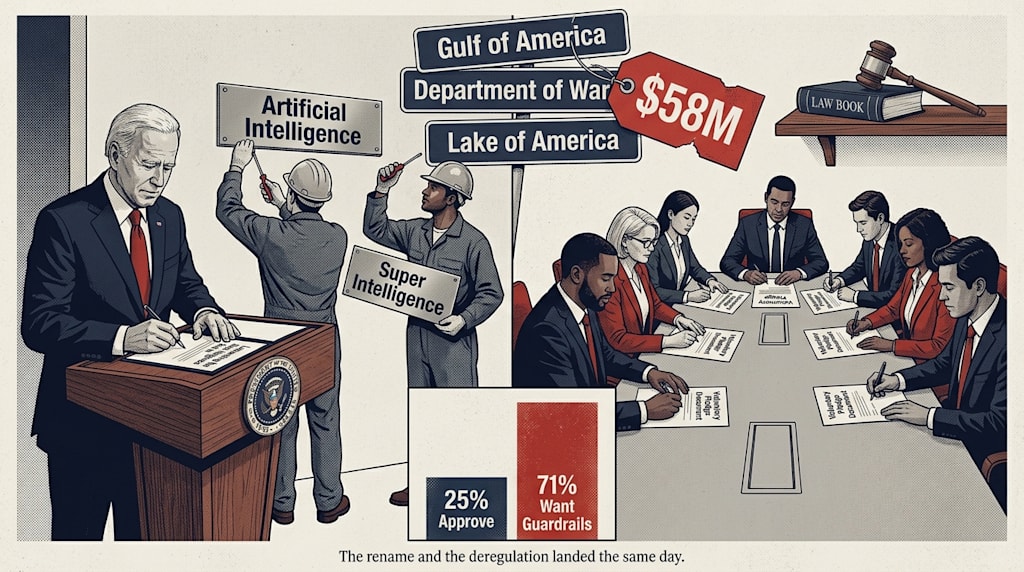
On September 29, 2026, Trump signed an executive order called Launching the Super Intelligence Era. It tells federal agencies to replace “artificial intelligence” with “Super Intelligence” in official communications. The same day, he signed the White House Super Intelligence Accord: Joint Commitment on Frontier Responsibility with the CEOs of Anthropic, Google, Meta, Nvidia, OpenAI, and xAI. The accord hands regulatory leadership to the companies themselves.
The two events belong together.
“Super intelligence” already means something else
In AI research, “superintelligence” is not a nickname for today’s chatbots. Oxford philosopher Nick Bostrom defined it in 2014 as “any intellect that greatly exceeds the cognitive performance of humans in virtually all domains of interest.” The standard framework separates AI into three levels. Narrow AI handles single tasks. Artificial general intelligence would match human learning and reasoning. Artificial superintelligence would surpass human intelligence and improve itself.
Today’s large language models and generative AI sit between the first and second levels. Calling them “Super Intelligence” pushes the term far beyond what it describes.
Simon Coghlan, a digital ethics lecturer at the University of Melbourne, called the rename “misleading.” Superintelligence, he said, usually refers to “a system capable of self-improvement.” Ben Leong, a computer science lecturer at the National University of Singapore, put it plainly: “Professionals would want to reserve ‘SI’ for a higher level of AI, rather than using it to describe today’s AI. It feels not there yet.” Jean-Pierre Dubé, a marketing professor at the University of Chicago, added that “Super Intelligence” already has a specific meaning in tech. Applying it to current AI is “premature,” and the brand confusion makes the change “unlikely to be accepted soon.”
A term for something that does not exist yet now names something that does. That does not raise AI’s status. It drains the phrase of its usefulness.
The rename and the deregulation are one move
The Joint Commitment on Frontier Responsibility, signed the same day, gives regulatory leadership to industry. The signatories say each company has a responsibility to develop its technology safely and to build trust. They promise “robust internal processes and controls” and recommend four layers of control. House Speaker Mike Johnson described the document as a “statement of principles” with “voluntary commitments,” “robust internal controls,” and “multiple layers of internal and external review.”
There is no enforcement mechanism. There is no legal force. When reporters asked Trump whether the pledge bound anyone, he said it carried “moral force.” The Guardian noted that the commitment “appears to contain no enforcement mechanism or legal meaning, merely a voluntary commitment.” The New York Times Chinese edition reported the same: the promises are “non-binding,” and they had largely lapsed early in the Trump administration after the president revoked earlier safety requirements.
The rename and the deregulation work as a pair. Calling AI “Super Intelligence” pulls it out of the frame of a man-made tool, something that can fail and needs oversight. It recasts the technology as a powerful, positive force driving a new era. The executive order says these technologies “increasingly enhance human creativity and empower Americans to achieve things previously impossible in science, medicine, and nearly all areas of human activity.” Once a thing is described as “super” and as the start of a new era, restricting it sounds like standing in the way.
The timing and the polls
The order landed about five weeks before the midterm elections. A Quinnipiac University poll released that day found that 25 percent of respondents approved of Trump’s handling of AI. Fifty-eight percent disapproved. Seventy-one percent wanted stricter guardrails for AI. Seventy-three percent opposed new data centers in their own communities.
Trump’s position on AI is to promote it, reject new regulation, and support data center expansion. Most voters want something else. Against that gap, the rename is a move at the level of language. It does not answer calls for safety and oversight. It tries to change how people talk about the technology, and through that, how they see it.
This is not Trump’s first rename. He has called the Gulf of Mexico the “Gulf of America.” He proposed renaming Lake Ontario “Lake of America.” He gave the Department of Defense the secondary label “Department of War.” According to the Spanish newspaper El Economista, his renaming costs have passed $58 million. The Defense Department change alone touches about 7,600 legal provisions and is estimated to cost about $52.5 million. Canadian AI Minister Evan Solomon responded for many: “Canadians are not particularly enthusiastic about renaming.”
What the order can actually do
The order’s limits are easy to see. It does not require changes to existing regulations, presidential actions, contracts, appropriations, or historical documents. It applies to official communications and non-statutory documents from federal executive agencies. It cannot change statutory language. Replacing “artificial intelligence” with “Super Intelligence” in law would require Congress to pass legislation. The order gives the president’s science and technology adviser 60 days to submit a legislative proposal assessing whether existing legal definitions of AI should be amended, expanded, or replaced.
Even inside the federal government, the rename may not travel far. Companies, developer communities, and international institutions do not have to follow the U.S. government’s internal vocabulary. BBC reported that the purpose of the rename is “unclear” and that industry adoption is uncertain. Gizmodo was sharper: Trump “has no constitutional power over how industry leaders speak,” and “artificial intelligence” is a term of art for these companies. OpenAI’s name contains the letters “AI.”
When regulators cannot agree, renaming becomes a cheap substitute for policy. One executive order costs no congressional approval and no budget appropriation, yet it can produce global headlines. The line saying the government “will not recognize the use of ‘artificial intelligence’ and ‘AI’ in any applicable context” is less an enforceable rule than a political gesture.
But gestures have limits. When “Super Intelligence” refers to today’s chatbots and image generators, it cannot change how the technology develops. It cannot solve the safety and ethics problems the industry faces. Dubé said the phrase may create more public distrust than “artificial intelligence,” because it “refers to technology we cannot understand.” A rename meant to improve AI’s image could make people more suspicious.
Whether “Super Intelligence” catches on matters less than what the episode shows: when regulatory consensus is hard to reach and public anxiety keeps rising, naming becomes a low-cost political action. The harder question, how to promote innovation while preventing harm, remains open.
About the Creator
Jin
Writer of reamstories
https://reamstories.com/jin
Enjoyed the story? Support the Creator.
Subscribe for free to receive all their stories in your feed. You could also become a paid subscriber, letting them know you appreciate their work.
Comments
There are no comments for this story
Be the first to respond and start the conversation.