
The UN Report on Iran Accuses America of War Crimes. It Also Accuses Iran of Crimes Against Humanity.
A school in Minab. A sports complex in Lamerd. 177 civilians dead. And a finding that both governments are guilty.
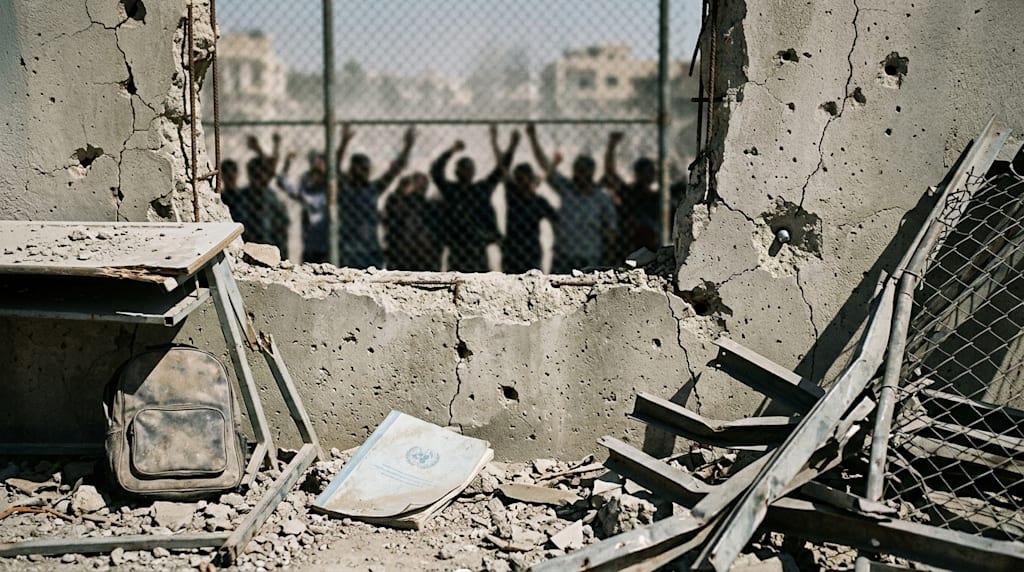
UN panel says US strikes in Iran were war crimes, and Iran's crackdown was a crime against humanity
On September 17, 2026, the UN Independent International Fact-Finding Mission on Iran released a report in Geneva. Three experts wrote it. They had no access to Iran. They used satellite images, weapon debris, witness testimony, medical records, and contradictions in public statements. The report found reasonable grounds to believe the United States committed war crimes in two missile strikes. The same report found that Iran's government committed crimes against humanity during a crackdown on protests.
The mission's chair, Sara Hossein, said: "Iranian civilians are caught between two things: serious human rights abuses and crimes against humanity by their own government, and a deadly conflict between Iran and the United States and Israel." That sentence describes a structure, not a metaphor. Children in Minab died under foreign missiles. Protesters in Isfahan died under their own government's guns. Both happened in the same country, in the same month, under the same body of international law.
Minab: the school
On February 28, 2026, the United States and Israel began a military campaign called "Epic Fury." That day, a Tomahawk cruise missile hit Shajareh Tayyebeh Primary School in Minab, in southern Iran. At least 156 people died. Of those, 120 were children. Twenty-six were teachers.
The school was next to an Islamic Revolutionary Guard Corps naval facility. That facility was also struck that day. But the school was clearly marked. No information shows it was used for military purposes. Survivors said the building was hit twice. The UN experts concluded the school was a "pre-planned target." The damage was not collateral from a strike on the IRGC facility.
The New York Times and The Intercept reported that US Central Command used outdated Defense Intelligence Agency data to create coordinates. Satellite images from 2013 showed the school and the naval base sharing a compound. Images from 2016 showed a fence and a separate entrance. US officials knew this, according to those reports. An internal investigation found "target misidentification." The UN experts rejected that as a legal defense.
Human Rights Watch's Washington director, Sarah Yager, put it this way: "Even if those responsible for the strike did not intentionally target a school full of children, the US had an obligation to take all feasible precautions to avoid civilian harm, and it clearly did not." War crimes do not always require intent. Recklessness is enough.
As of the report's release, the US military had not published the final results of its investigation. Defense Secretary Pete Hegseth said only that the US military "will never target civilians."
Lamerd: the sports complex
The same day, in Lamerd, in Fars province, a Precision Strike Missile exploded above a sports complex and a residential area. The missile scattered tungsten pellets. This weapon has a kill radius of 50 meters. Its damage radius is three times that. At least 21 civilians died. Seven were children.
Iran's foreign ministry spokesman, Esmail Baghaei, wrote on social media: "The US's new precision strike missile was used in combat for the first time on February 28, 2026, hitting a stadium packed with innocent teenagers in Lamerd, Fars province, killing 21 young boys and girls. The missile exploded above the target and scattered thousands of deadly fragments."
The US military denied any strike in Lamerd that day. It also disputed reports that the weapon was a Precision Strike Missile. But the US is the only party in the conflict that has that missile. An Associated Press investigation independently confirmed its use in Lamerd. The targets included a residential area and a gymnasium.
For both strikes, the UN experts reached the same conclusion: reasonable grounds to believe the United States committed the war crime of launching indiscriminate attacks, causing civilian death and damage to civilian objects.
Iran's crackdown
The report also covers Iran's response to nationwide protests that began on December 28, 2025. The protests started over economic conditions and living standards. They spread to all 31 provinces. On January 8, 2026, authorities shut down the internet and mobile networks. The UN mission said one purpose of the shutdown was to hide what was happening.
Witnesses, medical workers, and family members of the dead described security forces firing from rooftops and other high positions. Protesters suffered severe injuries to the head, chest, and eyes from metal pellet rounds. Some lost their sight permanently. At one hospital in Isfahan, 500 protesters with eye injuries arrived on January 10 alone. Video evidence showed security forces firing lethal ammunition into crowds that posed no imminent threat.
As the crackdown escalated, security forces attacked medical facilities. They beat and arrested injured protesters. They arrested medical workers. Injured people stopped seeking treatment that could save their lives.
The death toll is disputed. Iran's government says 3,117 people died. It says most were security forces or bystanders. The UN special rapporteur on human rights in Iran, Sato Mai, said in January 2026 that at least 5,000 people were killed by security forces. The US-based Human Rights Activists News Agency said it confirmed more than 7,000 deaths, almost all protesters. The UN mission could not independently verify the exact number. It said there are strong reasons to believe the real toll is far higher than the official figure.
The mission also found that tens of thousands of people detained during the protests were tortured, held in solitary confinement, and denied access to legal representation. At least 29 men were executed after quick trials on charges related to the unrest. More than 70 others remained at risk of execution. The experts concluded that these acts amounted to crimes against humanity: murder, imprisonment, torture, and other inhumane acts, all part of a widespread and systematic attack on the civilian population.
Responses
The US State Department said it did not agree with the report's findings. White House deputy press secretary Anna Kelly said: "The only party that committed war crimes in this conflict is the Iranian regime." That statement avoids a legal fact. Both can be true. International law does not require one side to be clean for the other side to be guilty.
The United States withdrew from the UN Human Rights Council in 2025. That means it is no longer bound by the council's follow-up procedures, including those for this report. Iran has called for the International Criminal Court to intervene. But the United States is not a party to the Rome Statute. The ICC's ability to exercise jurisdiction over US citizens is limited.
What remains
The father of a Minab victim, Abbas Milani, said: "We had to give this blood, for our country, for our people, so they understand there are no American soldiers, no Europeans..." He did not finish the sentence. Or the recording stopped. The report does not say.
Anita Ghasemi is 11. She survived the Lamerd strike. She stood in front of a wall pocked by shrapnel. She lifted her shirt and showed her wounds. Her name appears in an annex to the UN report. The report has no legal force. Its effect depends on whether the international community moves from "reasonable grounds to believe" to binding accountability. That is unlikely now.
Anita still stands in front of that wall. The wall has holes. She has scars. The report has footnotes.
About the Creator
Jin
Writer of reamstories
https://reamstories.com/jin
Enjoyed the story? Support the Creator.
Subscribe for free to receive all their stories in your feed. You could also become a paid subscriber, letting them know you appreciate their work.
Comments
There are no comments for this story
Be the first to respond and start the conversation.