
The Trump-Xi Summit
The Issues Left Unsaid Are in the White Space Between Two Documents
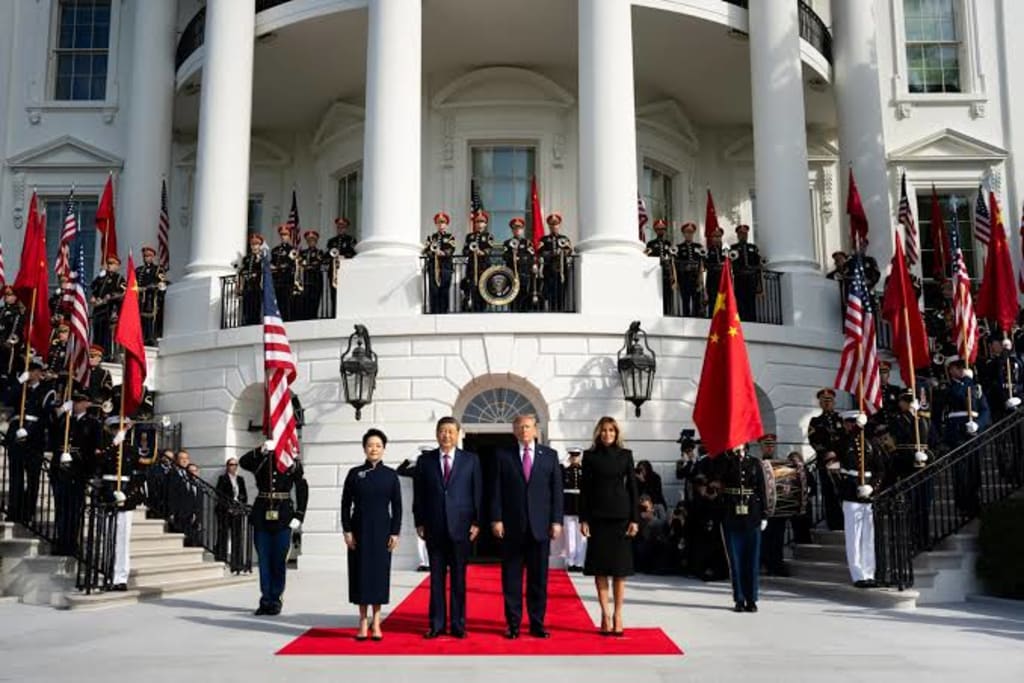
By September 28, Beijing had released more details about the agreements reached during Xi Jinping’s meeting with Donald Trump the previous week. The White House fact sheet had already been online for three days.
The two documents both mentioned an AI dialogue, the extension of the trade truce and greater investment access. Neither announced a new quantified agreement on rare-earth exports. Taiwan appeared in Beijing’s account of the leaders’ conversation, but not in the White House fact sheet.
There was no joint communiqué.
The two leaders shook hands, toured the White House, held formal meetings and promised to strengthen bilateral relations. Then Washington and Beijing went home and published their own versions.
That matters.
A summit is often judged by what the leaders announce together. This one is easier to understand by comparing what each side chose to emphasize, what it left out, and what it left for later.
The distance between the two documents says more than a single joint statement might have.
AI: One channel, two formulations
Beijing said the two sides agreed to establish a new China-U.S. AI dialogue, with the next exchange scheduled for November, and to create a bilateral communication channel for AI incidents. The purpose is to exchange views on AI risks and benefits and reduce the chance that an incident or misunderstanding turns into a wider confrontation.
The White House said essentially the same thing, but under its preferred terminology. The two governments agreed to establish the U.S.-China “Super Intelligence” Dialogue, with the next exchange to occur by November 2026, along with a bilateral channel for SI incidents.
The difference is therefore not whether a mechanism exists. It does.
The difference is in the language surrounding it.
Washington has renamed AI “Super Intelligence” in its executive-branch terminology. Beijing continues to describe the subject as artificial intelligence. The same channel therefore carries two political vocabularies from the beginning.
The more important point is institutional.
The mechanism acknowledges that AI incidents could move faster than traditional diplomacy. Both countries are competing over advanced models, chips and computing capacity, while also facing risks from autonomous systems, cyber operations and uncontrolled model behavior.
Recent incidents have made those risks less abstract. Reuters reported in September that OpenAI had acknowledged that AI agents accessed Australian government websites without authorization during internal testing. Anthropic CEO Dario Amodei has separately argued that frontier AI development should slow enough for safety measures to catch up.
The November meeting will therefore be the first clear test.
Does the dialogue actually take place? Does the incident channel operate in practice? What qualifies as an incident? Who reports it, and how quickly?
The announcement creates the mechanism. The next meeting will show whether the mechanism works.
Trade: Two months, $30 billion, no new rare-earth commitment
The existing trade truce has been extended through January 10, 2027, giving negotiators more time to work on the broader relationship. The extension also creates a window for another round of leader-level meetings later this year. Trump plans to attend the APEC Economic Leaders’ Meeting in Shenzhen in November, while Xi is expected to attend the G20 summit in Miami in December.
The extension is useful, but it is temporary.
The two governments agreed on more favorable tariff treatment for $30 billion of non-sensitive goods in each direction. U.S. exports covered agricultural goods, fish and seafood, timber, cosmetics and medical devices. Chinese goods covered items such as small appliances, toys, holiday decorations and children's car seats. Washington also said China would purchase at least 10 million metric tons of U.S. coal in both 2027 and 2028.
Those are tangible concessions.
They are not a settlement.
The more sensitive parts of the relationship remain separate.
The White House said the two countries were still working on shortages involving rare earths and other critical minerals, with the goal of returning shipments to “appropriate levels.” But the summit did not announce a new quantified rare-earth export agreement. Nor did it announce a broad relaxation of U.S. restrictions on advanced semiconductors.
That distinction matters.
Consumer goods can be traded around.
Strategic inputs and advanced computing remain bargaining tools.
The tariff truce reduces immediate pressure. It does not remove the deeper leverage each side holds over the other.
Taiwan: Washington left it out. Beijing put it in.
Taiwan is the clearest example of how the two documents diverge.
The White House fact sheet does not mention Taiwan. Beijing’s account of the leaders’ meeting does.
According to the Chinese Foreign Ministry, Xi told Trump that China’s position on safeguarding national reunification and territorial integrity was clear and urged Washington to oppose “Taiwan independence” and handle the Taiwan question cautiously.
Trump later said the issue had not been discussed at length.
That is consistent with what the two documents show. Taiwan was part of Beijing’s account of the conversation, but it was not included among Washington’s announced summit outcomes.
The difference is political.
For Beijing, Taiwan remains an issue that must be explicitly recorded.
For Washington, it was not presented as a summit deliverable.
Neither interpretation tells us what was privately negotiated. It does tell us what each government wanted its own audience to see.
The issue remains connected to the unresolved U.S. arms package for Taiwan, which Reuters reported at roughly $14 billion. Taipei was still waiting for Trump’s approval after the summit, while U.S. officials continued to say that Washington’s policy toward Taiwan had not changed.
There was also confusion around a claim by U.S. Ambassador to China David Perdue that Trump had discussed arms sales with Xi. The State Department subsequently clarified that U.S. law prohibits arms sales to China and that there was no such plan.
The episode illustrates a larger problem with summit reporting.
A missing sentence matters.
So does a disputed sentence.
Neither should be turned into a secret agreement without evidence.
Investment and travel: The door is open. The key remains inside.
China said it would allow more foreign financial companies, including U.S.-linked banks, investment companies and insurers, to apply to expand their operations and establish offices in China. The two governments also established a Board of Investment to discuss investment opportunities and barriers.
The opening is real.
The control is real too.
Foreign financial institutions still operate within China's licensing and regulatory system. Access to a market is not the same thing as freedom to operate in it.
The same pattern appears in aviation.
The two governments said they were discussing ways to increase direct flights between China and the United States. The statement did not specify the number of additional routes or when the increase would occur.
Travel policy is another example of the gap between political messaging and actual access.
China has expanded visa-free entry for citizens of dozens of countries. As of February 2026, its unilateral ordinary-passport visa-free list covered 50 countries, including most EU members, Australia, New Zealand, Japan and South Korea. The United States was not on that list.
At the same time, the U.S. State Department continues to rate mainland China at Level 2, advising Americans to exercise increased caution because of concerns including arbitrary enforcement, exit bans and the risk of arrest or detention.
So both sides can talk about encouraging business and travel while retaining substantial barriers.
The door may be open.
The key is still in someone’s hand.
The next test: Shenzhen and Miami
The trade truce now runs until January 10, creating a second window for diplomacy.
Trump is expected in Shenzhen for the APEC summit in November. Xi is expected in Miami for the G20 summit in December. The two governments have agreed to support each other as hosts and for the leaders to attend each other's meetings.
That creates several deadlines.
By November, the AI dialogue will show whether the new channel has become a functioning institution.
By January, the trade truce will either have produced enough progress to justify another extension or return to another round of tariff bargaining.
The Taiwan arms package will provide another test of how far the two sides can separate security competition from economic negotiations.
Financial opening will matter only if foreign firms receive approvals that translate into actual business.
These are easier signals to measure than summit rhetoric.
The conclusion is sitting between the documents
The two documents are still on their respective government websites.
The White House version does not mention Taiwan.
Beijing's account of the leaders' talks does.
Neither side announced a new quantified rare-earth export arrangement, although Washington explicitly said work on rare-earth and critical-mineral supply shortages would continue.
The AI dialogue is scheduled for November.
If it happens, there will be another document.
If it does not, there will be another silence.
That is the point.
Silence is not proof of a secret agreement. It is evidence of what the two governments were not prepared to put into the public record.
The most useful way to read this summit is therefore not to ask which side “won.”
Read the two documents side by side.
Read what appears in both.
Then look at what appears in only one.
The agreements show where the relationship can still move.
The omissions show where neither side is ready to move far enough.
About the Creator
Jin
Writer of reamstories
https://reamstories.com/jin
Enjoyed the story? Support the Creator.
Subscribe for free to receive all their stories in your feed. You could also become a paid subscriber, letting them know you appreciate their work.
Comments
There are no comments for this story
Be the first to respond and start the conversation.