
The Strait of Hormuz Is Opening Without a Deal
Washington says it isn’t rushing. Tehran says it has seven days. The oil tankers tell a different story.
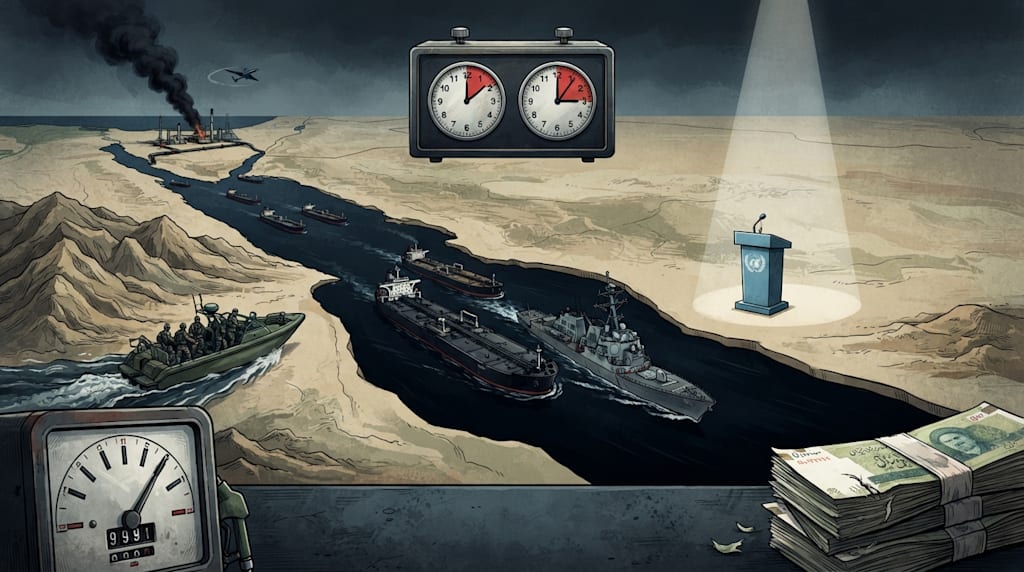
On September 25, Iranian Foreign Minister Abbas Araghchi announced a “seven-day plan” at the United Nations in New York. The plan was simple. The United States would carry out, within four or five days, the actions it had already promised in the June memorandum. The Strait of Hormuz would reopen on the sixth day. On the seventh day, the two sides would begin talks on a final agreement. Araghchi said the plan demanded “no new conditions.” It only asked for what Washington had already signed.
That same day, a U.S. official gave CCTV a different message. Washington was in “active and constructive” talks with Iran, the official said. But it was “not in a hurry.” The official offered one number: nearly 40 million barrels of oil had passed through the Strait of Hormuz under U.S. escort in the previous 48 hours.
Put those statements together and the shape of the negotiation becomes clear. One side says, “You owe me. Pay first.” The other says, “I owe you nothing. The Strait is already open.”
The Strait is opening by itself
The U.S. refusal to rush rests on tanker data. Kpler, a tracking firm, found that by late September the seven-day average of crude oil passing through the Strait of Hormuz had reached 13.5 million barrels per day. That matched prewar levels. Across the Middle East, crude shipments were higher than before the war: about 19.5 million barrels per day, compared with a prewar baseline of about 17 million.
Iran did not open the Strait. The U.S. escort system is doing part of that work. Saudi very large crude carriers keep moving under U.S. Navy escort. The Revolutionary Guard Navy says it controls the Strait. In practice, its ability to stop traffic is weaker. Matt Smith of Kpler put it plainly: with so much oil moving through, Tehran’s influence is shrinking.
The recovery is uneven. Refined products passing through the Strait averaged only 677,000 barrels per day. Before the war, that number was 3.6 million. Gasoline and diesel shortages remain severe. U.S. diesel prices have hit record highs. With the midterm elections close, that is the political pressure that matters. Trump is considering a diesel export ban. The fact that he is considering it shows that crude flows have not solved the refined-products crisis.
The U.S. position rests on one judgment: time favors Washington. The Strait is opening in practice. That erodes Iran’s main bargaining chip. Every day that passes weakens Iran’s ability to trade a blockade for sanctions relief.
The two sides are not talking about the same thing
Both sides say “Strait of Hormuz.” They mean different things. The U.S. proposal matches its previous position and mainly concerns the Iranian nuclear issue. Iran says the focus at this stage is the Strait of Hormuz. Iranian Foreign Ministry spokesman Esmaeil Baghaei added that security in the Strait requires concrete U.S. steps: stop interfering with Iranian commercial shipping, stop sanctions, end other interventionist measures.
Washington wants to pull the talks back to the nuclear file: enriched uranium, the length of any enrichment pause, verification details. Tehran wants to keep the focus on the precondition: lift the blockade and sanctions.
The deeper dispute is sequence. Iran wants the United States to lift the blockade, unfreeze assets, and cancel oil sanctions first. Then Iran will open the Strait. The United States wants Iran to open the Strait first. Then sanctions relief can be discussed. The June 18 memorandum had 14 clauses. The United States promised to lift the naval blockade, invest at least $300 billion in Iranian reconstruction, end various sanctions, allow Iranian crude exports, and unfreeze Iranian assets. Iran’s logic is simple: you signed this. The promises were not carried out. That is why the deadlock exists.
The memorandum’s force is limited. Its language only commits each side to a degree of intent, not to full implementation. Almost every hard issue was pushed to the 60-day talks on a final agreement. Iran’s “seven-day plan” is therefore a demand letter, not a new proposal.
The New York talks collapsed
During the UN General Assembly in September, the two sides held two rounds of indirect talks through intermediaries. One was on September 22. The other was on September 28. By the close of the general debate, they had nothing to show.
The end of the September 28 round was symbolic. U.S. officials said Washington thought progress might be possible earlier that day. Then the talks stalled. Secretary of State Marco Rubio issued what amounted to an expulsion order to the Iranian delegation. He told it to leave the United States immediately. The move was a highly unusual diplomatic rebuke. It exposed the deep distrust between the two countries.
Iran said the delegation’s departure had been planned. It accused the State Department of “spreading baseless and worthless claims.” The two accounts of the same event do not match. That kind of diplomatic friction is its own evidence of the trust deficit.
Inside Iran, Parliament Speaker Mohammad Bagher Qalibaf took a harder line. After Araghchi proposed the seven-day plan, Qalibaf said the Strait would “absolutely not open” until Iran’s seven conditions, based on the Islamabad memorandum, were met. That narrowed the government’s room to negotiate.
The Houthis are a structural flaw in any deal
Even if Washington and Tehran reached an arrangement on the Strait, any deal would face an obstacle: the Houthis.
In mid-September, the Houthis attacked a major Saudi oil pipeline. They also seized strategic islands in the Bab el-Mandeb Strait. Brent crude briefly rose above $107 a barrel. The pipeline was the alternative route Saudi Arabia had expanded after the Strait of Hormuz was blocked. About 70 percent of Saudi Aramco’s exported oil had been rerouted through it to the Red Sea. After the attack, the pipeline stopped. Saudi crude supply fell to 6 million barrels per day, the lowest in more than 30 years.
This creates a problem. The June memorandum and every plan now under discussion leave the Houthis outside the constraints. Iran says the Houthis act on their own. In practice, Houthi attacks in the Bab el-Mandeb and Iranian pressure in the Strait of Hormuz work together. Saudi energy exports face threats from the Persian Gulf and the Red Sea at the same time.
Fatih Birol of the International Energy Agency called it “the greatest energy security crisis the world has ever experienced.” Iran and its allies now sit on the world’s two most important trade chokepoints. Any deal that excludes the Houthis cannot be enforced. The Revolutionary Guard can use its proxy forces to create new tensions and block implementation.
The midterm elections set the clock
The short-term strategies of both capitals run on the U.S. midterm elections in November.
Trump has said repeatedly that the war will “end immediately” after the midterms. He says “gasoline prices will fall quickly.” He rejected Iran’s ceasefire proposal. In an October 1 interview with Time, he said he “might” order a larger strike on Iran after the midterms.
The U.S. military schedule fits that timeline. The USS Roosevelt left San Diego on September 27. The Makin Island Amphibious Ready Group followed with more than 2,000 Marines. The additions total nearly 10,000 personnel. The ships and Marines are set to arrive exactly after the U.S. midterm elections. Trump has told aides he expects to resume bombing Iran in November.
Domestic pressure is rising. An August Politico poll found that 61 percent of Americans believed the Iran war had raised household expenses. 56 percent said the top domestic issue was the cost of living. Only 17 percent named “global instability” as a major concern. About two-thirds said the Trump administration’s military decisions on Iran had harmed U.S. interests.
In that environment, Trump’s strategy is to keep a “no war, no peace” stability before the election. He does not want the war to escalate and oil prices to spiral. He also does not want a deal before the election that gives Iran a “victory” narrative. After the election, he will have more room to choose negotiation or military escalation.
Iran’s dilemma: economic pressure and a split decision-making structure
Iran faces its own constraints.
Economic pressure is growing. Reuters, citing Iran’s Statistical Center, reported that annualized inflation reached 66 percent in July. The consumer price index rose 87.9 percent year-on-year. Food prices rose 128 percent. The rial fell to a historic low during the war: 1.8 million rials per dollar.
Oil exports have taken a heavy hit. Kpler data show that since the United States imposed a naval blockade on April 13, Iranian crude exports fell from 1.85 million barrels per day in March to about 567,000 barrels per day. That is a drop of nearly 70 percent. Iranian crude loadings fell to 255,000 barrels per day in August, about half of prewar output.
The deeper problem is Iran’s internal power structure. The civilian government, led by President Masoud Pezeshkian and Foreign Minister Araghchi, wants a deal with the United States. The Revolutionary Guard leadership does not want to negotiate Iran’s military capabilities or its support for proxies. The two sides disagree over concessions to Washington. The Revolutionary Guard Navy says it has “absolute control” over the Strait of Hormuz and demands tolls from passing vessels. After Araghchi announced the Strait was open to all commercial ships, the Revolutionary Guard Navy called him an “idiot” over radio.
That internal tension means the Iranian government’s promises lack reliable enforcement. Whether Araghchi’s seven-day plan can be carried out by the Revolutionary Guard is an open question.
Negotiation is posture; the countdown is the substance
The logic of the current U.S.-Iran game is now clear. Both sides are preparing for the period after the November midterms. The United States is building military pressure, keeping sanctions in place before the election, and preserving options for talks or strikes afterward. Iran is trying to use the pre-election window to win favorable terms without being blamed for “breaking off talks.” It is also waiting for a possible softening of the U.S. position after the results.
Crude flows through the Strait of Hormuz keep recovering even while talks stall. That is not because the two sides reached a deal. The U.S. escort system is replacing part of Iran’s “transit permission” role. Refined-product shortages remain the U.S. vulnerability. That is where Iran may push in future talks.
A short-term deal is unlikely. The variable to watch is whether economic pressure inside Iran reaches a point that forces the Revolutionary Guard to change strategy. Inflation at 66 percent and shrinking oil export revenue are bringing that point closer. Before November, neither side has enough incentive to touch the button that could make the situation spin out of control.
About the Creator
Jin
Writer of reamstories
https://reamstories.com/jin
Enjoyed the story? Support the Creator.
Subscribe for free to receive all their stories in your feed. You could also become a paid subscriber, letting them know you appreciate their work.
Comments
There are no comments for this story
Be the first to respond and start the conversation.