
The Puppet Masters of Policy: How Bureaucrats and the Public Control the State
What Washington Didn't Foresee About Modern Politics

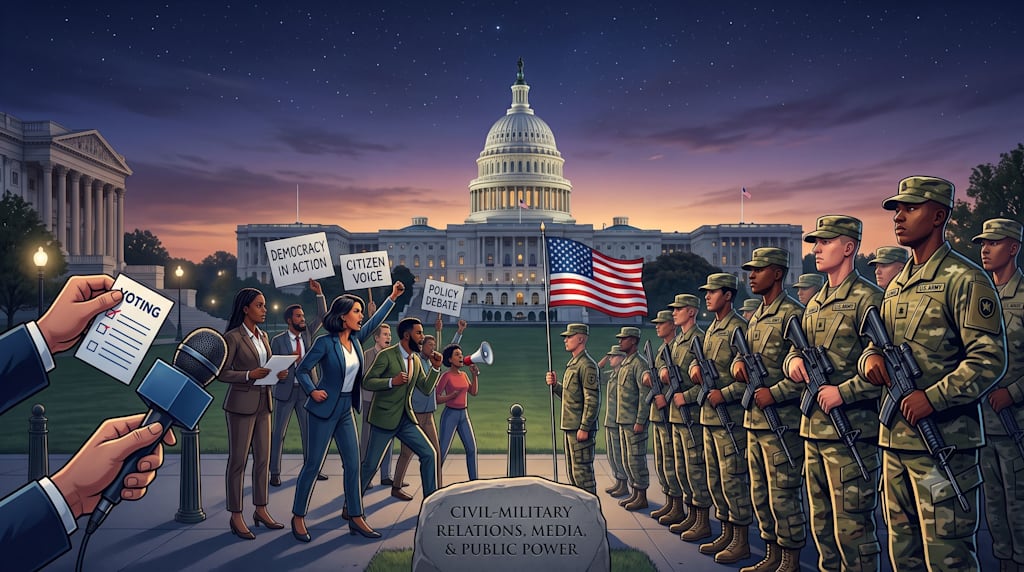
Behind the closed doors of Washington, the fragile balance of American democracy relies less on the strict words of the Constitution and more on a constant, invisible tug-of-war between military brass, media giants, and the court of public opinion.
From the founding of the United States to the present day, there has always been a relationship between the civilian leaders in government and the U.S. Military. The boundaries of this relationship have been ever-changing, and there have been questions raised such as: How to preserve this relationship and how can the military protect the country and avoid threatening the civilian population? These are both complex answers that require a deeper understanding.
To answer the first question, the most important principle to preserving the civil-military relationship is to ensure that the civilian government maintains the power to control the military. The military leaders are experts on conducting operations and winning wars, but in the United States, it is vital that the top leader of the military is a civilian elected by the people. This is what our country was founded on, and it is what past members of the military have fought for. As Nielson explains in “The Army Officer,” those in the military understand that they are servants to the country and take orders from their commanding officers, which eventually lead to the President and his executive branch. Although this relationship is very reliant on the military to understand their duty to be professionals and obey civilian authority, it also requires civilians to respect the fact that the military is a subject matter expert at what they do and should allow military leaders to advise them on situations that involve the military. This plays into the Feaver’s principal-agent problem, which helps explain the answer to the second question.
The civilian government and the military both have one common goal, which is to protect the civilian population from threats. As mentioned earlier, this principal-agent relationship is vital for this to work. The principal, the government, needs this mission of protecting the United States to be accomplished. To do that, they employ the agent, the military. This created the bureaucratic environment of working and shirking in which the military is essentially trying to do the least amount for the most money, and the government is trying to get the most work done for the lowest price. In the end, the country is protected without any harm to the citizens. This is because the military exercises its professionalism and avoids overstepping. There have been recent examples of this presented in the article, such as the Captain Crozier incident. It stated that the military leadership, General Milley and Admiral Gilday, recommended that the issue be dealt with internally and opposed the decision to remove Crozier from his command. However, the final word sits with the civilian leadership within the executive branch. This relationship will continue far into the future and how the principal and agent interact will shift depending on the current administration, but at the end of the day, the civilians will always maintain control, and the military will continue to work as a profession of arms.
When the founders created the United States, they intended to form a nation built on the ideology of freedom. Their goal was to ensure that the government was of the people and to avoid any form of tyranny. As time has gone on, the way American politics runs has vastly changed. The government has grown astronomically large from where it was 200 years ago, and the influencers of how policies are made have stretched beyond just members of the government. However, with all of this, the country our founders made still maintains the values it was originally designed to represent. American politics has advanced to include informal actors. This includes political parties, interest groups, the media, and public opinion. All these actors influence how our government creates new policies and how formal institutions conduct business.
In the early years of our country, those involved in politics were the wealthy and educated, the common man could vote and received the majority of his information pertaining to politics from the newspaper. Other than that, there was not much participation from the average citizen. In modern times, the average citizen can be involved by supporting interest groups, campaigns, and they can choose what information to hear due to the hundreds to thousands of media sources thanks to the internet. This participation from citizens is what fuels the informal actors listed earlier to continue their influence in the policymaking process. As described by Thomas Dye, the policymaking process has six steps. Informal actors largely influence the first two steps, problem identification and agenda setting. Dye states that the three most important actors are the political elite, public opinion, and the media. However, it appears that in recent years, interest groups and political parties have had just as much influence in the process as well. Each of these informal actors has specific roles in influencing change. The media and interest groups focus on the first step, they bring problems to the spotlight and attract attention. This attention creates public opinion over the issue. There will always be opposing opinions, which will lead to competition, and groups will form. Interest groups have the goal of combining influence and exerting change. Political parties will take stances on these issues and place them on their agenda.
This is the point at which informal actors begin to influence the formal institutions of our government. Almost every elected official in the United States government identifies with a political party. Which means they represent their party’s stances on issues. This influences how they vote on certain policies or whether or not they will even look at an issue. Not only do these informal actors influence Congress, but they can also influence the policy decisions made by the executive branch’s bureaucracy. The media and public opinion have a large role in this. For example, the media will report a story on pollution and the environment, this will form public opinion about the issue. Certain interest groups will also step in and fund advertisements and create pressure. The public outcry and media coverage will force the Environmental Protection Agency to review the issue and potentially change its policy. However, public opinion should only impact policy so much; in Zaller’s “The Nature and Origins of Mass Opinion,” he describes that the weight of public opinion should depend on how informed the public is. This is difficult in modern times, where anyone can place information out to the world, and we do not know if it is true or false. Due to this, many people form latent opinions, or opinions that they make right there as opposed to fully understanding the issue and researching the topic.
The Founding Fathers did not imagine that there would be so much that goes into creating a policy, and they did not envision the scope that informal actors have in this process. However, it is safe to argue that the role of informal actors is not their worst fear. The Founders’ worst fear was a tyrannical government in which there was no room to debate opinions and all freedoms would be gone. They would appreciate knowing that in today’s political environment, although it can get ridiculous at times, there are multiple opinions on nearly every issue and American citizens maintain the freedom to agree and disagree on issues and policies.
About the Creator
Sam Shroyer
I am an active-duty Engineer Officer in the US Army with a BS in Environmental Engineering from West Point. My previous positions include the following:
- Assistant Training Officer
- Sapper Platoon Leader
- Company Executive Officer
Enjoyed the story? Support the Creator.
Subscribe for free to receive all their stories in your feed.
Comments
There are no comments for this story
Be the first to respond and start the conversation.