
The Last Blast Furnace: How Ukraine’s Steel Industry Went Dark in One Month
Three plants. Seventeen missiles. Fifteen thousand workers. The strikes that erased 90 percent of Ukraine’s remaining steel capacity.
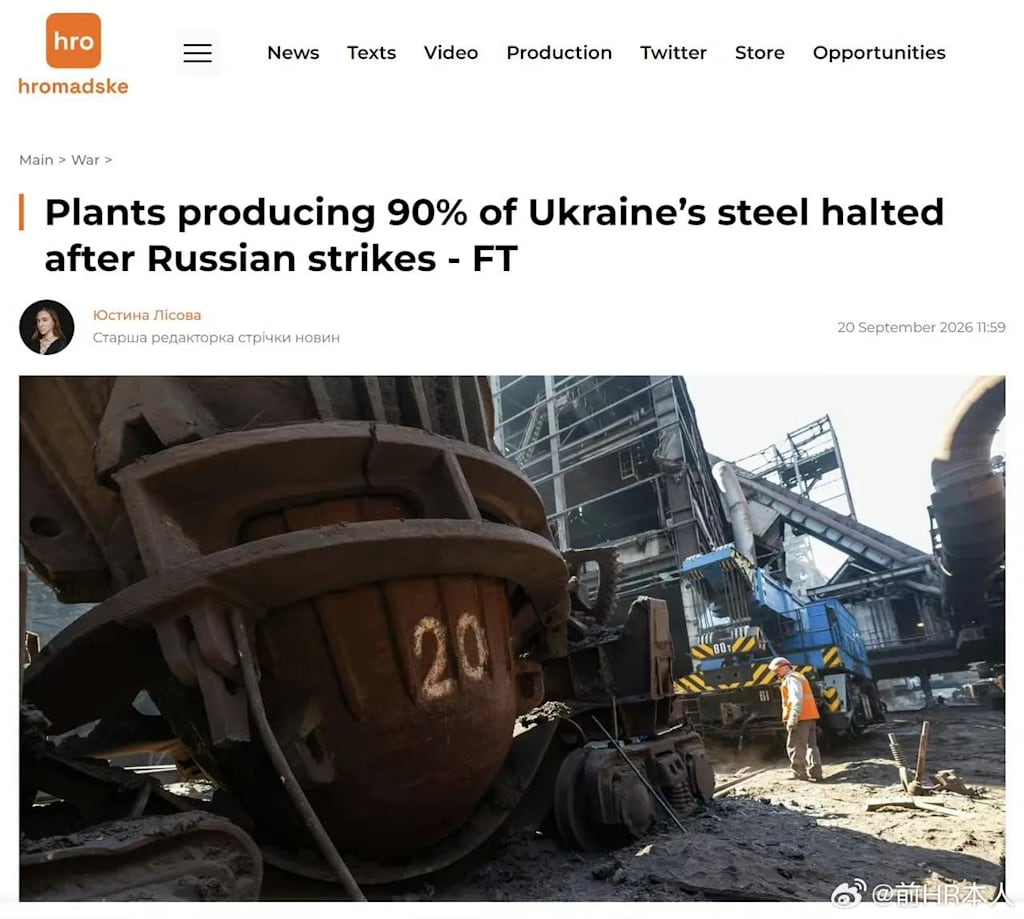
In the early hours of September 12, 2026, in Kryvyi Rih, the blast-furnace operator on duty at the ArcelorMittal plant saw the hot-blast stove pressure drop to zero in the control room. There was no explosion. The power system went down first. The pipe network lost pressure afterward. The molten iron in the hearth stopped flowing. Its temperature fell, degree by degree. Workers called over the radio. No answer. A few hours later, the plant announced a shutdown. This time, the blast furnaces could not be lit again.
Three weeks earlier, on August 11, Zaporizhstal was hit by ballistic missiles. After August 15, the strike waves intensified. On the night of September 5, Kamet Steel, known in the Soviet era as the Dnipro Metallurgical Plant, was hit by multiple missiles. Some reports said they included Zircon hypersonic missiles. On September 12, the Kryvyi Rih plant was hit in two more waves. By mid-September, all three of Ukraine’s remaining large steel plants had stopped. Together they had accounted for about 90 percent of Ukraine’s remaining steel output.
Oleksandr Vodovyz, head of the CEO’s office at Metinvest, told the Financial Times: “As of today, Ukraine no longer has a steel industry.”
The sentence described a fact. It matched a set of figures. In August 2026, Ukraine’s crude steel output was 277,000 tonnes, down 57.3 percent year on year and 39.4 percent month on month. Pig iron output fell 65.6 percent year on year and 40.5 percent month on month. Before the war, Ukraine produced about 20 million to 21 million tonnes of steel a year. It ranked fourth in Europe and thirteenth in the world. The metals industry contributed about 10 to 12 percent of GDP and more than 30 percent of total exports. Eighty percent of Ukraine’s finished steel went to the European Union.
In 2022, the battle for Mariupol destroyed Azovstal and Ilyich. Together the two plants accounted for about 40 percent of Ukraine’s steel output. Azovstal’s underground tunnels once became the last stronghold of Ukrainian forces. Its surface facilities were destroyed during the siege. After that, Ukraine’s steel industry depended on three plants in the center and south. Zaporizhstal, Kamet Steel, and ArcelorMittal Kryvyi Rih became the last sources of capacity.
From August to September 2026, these three plants were taken out one by one.
In the August 11 attack on Zaporizhstal, energy infrastructure and blast-furnace facilities were hit. Eight workers were killed and twenty-eight injured. The core power-distribution system was destroyed, and the plant shut down completely. Within less than a month, the plant was hit at least three more times, including by two ballistic missiles on September 17. By mid-September, Zaporizhstal had been hit by a total of seventeen missiles. Workshop equipment, the power system, pipe networks, and logistics infrastructure were all damaged.
Kamet Steel was hit by multiple missiles on the night of September 5. Metinvest reported five dead and four injured. In the first half of 2026, the plant had contributed nearly 29 percent of the country’s steel output. After the missiles hit critical nodes, the production chain broke.
The Kryvyi Rih plant was hit in two waves, in mid-August and on September 12. The September 12 attack killed two contractor employees and injured two employees. Power generation, hot-blast, and energy pipe-network systems were severely damaged. The molten iron in the blast furnaces solidified and cooled. The plant assessed that repair was no longer possible.
Metinvest Chief Operating Officer Mironenko rejected Russia’s claim that it was striking military targets. He said the destroyed plants made civilian steel products. Whatever the target definition, the industrial base on which Ukraine’s war economy depended was erased in less than a month.
The steel industry was not the only target.
Ukraine’s five largest nitrogen-fertilizer plants were destroyed in strikes since August 2026. They were the Pavlohrad Chemical Plant, Rivne-Azot, the Cherkasy Nitrogen Fertilizer Plant, and the Dnipro Dzerzhinsk Chemical Plant. The Sievierodonetsk Azot plant had already been destroyed in the 2022 war. The nitrogen-fertilizer industry was wiped out. Ukrainian agriculture relies heavily on nitrogen fertilizer. As a major global grain exporter, Ukraine will feel the cutoff in its harvests in the coming years.
Ukraine’s only crude-oil refining facility, the Kremenchuk refinery, had been under sustained attack since early 2026. It was hit by more than sixty missiles and about 260 drones. Energy Minister Shmyhal confirmed in a parliamentary report that the plant had completely stopped operating. Ukraine lost all refining capacity. Its fuel supply became 100 percent dependent on imports from NATO countries.
The logistics system was targeted as well. Ruslan Shostak, founder of the Ukrainian retail chains Eva and Varus, told the Financial Times that of Ukraine’s roughly 5 million square meters of modern warehouse space, 2.1 million square meters had been destroyed. That was about 42 percent of the total. In the past few months alone, about 900,000 square meters of logistics warehousing had been bombed out. Some areas saw supermarket goods shortages for the first time since the early days of the 2022 war.
Bilan, chief economist at the Ukrainian investment bank Dragon Capital, warned that Ukraine would likely fail to achieve any economic growth this year. Businesses had “no choice but to pass costs on to consumers.”
The steel industry’s contribution to Ukraine’s economy had fallen to zero. Serhiy Bielienkyi, head of Ukraine’s steel industry association, predicted that in 2026 the metals industry’s share of GDP could fall below 1 percent. In 2025, the steel industry had contributed 15.2 percent of Ukraine’s export revenue, about $6.2 billion. With capacity fully halted, that revenue disappeared. Ukrainian Prime Minister Koretskyi said the Russian strikes could cost Ukraine about $1.5 billion in tax revenue. Ukraine’s 2026 budget gap was projected at as much as $27 billion.
Import dependence rose quickly. In the first half of 2026, the share of imported steel in Ukraine rose from 37 percent in 2025 to 43.8 percent. Turkey and China were the main suppliers. The blockade of Black Sea ports sharply reduced export capacity. Agriculture Minister Vysotskyi said alternative export routes allowed Ukraine to export only about 40 percent of its normal agricultural volume. The Ukrainian government estimated that Russia’s Black Sea blockade had cost Ukraine about 1.5 percent of GDP.
The three Metinvest plants employed more than 15,000 workers. After the shutdown, their livelihoods hung in the air. In the small towns near the plants, shops, transport, and schools all depended on the flow of factory wages. In the same week the blast furnaces cooled, tea mugs were still in workers’ lockers. The duty log on the control desk lay open at the page for September 12.
The strikes changed what the war targeted. From 2022 to 2024, fighting had mainly been about territorial control. The strike waves of August and September 2026 targeted the economic base and war potential. Russia’s Ministry of Defense claimed the targets were plants producing metallurgical products for weapons and military equipment. Metinvest countered that the plants bombed were civilian steel mills. Beyond the dispute, the effect was clear: energy, logistics, and basic industry were removed node by node.
Precision strikes depended on several conditions. Intelligence had to reveal the internal structure of target facilities. Missiles had to hit blast furnaces, power systems, and pipe networks. Ammunition stocks had to support repeated waves. A Metinvest executive said: “They know everything about the plants. They know exactly where to hit.” The sentence pointed to intelligence capability and to strike precision. When Kamet Steel was hit, some reports said Zircon hypersonic missiles were used. Existing air-defense systems struggled to intercept such missiles.
International legal scholars debated the limits of strikes on civilian industrial facilities. How should economic targets be distinguished from military targets? Did the destruction of steel plants, nitrogen-fertilizer plants, and oil refineries constitute a war crime? The case of Ukraine’s steel industry could become a reference for future jurisprudence. The debate continued. The blast furnaces had already cooled.
Ukraine’s postwar reconstruction faced a steel shortage. Steel is a core material for rebuilding infrastructure. Ukraine now had to rely entirely on imported steel. Reconstruction costs would rise sharply. The country would pay for imports and for the investment needed to rebuild the steel industry itself. Metinvest executives said the repair time was uncertain and could take “days, weeks, months, or even years.” The damage from molten iron solidifying and cooling in the blast furnaces was irreversible. The destruction of power systems, pipe networks, and logistics infrastructure made a return to production even more distant.
The global steel market was adjusting too. Ukraine had been a steel supplier to the EU market. After its capacity disappeared, steel exporters such as Turkey, China, and India gained new market space. With Ukrainian supply gone, the EU faced greater supply pressure. Construction and automobile manufacturing felt the effect. Turkey, China, and India gained. The EU lost a supplier. Tensions in the European steel market had already intensified.
Back in Kryvyi Rih. After September 12, the plant area fell quiet. The molten iron in the blast furnaces solidified at the bottom, like a huge block of iron. No one knew when it could be melted again. Ukraine now imported steel from Turkey. In Metinvest’s office, Vodovyz’s sentence was quoted again and again: “As of today, Ukraine no longer has a steel industry.”
Outside the plant, a commuter bus arrived at the gate on schedule, then left empty. The driver did not turn off the engine. He waited ten minutes, honked once, and drove on to the next stop.
About the Creator
Jin
Writer of reamstories
https://reamstories.com/jin
Enjoyed the story? Support the Creator.
Subscribe for free to receive all their stories in your feed. You could also become a paid subscriber, letting them know you appreciate their work.
Comments
There are no comments for this story
Be the first to respond and start the conversation.