
The Geopolitical Gambit
Peru just broke ties with Iran. But this isn't about Tehran—it's about Washington, Beijing, and a century‑old Japanese blueprint for South America.
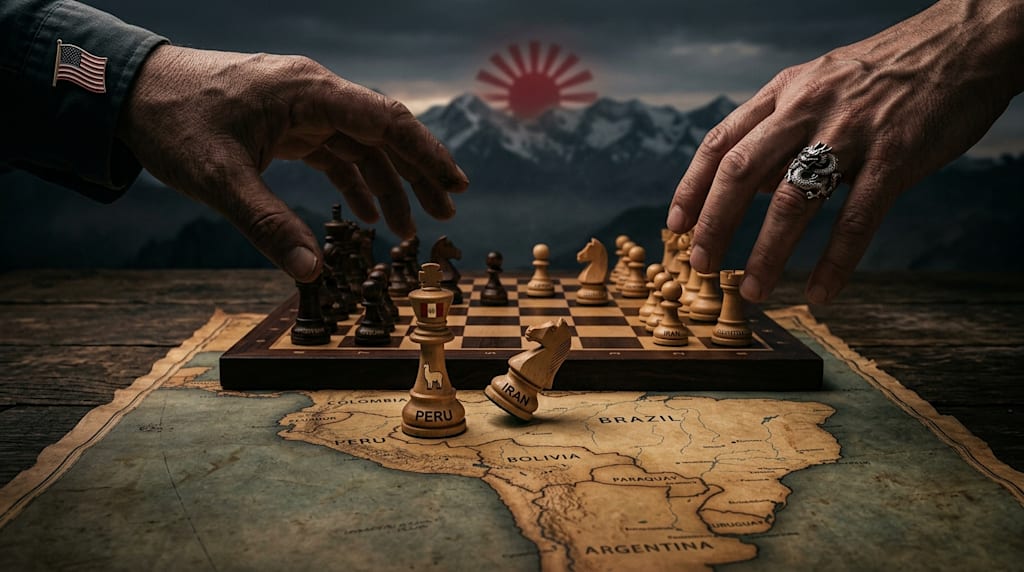
On 1 September 2026, Peru’s Foreign Ministry issued a terse communiqué severing diplomatic ties with the Islamic Republic of Iran. The official statement listed four charges: destabilising the Middle East, obstructing nuclear inspections, disrupting shipping in the Strait of Hormuz, and suppressing domestic dissent. The rupture came barely one month after Keiko Fujimori, a third‑generation Japanese‑Peruvian and daughter of former president Alberto Fujimori, was sworn in as the country’s first elected female president.
The two countries share no border, no significant trade, and no substantial diaspora. For Peru, breaking with Tehran carried almost zero economic cost. In 2025, bilateral commerce between Lima and Tehran was negligible – less than 0.01% of Peru’s total foreign trade. Peru’s copper and zinc go to China, Japan, and the United States; its food imports come from the Americas and Europe. Iran buys none of that and sells little in return. A diplomatic rupture, therefore, is a zero‑price gesture – but a high‑signal one.
That signal points in three directions.
1. A “Letter of Allegiance” to Washington
The most immediate driver is security and market access. Keiko Fujimori campaigned on a clearly pro‑American platform, and her first personnel move confirmed it. She appointed Édgar Esparza as foreign minister, a diplomat with fifteen years of service inside the U.S. embassy in Lima. Esparza’s network in Washington is not abstract; he personally briefed multiple U.S. undersecretaries on counternarcotics operations in the Upper Huallaga Valley. Within weeks of taking office, he recommended the Iran break as “the cheapest way to buy goodwill on the Potomac.”
Peru wants tangible returns: upgraded military radars for its Amazonian border, accelerated extradition treaties for drug‑kingpin cases, and a renewed push for lower U.S. tariffs on its blueberry and avocado exports – products that directly employ over 200,000 Peruvian smallholders. The Fujimori government calculates that a clear stance against Tehran will open doors at the Pentagon and the Office of the U.S. Trade Representative that have been half‑shut since the previous left‑leaning administration.
Moreover, the timing aligns with the U.S. Navy’s increased patrols off the Ecuadorian coast. By siding openly with Washington’s maximum‑pressure campaign, Lima hopes to secure a privileged spot in the next round of the Andean Counterdrug Program, which brings annual aid of roughly $150 million. The Iranian dossier is a cheap bargaining chip to unlock that aid.
2. A Domestic Smoke Screen
Peru’s political landscape has been fractured for a decade. Nine presidents have passed through the palace in ten years, three of them impeached or imprisoned. Keiko Fujimori won the 2026 runoff by a razor‑thin margin of 2.3%, and her party holds only 47 of 130 congressional seats. Inflation in July 2026 hit 6.8% – the highest since the 1990s – while street crime in metropolitan Lima rose 14% year‑on‑year.
A distant enemy in the Middle East offers a convenient foreign foil. On the very day the break was announced, the government’s approval rating ticked up four points in a quick poll – a classic rally‑around‑the‑flag effect, even if temporary. The administration also used the news cycle to bury an unfavourable congressional audit of its agricultural subsidy programme. By framing the rupture as a “principled stand for human rights,” Fujimori reinforces her father’s old image of iron‑fisted resolve without having to arrest a single local gang leader.
Yet the smoke does not extinguish the fire. The same week, supermarkets in Callao posted new price tags on imported wheat, and blueberry growers in Ica cut their wholesale prices by 12% because export orders to Europe had stalled. Those are the realities that no diplomatic rupture can fix.
3. Ideological Alignment with Latin America’s Rightward Swing
From Buenos Aires to Santiago, South America is tilting right. Javier Milei’s Argentina has already moved its embassy to Jerusalem and voted against Iran in UN resolutions; Chile’s new centre‑right coalition has tightened visa requirements for Iranian nationals. Peru’s break is not an outlier – it is a synchronised step in a regional chorus.
For Keiko Fujimori, the move also signals a clean break from the “non‑alignment” rhetoric of her immediate predecessors, who courted both Tehran and Beijing. She wants Peru to be seen as the “Pacific anchor” of a democratic, pro‑Western bloc – a role that gives Lima leverage in the Pacific Alliance and the Organization of American States. The calculation is that ideological clarity will attract foreign direct investment from European pension funds and U.S. private equity, which have grown wary of leftist resource nationalism in Bolivia and Mexico.
The Japanese Thread: A Century of Quiet Footprints
Beneath the political drama lies a deeper historical layer – the Japanese presence in South America, which has quietly shaped Peru’s elite for over a century.
In 1908, the Kassato‑maru docked in Santos, Brazil, carrying the first 781 Japanese contract labourers. Over the following decades, immigrants spread to Peru, working in coastal cotton fields and Andean mines. Today, Brazil hosts about 1.6 million Japanese‑descended people; Peru has roughly 1.4 million Nikkei and mixed‑race descendants – 4% of its population, the highest density on the continent. The community has woven itself into commerce, academia, and politics. Alberto Fujimori’s 1990 election was the apex of that integration; his daughter’s victory is its continuation.
But this is not merely about ethnic symbolism. Japan’s trading houses – Mitsui & Co., Sumitomo Corporation – have built a strategic web across South America, driven by two home‑island obsessions: food security and mineral supply.
Agricultural land: In Brazil, Japanese companies legally hold about 420,000 hectares of farmland, and through joint ventures their effective control may reach 2.7 million hectares – roughly 7% of Japan’s own arable area. Mitsui alone operates integrated soybean and corn chains, from planting to port silos, that ship directly to Japanese feed mills.
Minerals: In Peru, Sumitomo and Mitsui jointly own a significant stake in the Las Bambas copper mine – one of the largest Japanese overseas mining investments. In 2023, Peru supplied 18% of Japan’s copper imports and 12% of its zinc. That metal flows to Japanese electronics and car factories; any disruption would pinch the world’s third‑largest economy.
Keiko Fujimori’s pro‑Washington tilt also serves Tokyo’s long‑term interests. By aligning with the U.S., she ensures that the mining concessions remain insulated from nationalist expropriation threats. Japan quietly welcomed the rupture with Iran, because Tehran’s occasional naval posturing in the Arabian Sea has no bearing on the Pacific – and because Tokyo prefers its South American supply chain to operate under a stable, U.S‑friendly security umbrella.
The China Calculus: Pragmatism Over Passion
If the break with Iran is a bow to Washington, the test of Peru’s foreign policy is its relationship with Beijing. China is Peru’s largest trading partner, absorbing roughly 30% of Peruvian exports – mostly copper, iron ore, and fishmeal. In 2025, bilateral trade exceeded $28 billion. The recently inaugurated Chancay Port, built with heavy Chinese investment and operated by Cosco Shipping, is now the Pacific gateway for Peruvian shipments to Asia. It processes over 1.5 million TEUs annually and has cut shipping time to Shanghai by 10 days.
Can a pro‑American, Japanese‑descended president afford to alienate that economic lifeline?
Her public statements and early actions suggest she will not. During her campaign, Keiko Fujimori said explicitly: “National interest comes first; we are not anyone’s backyard.” In her first month, she visited the Chancay terminal and reaffirmed the concession contracts. She has not suspended any Chinese mining permits, nor has she joined the U.S.‑led semiconductor export controls that would affect Chinese tech firms.
Her strategy is a dual‑track one: security leans west, business leans east. She knows that any move against Chinese capital would immediately throttle mining revenue, trigger a currency crisis, and spark street protests from the powerful mining unions. The Iran break is a cheap signal to Washington; a China break would be political suicide.
Thus, the rupture with Tehran remains quarantined. It does not touch the deep economic entanglement with Beijing. Peru’s diplomats have already clarified, through back channels, that the decision is “strictly bilateral and does not affect third‑country relations.” That is diplomatic code for: We are still open for Chinese business.
Winners, Losers, and Unintended Ripples
For Iran, the loss is mostly symbolic. Tehran’s influence in Latin America never rested on Lima – it rested on Caracas, Managua, and La Paz. Peru’s move gives Iran one less embassy in the region, but the Islamic Republic still maintains trade offices in Bolivia and trade‑financing mechanisms with Brazil. The real sting is diplomatic isolation, not economic damage.
For the United States, the rupture is a free dividend. No aid package, no military base, no trade concession – just a welcome win in its campaign to delegitimise Iran. Washington will likely reward Peru with accelerated technical assistance for its police aviation fleet, but nothing more.
For Peru itself, the short‑term boost in public approval may fade as winter inflation bites. The longer‑term risk is over‑commitment: if the next U.S. administration pivots back to engagement with Iran, Lima will be left holding an empty gesture. And within South America, the rupture deepens the ideological rift with Colombia and Bolivia, weakening the already fragile Andean Community.
For regional integration, it adds another crack. The Union of South American Nations (UNASUR) has been moribund since 2019; this unilateral move confirms that members no longer coordinate foreign policy. Each capital now pursues its own geopolitical gambling, often at the expense of collective bargaining power.
The Unfinished Story
On the morning of 2 September 2026, the day after the break, a lone Iranian flag was lowered from the embassy building in Lima’s San Isidro district. The building will be handed over to the Swiss embassy as a protecting power. But two kilometres away, at the Chancay Port, Chinese‑flagged container ships were loading copper concentrate under floodlights. The loading arms did not stop. The port’s digital display showed the next departure to Shanghai: 14:30, on time.
That is the dual reality of modern Peru – a country that can afford to sever ties with a distant regime because its real economic arteries run elsewhere. Keiko Fujimori has traded a distant symbol for a near‑term political gain, but the cranes at Chancay keep turning, and the wheat prices in Callao keep climbing. No diplomatic note can change either of those facts.
About the Creator
Jin
Writer of reamstories
https://reamstories.com/jin
Enjoyed the story? Support the Creator.
Subscribe for free to receive all their stories in your feed. You could also become a paid subscriber, letting them know you appreciate their work.
Comments
There are no comments for this story
Be the first to respond and start the conversation.