
THE CURRENT AND FUTURE STATE OF THE U.S. ARMY’S C-UAS CAPABILITIES
TRANSFORMATION AND INNOVATION

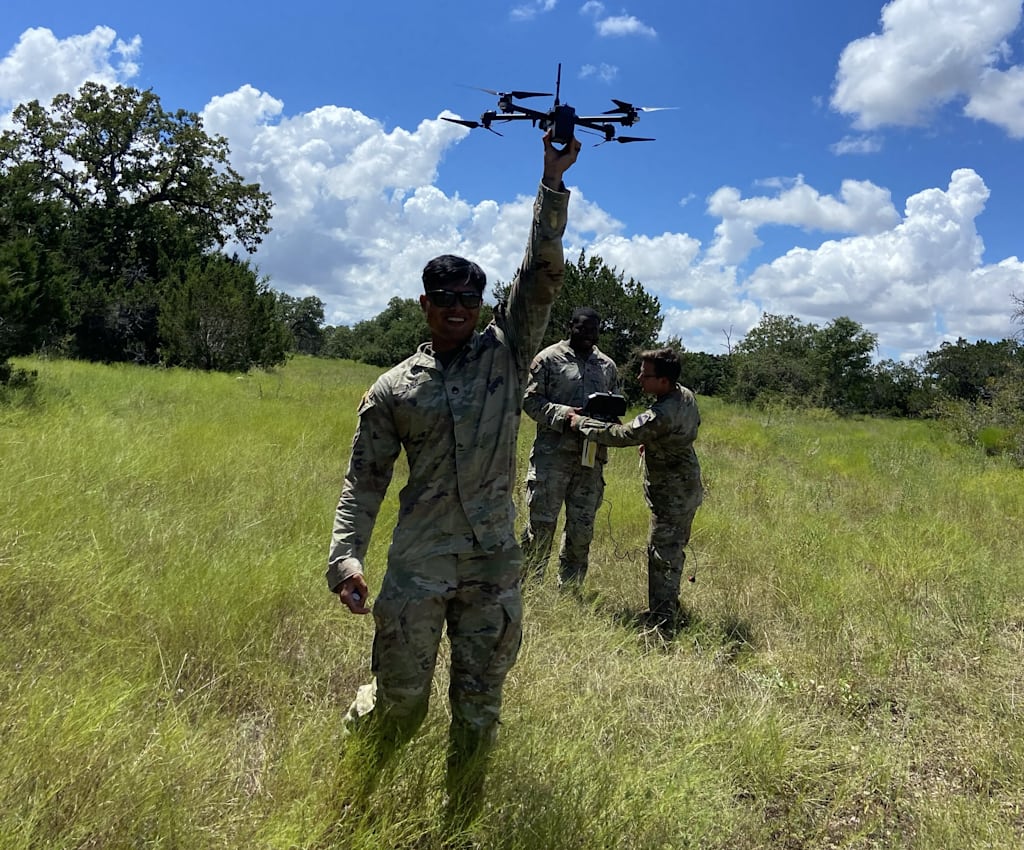
Anyone who follows world news and online media has seen videos over the last three to four years of mounted and dismounted soldiers being killed or wounded by various drones. In 2022, The Russia-Ukraine Conflict became the first place for widespread use of drone warfare. Then the Israel-Hezbollah Conflict showed the world that these technologies and tactics are not isolated to one war but are now the norm for modern combat. Most recently, the heightened tensions between the United States and Iran have proven that even the U.S. Military is vulnerable to simple and sophisticated drones.[1] This presents the question, does the United States Army currently have the capabilities to combat hostile drones and are our protection and defensive innovations reactive or proactive to what we are seeing across the globe in these current events?
To understand our capabilities, we must recognize how the U.S. Army has its current Counter-Unmanned Aircraft System (C-UAS) framework laid out. Most of this is detailed in ATP 3-01.81 (C-UAS Operations). It depicts the C-UAS operational environment and describes the Army’s current capabilities broken down into four categories: Fixed, Semi-Fixed, Mounted, and Dismounted. Each of these capabilities comes with sensors that help detect and identify UAS threats; then using this information, a “Defeat Decision” is made to determine whether a lethal or non-lethal response is required to counter the threat. The prescribed technique that the Army currently uses is the “Layered Defense Technique,” which provides strength in depth and calls for additional protection capabilities, such as structure hardening or camouflage.[2] The Army doctrine outlines a developed and thought-out plan for countering UAS threats from fixed locations or in the vicinity of those locations. However, even with these techniques in place, multiple Iranian drones managed to pass through the entire layered defenses across various U.S. sites in CENTCOM.[3] In addition to the flaws in the current protection and defensive guidelines, what it has failed to do is provide solid C-UAS plans and techniques that mesh with the Army’s future fight in a Large-Scale Combat Operation (LSCO).
The gap between current drone threats and what the Army has at its disposal to counter these threats has been known for some time, and the gap was validated in the last six months, as seen in the Middle East. Understanding the emerging innovations and how they will be fielded to the force will help depict how they fit in a LSCO environment. In late 2024, the Department of Defense (now Department of War) released its updated Strategy for Countering Unmanned Systems which addressed many of the environmental changes and laid out a new approach for implementing change. It defined five “strategic ways” to execute this. The one of most relevance in today’s environment is the fourth way which states: “Deliver Solutions with Greater Speed, Adaptability, and Scale.”[4] This can currently be seen in the Army’s Transformation in Contact (TiC) 2.0. Through this initiative, multiple U.S. Army Divisions have been fielded with new and specialized C-UAS equipment for fixed and mobile platforms. In addition, they also fielded the first high energy laser prototypes.[5] While many of the new systems, sensors, and weapons have come from private industry, the tactics, techniques, and procedures for implementing these innovations into formations have come from Fort Sill, Oklahoma which is home to the Joint Counter-Small Unmanned Aircraft System University.[6]
In an effort to be proactive, many of these new C-UAS innovations were initiated prior to the most recent threats that U.S. bases have received. However, the flexibility in development has allowed the programs to shift and be reactionary when needed. For example, when a new form of drone is used against us or if new technologies emerge. The new C-UAS advances can be broken down into the same four capability categories that were previously mentioned. The first and second being fixed and semi-fixed systems. These systems are designed to provide protection for static positions such as bases, base camps, and our critical infrastructure.[7] The most up-to-date and promising product for this capability is Lockheed Martin’s GRIZZLY containerized launcher paired with the Sanctum C-UAS Battle Manager and Fortem R-40 Radars. The system comes in a ten-foot container and can be scaled using multiple systems. It can detect and defeat UAS groups 1-4. It recently completed its first successful live fire on June 3, 2026, at U.S. Army Yuma Proving Grounds.[8] This system provides a greater solution for fixed positions given their relatively small footprint and easy setup; however, it is also its downfall given that it can only be used in a fixed capacity and it has not been fielded to units within the CENTCOM area of responsibility.
With the emphasis on LSCO and the weaning from counterinsurgency-style fighting, the need to support maneuver forces against UAS threats is greater than it ever has been before. There are many systems already fielded and many more in testing stages across various divisions that are aimed at supporting the last two categories: mounted and dismounted. On the mounted side, current systems like the Maneuver Short-Range Air Defense (M-SHORAD) System, based off M1126 Stryker Platforms, have received upgrades like a direct energy 50 kW laser as well as replacement missiles for the legacy FIM-92 Stingers to defeat UAS threats.[9] New systems such as the M2 Bullfrog have been mounted on M2A4 Bradley Fighting Vehicles and M1A2 Abrams Tanks through TiC 2.0. The system integrates an existing weapon with new artificial intelligence targeting software to increase the C-UAS capabilities across armored formations.[10] For dismounted troops, new systems, such as the SMASH 2000LE optic, provide Soldiers with a target tracking and acquisition system to shoot down enemy UAS using their individual weapons. Just months after successful testing during TiC 2.0, the Army started procuring these systems.[11] Other options are also being procured, like the TLS Manpack, which gives dismounted Soldiers a wearable system that uses electromagnetic signals to detect and disrupt enemy signals, such as remote-controlled UAS platforms.[12]
Each example above is a small portion of the overwhelming innovation and development that the Army is taking to combat UAS threats. The newest innovations are rising to the levels needed to defeat modern UAS platforms. Inventions are reactive in nature because a threat must exist for developers to know what to counter. However, what the Department of War and U.S. Army is doing can be seen as very proactive. The time between testing across various formations and the procurement and fielding of new C-UAS systems has been much faster than historic acquisition programs. The biggest challenge that remains is that there are so many new systems and not all units have been trained or even exposed to them. This may cause issues in a future conflict. What the Army needs to do is solidify which specific system will be used for each of the four categories of C-UAS in order to create a commonality across units. Once that has been achieved, more time needs to be invested in the competence of the users who operate the systems and how they all work together. The end state should be to create the same “layered defense technique” that already exists but with the newer technologies; that way the United States can prevent future breaches of this defense, as we have seen in the Iran conflict.
[1] Kelly Campa, et al., “Iran Update Evening Special Report,” February 28, 2026, https://understandingwar.org /research/middle-east/iran-update-evening-special-report-february-28-2026/.
[2] Department of the Army, ATP 3-01.81, Counter-Unmanned Aircraft System (C-UAS) Operations, May 23, 2025.
[3] Campa, et al. “Iran Update.”
[4] Department of Defense, Fact Sheet: Counter-Small Unmanned Aircraft Systems Strategy, December 05, 2024.
[5] GEN James Mingus, Statement to Subcommittee on Readiness, Committee on Armed Services, U.S. House of Representatives, May 06, 2025.
[6] Katie Lange, “Drones 101: Welcome to DOW’s Joint C-SUAS University,” September 19, 2025, https://www. army.mil/article/288598/drones_101_welcome_to_dows_joint_counter_small_uas_university.
[7] Department of the Army, ATP 3-01.81.
[8] Lockheed Martin, “Demonstrates First-Ever Sanctum™ C-UAS Launch from GRIZZLY™ Containerized Launcher,” June 03, 2026, https://news.lockheedmartin.com/2026-06-03-Lockheed-Martin-Demonstrates-First-Ever-Sanctum-TM-C-UAS-Launch-from-GRIZZLY-TM-Containerized-Launcher.
[9] Congressional Research Service, U.S. Army’s Maneuver Short-Range Air Defense (M-SHORAD) System, January 20, 2026.
[10] Allen Control Systems, “Bullfrog M2,” 2025, https://www.allencontrolsystems.com/products/bullfrog-m2.
[11] LTC Adam Scher, “Joint Interagency Task Force Awards Critical Counter-UAS Contract,” March 24, 2026, https://www.war.gov/News/News-Stories/Article/Article/4443046/joint-interagency-task-force-awards-critical-counter-uas-contract/.
[12] Brandon Pollachek, “New dismounted spectrum warfare system rapidly addresses critical Army need,” December 11, 2024, https://cpeisw.army.mil/2024/12/11/278232/.
About the Creator
Sam Shroyer
I am an active-duty Engineer Officer in the US Army with a BS in Environmental Engineering from West Point. My previous positions include the following:
- Assistant Training Officer
- Sapper Platoon Leader
- Company Executive Officer
Enjoyed the story? Support the Creator.
Subscribe for free to receive all their stories in your feed.
Comments
There are no comments for this story
Be the first to respond and start the conversation.