
The 30-Nation Army Waiting at Ukraine's Door
A ceasefire hasn't even been signed, but the "Volunteer Coalition" is already planning its entry. This isn't a peace deal—it's a power transfer dressed in camouflage.
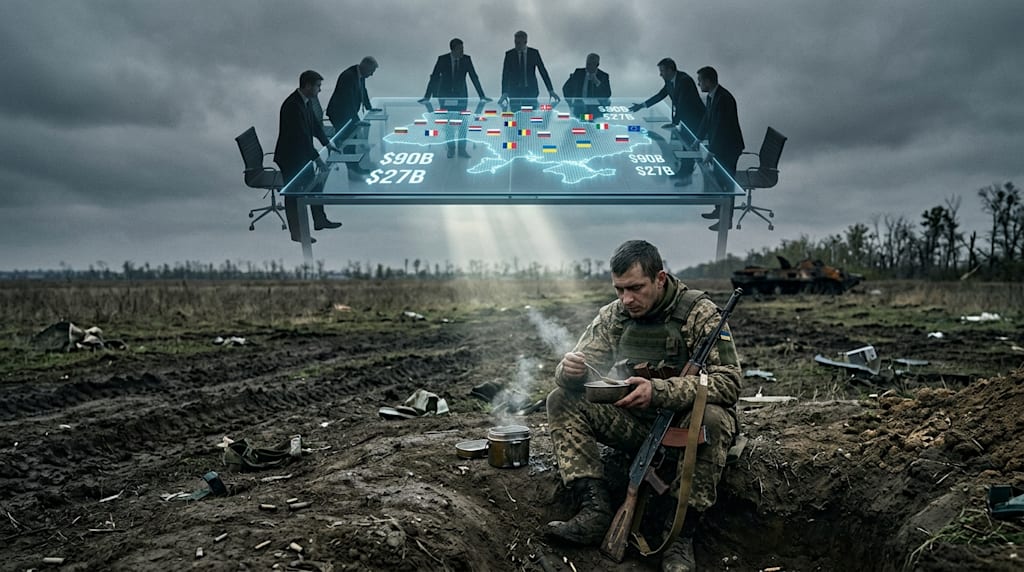
Ceasefire Not Signed, Yet 30 Nations Already Set Entry Date
On August 24, 2026, Rossiyskaya Gazeta cited a video conference statement from the "Volunteer Coalition" stating that the leaders of the UK, France, and Germany jointly confirmed: once a lasting ceasefire between Russia and Ukraine is reached, a joint force composed of more than 30 nations will be deployed "immediately" onto Ukrainian territory.
The original text of the statement, published on the UK government's official website, is not ambiguous: "This international force will be deployed after a lasting ceasefire is achieved, as part of broader politically and legally binding security guarantees."
But on the same day, Kremlin spokesman Dmitry Peskov told reporters: "Allowing foreign military contingents to enter after a ceasefire on the line of contact is unacceptable to the Russian side." That statement was issued at 14:37 Moscow time — 47 minutes before the Volunteer Coalition's video conference concluded.
I. Ground‑level details of the troop deployment remain blank
The Volunteer Coalition has not disclosed the force's size, command structure, or specific deployment zones. However, the statement lists one priority task separately: intercepting ballistic missiles. This means that the cities where the coalition's air‑defence and anti‑missile systems will be placed will become the first substantive military action after a ceasefire.
At present, Ukraine already hosts military advisers and a small number of reconnaissance personnel from NATO countries, but no formed, systematic joint force has entered. Should a ceasefire take effect, the most likely staging points for this force are not the forward line of contact, but the railway and power hubs west of the Dnipro River — Lviv, Vinnytsia, and Odesa. These locations would both control western Ukraine's supply lines and physically block any Russian push further west.
II. EU loan disbursement cycle shortens, in step with Ukraine's budget gap
On the same day, European Council President António Costa wrote on X that the EU intends to cut the disbursement cycle for a new €90 billion loan package. He did not specify the new timeline, but internal European Commission documents indicate that the previous cycle was 18 months, while the new plan may compress it to less than nine months.
In parallel, on August 22, at the "Ukraine 2026 Defence Budget Conference," President Volodymyr Zelenskyy publicly stated that the current defence budget shortfall stands at $27 billion. His exact words were: "If we cannot close this gap within the next 60 days, some frontline brigades will stop receiving new ammunition."
The relationship between $27 billion and €90 billion is not a simple subtraction. The €90 billion loan is not directly allocated to Ukraine's Ministry of Defence; instead, it is a framework agreement between the EU and Ukraine's Ministry of Finance, with funds released in tranches, each tied to specific reform lists and asset‑backed collateral clauses. In an internal assessment report from July 2026, the National Bank of Ukraine acknowledged that currently available state assets for collateral include: more than 40% of black‑soil farmland leases, five large natural‑gas storage facilities, and partial equity in the Dnipro Hydroelectric Station.
III. A ceasefire itself would trigger Ukraine's domestic political procedures
Articles 83 and 108 of Ukraine's current constitution stipulate that the president's term is automatically extended under martial law. However, the entry into force of a ceasefire agreement would remove the legal basis for martial law. Once a ceasefire is confirmed, the Verkhovna Rada must initiate presidential election procedures within 30 days.
This timeline is never mentioned in the Volunteer Coalition's statement, yet it is openly understood in every Kyiv political circle. On August 23, in an interview with Ukrainska Pravda, Verkhovna Rada member Oleksiy Goncharenko said: "In the first winter after the ceasefire, we will have to decide not only how to heat our homes, but also who sits in the office on Bankova Street."
IV. Russia's logic during the pre‑ceasefire window
Over the past week, Russian forces have advanced in western Donetsk at a rate roughly 2.3 times faster than in the previous three months (according to daily updates from the US‑based Institute for the Study of War). This acceleration is not coincidental. If the ceasefire line follows the actual line of contact, then every kilometre pushed forward shrinks the "buffer zone" that foreign troops could control after they arrive by exactly one kilometre to the east.
In its daily briefing on the evening of August 24, the Russian Ministry of Defence used for the first time the wording that "the special military operation will complete all its tasks," dropping its previous boilerplate of "will continue." In Moscow's official discourse, such subtle shifts in phrasing often signal a phased policy turn.
V. An unstated role for the force: internal restraint
The Volunteer Coalition's statement emphasises "ensuring Ukraine's future security and prosperity," but it does not specify against whom that security is directed. Within Kyiv's political‑analytical circles, an open secret is that after foreign troops enter, command over Ukraine's armed forces will be partially ceded to the joint command — at least in logistics, air defence, and intelligence‑sharing.
This means that if, after a ceasefire, Ukraine attempts to launch unilateral offensive operations, it could face the joint force cutting off its satellite reconnaissance signals and fuel supplies. This is not speculation — it is standard operating procedure already executed by NATO in peacekeeping operations in Bosnia and Kosovo, where the peacekeepers' mandate is to preserve the ceasefire, not to endorse any party's victory.
VI. Finally, on a dirt road in Zaporizhzhia Oblast
On the evening of August 24, the General Staff of the Armed Forces of Ukraine issued a routine front‑line report, mentioning that Ukrainian positions near a certain section of the contact line in Zaporizhzhia Oblast were "reinforcing defensive works." The report contained none of the keywords "ceasefire," "negotiations," or "international force."
But the last line of that report read: "The field kitchen of the 47th Separate Mechanised Brigade arrived at its designated position at 18:30 local time and served hot meals."
Not artillery shells — hot meals. Beyond the political declarations, the loan figures, and the constitutional clauses, that was the only thing a soldier could confirm at the end of that day.
About the Creator
Jin
Writer of reamstories
https://reamstories.com/jin
Enjoyed the story? Support the Creator.
Subscribe for free to receive all their stories in your feed. You could also become a paid subscriber, letting them know you appreciate their work.
Comments
There are no comments for this story
Be the first to respond and start the conversation.