transportation
Where there's public transportation, there's problems, policy and bureaucratic politics; mitigate road rage and commiserate with your fellow travelers.
Fuel on Fire: How Rising Petrol Prices Are Crushing the Public in 2026
Fuel on Fire: How Rising Petrol Prices Are Crushing the Public in 2026 The Introduction The price of gasoline is continuing to rise in Pakistan, which is having an impact on every sector of society. From daily wage earners to salaried professionals, the rising cost of fuel has become more than just an economic issue—it is a national crisis impacting livelihoods, mobility, and overall quality of life.
By Farida Kabir6 months ago in The Swamp
Pakistan's Strategic Importance and Global Impact in US-Iran Relations A Silent Power in a Dangerous Conflict
Pakistan's Strategic Importance and Global Impact in US-Iran Relations A Silent Power in a Dangerous Conflict An Introduction In the complex world of global politics, not every influential country dominates headlines.
By Farida Kabir6 months ago in The Swamp
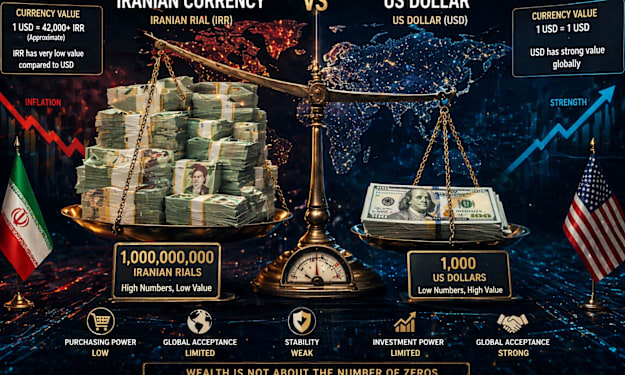
Iranian Currency vs US Dollar
Iranian Currency vs US Dollar The comparison between the Iranian Rial and the US Dollar presents one of the most striking examples of how currency value affects wealth perception. At first glance, earning millions or even billions in Iranian currency may appear to represent significant financial success. However, when compared with the US Dollar, the reality becomes very different. This comparative analysis examines whether becoming a millionaire in Iranian currency truly reflects financial wealth.
By Wings of Time 6 months ago in The Swamp
Talks in Islamabad: Can Pakistan Resolve the US-Iran Conflict? A World Holding Its Breath in the Beginning
Talks in Islamabad: Can Pakistan Resolve the US-Iran Conflict? A World Holding Its Breath in the Beginning In April 2026, the world witnessed a rare and historic diplomatic moment: high-level talks between the United States and Iran held in Islamabad, Pakistan. The Islamabad Talks, or these talks, were the first time the two countries had spoken directly to each other at such a high level in decades.
By Farida Kabir6 months ago in The Swamp
Pakistan’s Successful Repayment of $1.3 Billion Eurobond
Introduction In April 2026, Pakistan made headlines by successfully repaying its $1.3 billion Eurobond, marking a significant milestone in its ongoing efforts to stabilize the national economy and strengthen international credibility. This repayment, while a routine debt obligation on paper, carries broader implications for Pakistan’s financial health, investor confidence, and geopolitical positioning.
By shaoor afridi7 months ago in The Swamp
The "Benefits Cliff"
The System Is Not Cash, It Is Replacement For a family of five in Salem, Oregon, the low-income support system is not built primarily on direct cash transfers. It is built on a small number of high-impact programs that function as after-tax purchasing power, replacing major expenses rather than adding to pre-tax income. This distinction matters because it changes how the system must be evaluated. Income is taxed before it becomes usable, while benefits replace costs that would otherwise require after-tax dollars. That means these programs effectively operate as a parallel income structure, but one that is locked into specific categories such as food, housing, childcare, and healthcare rather than flexible cash.
By Peter Thwing - Host of the FST Podcast7 months ago in The Swamp
The Ecosystem
Why Swamps Are the Planet's Most Important and Most Misunderstood Landscape THE WORLD'S MOST HATED ECOSYSTEM 🐊 For centuries human civilization has treated swamps, marshes, bogs, and wetlands as wastelands, as obstacles to progress that should be drained, filled, developed, and converted into productive land, and this attitude has resulted in the destruction of approximately sixty-four percent of the world's wetlands since 1900 with the rate of loss accelerating in recent decades despite growing scientific understanding that wetlands are not wastelands but rather among the most ecologically valuable and productive ecosystems on Earth, providing services worth an estimated forty-seven trillion dollars annually including water purification, flood protection, carbon sequestration, biodiversity support, and coastal storm buffering that no human technology can replicate at comparable scale or cost, and the continuing destruction of these ecosystems represents one of the most catastrophic environmental miscalculations in human history driven by the fundamental misunderstanding that an ecosystem's value is determined by its utility for agriculture or development rather than by its ecological function 🌍
By The Curious Writer7 months ago in The Swamp
Saudi Arabia East- West Petroline
The Middle East has long been the center of global energy politics, with its vast oil and gas reserves shaping not only regional dynamics but also the priorities of major world powers. However, in recent years, a critical question has emerged: should the world continue relying on a few strategic maritime chokepoints for energy transportation, or is it time to develop alternative routes?
By Ibrahim Shah 7 months ago in The Swamp
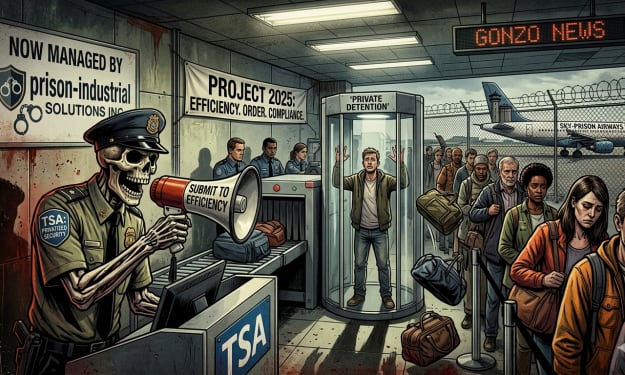
THE SKY-PRISON COMMUTE: THE GREAT AMERICAN AIRPORT SHAKEDOWN
LOS ANGELES, CALIFORNIA — I am standing in a security line at Los Angeles International Airport, staring into the dead, glazed eyes of a man who has been screaming "LAPTOPS OUT" for six straight hours. Currently, he is a federal employee. He has a pension. He has health insurance. But if the ghouls behind Project 2025 have their way, this man is about to be "liberated". By liberated, I mean he’s about to be fired, stripped of his union card, and rehired at $18.00 an hour by a subsidiary of a private equity firm that also manages an "enhanced detention center" in the Mojave Desert, that's conveniently housing all the dangerous undocumented immigrants, and keeping "America Safe"... again.
By Meko James 7 months ago in The Swamp
Trump: Considering Occupying Kharg Island.
When Israel and the US decided on 28 February to take military action against Iran, they were in for a shock, or so it seems. The policy of decapitation of enemy leadership has always been Israel's policy. Countless leaders that Israel regards as enemies have been assassinated in this way. Whether from Mossad, the IDF, the Israeli Air Force, whatever. The US, of late, has also adopted this policy. The reasoning being that killing the leaders of an enemy organisation or country will cut off the head of the snake. The problem with that is the snake grows another head. When Israel killed Hezbollah Chief Hasan Nasrallah, yes, it shook the group to its very foundations. But the group under a new leadership is battling Israel in Lebanon now as we speak.
By Nicholas Bishop7 months ago in The Swamp