trade
How will free-trade fare under the Trump administration? Trade thoughts and opinion about negotiations, embargo, what works and what doesn't..
"The Streets of Defiance: Los Angeles vs. Federal Force"
1. Catalyst: Federal Immigration Raids (June 6–7) On June 6, 2025, a series of coordinated federal raids by U.S. Immigration and Customs Enforcement (ICE) swept through the Los Angeles Fashion District, a clothing warehouse, a Home Depot parking lot, and a doughnut shop
By Saboor Brohi about a year ago in The Swamp
🇺🇸🇨🇳 Trump Announces Second Round of U.S.–China Trade Talks Set for London Next Week
A New Chapter in the Trade Saga Former President Donald Trump has announced that the second round of U.S.–China trade negotiations will be held in London on Monday, June 9, 2025. This follows a surprising but constructive 90-minute phone call with Chinese President Xi Jinping, signaling renewed willingness to stabilize one of the world’s most strained economic relationships.
By Saboor Brohi about a year ago in The Swamp
The Dollar Is Falling: What It Really Means for Small Countries
In the global economic theater, the U.S. dollar has long played the leading role — a symbol of stability, strength, and trust. But today, the spotlight is shifting. From the rise of alternative alliances like BRICS to increasing distrust in U.S. global leadership, the fall of the dollar is no longer a conspiracy theory — it's a visible trend. And while the headlines focus on Washington and Wall Street, the real impact is unfolding quietly in small and developing countries.
By Keramatullah Wardakabout a year ago in The Swamp
"Diplomatic Turbulence: Qatar Gifts Jet to Trump Amid Global Tensions"
In a move that has shocked Washington and raised fresh questions about international influence in U.S. politics, Qatar has reportedly gifted a private jet to former President Donald J. Trump. While details surrounding the aircraft’s value, origin, and intended use remain sparse, the gesture has already sparked bipartisan concern over what it might signify for American foreign policy — past, present, and future. The jet, said to be a state-of-the-art long-range aircraft, allegedly came as a token of appreciation for Trump’s role in fostering strong U.S.-Qatar relations during his time in office. Critics, however, are calling it an audacious example of "jet diplomacy" — a term coined to describe high-value gifts or privileges offered by foreign governments to powerful individuals in exchange for favorable treatment or long-term leverage. A Gift or a Political Statement? Qatar, a small but wealthy Gulf state with outsized geopolitical influence, has long sought to maintain close ties with American administrations. Under Trump, relations were notably strong despite initial tensions during the 2017 Gulf crisis, when Saudi Arabia, the UAE, and others severed ties with Qatar. The Trump administration’s eventual support for a resolution — and its refusal to condemn Qatar outright — was seen by some as a diplomatic win for Doha. Fast forward to 2025, and this new gesture is prompting speculation about what Qatar hopes to gain. With Trump actively campaigning for a return to the White House and dominating Republican primary polls, the timing of the gift could be interpreted as a strategic bet on the future. “This isn’t just a lavish thank-you note,” said Dr. Karen Holt, a professor of international relations at Georgetown University. “It’s a calculated move designed to stay in the good graces of someone who could potentially wield power again.” Legal and Ethical Implications The legality of the gift is already under scrutiny. While private citizens — even former presidents — are not bound by the same gift restrictions as sitting officials, the sheer scale and political timing of the gesture have ethics watchdogs sounding alarms. “There is no universe in which this gift is simply symbolic,” said Jacob Klein, director of the nonpartisan Center for Political Integrity. “This is a multimillion-dollar asset being handed to a political figure with clear aspirations to regain power. The American public deserves to know what’s behind it.” Congressional Democrats are already calling for an investigation into whether the gift violates the Foreign Agents Registration Act (FARA) or any other statutes governing foreign influence. Meanwhile, several Republicans have remained quiet, wary of alienating Trump's voter base ahead of a contentious primary season. Qatar’s Diplomatic Playbook Qatar has a history of strategic generosity. From investments in Western real estate to hosting international events like the 2022 FIFA World Cup, the Gulf state has used soft power to expand its global reach. This jet, experts say, may be part of a broader effort to entrench relationships with influential figures in the West. In recent years, Qatar has also positioned itself as a diplomatic mediator, hosting talks between the U.S. and the Taliban and playing a role in hostage negotiations in Gaza. Maintaining access to decision-makers in Washington — whether current or prospective — is central to its diplomatic calculus. Trump’s Response and the Political Fallout As of this writing, Trump’s team has neither confirmed nor denied receipt of the aircraft, offering only a vague statement: “President Trump has always appreciated the strong and respectful relationship between the United States and Qatar.” That noncommittal tone has not stopped his critics from seizing on the story. President Joe Biden’s re-election campaign quickly released a statement denouncing the gift as “a flagrant symbol of foreign interference and elite privilege,” accusing Trump of putting personal gain above American interests. Still, among Trump’s base, the controversy appears to have little impact. If anything, it reinforces his outsider status — someone powerful enough to attract attention from world leaders, and controversial enough to provoke media outrage. What Comes Next? The Federal Election Commission (FEC) and the Department of Justice could become involved if evidence emerges that the jet was offered in exchange for political favors or if it’s being used to support Trump’s 2024 campaign. Foreign gifts used to advance political activity would raise serious legal red flags. Meanwhile, Qatar has remained tight-lipped, issuing only a short statement through its U.S. embassy: “The State of Qatar values its longstanding friendship with the United States and has always engaged in diplomacy through mutual respect and cooperation.” Whether the gesture was legal, ethical, or politically wise remains an open question. What’s certain is that this high-flying gift has reignited debates about global influence, foreign money, and the thin line between diplomacy and favoritism. As Trump’s political ambitions continue to dominate the headlines, and as Qatar navigates its role on the world stage, this unusual gift has become more than a diplomatic curiosity — it’s a symbol of the complex, often murky world of international power politics.
By Kaleem Ullahabout a year ago in The Swamp
Can America Bring Jobs Back?
Can America Bring Jobs Back? The Truth About Policies, Politics, and People For decades, the United States has seen its manufacturing base shrink. Once the backbone of the American middle class, industries like steel, automobiles, textiles, and electronics have either downsized or moved operations abroad. In response, both Republicans and Democrats now say they want to “reshore” jobs — bring them back to the U.S.
By Lanny Newvilleabout a year ago in The Swamp
Why Donald Trump’s Visit to Abu Dhabi Matters Now. AI-Generated.
On the morning of May 15, 2025, U.S. President Donald Trump landed in Abu Dhabi, the capital of the United Arab Emirates. His sudden, low-profile visit has captured the world’s attention. This trip isn’t just about diplomacy—it may carry deeper political and business meanings.
By Nouman waliabout a year ago in The Swamp
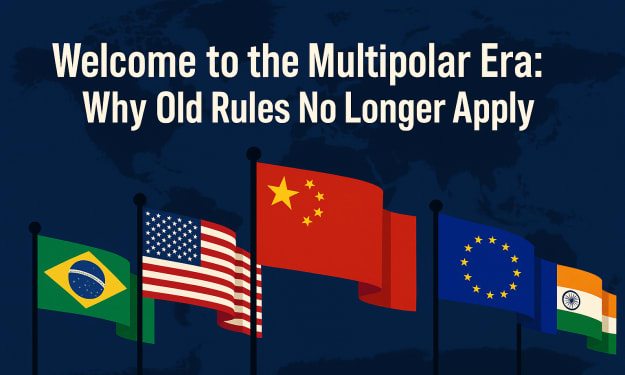
“Welcome to the Multipolar Era: Why Old Rules No Longer Apply”
Welcome to the Multipolar Era: Why Old Rules No Longer Apply Inside the Rise of a World Where No One Power Calls the Shots --- Introduction Not long ago, world politics revolved around a single axis — the United States. Following the Cold War, America’s military might, economic dominance, and cultural influence gave it an unrivaled role in setting global agendas. But that era is fading fast. Today, we live in a world where no single nation can dictate the terms. Power is more distributed, alliances are more fluid, and the rules of engagement are constantly shifting. From Beijing to Brasília, from Ankara to New Delhi, a new set of actors is redefining influence in a chaotic and contested global order. The question is no longer who leads — it's how the world manages without clear leadership. --- The End of Unipolarity The post-Cold War unipolar moment, which placed the U.S. at the apex of global power, is now history. Two decades of military overstretch, internal political divisions, and economic upheaval have eroded America's ability to act as the world's de facto leader. The withdrawal from Afghanistan, inconsistent global policies, and an increasingly inward-looking electorate have signaled a step back from the assertive global policing of the early 2000s. This vacuum hasn't gone unnoticed. Instead of a new hegemon rising to replace the old, what we see is a diffusion of power across multiple regional centers. It’s not a bipolar world of the Cold War era, nor a balanced multipolar structure of the early 20th century. This new landscape is messy, unstable — and permanent. --- China and the Economic Realignment China stands at the forefront of this shift, but even its rise comes with caveats. With the Belt and Road Initiative, Beijing has extended its economic reach into Asia, Africa, and parts of Europe. Its influence over supply chains, infrastructure, and digital technologies challenges the dollar-based global system. However, China's ambitions face resistance. Tensions over Taiwan, territorial disputes in the South China Sea, and pushback from Western nations on tech and trade indicate that its power, while rising, is also contested. China is not replacing the U.S. — it’s carving out its own sphere, one that’s economic rather than ideological, and subject to friction. --- Russia’s Military Gambit and Strategic Isolation Russia, too, has sought to challenge the Western-dominated order, most dramatically through its invasion of Ukraine. While the war has demonstrated Moscow’s willingness to use force to protect perceived national interests, it has also exposed its strategic limits. Sanctions, international condemnation, and battlefield losses have isolated Russia from much of the world economy, while simultaneously deepening its ties with non-Western partners like Iran and China. In trying to redefine regional borders by force, Russia has sparked a renewed unity among NATO members, paradoxically reinforcing the very alliances it sought to divide. --- Middle Powers and Fluid Alliances Perhaps the most defining feature of the multipolar era is the rise of middle powers — nations like India, Brazil, Turkey, and Saudi Arabia that are no longer content to align strictly with the West or East. These countries pursue strategic autonomy, balancing relationships across global fault lines. India, for example, is a member of the Quad (with the U.S., Japan, and Australia) while also maintaining defense ties with Russia and participating in BRICS. Turkey, a NATO member, buys Russian arms and projects influence across Central Asia and the Middle East. These states navigate global politics based not on ideology, but on opportunity and self-interest. --- Global Institutions Under Strain The United Nations, World Trade Organization, and other postwar institutions are increasingly ineffective at managing today’s fragmented world. Vetoes stall progress at the UN Security Council. Trade disputes paralyze the WTO. And new power blocs like BRICS and the Shanghai Cooperation Organization aim to create parallel systems that reflect non-Western values and priorities. The rules-based international order — long championed by the West — now finds itself questioned not only by adversaries, but by allies frustrated with its limitations and hypocrisy. --- Technology, Climate, and the New Arenas of Power While traditional power still matters, influence in today’s world is also determined by less tangible forces. Control over technologies like artificial intelligence, 5G, and semiconductors is becoming as critical as nuclear weapons were in the past. Meanwhile, climate change, pandemics, and migration flows expose the limitations of national solutions to global problems. These issues demand coordination, yet in a fragmented world, cooperation is the first casualty of geopolitical rivalry. --- Conclusion: Embracing Complexity The multipolar era is not just a phase — it is the defining condition of our time. It offers opportunities for a more inclusive, balanced world, but also risks greater instability, miscalculation, and fragmentation. Old rules no longer apply, because the old world no longer exists. The future will depend not on domination, but on how nations adapt, negotiate, and share power in a world where no one — and everyone — leads.
By World politics about a year ago in The Swamp
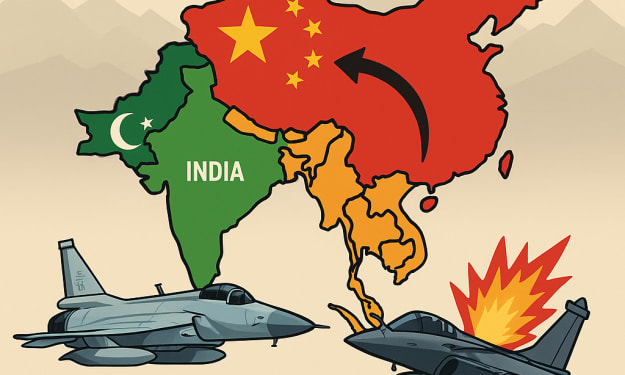
How China Got Benefit from Pakistan and India Conflict
In a dramatic turn of events during a recent India-Pakistan conflict, the Pakistan Air Force (PAF) reportedly downed a French-made Rafale fighter jet using the JF-17 Thunder, a multi-role combat aircraft developed jointly by China and Pakistan. Though official confirmation is still pending, the symbolic value of this event is already resonating across global defense and strategic communities.
By Zakir Ullahabout a year ago in The Swamp
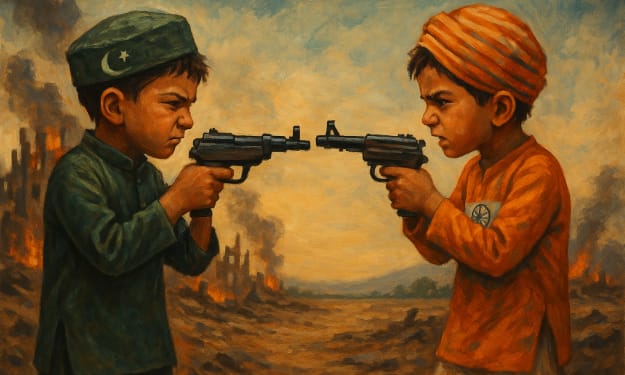
War Between Brothers: A Call for Peace in South Asia
The world watched in horror as tensions between Pakistan and India erupted once again into a full-blown conflict in these recent days. What began as a border skirmish soon escalated into one of the most destructive confrontations in recent South Asian history. While the international media flooded timelines with statistics and breaking updates, the real cost of this war—human lives, fractured communities, economic collapse, and regional instability—remains far more than what any headline can convey.
By Zakir Ullahabout a year ago in The Swamp