supreme court
The highest court has the highest stakes. Analysis of Supreme Court justices and their always-controversial rulings.
Bitcoin vs Open Interest Should traders be worried by THIS divergence
The price action of Bitcoin has recently been scrutinized, but savvy traders are also paying attention to something even more telling: a significant divergence between open interest in Bitcoin and its price. The derivatives market may be sending a cautious signal while the spot market maintains its optimism. Analysts are concerned about this divergence, which raises the question of whether traders should be concerned. Understanding what open interest actually entails is essential before delving into its ramifications. The total number of unresolved derivative contracts in the futures and options markets is referred to as open interest. It shows how much activity and participation there is in the market. An increase in open interest typically suggests that new money is flowing into the market, which can reinforce a trend. A decline could indicate that traders are closing positions, which could indicate indecisiveness or exhaustion of the trend. The price of Bitcoin has been either steady or showing signs of rising, hovering in bullish territory above key support levels in recent weeks. However, open interest in Bitcoin futures has not followed suit. In fact, in several instances, open interest has dropped or stagnated while prices climbed—a classic divergence.
By GLOBAL NEWSabout a year ago in The Swamp
Altcoin season could be near: Why June can see a 2021-style rally
**Altcoin Season Could Be Near: Why June Can See a 2021-Style Rally** Numerous analysts and investors are beginning to speculate that an altcoin season may be just around the corner as the cryptocurrency market continues to show signs of recovery. The month of June, historically a favorable period for crypto rallies, is shaping up to potentially mirror the explosive growth seen in 2021. The stage may be set for altcoins to take the lead as Bitcoin's strength and dominance plateau. ### What Is the Season for Altcoins? Altcoin season, or "alt season," refers to a period when alternative cryptocurrencies—those other than Bitcoin—outperform the leading digital asset. During this phase, investors rotate capital from Bitcoin into smaller market cap assets in pursuit of higher gains. This is a time when tokens like Ethereum, Solana, Cardano, and a number of smaller-cap projects saw huge returns in a short amount of time. Typically, altcoin seasons follow a strong Bitcoin rally as market participants look for the “next big thing.”
By GLOBAL NEWSabout a year ago in The Swamp
The Great Depression:
Introduction The Great Depression was a significant and harrowing chapter in American history, reshaping the economy, society, and government. It serves as a stark reminder of how interconnected our financial systems are and how the decisions we make today can echo through time. Alarmingly, many of the factors that contributed to the Great Depression are resurfacing in our current climate. This essay will highlight the causes of the Great Depression and draw parallels to contemporary issues, including government deregulation, corruption, the glorification of wealth, and the rise of exclusionary purity movements. With only 4 years away from the 100th anniversary of the beginning of the Great Depression, it behoves us to take a serious sociopolitical look at the parallels of today that have us headed unavoidably to our next one.
By Meko James about a year ago in The Swamp
Autopen Gate: The Constitutional Crisis On The Horizon
Politics is a tricky beast, and whether you love or hate the guy in office, they have rules they’re supposed to follow. One of those rules is that they must abide by their duties. One is that they have a constitutional duty to sign bills into law.
By Jason Mortonabout a year ago in The Swamp
Western Media and the Double Standard in Portraying Black Men
In the digital age, media narratives significantly shape public perception. However, a persistent issue remains: the portrayal of Black men in Western media often reflects deep-seated biases and double standards. These portrayals not only influence societal attitudes but also have tangible effects on the lives of Black individuals.
By Mohammad Ashiqueabout a year ago in The Swamp
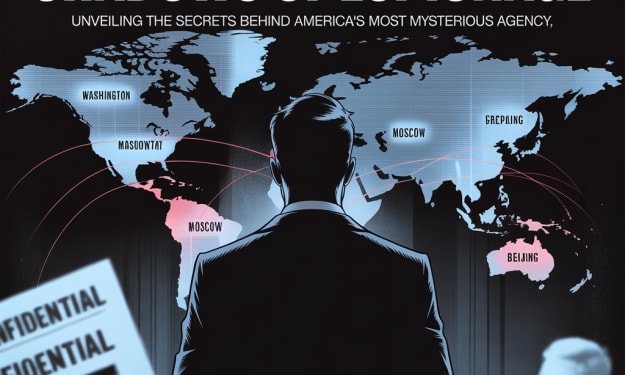
Inside the CIA: America’s Secret Intelligence Agency
From Cold War Tactics to Cyber Wars: The CIA’s Global Reach In the shadows of global politics, where nations maneuver not through diplomacy alone but through secrecy, deception, and surveillance, the Central Intelligence Agency (CIA) stands as one of the most powerful and enigmatic institutions in the world. Born from the ashes of World War II and raised during the height of the Cold War, the CIA has evolved from traditional espionage operations to become a digital-age intelligence giant. Its reach extends across borders, ideologies, and technologies—operating in a world where knowledge is power and information can change the fate of nations. As threats have shifted from Soviet missiles to cyberterrorism and AI warfare, so too has the CIA adapted, making it not only a historical cornerstone of American security but also a critical player in today’s global power struggle. The Origins: An Agency Born in Secrecy The CIA was formally established in 1947 under the National Security Act, but its roots trace back to the Office of Strategic Services (OSS), the United States' first intelligence agency during World War II. Designed to combat Nazi Germany and Imperial Japan through covert operations, the OSS laid the foundation for modern U.S. espionage. When the Cold War began, the United States recognized the need for a peacetime intelligence service capable of gathering foreign information and executing clandestine operations. Thus, the CIA was born—not as a military branch, but as an independent civilian agency reporting directly to the President. Cold War Operations: Spies, Coups, and Proxy Wars The Cold War era defined the CIA’s early years. It was during this period that the agency conducted some of its most controversial and defining operations. The primary adversary was the Soviet Union, and the battlefield was the entire world. Through programs like Operation AJAX in Iran (1953) and Operation PBSUCCESS in Guatemala (1954), the CIA orchestrated coups to install pro-American regimes. It ran surveillance and counterintelligence against Soviet spies and played key roles in proxy wars like Vietnam and Afghanistan. The agency’s use of human intelligence (HUMINT), psychological warfare, and propaganda became hallmarks of its Cold War strategy. However, not all actions met success. The failed Bay of Pigs Invasion in Cuba (1961), an attempt to overthrow Fidel Castro, became a major embarrassment. Nonetheless, these years solidified the CIA’s reputation as a formidable and secretive power broker in international affairs. The Post-Cold War Shift: Terrorism and Rogue States With the collapse of the Soviet Union in 1991, the CIA faced a moment of existential uncertainty. Without its traditional enemy, the agency had to adapt. In the 1990s and early 2000s, its focus shifted to emerging threats: rogue states, international terrorism, and the spread of weapons of mass destruction. After the 9/11 terrorist attacks, the CIA entered a new era. It was at the forefront of the War on Terror, playing key roles in tracking Al-Qaeda, capturing or killing terrorist leaders, and operating secret detention facilities. The agency’s controversial use of “enhanced interrogation techniques”, drone strikes, and black sites ignited debates on ethics, legality, and human rights—questions that still haunt the agency’s legacy. Enter the Cyber Era: Intelligence in the Digital Age Today, the battlefield has shifted again—from deserts and jungles to cyberspace. The rise of cyberwarfare, state-sponsored hacking, and digital espionage has pushed the CIA to evolve once more. The agency now works closely with other U.S. intelligence bodies like the NSA and FBI to counteract threats from nations such as China, Russia, Iran, and North Korea, which use cyberattacks as a form of asymmetric warfare. The CIA has also developed capabilities to monitor global internet traffic, infiltrate secure communications, and conduct offensive cyber operations—all while protecting U.S. national interests from increasingly sophisticated cyber threats. Additionally, emerging technologies such as artificial intelligence, big data analytics, satellite imagery, and biometric surveillance have given the CIA new tools in its intelligence arsenal. With these, it can track individuals globally, predict political upheavals, and identify terrorist plots before they unfold. Global Reach, Ethical Debate Despite its strategic importance, the CIA continues to face criticism and scrutiny. Leaks by whistleblowers such as Edward Snowden and WikiLeaks' Vault 7 disclosures revealed the extent of CIA surveillance and hacking capabilities. These revelations sparked global conversations about privacy, civil liberties, and the balance between security and freedom. Domestically, the CIA is overseen by the Senate Intelligence Committee, but many argue that real transparency is lacking. Internationally, its covert actions often blur the lines between security and interference, leading some to view it as both a protector and a puppet master. Conclusion: A Shadow That Shapes the Future From covert Cold War missions to cyber operations in the digital age, the CIA’s evolution reflects the changing nature of global conflict. Its ability to adapt to new threats has made it a pillar of American defense and foreign policy. Yet with great power comes great responsibility—and the agency’s future will depend not just on its technological capabilities, but also on its commitment to ethics, oversight, and transparency in an increasingly interconnected world.
By World politics about a year ago in The Swamp
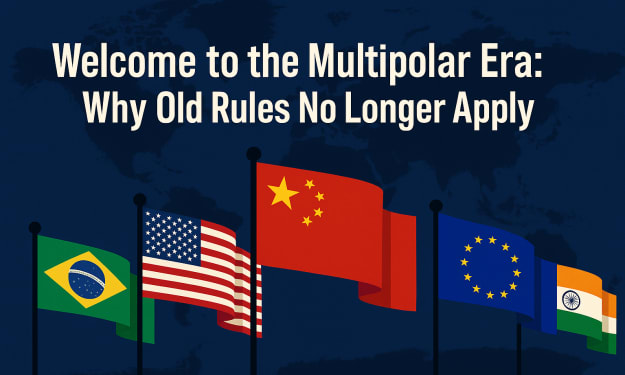
“Welcome to the Multipolar Era: Why Old Rules No Longer Apply”
Welcome to the Multipolar Era: Why Old Rules No Longer Apply Inside the Rise of a World Where No One Power Calls the Shots --- Introduction Not long ago, world politics revolved around a single axis — the United States. Following the Cold War, America’s military might, economic dominance, and cultural influence gave it an unrivaled role in setting global agendas. But that era is fading fast. Today, we live in a world where no single nation can dictate the terms. Power is more distributed, alliances are more fluid, and the rules of engagement are constantly shifting. From Beijing to Brasília, from Ankara to New Delhi, a new set of actors is redefining influence in a chaotic and contested global order. The question is no longer who leads — it's how the world manages without clear leadership. --- The End of Unipolarity The post-Cold War unipolar moment, which placed the U.S. at the apex of global power, is now history. Two decades of military overstretch, internal political divisions, and economic upheaval have eroded America's ability to act as the world's de facto leader. The withdrawal from Afghanistan, inconsistent global policies, and an increasingly inward-looking electorate have signaled a step back from the assertive global policing of the early 2000s. This vacuum hasn't gone unnoticed. Instead of a new hegemon rising to replace the old, what we see is a diffusion of power across multiple regional centers. It’s not a bipolar world of the Cold War era, nor a balanced multipolar structure of the early 20th century. This new landscape is messy, unstable — and permanent. --- China and the Economic Realignment China stands at the forefront of this shift, but even its rise comes with caveats. With the Belt and Road Initiative, Beijing has extended its economic reach into Asia, Africa, and parts of Europe. Its influence over supply chains, infrastructure, and digital technologies challenges the dollar-based global system. However, China's ambitions face resistance. Tensions over Taiwan, territorial disputes in the South China Sea, and pushback from Western nations on tech and trade indicate that its power, while rising, is also contested. China is not replacing the U.S. — it’s carving out its own sphere, one that’s economic rather than ideological, and subject to friction. --- Russia’s Military Gambit and Strategic Isolation Russia, too, has sought to challenge the Western-dominated order, most dramatically through its invasion of Ukraine. While the war has demonstrated Moscow’s willingness to use force to protect perceived national interests, it has also exposed its strategic limits. Sanctions, international condemnation, and battlefield losses have isolated Russia from much of the world economy, while simultaneously deepening its ties with non-Western partners like Iran and China. In trying to redefine regional borders by force, Russia has sparked a renewed unity among NATO members, paradoxically reinforcing the very alliances it sought to divide. --- Middle Powers and Fluid Alliances Perhaps the most defining feature of the multipolar era is the rise of middle powers — nations like India, Brazil, Turkey, and Saudi Arabia that are no longer content to align strictly with the West or East. These countries pursue strategic autonomy, balancing relationships across global fault lines. India, for example, is a member of the Quad (with the U.S., Japan, and Australia) while also maintaining defense ties with Russia and participating in BRICS. Turkey, a NATO member, buys Russian arms and projects influence across Central Asia and the Middle East. These states navigate global politics based not on ideology, but on opportunity and self-interest. --- Global Institutions Under Strain The United Nations, World Trade Organization, and other postwar institutions are increasingly ineffective at managing today’s fragmented world. Vetoes stall progress at the UN Security Council. Trade disputes paralyze the WTO. And new power blocs like BRICS and the Shanghai Cooperation Organization aim to create parallel systems that reflect non-Western values and priorities. The rules-based international order — long championed by the West — now finds itself questioned not only by adversaries, but by allies frustrated with its limitations and hypocrisy. --- Technology, Climate, and the New Arenas of Power While traditional power still matters, influence in today’s world is also determined by less tangible forces. Control over technologies like artificial intelligence, 5G, and semiconductors is becoming as critical as nuclear weapons were in the past. Meanwhile, climate change, pandemics, and migration flows expose the limitations of national solutions to global problems. These issues demand coordination, yet in a fragmented world, cooperation is the first casualty of geopolitical rivalry. --- Conclusion: Embracing Complexity The multipolar era is not just a phase — it is the defining condition of our time. It offers opportunities for a more inclusive, balanced world, but also risks greater instability, miscalculation, and fragmentation. Old rules no longer apply, because the old world no longer exists. The future will depend not on domination, but on how nations adapt, negotiate, and share power in a world where no one — and everyone — leads.
By World politics about a year ago in The Swamp
How Pakistan and India Ceased Fire by U.S.?
In one of the most historic moments of South Asian diplomacy, the decades-long tension between India and Pakistan found a sudden pause with a surprising but decisive intervention by the United States. On May 10, 2025, an immediate ceasefire was declared between the two nuclear-armed nations after a night of high-level negotiations. This article explores how the United States orchestrated peace talks between these long-standing rivals and the implications for the region and the world.
By Keramatullah Wardakabout a year ago in The Swamp
What I Would Do If I Became President
Here is a bit of a rant of what I would do if I had the power, which of course I don't. I would add a new constitutional amendment stating clearing we have freedom from religion since a lot of religious folks claim it is not in the constitution when you cannot have freedom of religion without freedom from religion. All religions and lack thereof will be respected. No political office can ask about religious affiliation or lack thereof.
By Ferrari Kingabout a year ago in The Swamp
Ordinary Thief vs Political Thief: The Real Cost of Corruption
The word “thief” usually brings to mind someone who steals wallets, breaks into homes, or snatches phones on the street. But there’s another kind of thief that operates on a much larger scale, often in plain sight — the political thief. While both are involved in theft, the consequences of their actions are vastly different. In this article, we’ll explore the differences between an ordinary thief and a political thief — and why the latter often causes far more damage to society.
By CodeCraft By Rashidabout a year ago in The Swamp