social media
The scoop on social media for influencers, lobbyists, budding politicians and civilians with a stake in the Swamp's trending issues.
What I Learned Growing Up in a Cult. Top Story - June 2025.
Earlier this week I was talking to a coworker about life. After a while, we somehow got on the subject of religion. I had to explain that I have an aversion to most organized forms of religion, having been raised in a church that at the time was very cult-like, and later after a split, the faction that stayed with the original leader went full cult. But that begs the question.
By Atomic Historianabout a year ago in The Swamp
NATO Summit in The Hague Signals Shift Toward Greater Defense Spending
has placed renewed emphasis on alliance unity, military readiness, and a significant increase in defense spending among member states. A Turning Point for NATO NATO Secretary General Jens Stoltenberg opened the summit with an urgent call for greater resolve in the face of new and evolving global threats. “Our security environment is more unpredictable than ever,” he said. “Authoritarian regimes are challenging the rules-based international order. NATO must adapt—not tomorrow, but today.” The summit comes just weeks after coordinated U.S. and Israeli strikes on Iranian military targets in retaliation for Tehran’s alleged involvement in regional destabilization. The events reignited concerns over the alliance’s readiness for potential escalation in the Middle East and the possibility of broader global conflict. A Renewed Push for Defense Spending One of the clearest outcomes from the summit has been a recommitment to defense spending goals. Since the 2014 Wales Summit, NATO members have pledged to allocate at least 2% of their GDP to defense. While progress has been uneven, the latest events have accelerated urgency. Germany, France, Italy, and Spain—previously among those criticized for lagging behind—have all announced updated timelines to meet or exceed the 2% benchmark by 2027. In a major policy shift, Germany unveiled a €30 billion increase to its annual defense budget, with new investments in cyber defense, air mobility, and NATO’s rapid reaction forces. U.S. Defense Secretary Kathleen Hicks, representing the Biden administration, applauded the movement. “America remains committed to NATO, but we must see fairer burden sharing. The security of the transatlantic alliance cannot rest on U.S. shoulders alone.” Alliance Cohesion Tested Despite strong rhetoric of unity, the summit revealed underlying concerns about alliance cohesion, particularly with looming elections in several NATO countries and shifting domestic attitudes toward defense priorities. Hungary and Slovakia have expressed reservations about increased troop commitments, citing economic pressures and political opposition at home. Meanwhile, Turkish President Erdoğan voiced frustrations over NATO’s stance on regional conflicts and criticized what he called “Western double standards” in Middle East policy. However, these tensions have not derailed the summit’s core goals. A joint communiqué issued Tuesday reaffirmed “unwavering solidarity” among members and outlined concrete steps to modernize NATO’s military posture, including: Establishing a new NATO Cyber Command Center based in Brussels Expanding rapid deployment capabilities with a proposed 300,000-strong high-readiness force Increasing joint exercises in the Baltic and Black Sea regions Enhancing intelligence-sharing protocols among members Geopolitical Ripple Effects Outside observers are closely watching how NATO’s moves will be interpreted by global rivals. Russia, though currently entangled in internal political turmoil and economic slowdown, responded harshly to the summit’s opening statements. A Kremlin spokesperson warned that NATO’s “aggressive expansion of military infrastructure” could “destabilize European security for decades.” China, while not directly addressed in the summit’s early briefings, looms large in NATO’s long-term strategic outlook. The alliance’s recent Strategic Concept document labeled Beijing as a “systemic challenge,” and this year’s discussions have included preliminary talks about expanding cooperation with Indo-Pacific partners such as Japan, South Korea, and Australia. Iran, the focal point of recent conflict, issued a statement through state media accusing NATO of “provoking regional instability through militarization and coercive diplomacy.” The regime has also increased military drills in the Persian Gulf and threatened to restrict access through the Strait of Hormuz, a move that could have significant global economic implications. Public Sentiment and Political Ramifications Back in Europe and North America, public support for NATO remains high, particularly in Eastern European countries like Poland, Estonia, and Romania, where the Russian threat feels most immediate. In Western Europe, however, opinions are more mixed. Recent polling by the European Policy Centre shows growing concern over the cost of defense increases, especially among younger voters more focused on climate and social issues. In the U.S., where presidential elections are just months away, NATO is again becoming a campaign issue. Former President Donald Trump, a prominent critic of the alliance during his tenure, has warned against “blank checks to Europe” and has suggested withdrawing troops unless burden-sharing improves. Analysts believe this dynamic could shape future U.S. involvement in NATO and have encouraged European members to take greater initiative in defense planning and procurement. Looking Forward: What Happens Next? While many of the summit’s announcements focus on long-term goals, there are immediate operational implications. NATO will begin a new round of joint military exercises in late July, including simulated cyberattacks, coordinated missile defense drills, and enhanced maritime patrols in the Mediterranean. The alliance is also set to release a classified review of its nuclear posture later this year, in response to Russia’s deployment of tactical nuclear weapons in Belarus and growing concerns about Iran’s nuclear ambitions. Stoltenberg concluded the summit with a message of cautious optimism: “NATO is not just a military alliance. It is a community of values. Today we have shown that even in uncertain times, we stand together—united, committed, and ready.” Conclusion The 2025 NATO summit in The Hague has reinforced the alliance’s strategic priorities amid rising global tensions. With defense spending on the rise and new military commitments on the table, NATO appears to be entering a phase of renewal. Yet the path ahead is not without challenges—from internal divisions to external threats. What is clear, however, is that the decisions made this week will shape the alliance’s trajectory for years to come. ---
By Shehzad Khanabout a year ago in The Swamp
The Fear That Shapes Us
“In times of universal deceit, telling the truth becomes a revolutionary act.” — George Orwell e World on Edge It begins in silence. A mother turns off the news and looks at her child differently. A father locks the door, not from robbers, but from headlines. An elderly man walks past a newspaper stand and mutters, “They’re lying again.” All over the world—from the White House to West Bank, from Tehran to Tel Aviv, from Kashmir to Kyiv—fear has replaced logic. Power has replaced truth. And for many, the only real battlefield is the human mind. --- 🧠 Fear as a Political Weapon Fear is the most ancient, primal human response. But in the hands of modern politics, it has evolved into a silent psychological weapon. Governments no longer need bullets to dominate minds. They have talking heads, clickbait headlines, deepfakes, and carefully scripted press releases. Through them, fear becomes systematic—administered like medicine and justified like war. We are told to fear: The other religion. The immigrant. The foreign power. Our own freedom of thought. But what if the enemy is not across borders, but inside the broadcast? --- 🔁 The Psychological Cycle Psychologically, fear triggers fight, flight, or freeze. But in global affairs, it creates something worse: submissive obedience. The average citizen, overwhelmed and anxious, begins to: Distrust everything Avoid complex truth Seek refuge in simplified lies Justify inhumane actions in the name of safety That is how entire populations slowly begin to accept war as defense, censorship as order, and power as morality. --- 🏛️ Superpowers or Superpredators? Let’s be honest: The term “superpower” has lost its dignity. Once a symbol of stability and guidance, today it reminds us of: Proxy wars fought in poor countries Weapon sales in the name of peace Diplomacy used for economic bullying Alliances built on shared paranoia, not shared values Whether it’s America’s role in Ukraine, China's eye on Taiwan, or Israel’s actions in Gaza, we must ask ourselves: When does power become the enemy of humanity? --- 🪞 A Mirror to Our Own Minds This isn’t just geopolitics. It’s psychology. Each headline we read, each image of a bombing or protest, triggers something inside us. Some feel anger. Some feel numbness. Some feel guilt. But very few ask: Why do I feel this way? Here are a few reasons: Childhood trauma reawakened by images of suffering Groupthink that pushes us to echo what others say Cognitive dissonance when we support a cause that harms innocents Moral fatigue when we stop caring because caring hurts too much --- ⚖️ Truth Is Not Neutral Anymore “Stay neutral” is a lie told by those who benefit from imbalance. Neutrality, in the face of genocide, is not wisdom—it’s compliance. Silence, in the face of lies, is not peace—it’s permission. And apathy, in the face of global suffering, is not protection—it’s participation. We live in a time when morality has been hijacked by narratives. Where media houses sell you rage per click. Where empathy is algorithmically filtered. Where the victims are judged by their side of the map. --- 🌐 A Global Mind in Crisis Let’s zoom out: Humanity is not just at war with itself—it is at war with truth. And the battleground is your mind. Each day, you are being shaped. Each day, you are nudged closer to acceptance or resistance. Each day, you are choosing—consciously or unconsciously—between fear and understanding. So what will you choose today? --- 🔦 A Call to Mental Resistance It’s time we stopped looking at world affairs like sports. This is not “us vs them.” This is “truth vs illusion.” And the most dangerous weapon of the 21st century is not a nuclear bomb. It is a narrative. Let’s reclaim our minds. Question what you believe Ask where your beliefs come from Listen deeply to those who suffer And if you must take a side—choose the side of the voiceless --- 📣 Final Reflection History will not remember your Twitter debates. It will remember your silence when your voice could save lives. Truth is not just about facts—it’s about courage. And today, to seek truth is to resist. --- 🧩 Engage With Humanity, Not Headlines If this reflection sparked something in you, share it. Let’s rebuild the world, not with weapons, but with awareness. Your mind is not a battlefield. It is a seed. Water it with truth. ---
By Riaz Gillani Exclusiveabout a year ago in The Swamp
Oil price jumps after US strikes Iran
"A Deep Dive into Global Energy Markets": "Oil Price Jumps After US Strikes Iran" In a move that has sent shockwaves through global markets, the price of crude oil spiked following a series of military strikes carried out by the United States against Iranian targets. The escalation of tensions between two of the world's most influential oil-producing nations has led to uncertainty in the energy sector, with far-reaching implications for both oil prices and the broader geopolitical landscape.
By GLOBAL NEWSabout a year ago in The Swamp
us bombs iran
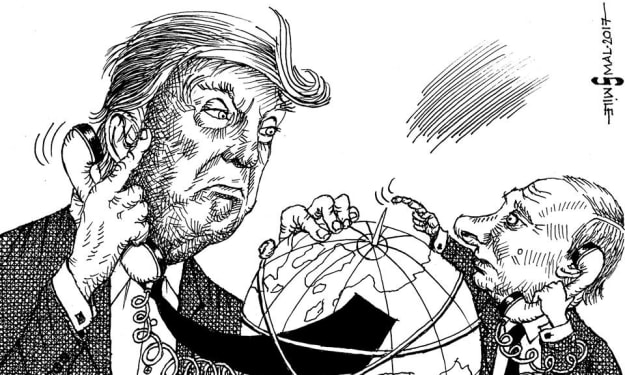
Washington, D.C., June 23, 2025 — In a stunning escalation of Middle East tensions, the United States confirmed a pre-dawn airstrike on Iran’s heavily fortified Fordow nuclear site, marking the most aggressive U.S. military action in the region since the 2020s. The bombing, dubbed “Operation Midnight Hammer,” was personally authorized by former President Donald Trump, who re-entered office amid a heated global security crisis.
By Saboor Brohi about a year ago in The Swamp
💔 Tragedy Above Ahmedabad: Air India Flight 171 Crash
On the afternoon of June 12, 2025, Air India Flight AI‑171—a Boeing 787‑8 Dreamliner—suffered a catastrophic fate just 30 seconds after takeoff from Ahmedabad, heading to London’s Gatwick. With 230 passengers and 12 crew onboard, the aircraft tragically plunged into the BJ Medical College hostel, claiming 241 lives and causing at least 28 ground fatalities among on-campus residents . A horrific scene: eyewitnesses described the impact as “like an earthquake,” followed by a deafening roar . --- 🕯️ The Lone Survivor In the wreckage emerged a glimmer of hope: one survivor, identified as British–Indian national Vishwashkumar Ramesh, seated in row 11A. Miraculously, he emerged relatively unscathed and is now receiving medical care—walking away on foot from debris captured on video . --- 📊 Who Was Onboard Of the 242 souls aboard: 169 Indians 53 British nationals 7 Portuguese 1 Canadian 12 cabin crew and 2 pilots . Notably among the dead was former Gujarat Chief Minister Vijay Rupani, along with several students and even a travel influencer—depth and diversity spanning the global Indian diaspora . --- 🔧 What Went Wrong? Preliminary reports from Flightradar24 show the Boeing reached merely 625 ft before losing contact and issuing a mayday that wasn’t answered . Investigator notes highlighted: The landing gear was reportedly barely retracting, suggesting a mechanical malfunction . Experts pointed to possible post-pandemic pilot training gaps, overburdened air traffic control, and factory standard erosion . This marks the first hull loss of a Boeing 787 since its 2011 debut—a major aviation industry shock . --- 🌍 Ripple Effects & Investigation The black box has been recovered, with US NTSB and UK investigators joining Indian authorities to determine the cause . Boeing has pledged full cooperation, while Air India and its parent, the Tata Group, work closely with investigators, offering assistance to victims’ families . Facing a potential historic insurance claim, analysts predict this catastrophe could rival or exceed prior records . --- 🕊️ A Nation in Mourning India’s prime minister, Narendra Modi, expressed deep grief, and condolence messages poured in from around the world. This has sparked a nationwide conversation on aviation safety standards, especially amid growing concerns about pilot readiness and systemic vulnerabilities . --- 🔍 What Comes Next Full technical investigations are underway—watch for official DGCA, NTSB, and AAIB reports. Air India and Boeing may need to reassess safety protocols, training, and manufacturer oversight. Families and survivors will look to fair, transparent compensation and justice—not only for those lost onboard, but also for ground victims. --- In Reflection The AI-171 crash forces us to confront the intersection of technology, human error, and institutional preparedness. The Dreamliner’s first fatal catastrophe in over a decade underscores how even the most advanced aircraft remain vulnerable. As the probe unfolds, it’s clear that lessons learned could reshape aviation safety—not just in India, but worldwide. Let us remember the souls aboard—passengers, crew, and ground victims—with empathy and respect. And support those left behind as they seek answers and healing.
By GadgetGroundabout a year ago in The Swamp
Bitcoin vs Open Interest Should traders be worried by THIS divergence
The price action of Bitcoin has recently been scrutinized, but savvy traders are also paying attention to something even more telling: a significant divergence between open interest in Bitcoin and its price. The derivatives market may be sending a cautious signal while the spot market maintains its optimism. Analysts are concerned about this divergence, which raises the question of whether traders should be concerned. Understanding what open interest actually entails is essential before delving into its ramifications. The total number of unresolved derivative contracts in the futures and options markets is referred to as open interest. It shows how much activity and participation there is in the market. An increase in open interest typically suggests that new money is flowing into the market, which can reinforce a trend. A decline could indicate that traders are closing positions, which could indicate indecisiveness or exhaustion of the trend. The price of Bitcoin has been either steady or showing signs of rising, hovering in bullish territory above key support levels in recent weeks. However, open interest in Bitcoin futures has not followed suit. In fact, in several instances, open interest has dropped or stagnated while prices climbed—a classic divergence.
By GLOBAL NEWSabout a year ago in The Swamp