president
They've chopped down cherry trees and waged full-on war. Riding the highs and lows of the leaders who've tried to Make America Great Again.
The Great Depression:
Introduction The Great Depression was a significant and harrowing chapter in American history, reshaping the economy, society, and government. It serves as a stark reminder of how interconnected our financial systems are and how the decisions we make today can echo through time. Alarmingly, many of the factors that contributed to the Great Depression are resurfacing in our current climate. This essay will highlight the causes of the Great Depression and draw parallels to contemporary issues, including government deregulation, corruption, the glorification of wealth, and the rise of exclusionary purity movements. With only 4 years away from the 100th anniversary of the beginning of the Great Depression, it behoves us to take a serious sociopolitical look at the parallels of today that have us headed unavoidably to our next one.
By Meko James about a year ago in The Swamp
Trump and Musk’s Explosive Rift Shakes Political and Business Worlds
In a clash that’s rattling both Washington and Wall Street, President Donald Trump and tech billionaire Elon Musk have gone from political allies to bitter opponents in a public feud erupting with personal jabs, policy disputes, and financial threats.
By arafat chowdhuryabout a year ago in The Swamp
TACO & PACO. Top Story - June 2025.
On June 1, 2025 Ukraine conducted a massive drone attack on strategic bomber airfields deep in Russia. So deep the drones had to be delivered in secret double ceiling containers by long-haul trucks. The operation had been planned for 1.5 years in complete secrecy and had been personally supervised by President Zelenskyy. The drone attack was incredibly successful as Ukraine claims it has destroyed 41 bombers, or roughly one-third of Russian strategic bomber fleet. Russia has downplayed the operation results claiming that only five bombers had been destroyed.
By Lana V Lynxabout a year ago in The Swamp
Opinion: The AMCAN Trade War
Imagine if you're a potato farmer who sells potatoes to a large grocery chain. Then imagine you go to this grocery store and buy carrots, not a lot, just enough for your own family. You get to the register and are met by an indignant manager.
By C. P. McAllisterabout a year ago in The Swamp
Trump Nominates Emil Bove III, Controversial DOJ Powerbroker, to Federal Appeals Court
In a move that’s already igniting political controversy, former President Donald Trump announced Wednesday his intention to nominate Emil Bove III—one of the Justice Department’s most formidable and polarizing figures—to serve on the U.S. Court of Appeals for the Third Circuit.
By arafat chowdhuryabout a year ago in The Swamp
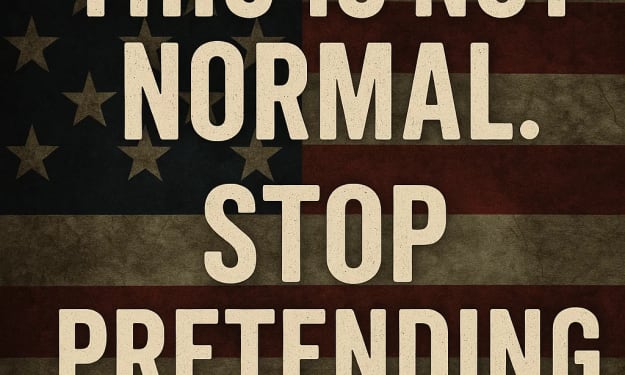
This Is Not Normal. Stop Pretending It Is
Editorial note: I protest. I do. Our current political climate is distasteful, driven by hatred and division, and such a departure from when America was Truly Great. Donald Trump is a symptom, not the disease, but unfortunately for him, he is its chosen figurehead of the far right Christian Nationalist MAGA movement. So if you've read any of my other contributions, the theme is recurrent and most often aimed at rebutting misinformation flung rampantly on social media through memes, mindless repetition of extreme rhetoric, and yes, I'll call some of it outright lies. Oh how I wish for a vaccine. The disease is endemic. Unfortunately, funding for that seems to have dried up.
By Lanny Newvilleabout a year ago in The Swamp
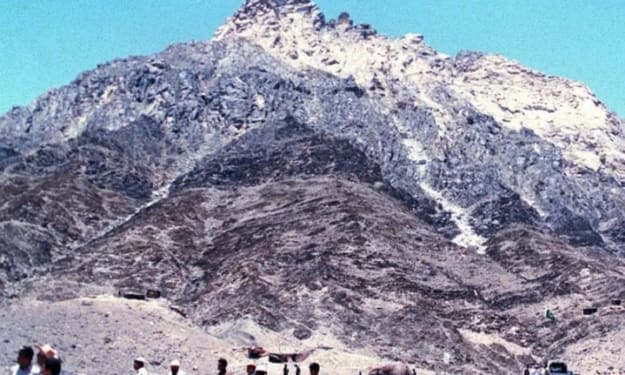
Why Chagai Was Chosen: The Hidden Story Behind Pakistan’s Nuclear Tests
From the Hijacking of the PIA Plane to the Chants of ‘Allahu Akbar’ in Chaghi: When the Black Granite of the Chaghi Mountain Turned White "To India!" the hijacker screamed, pressing a pistol to the pilot’s temple. Pakistan International Airlines (PIA) Flight 544 had taken off from the city of Turbat in Balochistan just ten minutes earlier when this threatening voice reached the pilot’s ears. The Fokker aircraft had departed from Turbat and was en route to Karachi, a city in the Sindh province. According to the pilot, Uzair Khan, the moment the hijacker was distracted by a noise from the rear of the aircraft, he pressed a button that sent a signal to radar indicating that the passenger plane had been hijacked. Later, in the documentary "Flight 544," Uzair Khan explained, “The hijacker had brought maps and such. He told me to keep flying straight. Flying straight would have eventually brought us to the Indian border.” “I told him that the aircraft didn’t have enough fuel. He accepted my request and said we should refuel at Bhuj Airport in Indian Gujarat and then fly to New Delhi.” He adds that after receiving these instructions, “As I neared the border, I used aviation code and said ‘Kilo Delta,’ a term used for the Pakistani city of Hyderabad. Then, while letting the hijacker hear, I asked airport control if this was Bhuj Airport in India. Air traffic control already knew the Pakistani aircraft had been hijacked, so they responded, ‘Yes, this is Bhuj Airport.’” He explains, “Thus, while convincing the hijacker that it was the Indian city of Bhuj, I managed to land at Pakistan’s Hyderabad Airport in the dark of night. That was exactly what I wanted.” This hijacking took place on May 24, 1998. Just days earlier, from May 11 to 13, India had conducted multiple nuclear tests, and it was widely expected that Pakistan would soon respond with its own. After landing at Hyderabad Airport, Pakistani officers there posed as Indian personnel. Following several hours of negotiation, they managed to overpower the three hijackers before dawn. No passengers or crew were harmed. The hijackers were members of the Baloch Students Organization (BSO). According to Pakistani authorities and media reports from that time, the motive behind the hijacking on May 24, 1998, was to prevent Pakistan from responding to India’s nuclear tests. A CNN report from May 1998 indicated that shortly before the hijacking, there were reports of Pakistan preparing a site in Balochistan for nuclear tests. This led to anti-government protests by some political groups in the province. The next day, leading newspapers across Pakistan reported on their front pages that the hijackers had demanded Pakistan not conduct nuclear tests in Balochistan and had also called for increased funding for the province. The three hijackers were later sentenced to death and were executed on May 28, 2015—exactly 17 years after Pakistan’s nuclear tests—at jails in Karachi and Hyderabad. --- How Did Pakistan Manage to Conduct Nuclear Tests on May 28, 1998? Dr. Samar’s Congratulations on India's Tests According to Dr. Samar Mubarakmand, a member of the Pakistan Atomic Energy Commission, he received a call from a friend in the military on the morning of May 11, 1998, informing him about India’s nuclear tests in Pokhran. Speaking at a Khwarizmi Science Society event in Lahore on November 30, 1998, Dr. Samar recounted, “I said, ‘Congratulations!’ I was genuinely happy.” His military friend responded, “You’re congratulating us on India’s nuclear tests?” To which he replied, “Yes, because now we’ll be able to conduct our own.” Dr. Samar explained that back in 1972, when then-Prime Minister Zulfikar Ali Bhutto gathered the country’s scientists in Multan, they had all taken an oath to develop nuclear weapons. After India conducted its first nuclear test in 1974 at Pokhran, Pakistan accelerated its nuclear program. Soon after, Dr. Abdul Qadeer Khan returned from abroad to join the effort. By the late 1980s, the Kahuta plant was complete, and Dr. A.Q. Khan was appointed its head, having previously worked there as a scientist. In this context, after India’s 1998 nuclear tests, it was widely expected that Pakistan would respond. During the same 1998 Lahore event, Dr. Samar said, “As expected, after India’s tests, the Prime Minister became very active. He asked me, ‘Are you ready for this?’ I replied, ‘Absolutely.’ He said, ‘Good! Prepare.’” On the international front, U.S. President Bill Clinton began efforts to prevent Pakistan from conducting nuclear tests, citing concerns of a nuclear conflict in South Asia. In their book “The Man From Pakistan,” Douglas Frantz and Catherine Collins detailed U.S. efforts and Pakistan’s response. They wrote that Clinton called Prime Minister Nawaz Sharif four times, offering incentives to dissuade him from testing. Clinton promised to forgive U.S. loans, remove the Pressler and Solarz amendments (which restricted aid to Pakistan), and secure new military assistance from Congress. In the book “Deception,” Adrian Levy and Catherine Scott-Clark noted that a U.S. delegation led by Deputy Secretary of State Strobe Talbott arrived in Islamabad on May 13, and Pakistan’s Foreign Minister Gohar Ayub reportedly mocked their offer of F-16 jets. In a 2006 interview in London, Nawaz Sharif said Clinton called him five times to urge restraint and avoid testing. “When Talbott came, they thought we would agree. Clinton thought the same. But only we knew what we were going to do.” Frantz and Collins further wrote that three days after India’s tests, CIA Director George Tenet told closed sessions of the U.S. Senate and Congress Intelligence Committees that satellite images showed underground nuclear test preparations in Pakistan’s Chaghi Hills.
By Ikram Ullahabout a year ago in The Swamp
When You Cherry-Pick Facts and Poll Numbers…
It is being reported by Newsweek that Donald Trump is experiencing a popularity surge based on the results of a single poll (Quantas Insights). Making hay from those results may put you on less solid footing than you think.
By Lanny Newvilleabout a year ago in The Swamp
Rep. Gerry Connolly Dies at 75 After Cancer Battle
Rep. Gerry Connolly Dies at 75 After Cancer Battle The passing of Representative Gerry Connolly of Virginia at the age of 75 leaves behind more than a vacant congressional seat it leaves a space in the hearts of countless people who saw in him not just a politician but a deeply principled man who genuinely cared for his community and country. After a courageous battle with esophageal cancer Connolly passed away peacefully at his home in Fairfax County surrounded by his family. Born on March 30/1950 in Boston Massachusetts Gerald Edward Connolly was a man driven by conviction and a commitment to public service. From his early days he displayed a deep curiosity about global affairs and government which led him to earn a Master's degree in Public Administration from Harvard University. His path into politics was never about power it was about people. For nearly 30 years Gerry Connolly served Northern Virginia with heart and distinction. He began his political career in local government serving on the Fairfax County Board of Supervisors and eventually becoming its chairman. In that role he oversaw critical initiatives that modernized public infrastructure and expanded services for a rapidly growing community. He was known to work long hours sometimes responding to resident emails late into the night not because he had to but because he believed that every voice deserved to be heard.
By Adnan Rasheedabout a year ago in The Swamp