defense
Moving through the ranks of military activity including infrastructure, wars, our commander in chief and the nucleur arms race.
Why Donald Trump’s Visit to Abu Dhabi Matters Now. AI-Generated.
On the morning of May 15, 2025, U.S. President Donald Trump landed in Abu Dhabi, the capital of the United Arab Emirates. His sudden, low-profile visit has captured the world’s attention. This trip isn’t just about diplomacy—it may carry deeper political and business meanings.
By Nouman waliabout a year ago in The Swamp
" Trump returns to Riyadh "
Riyadh, Saudi Arabia — May 2025 In a move that has captured international attention, former U.S. President Donald J. Trump made a high-profile visit to Saudi Arabia in May 2025, reigniting discussions about U.S. foreign policy, global diplomacy, and the evolving relationship between Washington and Riyadh. The visit, his first since leaving the White House, was marked by both symbolism and substance, offering insights into Trump's ongoing political influence and his vision for America's role in the Middle East. The visit comes amid shifting global dynamics and internal political momentum in the United States, with Trump maintaining a significant presence in the American political landscape. His arrival in Riyadh—hosted with royal fanfare by Crown Prince Mohammed bin Salman—served as a diplomatic spectacle and a platform for serious discussions on regional security, economic cooperation, and strategic alliances. Echoes of 2017, with a New Agenda Trump’s 2025 visit draws inevitable comparisons to his first overseas trip as president in 2017, which also began in Riyadh. At that time, he emphasized unity in the fight against extremism and unveiled a historic $110 billion arms deal. Eight years later, Trump’s return to Saudi Arabia carried a different tone—less about making first impressions and more about reinforcing long-standing ties. This time, the former president met with Saudi leaders to discuss shared concerns over escalating tensions in the Gulf, the evolving role of Iran, and the lingering effects of regional conflicts in Yemen and Syria. Trump was also briefed on Saudi Arabia’s ongoing Vision 2030 projects—massive reforms aimed at modernizing the Kingdom’s economy, society, and infrastructure. Security and Defense Cooperation High on the agenda were matters of defense and regional security. Trump, known for his emphasis on a strong military partnership during his presidency, reiterated the importance of U.S.-Saudi collaboration in counterterrorism and intelligence sharing. Though no official agreements were signed during the visit, sources within the Saudi Ministry of Defense reported discussions about future joint military exercises and potential procurement deals involving U.S. defense contractors. The former president’s visit included a closed-door session with senior Saudi defense officials and U.S. business executives, suggesting that the trip may lead to renewed security cooperation even outside official government channels. Economic Partnerships and Private Sector Diplomacy Another major component of the visit was economic diplomacy. Trump attended the U.S.-Saudi Business Forum in Riyadh, where he gave a keynote address promoting American enterprise, energy collaboration, and investment in Saudi infrastructure. He praised the Kingdom’s progress on its Vision 2030 goals and encouraged U.S. companies to take part in the transformation of Saudi cities and industries. Key sectors under discussion included renewable energy, artificial intelligence, tourism, and digital infrastructure. Trump's presence helped draw attention to several new partnerships between American firms and Saudi state-backed ventures—deals that, while not yet finalized, represent billions of dollars in potential investment. Political Undertones and Global Optics While the visit was framed as a private diplomatic mission, its political undertones were unmistakable. As Trump continues to play a dominant role in U.S. political discourse—either as a former president or a prospective candidate—his international engagements are scrutinized through a political lens. The 2025 visit to Riyadh, therefore, served not only as a gesture of goodwill toward a longtime ally but also as a platform for Trump to project leadership on the global stage. International media outlets noted the sharp contrast between Trump’s visit and the foreign policy approach of the current U.S. administration, particularly in areas such as arms sales, human rights, and climate cooperation. Analysts suggest that Trump’s return to Saudi Arabia could influence American diplomatic posture in the region, especially if his political aspirations materialize further. Cultural and Symbolic Moments Beyond politics and policy, the visit was rich with symbolism. Trump was received with traditional Saudi hospitality, including a private audience with King Salman, a tour of Diriyah—the birthplace of the Saudi state—and attendance at a gala hosted by the Royal Court. He also visited the King Abdulaziz Center for World Culture and participated in a roundtable with Saudi youth leaders and entrepreneurs. These symbolic gestures were widely covered by regional media, portraying the visit as a reaffirmation of friendship and mutual respect between the two nations. Conclusion: A Strategic and Symbolic Visit Donald Trump's 2025 trip to Saudi Arabia was more than just a return to familiar territory—it was a calculated display of diplomacy, business outreach, and geopolitical messaging. While no major policy breakthroughs were announced, the visit reinforced the enduring relationship between the U.S. and Saudi Arabia and emphasized Trump's continued interest in shaping that partnership. Whether seen as a private citizen wielding influence or a political figure staging a comeback, Trump's presence in Riyadh reminded the world of the complexities of American diplomacy and the personal relationships that often drive it. As the Middle East navigates a new era of challenges and opportunities, the U.S.-Saudi relationship—long shaped by leaders on both sides—remains a central force in the region’s future.
By Kaleem Ullahabout a year ago in The Swamp
"The 2025 Indo-Pak War"
In early 2025, the long-standing tensions between India and Pakistan escalated into one of the most significant military confrontations of the 21st century. Though brief, the conflict shook the South Asian region, drawing global attention due to the nuclear capabilities of both nations. The Indo-Pak War of 2025 lasted only two weeks, but its impact on regional politics, economy, and international relations remains profound. Origins of the Conflict The roots of the 2025 conflict can be traced to a series of skirmishes in Kashmir throughout 2024, which saw increased cross-border shelling and militant incursions. Diplomatic efforts led by the United Nations and regional powers failed to de-escalate tensions. A deadly attack on an Indian Army convoy in January 2025, allegedly orchestrated by Pakistan-based militants, became the flashpoint. India responded swiftly with “Operation Trishul,” a large-scale surgical strike across the Line of Control (LoC), targeting what it claimed were terrorist launch pads and supply routes. Pakistan condemned the strikes as an act of aggression, retaliating with air raids on Indian military positions in Kashmir. This tit-for-tat exchange rapidly spiraled into full-scale conventional warfare. The Course of the War The war officially began on February 10, 2025, when Pakistan launched coordinated artillery and air strikes along the LoC and into Ladakh. India responded by mobilizing troops in Jammu, Punjab, and Rajasthan, leading to battles on multiple fronts. Northern Front (Kashmir and Ladakh): Intense mountain warfare dominated this theater. India deployed its elite high-altitude troops to counter Pakistani advances in the Dras and Kupwara sectors. Indian forces gained the upper hand by capturing key outposts by the seventh day of the war. Western Front (Punjab and Rajasthan): This front saw rapid tank battles and air raids. India’s armored divisions pushed into Pakistan’s Sialkot sector, while Pakistan counterattacked in the Fazilka and Barmer regions. Heavy casualties on both sides marked this phase, but neither side achieved a decisive breakthrough. Naval Engagements: The Indian Navy blockaded Karachi Port temporarily and intercepted Pakistani vessels in the Arabian Sea. Pakistan responded with the deployment of submarines near the western Indian coast, creating tension in vital sea lanes. Though the war remained conventional, both nations issued subtle nuclear warnings through media and diplomatic channels. The threat of escalation prompted urgent international mediation. International Response The global community watched with growing alarm. The United States, China, Russia, and the United Nations called for an immediate ceasefire. Fearing a nuclear confrontation, back-channel diplomacy intensified, with the UAE and Saudi Arabia playing key mediatory roles. On February 24, under mounting pressure and facing economic strain, both countries agreed to a ceasefire brokered by the UN Security Council. The ceasefire restored pre-war territorial boundaries, with both nations claiming strategic and moral victories. Aftermath and Impact Despite the limited duration, the 2025 war had several long-lasting consequences: Human and Economic Cost: Over 5,000 soldiers and an estimated 1,200 civilians were killed on both sides. The conflict displaced tens of thousands, especially in border regions. Economically, both countries suffered a sharp GDP contraction in the first quarter of 2025, with markets plummeting and trade disrupted. Geopolitical Shifts: The war led to renewed calls for Kashmir resolution from the international community. China remained largely neutral but reinforced its border presence in Ladakh, signaling strategic interest. The U.S. and Russia, while advocating peace, used the situation to bolster arms sales and influence in South Asia. Domestic Ramifications: In India, nationalistic fervor surged, strengthening the ruling party’s political hold. In Pakistan, civil-military relations became more strained, with public protests demanding better governance and questioning the cost of perpetual conflict. Cyber and Information Warfare: The conflict also featured unprecedented levels of cyberattacks and disinformation campaigns. Both nations targeted each other’s infrastructure and media, leading to widespread misinformation and paranoia. Lessons Learned The 2025 Indo-Pak War reaffirmed the volatility of South Asia’s security landscape. It highlighted the dangers of unresolved territorial disputes, militant activity, and aggressive nationalism. Though nuclear weapons were not used, the threat hovered perilously close, serving as a reminder of how quickly things can escalate. The war also emphasized the importance of diplomatic engagement, regional cooperation, and conflict resolution mechanisms. While the guns may have fallen silent, the underlying issues—particularly the Kashmir dispute—remain unresolved. Conclusion The Indo-Pak War of 2025 was a sobering event that showcased the fragility of peace in South Asia. Both India and Pakistan walked away with heavy losses and hard-earned lessons. The need for sustained peace efforts, mutual trust-building, and international mediation has never been more critical. As the region looks toward the future, one can only hope that the scars of 2025 will guide its leaders toward dialogue rather than destruction
By Kaleem Ullahabout a year ago in The Swamp
Joseph Lamar Simmons Shares the Hardest Part of Intelligence Training
When you think of intelligence training, you might picture high-tech gear, decoding secret messages, or dramatic spy missions. But according to Joseph Lamar Simmons, an Intelligence Officer with the Department of Defense, that image doesn’t even scratch the surface.
By Alexanderaaryaabout a year ago in The Swamp
Inside the CIA: America’s Secret Intelligence Agency
From Cold War Tactics to Cyber Wars: The CIA’s Global Reach In the shadows of global politics, where nations maneuver not through diplomacy alone but through secrecy, deception, and surveillance, the Central Intelligence Agency (CIA) stands as one of the most powerful and enigmatic institutions in the world. Born from the ashes of World War II and raised during the height of the Cold War, the CIA has evolved from traditional espionage operations to become a digital-age intelligence giant. Its reach extends across borders, ideologies, and technologies—operating in a world where knowledge is power and information can change the fate of nations. As threats have shifted from Soviet missiles to cyberterrorism and AI warfare, so too has the CIA adapted, making it not only a historical cornerstone of American security but also a critical player in today’s global power struggle. The Origins: An Agency Born in Secrecy The CIA was formally established in 1947 under the National Security Act, but its roots trace back to the Office of Strategic Services (OSS), the United States' first intelligence agency during World War II. Designed to combat Nazi Germany and Imperial Japan through covert operations, the OSS laid the foundation for modern U.S. espionage. When the Cold War began, the United States recognized the need for a peacetime intelligence service capable of gathering foreign information and executing clandestine operations. Thus, the CIA was born—not as a military branch, but as an independent civilian agency reporting directly to the President. Cold War Operations: Spies, Coups, and Proxy Wars The Cold War era defined the CIA’s early years. It was during this period that the agency conducted some of its most controversial and defining operations. The primary adversary was the Soviet Union, and the battlefield was the entire world. Through programs like Operation AJAX in Iran (1953) and Operation PBSUCCESS in Guatemala (1954), the CIA orchestrated coups to install pro-American regimes. It ran surveillance and counterintelligence against Soviet spies and played key roles in proxy wars like Vietnam and Afghanistan. The agency’s use of human intelligence (HUMINT), psychological warfare, and propaganda became hallmarks of its Cold War strategy. However, not all actions met success. The failed Bay of Pigs Invasion in Cuba (1961), an attempt to overthrow Fidel Castro, became a major embarrassment. Nonetheless, these years solidified the CIA’s reputation as a formidable and secretive power broker in international affairs. The Post-Cold War Shift: Terrorism and Rogue States With the collapse of the Soviet Union in 1991, the CIA faced a moment of existential uncertainty. Without its traditional enemy, the agency had to adapt. In the 1990s and early 2000s, its focus shifted to emerging threats: rogue states, international terrorism, and the spread of weapons of mass destruction. After the 9/11 terrorist attacks, the CIA entered a new era. It was at the forefront of the War on Terror, playing key roles in tracking Al-Qaeda, capturing or killing terrorist leaders, and operating secret detention facilities. The agency’s controversial use of “enhanced interrogation techniques”, drone strikes, and black sites ignited debates on ethics, legality, and human rights—questions that still haunt the agency’s legacy. Enter the Cyber Era: Intelligence in the Digital Age Today, the battlefield has shifted again—from deserts and jungles to cyberspace. The rise of cyberwarfare, state-sponsored hacking, and digital espionage has pushed the CIA to evolve once more. The agency now works closely with other U.S. intelligence bodies like the NSA and FBI to counteract threats from nations such as China, Russia, Iran, and North Korea, which use cyberattacks as a form of asymmetric warfare. The CIA has also developed capabilities to monitor global internet traffic, infiltrate secure communications, and conduct offensive cyber operations—all while protecting U.S. national interests from increasingly sophisticated cyber threats. Additionally, emerging technologies such as artificial intelligence, big data analytics, satellite imagery, and biometric surveillance have given the CIA new tools in its intelligence arsenal. With these, it can track individuals globally, predict political upheavals, and identify terrorist plots before they unfold. Global Reach, Ethical Debate Despite its strategic importance, the CIA continues to face criticism and scrutiny. Leaks by whistleblowers such as Edward Snowden and WikiLeaks' Vault 7 disclosures revealed the extent of CIA surveillance and hacking capabilities. These revelations sparked global conversations about privacy, civil liberties, and the balance between security and freedom. Domestically, the CIA is overseen by the Senate Intelligence Committee, but many argue that real transparency is lacking. Internationally, its covert actions often blur the lines between security and interference, leading some to view it as both a protector and a puppet master. Conclusion: A Shadow That Shapes the Future From covert Cold War missions to cyber operations in the digital age, the CIA’s evolution reflects the changing nature of global conflict. Its ability to adapt to new threats has made it a pillar of American defense and foreign policy. Yet with great power comes great responsibility—and the agency’s future will depend not just on its technological capabilities, but also on its commitment to ethics, oversight, and transparency in an increasingly interconnected world.
By World politics about a year ago in The Swamp
Trump’s Strategic Demands from Saudi Arabia and Global Allies
Iran's Threat, the Cost of Protection, and the 'Promise of a Gift': What Does Trump Want from Saudi Arabia? During his first term in 2018, U.S. President Donald Trump made a historic statement: "There are countries that wouldn’t last even a week without our protection—and they’ll have to pay for it." Following this, Trump adopted a “pay-to-stay” policy, demanding that countries in Europe, the Middle East, Japan, and South Korea ensure payments to the United States for its protection. Now, with Trump returning to the White House in 2025, it appears that this policy remains unchanged. Ahead of his upcoming visits to Gulf countries—including Saudi Arabia, the UAE, and Qatar—Trump has once again publicly and clearly demanded payment from Saudi Arabia. This raises several questions: Will Saudi Arabia pay? What might compel it to do so? And what will it receive in return? During the January 2025 Davos Economic Forum, President Trump demanded a $1 trillion investment from Saudi Arabia. This came after Saudi Crown Prince Mohammed bin Salman announced plans to invest $600 billion in the U.S. over the next four years. Notably, according to international relations expert Dr. Ghada Jaber, "Saudi Arabia has not yet officially commented on Trump’s demand for a trillion-dollar investment." However, she added, "Trump might get what he wants, especially given his recent role in the region and his perceived successes concerning Iran." In 2017, during his visit to Saudi Arabia, Trump secured $350 billion in investments, including a $110 billion arms deal. He also managed to extract billions from Qatar, including $8 billion for renovations to the U.S. military base at Al-Udeid in 2019, alongside other defense agreements. In September 2020, Qatar’s foreign minister stated that his country had invested over $200 billion in the U.S. economy. Analysts say such Saudi funds underline the significance of shared interests between the two nations. Mohammed Al-Zayyat, Regional Director of the Al Yamamah Foundation and head of the Riyadh Center for Political and Strategic Studies, said: "This is the secret of U.S.-Saudi relations—it must be protected to prevent the decline of mutual interests." Potential for Increased Investment Recently, Saudi Minister of Economy Faisal Al-Ibrahim stated that additional investment opportunities could further increase the $600 billion Saudi investment commitment. Does this mean there’s no cap on Saudi investments in the U.S.? Especially as Saudi Arabia attempts to establish itself as a regional hub for industry and technology. These efforts are aligned with Saudi Vision 2030 and recent legal reforms aimed at encouraging industrial and technological growth within the kingdom. In an interview with the BBC, Mohammed Al-Zayyat said, "Saudi Arabia sees the U.S. as the world’s greatest power, while Washington views Saudi Arabia as the gateway to the Middle East and a shield for stabilizing oil markets and global energy security." Dr. Ghada Jaber told the BBC that Trump believes he has "secured many benefits" for Gulf nations, especially Saudi Arabia. She mentioned Trump's “successes” in the region include the weakening of the Assad regime in Syria, support for Israeli strikes on Hezbollah in Lebanon, recent strikes on Houthis in Yemen under his command, threats of military action against Iran, and limiting Iran’s regional influence. Recently, Trump announced the end of military operations in Yemen, claiming the Houthis have surrendered and will no longer attack U.S. ships in the Red Sea. Gulf Funds as a Major Source Trump's visit comes amid shifting regional dynamics, including negotiations over Iran’s nuclear program and its changing strategic position. Dr. Ghada Jaber said the U.S. has used the threat of Iran to pressure regional countries. Iranian presence in Syria, Iraq, Lebanon, and Yemen has been a longstanding concern for Saudi Arabia and others. Iran's nuclear program adds another layer, particularly alarming for Israel. Trump recently expressed a desire to completely dismantle Iran’s nuclear program. Sharif Abdul Hamid, director of Iranian Studies at the Gulf Center, stated that U.S. policy toward Iran is the biggest driver of Gulf funds. He said Trump aims to convince Saudi and Gulf leaders that their protection from Iranian threats depends on cooperating with the U.S. Tensions between Saudi Arabia and Iran date back to the 1979 Iranian Revolution. Saudi Arabia supported Iraq against Iran in the 1980s, and in 1987, the Saudi embassy in Iran was attacked and set on fire. Iran has supported the Houthis in Yemen, who have launched missile strikes on Saudi oil infrastructure—deepening the crisis between the two nations. In March 2023, with Chinese mediation, Saudi-Iran relations began to thaw—potentially paving the way for regional stability and cooperation. According to Zayyat, this Saudi-Iran agreement must be understood within the context of both countries’ domestic and foreign policies. Saudi Arabia wants to balance relations between East and West to promote economic growth. Iran, on the other hand, is facing internal unrest and economic struggles due to U.S. sanctions, and thus seeks to ease external tensions. Abdul Hamid argues that resolving issues with Iran may reduce conflict, but the U.S. and Israel might oppose this, since regional tension serves their political and economic interests. Investments from UAE and Qatar Even before Trump’s visit, the UAE and Qatar announced major investments. In Dubai, Trump Organization revealed plans to build a $1 billion Trump International Hotel and Tower. In Qatar, a $2 billion Trump International Golf Club project was unveiled. Trump’s “Gifts” Trump has made it clear: regional countries must bear the financial burden of American wars. The U.S. even asked Egypt to allow free passage through the Suez Canal for military and commercial ships targeting the Houthis. Egypt has not officially responded, but reports suggest that President El-Sisi rejected the request during a phone call with Trump. During his Gulf visit, Trump is also expected to offer a “political gift” to the region, possibly including renaming the Persian Gulf to the “Arabian Gulf” on official maps—something that could be seen as a symbolic win for Gulf states.
By Ikram Ullahabout a year ago in The Swamp
Top 10 Fighter Jets in the World in 2025. AI-Generated.
Top 10 Fighter Jets in the World in 2025 In 2025, fighter jets have become more advanced than ever, integrating stealth, speed, artificial intelligence, and multi-role combat capabilities. Countries are racing to develop aircraft that can dominate both the skies and the battlefield. Below is a detailed look at the top 10 most powerful and advanced fighter jets in the world today.
By Adnan Rasheedabout a year ago in The Swamp
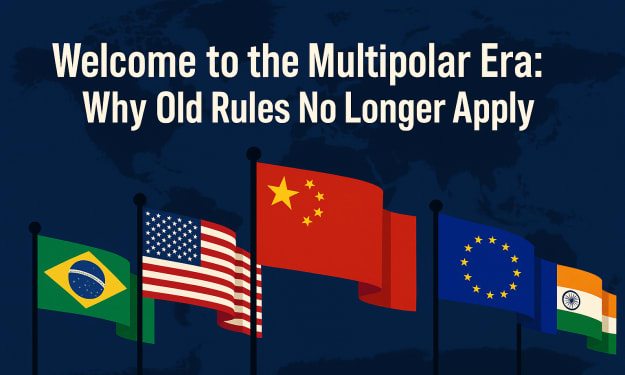
“Welcome to the Multipolar Era: Why Old Rules No Longer Apply”
Welcome to the Multipolar Era: Why Old Rules No Longer Apply Inside the Rise of a World Where No One Power Calls the Shots --- Introduction Not long ago, world politics revolved around a single axis — the United States. Following the Cold War, America’s military might, economic dominance, and cultural influence gave it an unrivaled role in setting global agendas. But that era is fading fast. Today, we live in a world where no single nation can dictate the terms. Power is more distributed, alliances are more fluid, and the rules of engagement are constantly shifting. From Beijing to Brasília, from Ankara to New Delhi, a new set of actors is redefining influence in a chaotic and contested global order. The question is no longer who leads — it's how the world manages without clear leadership. --- The End of Unipolarity The post-Cold War unipolar moment, which placed the U.S. at the apex of global power, is now history. Two decades of military overstretch, internal political divisions, and economic upheaval have eroded America's ability to act as the world's de facto leader. The withdrawal from Afghanistan, inconsistent global policies, and an increasingly inward-looking electorate have signaled a step back from the assertive global policing of the early 2000s. This vacuum hasn't gone unnoticed. Instead of a new hegemon rising to replace the old, what we see is a diffusion of power across multiple regional centers. It’s not a bipolar world of the Cold War era, nor a balanced multipolar structure of the early 20th century. This new landscape is messy, unstable — and permanent. --- China and the Economic Realignment China stands at the forefront of this shift, but even its rise comes with caveats. With the Belt and Road Initiative, Beijing has extended its economic reach into Asia, Africa, and parts of Europe. Its influence over supply chains, infrastructure, and digital technologies challenges the dollar-based global system. However, China's ambitions face resistance. Tensions over Taiwan, territorial disputes in the South China Sea, and pushback from Western nations on tech and trade indicate that its power, while rising, is also contested. China is not replacing the U.S. — it’s carving out its own sphere, one that’s economic rather than ideological, and subject to friction. --- Russia’s Military Gambit and Strategic Isolation Russia, too, has sought to challenge the Western-dominated order, most dramatically through its invasion of Ukraine. While the war has demonstrated Moscow’s willingness to use force to protect perceived national interests, it has also exposed its strategic limits. Sanctions, international condemnation, and battlefield losses have isolated Russia from much of the world economy, while simultaneously deepening its ties with non-Western partners like Iran and China. In trying to redefine regional borders by force, Russia has sparked a renewed unity among NATO members, paradoxically reinforcing the very alliances it sought to divide. --- Middle Powers and Fluid Alliances Perhaps the most defining feature of the multipolar era is the rise of middle powers — nations like India, Brazil, Turkey, and Saudi Arabia that are no longer content to align strictly with the West or East. These countries pursue strategic autonomy, balancing relationships across global fault lines. India, for example, is a member of the Quad (with the U.S., Japan, and Australia) while also maintaining defense ties with Russia and participating in BRICS. Turkey, a NATO member, buys Russian arms and projects influence across Central Asia and the Middle East. These states navigate global politics based not on ideology, but on opportunity and self-interest. --- Global Institutions Under Strain The United Nations, World Trade Organization, and other postwar institutions are increasingly ineffective at managing today’s fragmented world. Vetoes stall progress at the UN Security Council. Trade disputes paralyze the WTO. And new power blocs like BRICS and the Shanghai Cooperation Organization aim to create parallel systems that reflect non-Western values and priorities. The rules-based international order — long championed by the West — now finds itself questioned not only by adversaries, but by allies frustrated with its limitations and hypocrisy. --- Technology, Climate, and the New Arenas of Power While traditional power still matters, influence in today’s world is also determined by less tangible forces. Control over technologies like artificial intelligence, 5G, and semiconductors is becoming as critical as nuclear weapons were in the past. Meanwhile, climate change, pandemics, and migration flows expose the limitations of national solutions to global problems. These issues demand coordination, yet in a fragmented world, cooperation is the first casualty of geopolitical rivalry. --- Conclusion: Embracing Complexity The multipolar era is not just a phase — it is the defining condition of our time. It offers opportunities for a more inclusive, balanced world, but also risks greater instability, miscalculation, and fragmentation. Old rules no longer apply, because the old world no longer exists. The future will depend not on domination, but on how nations adapt, negotiate, and share power in a world where no one — and everyone — leads.
By World politics about a year ago in The Swamp
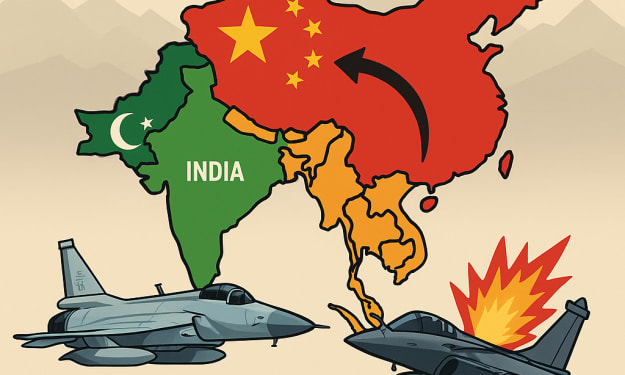
How China Got Benefit from Pakistan and India Conflict
In a dramatic turn of events during a recent India-Pakistan conflict, the Pakistan Air Force (PAF) reportedly downed a French-made Rafale fighter jet using the JF-17 Thunder, a multi-role combat aircraft developed jointly by China and Pakistan. Though official confirmation is still pending, the symbolic value of this event is already resonating across global defense and strategic communities.
By Zakir Ullahabout a year ago in The Swamp
India and Pakistan Agree to a Ceasefire – But Will It Hold? Here’s What to Know. AI-Generated.
India and Pakistan Agree to a Ceasefire – But Will It Hold? Here’s What to Know In a significant diplomatic development, India and Pakistan—two nuclear-armed neighbors with a long and turbulent history—have agreed to a ceasefire along the Line of Control (LoC) in Kashmir. This agreement, aimed at halting cross-border firing and reducing tensions, comes after months of backchannel diplomacy and increasing pressure from global powers for peace in the South Asian region. But as history has shown, ceasefires between the two nations often face a fragile future. So, will this one be any different?
By Adnan Rasheedabout a year ago in The Swamp
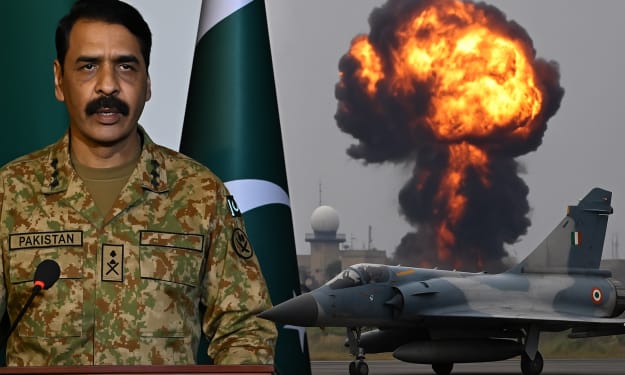
Alhamdulillah Pakistan Launches Fresh Military Action Claiming India Hit Its Military Bases. AI-Generated.
Alhamdulillah Pakistan Launches Fresh Military Action Claiming India Hit Its Military Bases May 11, 2025 — Tensions between nuclear-armed neighbors Pakistan and India have reached alarming levels after Pakistan launched a large-scale retaliatory military operation in response to what it claims was a series of missile strikes by India on its military airbases. This marks one of the most serious escalations between the two nations in recent years.
By Adnan Rasheedabout a year ago in The Swamp