controversies
It seems every time one racially-charged incident ends, a gender or religious controversy takes its place; Ruminate on the issues dividing our nation and world.
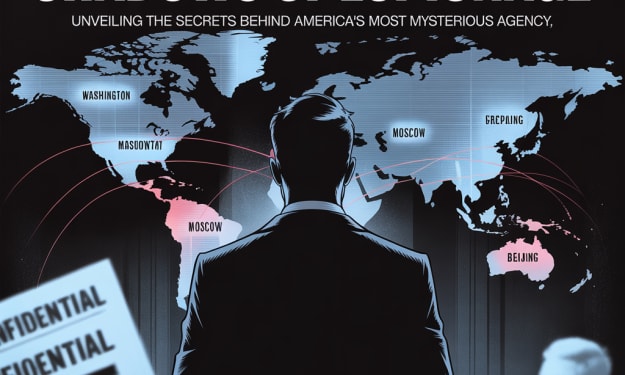
Inside the CIA: America’s Secret Intelligence Agency
From Cold War Tactics to Cyber Wars: The CIA’s Global Reach In the shadows of global politics, where nations maneuver not through diplomacy alone but through secrecy, deception, and surveillance, the Central Intelligence Agency (CIA) stands as one of the most powerful and enigmatic institutions in the world. Born from the ashes of World War II and raised during the height of the Cold War, the CIA has evolved from traditional espionage operations to become a digital-age intelligence giant. Its reach extends across borders, ideologies, and technologies—operating in a world where knowledge is power and information can change the fate of nations. As threats have shifted from Soviet missiles to cyberterrorism and AI warfare, so too has the CIA adapted, making it not only a historical cornerstone of American security but also a critical player in today’s global power struggle. The Origins: An Agency Born in Secrecy The CIA was formally established in 1947 under the National Security Act, but its roots trace back to the Office of Strategic Services (OSS), the United States' first intelligence agency during World War II. Designed to combat Nazi Germany and Imperial Japan through covert operations, the OSS laid the foundation for modern U.S. espionage. When the Cold War began, the United States recognized the need for a peacetime intelligence service capable of gathering foreign information and executing clandestine operations. Thus, the CIA was born—not as a military branch, but as an independent civilian agency reporting directly to the President. Cold War Operations: Spies, Coups, and Proxy Wars The Cold War era defined the CIA’s early years. It was during this period that the agency conducted some of its most controversial and defining operations. The primary adversary was the Soviet Union, and the battlefield was the entire world. Through programs like Operation AJAX in Iran (1953) and Operation PBSUCCESS in Guatemala (1954), the CIA orchestrated coups to install pro-American regimes. It ran surveillance and counterintelligence against Soviet spies and played key roles in proxy wars like Vietnam and Afghanistan. The agency’s use of human intelligence (HUMINT), psychological warfare, and propaganda became hallmarks of its Cold War strategy. However, not all actions met success. The failed Bay of Pigs Invasion in Cuba (1961), an attempt to overthrow Fidel Castro, became a major embarrassment. Nonetheless, these years solidified the CIA’s reputation as a formidable and secretive power broker in international affairs. The Post-Cold War Shift: Terrorism and Rogue States With the collapse of the Soviet Union in 1991, the CIA faced a moment of existential uncertainty. Without its traditional enemy, the agency had to adapt. In the 1990s and early 2000s, its focus shifted to emerging threats: rogue states, international terrorism, and the spread of weapons of mass destruction. After the 9/11 terrorist attacks, the CIA entered a new era. It was at the forefront of the War on Terror, playing key roles in tracking Al-Qaeda, capturing or killing terrorist leaders, and operating secret detention facilities. The agency’s controversial use of “enhanced interrogation techniques”, drone strikes, and black sites ignited debates on ethics, legality, and human rights—questions that still haunt the agency’s legacy. Enter the Cyber Era: Intelligence in the Digital Age Today, the battlefield has shifted again—from deserts and jungles to cyberspace. The rise of cyberwarfare, state-sponsored hacking, and digital espionage has pushed the CIA to evolve once more. The agency now works closely with other U.S. intelligence bodies like the NSA and FBI to counteract threats from nations such as China, Russia, Iran, and North Korea, which use cyberattacks as a form of asymmetric warfare. The CIA has also developed capabilities to monitor global internet traffic, infiltrate secure communications, and conduct offensive cyber operations—all while protecting U.S. national interests from increasingly sophisticated cyber threats. Additionally, emerging technologies such as artificial intelligence, big data analytics, satellite imagery, and biometric surveillance have given the CIA new tools in its intelligence arsenal. With these, it can track individuals globally, predict political upheavals, and identify terrorist plots before they unfold. Global Reach, Ethical Debate Despite its strategic importance, the CIA continues to face criticism and scrutiny. Leaks by whistleblowers such as Edward Snowden and WikiLeaks' Vault 7 disclosures revealed the extent of CIA surveillance and hacking capabilities. These revelations sparked global conversations about privacy, civil liberties, and the balance between security and freedom. Domestically, the CIA is overseen by the Senate Intelligence Committee, but many argue that real transparency is lacking. Internationally, its covert actions often blur the lines between security and interference, leading some to view it as both a protector and a puppet master. Conclusion: A Shadow That Shapes the Future From covert Cold War missions to cyber operations in the digital age, the CIA’s evolution reflects the changing nature of global conflict. Its ability to adapt to new threats has made it a pillar of American defense and foreign policy. Yet with great power comes great responsibility—and the agency’s future will depend not just on its technological capabilities, but also on its commitment to ethics, oversight, and transparency in an increasingly interconnected world.
By World politics about a year ago in The Swamp
Nuclear Panic in Pakistan: What Really Happened at Kirana Hills?. AI-Generated.
A Rumor That Froze the Region On a quiet May evening in 2025, a so-called "Radiological Safety Alert" began circulating on X (formerly Twitter). The document claimed a nuclear radiation leak had occurred in Kirana Hills, a remote, semi-secretive region in Pakistan long associated with nuclear weapons testing. It urged residents to evacuate and warned of radioactive exposure spreading over hundreds of kilometers.
By Hakim's Daily Insights about a year ago in The Swamp
Flying Palace or Political Turbulence?
Air Force One's Alternative ‘Flying Palace’: The Qatari ‘Gift’ That Could Land Trump in Trouble The recent discussions between the White House and Qatar’s royal family have focused on a luxury jumbo jet. This lavish aircraft might be handed over for use as Air Force One by the President of the United States. U.S. President Donald Trump has defended the White House’s plan to use a jet received from Qatar as the presidential aircraft, Air Force One. Speaking to journalists at the White House, Trump said, “They (Qatar) are giving a gift.” He added that refusing it would be “foolish.” However, in a statement, Qatar said the aircraft is not a gift, though a "temporary transfer" of the aircraft is under discussion between the two countries. According to BBC’s U.S. partner CBS News, the aircraft would be donated to the Presidential Library after Trump’s term ends. This news comes at a time when Trump is set to visit Qatar next week—his first major foreign trip in his second presidential term. Ali Al-Ansari, Qatar's media attaché to the U.S., said that the discussions are ongoing between Qatar's Ministry of Defense and the U.S. Department of Defense. He added that the legal departments of both countries are reviewing the matter, and no final decision has yet been made. Strict Laws on Presidential Gifts in the U.S. Reports suggest the jet is worth $400 million. Sources told CBS News it won’t be available for immediate use as several modifications will be made, and security clearance is required. Critics are expected to raise legal and ethical questions about the aircraft’s potential value and use. Democrats have accused Trump of ethical violations. Senator Adam Schiff from California cited the U.S. Constitution on social media, stating that no elected official may accept “any kind of gift” from a foreign leader without Congressional approval. Even Trump’s ally Laura Loomer criticized the move. She wrote that while she could “take a bullet for Trump,” if the reports are true, this could be a major stain on his administration. On Sunday, White House Press Secretary Karoline Leavitt said, “Any gift from a foreign government can be accepted legally after fulfilling required legal procedures. President Trump’s administration believes in full transparency.” Defending the negotiations with Qatar, Trump referred to the jet as a “gift” and claimed he was offered its use free of charge. On Truth Social, he wrote: “The Department of Defense is receiving a gift. Free. A 747 aircraft that will temporarily replace the 40-year-old Air Force One. It will be a public and transparent transfer. But dishonest Democrats want us to pay a huge amount for this aircraft.” A ‘Flying Palace’ The White House currently has two Boeing 747-200B planes customized for presidential use. According to the U.S. Air Force, they include special communications equipment, a state room, an office, and a conference room. These aircraft have been in use since 1990 and 1991. Air Force One planes are often passed on to the next U.S. administration. According to the National Archives, only President Reagan’s Presidential Library has an Air Force One plane. It was used by seven presidents before being donated. According to ABC News, Qatar has offered Trump a Boeing 737 aircraft. It’s a more modern model, upgraded into a “flying palace.” Boeing has a history of contracts with the White House for providing new aircraft. However, Trump complained earlier this year that the company has caused delays. During his first administration, Trump initially negotiated with Boeing for two special 747-8 aircraft. However, Boeing stated that they would not be available until 2027 or 2028. In February, Trump said: “No, I’m not happy with Boeing. They’re taking too long with Air Force One. We gave them the contract a long time ago.” “We might buy an aircraft or make one available for ourselves.” Trump had a positive diplomatic relationship with Qatar during his first term. In 2019, he announced that Qatar was purchasing U.S. aircraft on a large scale. Qatar has also given private jets as gifts to several countries in the past. In 2018, Qatar gifted a luxury aircraft to Turkey.
By Ikram Ullahabout a year ago in The Swamp
Maverick Aoko: Education, Biography, Age, Real Name, Net Worth & More
Maverick Aoko isn’t your typical online commentator. Loud, unfiltered, and unapologetically bold, she’s made a name for herself in Kenya’s digital and political spaces with her razor-sharp takes and fearless opinions.
By Marveline Merababout a year ago in The Swamp
Kasmuel McOure: Biography, Real Name, Tribe, Age, Parents & More
Kasmuel McOure has become one of the most talked-about young personalities in Kenya—known for his sharp wit, bold opinions, and viral presence both online and on stage. Whether he's trending for a skit, a sermon, or stirring up conversation on TikTok, Kasmuel continues to captivate audiences across the country.
By Marveline Merababout a year ago in The Swamp
When Terrorists Get a Makeover: What Are We Really Applauding?
There was a time - not too long ago - when the mere mention of Abu Mohammad al-Jawlani sent chills through intelligence agencies and conflict analysts across the globe. As the commander of Jabhat al-Nusra, an al-Qaeda-linked faction, he orchestrated some of the most violent and destabilizing attacks in the Syrian civil war. His name wasn’t just feared - it was a symbol of extremism, often topping international watch-lists. Governments branded him a priority threat to peace, stability and humanity at large.
By Dr Husain Shabbarabout a year ago in The Swamp
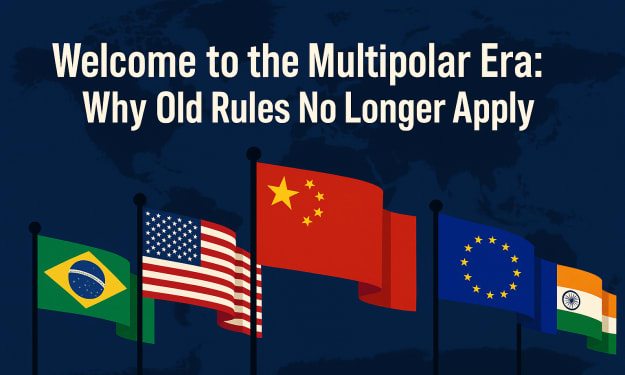
“Welcome to the Multipolar Era: Why Old Rules No Longer Apply”
Welcome to the Multipolar Era: Why Old Rules No Longer Apply Inside the Rise of a World Where No One Power Calls the Shots --- Introduction Not long ago, world politics revolved around a single axis — the United States. Following the Cold War, America’s military might, economic dominance, and cultural influence gave it an unrivaled role in setting global agendas. But that era is fading fast. Today, we live in a world where no single nation can dictate the terms. Power is more distributed, alliances are more fluid, and the rules of engagement are constantly shifting. From Beijing to Brasília, from Ankara to New Delhi, a new set of actors is redefining influence in a chaotic and contested global order. The question is no longer who leads — it's how the world manages without clear leadership. --- The End of Unipolarity The post-Cold War unipolar moment, which placed the U.S. at the apex of global power, is now history. Two decades of military overstretch, internal political divisions, and economic upheaval have eroded America's ability to act as the world's de facto leader. The withdrawal from Afghanistan, inconsistent global policies, and an increasingly inward-looking electorate have signaled a step back from the assertive global policing of the early 2000s. This vacuum hasn't gone unnoticed. Instead of a new hegemon rising to replace the old, what we see is a diffusion of power across multiple regional centers. It’s not a bipolar world of the Cold War era, nor a balanced multipolar structure of the early 20th century. This new landscape is messy, unstable — and permanent. --- China and the Economic Realignment China stands at the forefront of this shift, but even its rise comes with caveats. With the Belt and Road Initiative, Beijing has extended its economic reach into Asia, Africa, and parts of Europe. Its influence over supply chains, infrastructure, and digital technologies challenges the dollar-based global system. However, China's ambitions face resistance. Tensions over Taiwan, territorial disputes in the South China Sea, and pushback from Western nations on tech and trade indicate that its power, while rising, is also contested. China is not replacing the U.S. — it’s carving out its own sphere, one that’s economic rather than ideological, and subject to friction. --- Russia’s Military Gambit and Strategic Isolation Russia, too, has sought to challenge the Western-dominated order, most dramatically through its invasion of Ukraine. While the war has demonstrated Moscow’s willingness to use force to protect perceived national interests, it has also exposed its strategic limits. Sanctions, international condemnation, and battlefield losses have isolated Russia from much of the world economy, while simultaneously deepening its ties with non-Western partners like Iran and China. In trying to redefine regional borders by force, Russia has sparked a renewed unity among NATO members, paradoxically reinforcing the very alliances it sought to divide. --- Middle Powers and Fluid Alliances Perhaps the most defining feature of the multipolar era is the rise of middle powers — nations like India, Brazil, Turkey, and Saudi Arabia that are no longer content to align strictly with the West or East. These countries pursue strategic autonomy, balancing relationships across global fault lines. India, for example, is a member of the Quad (with the U.S., Japan, and Australia) while also maintaining defense ties with Russia and participating in BRICS. Turkey, a NATO member, buys Russian arms and projects influence across Central Asia and the Middle East. These states navigate global politics based not on ideology, but on opportunity and self-interest. --- Global Institutions Under Strain The United Nations, World Trade Organization, and other postwar institutions are increasingly ineffective at managing today’s fragmented world. Vetoes stall progress at the UN Security Council. Trade disputes paralyze the WTO. And new power blocs like BRICS and the Shanghai Cooperation Organization aim to create parallel systems that reflect non-Western values and priorities. The rules-based international order — long championed by the West — now finds itself questioned not only by adversaries, but by allies frustrated with its limitations and hypocrisy. --- Technology, Climate, and the New Arenas of Power While traditional power still matters, influence in today’s world is also determined by less tangible forces. Control over technologies like artificial intelligence, 5G, and semiconductors is becoming as critical as nuclear weapons were in the past. Meanwhile, climate change, pandemics, and migration flows expose the limitations of national solutions to global problems. These issues demand coordination, yet in a fragmented world, cooperation is the first casualty of geopolitical rivalry. --- Conclusion: Embracing Complexity The multipolar era is not just a phase — it is the defining condition of our time. It offers opportunities for a more inclusive, balanced world, but also risks greater instability, miscalculation, and fragmentation. Old rules no longer apply, because the old world no longer exists. The future will depend not on domination, but on how nations adapt, negotiate, and share power in a world where no one — and everyone — leads.
By World politics about a year ago in The Swamp
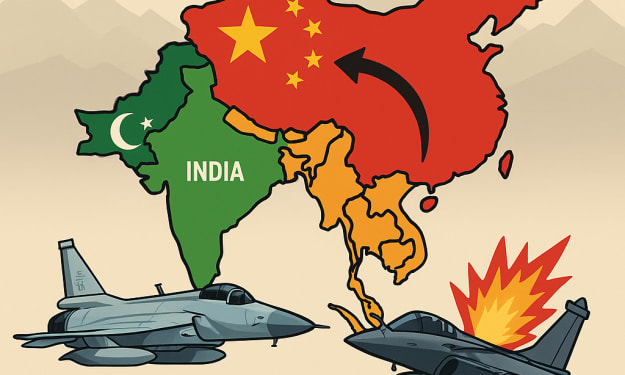
How China Got Benefit from Pakistan and India Conflict
In a dramatic turn of events during a recent India-Pakistan conflict, the Pakistan Air Force (PAF) reportedly downed a French-made Rafale fighter jet using the JF-17 Thunder, a multi-role combat aircraft developed jointly by China and Pakistan. Though official confirmation is still pending, the symbolic value of this event is already resonating across global defense and strategic communities.
By Zakir Ullahabout a year ago in The Swamp
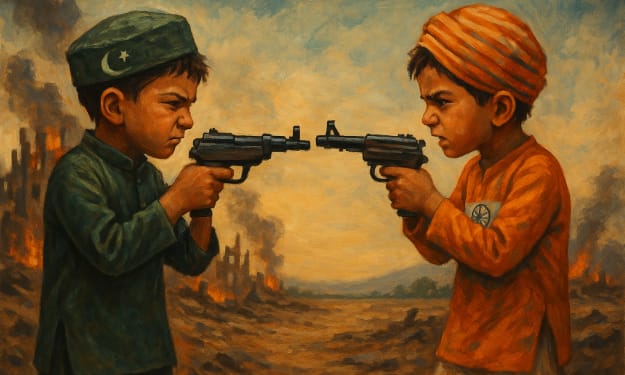
War Between Brothers: A Call for Peace in South Asia
The world watched in horror as tensions between Pakistan and India erupted once again into a full-blown conflict in these recent days. What began as a border skirmish soon escalated into one of the most destructive confrontations in recent South Asian history. While the international media flooded timelines with statistics and breaking updates, the real cost of this war—human lives, fractured communities, economic collapse, and regional instability—remains far more than what any headline can convey.
By Zakir Ullahabout a year ago in The Swamp
Power & Policy
A Deep Dive into Global Strategies: Understanding the Forces Shaping Our World In a rapidly evolving world, global strategies are more important than ever. These strategies are the frameworks through which nations navigate international relations, secure economic interests, assert political power, and foster security. At the heart of global strategy lies the delicate balance of diplomacy, military force, economic policy, and cultural influence, each of which plays a crucial role in shaping the future of the global community. This article will explore the complexities of global strategies, the key players involved, and the methods they use to maintain or expand their influence on the world stage. The Concept of Global Strategy Global strategy is the overarching plan or approach that nations, alliances, and international organizations use to achieve their objectives on the world stage. It is a multi-dimensional concept that involves not only military and economic considerations but also the cultivation of alliances, technological innovation, and soft power. Unlike national strategies, which are primarily focused on domestic issues, global strategies address external challenges and opportunities. A successful global strategy can determine the trajectory of a nation’s influence for decades to come, while a failed one can lead to economic collapse, political isolation, or even military conflict. Global strategies often incorporate elements of hard power (military and economic strength) and soft power (diplomacy, culture, values, and ideas). Nations may also engage in smart power, which is a combination of both hard and soft power, using each in the right proportion based on the situation at hand. Key Players in Global Strategy In any analysis of global strategies, it is essential to understand who the key players are. The most significant players include powerful nations, such as the United States, China, and Russia, as well as regional powers and multinational organizations like the United Nations, the European Union, and the World Trade Organization (WTO). Each of these entities formulates strategies based on a combination of economic capabilities, military power, political influence, and diplomatic ties. 1. The United States: As a superpower, the United States has long been at the center of global strategic discussions. Its global strategy revolves around maintaining its military dominance, ensuring access to key markets, and promoting democratic values. The U.S. also seeks to contain rival powers, notably China and Russia, through both hard and soft power mechanisms, including military alliances like NATO, economic sanctions, and diplomatic engagement. 2. China: Over the past few decades, China has emerged as a key challenger to U.S. dominance on the global stage. Its global strategy is characterized by economic expansion, technological advancements, and a growing military presence. One of China’s most ambitious strategies is the Belt and Road Initiative (BRI), a multi-trillion-dollar infrastructure project designed to connect Asia, Africa, and Europe through a network of trade routes. The BRI allows China to increase its influence in critical regions, securing vital resources, trade routes, and political allegiances. 3. Russia: Russia's global strategy has been shaped by a desire to reclaim its status as a great power following the dissolution of the Soviet Union. Russia’s strategy is characterized by a mix of military aggression, political influence, and energy dominance. For instance, Russia's military interventions in Ukraine and Syria are seen as efforts to protect its sphere of influence and project power into neighboring regions. Additionally, Russia uses its vast energy resources as leverage in geopolitical negotiations, particularly with Europe. 4. The European Union: The European Union (EU) is unique in its approach to global strategy, as it represents a collective effort by member states to assert influence on the world stage. The EU focuses heavily on diplomacy, trade, and human rights, leveraging its economic power as one of the world’s largest trading blocs. The EU also works to expand its sphere of influence through various partnerships and negotiations, particularly with countries in Eastern Europe, Africa, and Asia. 5. Multinational Organizations: Institutions such as the United Nations, the World Trade Organization, and the International Monetary Fund (IMF) play crucial roles in shaping global strategies. These organizations facilitate cooperation, mediate conflicts, and establish norms and regulations that govern international relations. Although not all countries agree with the actions of these institutions, they remain vital in coordinating global efforts in areas such as climate change, international security, and global trade. The Elements of Global Strategy Global strategies are multifaceted and include a variety of elements that work together to influence outcomes on the international stage. Some of the most important components of global strategies include: 1. Economic Power: Economic strategies are central to global influence. Nations use trade agreements, sanctions, and financial assistance to shape the global economy in ways that align with their interests. For example, the United States uses its control over the global financial system, especially through the U.S. dollar and institutions like the IMF, to maintain its economic dominance. On the other hand, China uses its growing economic influence to assert control over key supply chains, especially in the technology sector, and to secure long-term strategic investments through initiatives like the Belt and Road Initiative. 2. Military Power: Military strength remains one of the most significant pillars of global strategy. Nations use their military capabilities to project power, defend national interests, and deter potential threats. This includes not only traditional military forces but also nuclear deterrence, special forces, and cyber warfare capabilities. The U.S. maintains a vast network of military bases worldwide, while China is increasingly focusing on expanding its military presence in the South China Sea and beyond. 3. Diplomacy: Diplomatic efforts are essential in shaping the global environment. Effective diplomacy can result in strategic alliances, trade agreements, and conflict resolution. Countries engage in diplomacy through bilateral talks, multilateral forums, and international organizations. For example, the U.S. and China engage in regular diplomatic talks to manage their economic and political rivalry, while the EU plays a critical role in brokering peace and cooperation in various global hotspots. 4. Technology and Innovation: In today’s world, technological innovation has become an integral part of global strategy. Nations invest in cutting-edge technologies like artificial intelligence, quantum computing, and 5G networks to gain a strategic advantage. China, for instance, has made significant investments in 5G technology through companies like Huawei, which has raised concerns among the U.S. and its allies about cybersecurity and espionage. Additionally, technological leadership in space exploration, biotechnology, and clean energy is increasingly a key factor in global influence. 5. Soft Power: The power of culture, values, and ideas cannot be underestimated. Soft power allows countries to influence others without coercion or force. The United States, for example, has long relied on its entertainment industry, higher education institutions, and the spread of democratic ideals to project its influence globally. Meanwhile, China has sought to boost its soft power through cultural exchanges, educational initiatives, and media influence. Challenges to Global Strategy While global strategies can lead to considerable success, they also face numerous challenges. Geopolitical rivalries, economic disruptions, technological shifts, and domestic political pressures can undermine the effectiveness of any nation’s strategy. Moreover, global challenges like climate change, pandemics, and terrorism require multilateral cooperation, often complicating efforts to pursue individual national interests. In conclusion, global strategy is a dynamic and complex field that requires nations to constantly adapt to shifting circumstances. It is a delicate dance between power, diplomacy, and influence, and success often depends on the ability to blend these elements effectively. As the world continues to evolve, understanding global strategies will be key to predicting the future of international relations and shaping the global order in the years to come.
By World politics about a year ago in The Swamp