book reviews
Reviews for political die-hards of books about politicians, civil rights, Supreme Court rulings and the ever-changing Swamp.
Power Prefers Ambiguity to Truth
Ambiguity Is Safer Than a Lie Power rarely announces itself through outright lies. Lies are risky. They can be disproven. They can be exposed. They can be traced back to the person or institution that made them. What power often prefers instead is ambiguity. Ambiguity is safer than falsehood because it cannot be cleanly falsified. It blurs edges, stretches timelines, multiplies interpretations, and turns clarity into controversy.
By Peter Thwing - Host of the FST Podcast6 months ago in The Swamp
Belief Does Not Create Truth
When Belief Is Treated as Authority One of the most persistent confusions in modern discourse is the idea that belief itself carries epistemic authority. People speak as though believing something strongly, collectively, or sincerely grants it a special status, as if conviction were a substitute for correspondence with reality. This confusion is not harmless. It collapses the distinction between what people think and what actually is. Once that distinction collapses, truth becomes negotiable and error becomes untouchable.
By Peter Thwing - Host of the FST Podcast6 months ago in The Swamp
Moral Law and False Witness
When Truth Is Not Optional Moral systems do not begin with outcomes. They begin with constraints. Certain acts are treated as wrong not because they fail, but because performing them already constitutes the failure. Bearing false witness has always occupied that category. It is not condemned because it sometimes produces injustice. It is condemned because it corrupts the very process by which justice is discerned. Once falsehood is introduced deliberately, the pathway to truth is no longer reliable, even if it occasionally arrives at a correct destination.
By Peter Thwing - Host of the FST Podcast6 months ago in The Swamp
Created Risk, Inherited Risk, and the Moral Line We Keep Erasing (A Society That Tells the Truth: Chapter 3)
The Distinction Modern Rules Refuse to Make One of the quiet failures of modern rule making is the refusal to clearly distinguish between risk created by choice and risk inherited by existence. When this distinction collapses, responsibility becomes confused, guilt spreads outward indiscriminately, and ordinary behavior is treated as morally suspect. This is not a minor philosophical oversight. It is the foundation beneath many of the injustices people now experience in public life, from transportation and health policy to everyday regulation and enforcement. When systems fail to differentiate between what someone causes and what simply exists, moral clarity erodes at every level.
By Peter Thwing - Host of the FST Podcast6 months ago in The Swamp
Trump’s Record in Full Context (Part 2). AI-Generated.
(Continued from Part 1...) --- Building on first-term foundations, the second administration (2025– ) prioritized rapid executive action on border control, bureaucracy reduction, and cultural/policy reversals. This section records key executed actions and claimed outcomes through April 2026.)
By Peter Thwing - Host of the FST Podcast6 months ago in The Swamp
Trump’s Record in Full Context (Part 3). AI-Generated.
(Continued from Part 2...) --- The Other Side of the Ledger Parts 1 and 2 documented what actually happened on the accomplishment side: laws signed, executive actions taken, policies reversed, agencies redirected, courts reshaped, enforcement priorities changed, and measurable outcomes claimed or recorded. Part 3 completes the record by looking at the other side of the ledger: promises that were not fully delivered, policies that were blocked, outcomes that fell short of public expectation, legal battles that shaped the presidency, and cultural events that cannot honestly be ignored.
By Peter Thwing - Host of the FST Podcast6 months ago in The Swamp
Fuel on Fire: How Rising Petrol Prices Are Crushing the Public in 2026
Fuel on Fire: How Rising Petrol Prices Are Crushing the Public in 2026 The Introduction The price of gasoline is continuing to rise in Pakistan, which is having an impact on every sector of society. From daily wage earners to salaried professionals, the rising cost of fuel has become more than just an economic issue—it is a national crisis impacting livelihoods, mobility, and overall quality of life.
By Farida Kabir6 months ago in The Swamp
Pakistan's Strategic Importance and Global Impact in US-Iran Relations A Silent Power in a Dangerous Conflict
Pakistan's Strategic Importance and Global Impact in US-Iran Relations A Silent Power in a Dangerous Conflict An Introduction In the complex world of global politics, not every influential country dominates headlines.
By Farida Kabir6 months ago in The Swamp
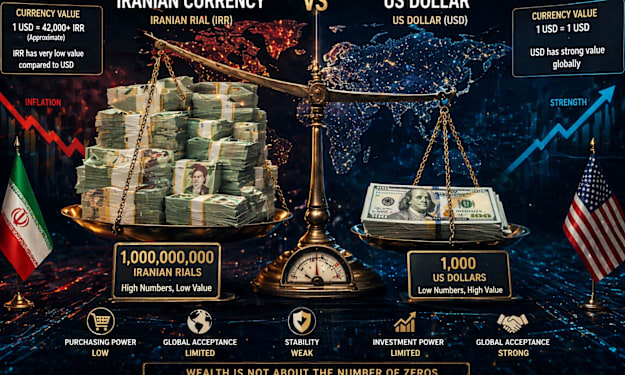
Iranian Currency vs US Dollar
Iranian Currency vs US Dollar The comparison between the Iranian Rial and the US Dollar presents one of the most striking examples of how currency value affects wealth perception. At first glance, earning millions or even billions in Iranian currency may appear to represent significant financial success. However, when compared with the US Dollar, the reality becomes very different. This comparative analysis examines whether becoming a millionaire in Iranian currency truly reflects financial wealth.
By Wings of Time 6 months ago in The Swamp
New World Order In 2026
The phrase “New World Order” has long stirred curiosity, debate, and sometimes fear. For some, it represents a hopeful vision of global cooperation in an increasingly interconnected world. For others, it signals concerns about centralized power, loss of national sovereignty, or hidden political agendas. In reality, the concept is complex and has evolved over time, shaped by historical events, geopolitical shifts, economic systems, and technological revolutions.
By Ibrahim Shah 8 months ago in The Swamp
The Protection-of-Innocence Reciprocity Doctrine. AI-Generated.
Core Moral Premise The highest duty of any legitimate social order is the protection of innocent life. Innocent life has absolute moral primacy. Any system that systematically insulates predators, tolerates predatory asymmetry, rewards hypocrisy, or allows aggressors to retain insulation has inverted its purpose and forfeited legitimacy. Truth, justice, reciprocity, humility, mercy, forgiveness, and vertical accountability are structural necessities rather than optional virtues. Vertical accountability means recognition of and submission to a moral law higher than oneself. Authority must flow toward those who most consistently demonstrate sustained competence in moral and epistemic discipline. This competence is shown through observable conduct and trajectory over time, not through doctrinal label, tribal identity, credential alone, or self-profession.
By Peter Thwing - Host of the FST Podcast8 months ago in The Swamp