
Singapore Raised Its Prime Minister’s Pay by 64%. The Math Is Only Half the Story.
The salary formula was frozen for 15 years. Unfreezing it exposes a bigger question about elections, opposition funding, and who can afford to run.
Formula Restart: How Singapore’s 64% Ministerial Pay Raise Works and What It Changes
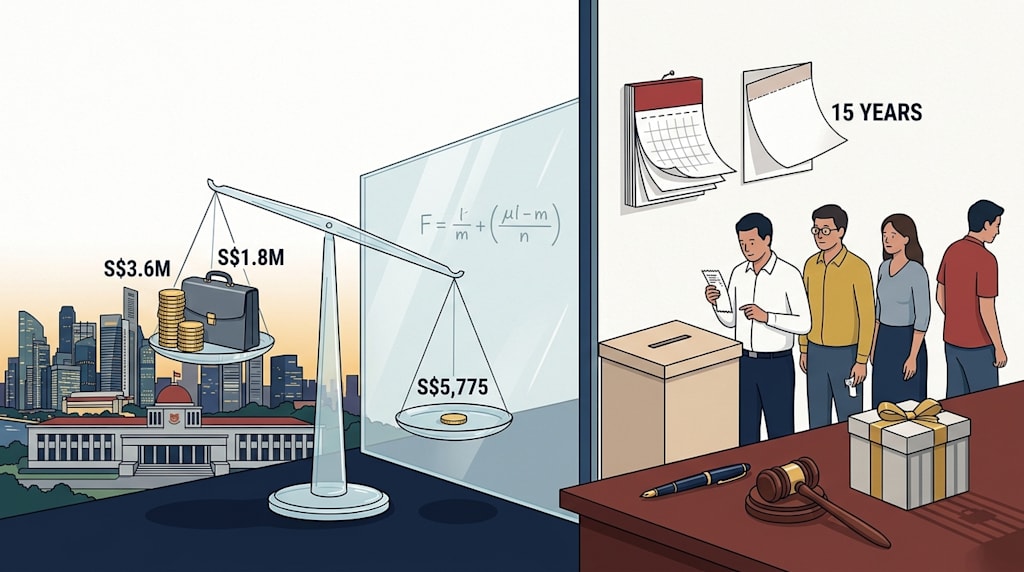
On 8 September 2026, in Singapore’s Parliament, Lawrence Wong delivered a ministerial statement. He accepted the recommendations of the independent committee on political salaries. The annual benchmark for an MR4 entry-level minister would rise from S$1.1 million to S$1.8 million. The Prime Minister’s salary would rise from S$2.2 million to S$3.6 million. The increase was about 64%. The previous adjustment was in 2012, fifteen years earlier.
Three opposition parties outside Parliament opposed the move: the Progress Singapore Party, the Singapore Democratic Party, and Red Dot United. The PSP said public service should not be attracted mainly by salary. On social media, someone posted the 2025 median monthly salary of S$5,775, with the caption: one year’s salary is not enough for a minister’s month.
The Mathematics of the Formula
Singapore ministerial pay has a formula. The MR4 benchmark equals the median annual salary of the top 1,000 citizens multiplied by 60%. The 40% discount is called the “public service discount.” It was introduced in 2012 to quell public anger. That year, ministerial pay was cut by about 36%. The Prime Minister’s salary fell to S$2.2 million. The new formula started at the same time.
After that, the formula was frozen. In 2017, an independent committee completed a review. The government decided not to implement changes because of the economic environment. The next review, due in 2023, was postponed because of post-pandemic uncertainty and the leadership transition. Over fifteen years, the median of the top 1,000 rose from about S$2 million to about S$3.1 million. Multiplied by 60%, that is S$1.86 million. MR4 stayed at S$1.1 million.
The gap: S$760,000.
Chan Chun Sing explained in Parliament that long-term non-execution of the formula makes the framework meaningless. Lawrence Wong said: restraint cannot become neglect.
The adjustment includes buffers. Current ministers do not reach the new benchmark immediately. They receive a one-time increase of up to 9%, depending on performance and time since the last adjustment. By the end of the current term, most MR4 ministers will receive about S$1.35 million, at the low end of the new range of S$1.35 million to S$2.25 million. The Prime Minister’s salary is always twice the MR4 benchmark, so the benchmark increase directly raised the Prime Minister’s salary from S$2.2 million to S$3.6 million. Wong pledged to donate five years of his salary increase to charity, about S$7 million.
The Economics of Entering Politics
Shanmugam was Singapore’s youngest senior counsel before entering politics. Before becoming a minister in 2007, his annual income was between S$3 million and S$5 million. He has said his income after entering politics dropped to about one-tenth of that. Cumulative loss: over S$100 million.
Vivian Balakrishnan was a top ophthalmologist. In 2001, as national eye centre director and SGH CEO, his annual salary was about S$2 million. He entered politics in 2002, with a salary of more than S$800,000. After the adjustment, it is S$2.88 million. If he had stayed in medicine for another 25 years, his income would be far higher.
Ng Eng Hen was a prominent doctor. His reported pre-politics annual salary was over S$4.5 million. After 24 years in politics, his annual salary is under S$2 million.
These numbers are documented. But “opportunity cost” explains why pay cannot be too low to exclude certain talent. It does not automatically prove the current level is appropriate. The PSP’s rebuttal: political talent is a system problem, not just a salary problem. Institutional space, policy influence, and the sense of achievement in a governance system that works all matter. None of these enter the salary formula.
Deposits and MP Allowances
Singapore’s election deposit system requires candidates to deposit an amount equal to the fixed monthly allowance of an elected MP in the month before Parliament dissolution, rounded to the nearest S$500. The 2025 election deposit was S$13,500, based on the then MP monthly allowance of S$13,750.
Twenty-seven candidates received less than 12.5% of the vote. Their deposits were forfeited. The People’s Power Party received 10.21% in Ang Mo Kio GRC and 0.43% in Tampines. The National Solidarity Party received 2.32% and 0.18% in two GRCs. Total loss: S$364,500.
Opposition candidates mostly lack state office. The deposit must come from personal legal income. Political donations are not allowed. PAP MPs, as civil servants, have stable salaries. Paying the deposit creates no pressure.
The MP monthly allowance was raised from S$13,750 to S$18,500. The next election deposit will rise from S$13,500 to about S$18,500. This is not the purpose of the pay raise. But it is a direct result of how the rules connect. Each MP allowance increase automatically raises the financial threshold for all candidates, especially opposition candidates without stable income.
Critics have long said the deposit system hits opposition funding. When the deposit is tied to MP allowances, civil service pay adjustment is no longer just a question of “how much should a minister earn.”
The Iswaran Case
“High pay for clean government” is the most cited justification. The logic: if pay is high enough, the marginal benefit of corruption falls, and the opportunity cost of losing office rises.
In 2024, former Transport Minister S. Iswaran received gifts worth over S$380,000 and obstructed justice. He was sentenced to one year. It was the first minister-level corruption conviction since independence.
A single case cannot overturn an institutional argument. But it shows high pay cannot completely eliminate the possibility of corruption. If high pay were sufficient, the Iswaran case should not have happened. If high pay is only one necessary condition, then making the pay raise mainly about “anti-corruption” exposes a weak link. A stronger guarantee of integrity is more likely to come from transparent oversight, an independent judiciary, and zero-tolerance enforcement.
Two Numbers
Wong acknowledged: political pay is a difficult and emotional issue, and the amounts are higher than most citizens’ income.
The median annual salary of the top 1,000 is about S$3.1 million. Singapore’s 2025 median monthly salary is S$5,775. Median annual salary is about S$69,300.
S$3.1 million versus S$69,300.
The “market” anchored by the salary formula is an unfamiliar economic space for most Singaporeans. This does not mean high pay necessarily leads to a loss of public trust. But it suggests a possibility: when politicians’ economic reference system continues to move away from the society they govern, the practical instincts policymakers use may gradually lose their grounding. This is not a variable the 40% discount can quantify.
Between Two Adjustments
In 2012, ministerial pay was cut by 36%, quelling public anger. In 2026, it was raised by 64%, returning to the formula. Between the two adjustments, fifteen years of freeze.
During the freeze, the median of the top 1,000 rose from S$2 million to S$3.1 million. MR4 stayed at S$1.1 million. The formula’s automatic adjustment mechanism failed. The 2017 review was not implemented. The 2023 review was postponed. Leadership passed from Lee Hsien Loong to Heng Swee Keat to Lawrence Wong. The transition was long. An old Prime Minister need not bear controversy before leaving. A new Prime Minister should not raise his own salary before a voter mandate.
Wong led the PAP to a higher vote share in the 2025 election, obtaining an electoral mandate. The 4G team operates independently. Now is the farthest point from the next election. The government has time to digest discontent, and it needs to let the failed formula work again.
For Singapore, high pay for political talent is normal. Freezing pay for leadership transition and consecutive crises is a temporary deviation. Now the formula follows the market again. The transition is basically complete. The government is running as before.
Shanmugam’s pre-politics annual income was S$3 million to S$5 million. After politics, about one-tenth. Vivian went from S$2 million to more than S$800,000. Ng Eng Hen went from S$4.5 million to under S$2 million. These are personal choices.
2025 median monthly salary: S$5,775. 2026 minister annual benchmark: S$1.8 million. Prime Minister: S$3.6 million. These are institutional parameters.
Between the two sets of numbers: fifteen years of formula freeze, and one 64% return.
About the Creator
Jin
Writer of reamstories
https://reamstories.com/jin
Enjoyed the story? Support the Creator.
Subscribe for free to receive all their stories in your feed. You could also become a paid subscriber, letting them know you appreciate their work.
Comments
There are no comments for this story
Be the first to respond and start the conversation.