
Russia’s Election Was Predictable. What Comes Next Is the Part That Matters.
United Russia won, the opposition was barred, and the Kremlin got its mandate. The real question is what that mandate will cost, and who will pay it.
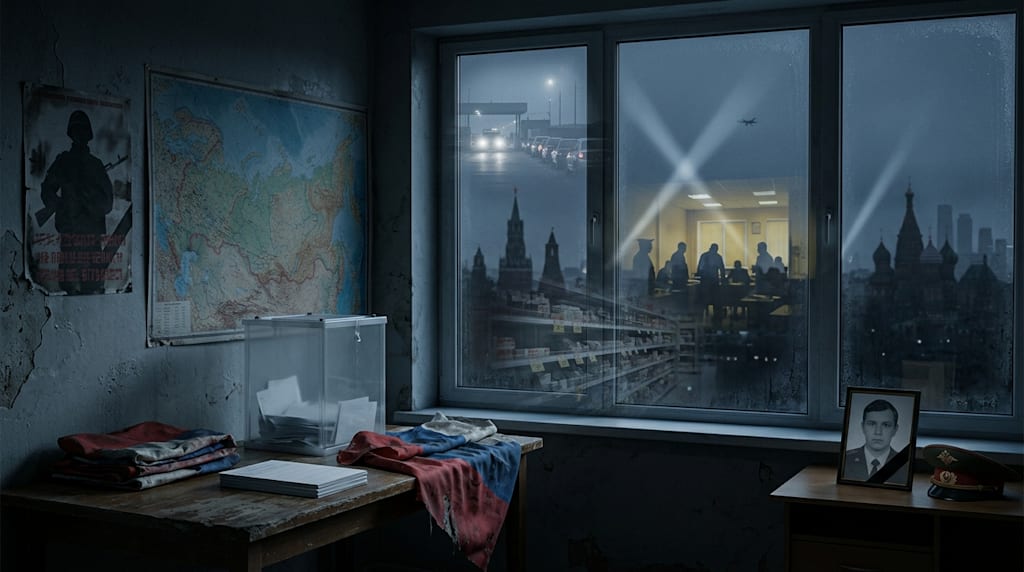
After Russia’s Parliamentary Election: A Vote With No Suspense, and Who It Will Press Down on Next
Moscow time, Sunday evening, at United Russia party headquarters. Dmitry Medvedev and Sergey Lavrov stood in front of a screen as the numbers jumped. Staff brought tea. No one drank it. This scene had been written before the vote. The only difference was where the percentage on the screen would finally stop.
The official result surprised no one. United Russia won overwhelmingly. The party supports President Putin, and it supports Russia’s war in Ukraine. There were still names on the ballot, but competition was gone. The only opposition party still calling for an end to the war, Yabloko, was barred from running. Before the vote, Putin told Russians the election would show national unity and that “millions of people are backing our fighters.” That line was printed on leaflets and placed at the top of television news broadcasts.
The election spanned 11 time zones. Polling stations also opened in Russian-occupied areas of Ukraine. Kyiv says these votes have no legal meaning. Moscow says they are proof of normal life. During voting, Ukrainian drones struck the Moscow region. Russian officials called it one of the largest drone attacks ever launched against Moscow. Polling stations opened as usual. An old woman voted, then bought bread at the corner. She did not speak to reporters. The detail explains nothing. Life continues.
Trump criticized Ukraine for banning elections under martial law. Russian media played the contrast repeatedly: Ukraine does not vote, Russia votes. The Kremlin needs that image. The war is in its third year. Frontline casualties are rising, the economy is under strain, and public anxiety is growing. A nationwide vote can be packaged as “business as usual.” But “as usual” has costs.
The first cost is manpower. In September 2022, Russia carried out a partial mobilization. About 300,000 people received call-up notices. Border checkpoints lined with cars. Some slept in their vehicles. Some burned their draft papers. After that, the Kremlin tightened border controls. Putin himself denied that a general call-up plan existed, calling speculation “nonsense” and “an information attack on Russia.” But the lights in draft offices stayed on late. Contract-soldier recruitment ads appeared in subway stations, on buses and on short-video platforms. Signing bonuses rose. Some regions offered free land, loan discounts and school places for children to attract recruits.
In this election, 49 veterans of the Ukraine war were elected as deputies. They wore suits, medals on their chests, and took the oath on camera. The arrangement made the point clear: fighting can earn you political office. For the Kremlin, this is cheaper than forced conscription and less likely to spark street anger. But contract soldiers cannot be replenished indefinitely. Frontline attrition rates, training cycles and casualty figures are calculations Moscow must face.
The second cost is the economy. In supermarkets, price tags for sugar and buckwheat change faster than the shelves. In job ads, wages for welders and truck drivers are rising. Labor shortages appear in factories, on construction sites and in the railway system. Military spending squeezes local budgets. In some towns, school repairs are delayed. Hospital queues grow longer. At funerals, a soldier’s photograph sits next to a military cap. Local officials attend, lay flowers, take photos and leave. These scenes repeat in many Russian cities. Television news rarely shows full funerals. It shows new factories opening, new schools opening, new bridges opening.
The third cost is control. After the war began, independent media were shut down or labeled “foreign agents.” Anti-war rallies were dispersed. Social media was restricted. Before the election, authorities tightened the space further. Yabloko was barred from running. Observers were restricted. Electronic voting systems were used in many regions. Critics say this makes fraud harder to detect. Officials say it makes voting more convenient. Both statements appear in the news. The ballot result did not change because of them.
Several paths exist at once.
First, military escalation. The frontline stalemate continues. Russia may try a new offensive to gain a better position in negotiations or on the battlefield. Ukrainian drones strike Russian refineries, airports and cities. Russian missiles strike Ukraine’s power grid and residential areas. Both sides are preparing for the next winter.
Second, disguised mobilization. It may not appear under the name “general mobilization.” It may expand manpower through contract recruitment, regional quotas, electronic call-ups, immigrants and prisoners. Putin denies a full call-up, but local officials face conscription quotas. Some enterprises are asked to recommend employees for the army. Universities are asked to cooperate with draft offices. These measures will not be announced all at once. They will increase month by month.
Third, tighter domestic control. The longer the war, the more the Kremlin needs to ensure society does not produce organized opposition. Speech, assembly, the internet and independent media are first in line. The election result, portrayed as an overwhelming victory, may be used as political cover for unpopular measures. A new round of restrictions may appear under the names of “anti-extremism,” “counterintelligence” or “protecting traditional values.”
Fourth, diplomatic signals. Russia may continue to signal to the Trump administration or other Western voices a willingness to talk, while insisting its military goals remain unchanged. The election itself can be packaged as evidence that Russia is “still normal.” Moscow hopes for cracks in the West. It hopes the cost of aiding Ukraine will break European unity. The vote result will not change the frontline, but it can change the narrative in some capitals.
Fifth, economic and social pressure accumulating. Military spending first, labor drain, technology blockades and brain drain will weaken Russia’s war potential and social stability over the long term. Some young people leave Russia. They are not necessarily anti-war; they simply do not want to be drafted. They go to Kazakhstan, Georgia, Armenia, Serbia. Border checkpoint lights stay on at night. Some make it out. Some are stopped.
Polling stations close. Workers fold up banners and stuff them into cardboard boxes. Drone sounds come from the Moscow night sky. Border checkpoint lights are still on. In the windows of the draft office, someone is still working overtime.
About the Creator
Jin
Writer of reamstories
https://reamstories.com/jin
Enjoyed the story? Support the Creator.
Subscribe for free to receive all their stories in your feed. You could also become a paid subscriber, letting them know you appreciate their work.
Comments
There are no comments for this story
Be the first to respond and start the conversation.